Geyser Apple Tree: Variety and Care Features
| Color | Reds |
|---|---|
| Ripening season | Autumn |
| Size of apples | Large |
| Taste | Sweet and sour |
| Crown type | Columnar tree |
| Shelf life | Average shelf life |
| Application | Fresh , For recycling |
| Winter hardiness | High winter hardiness |
| Fruiting age | Up to 5 years |
 History of origin and regions of growth
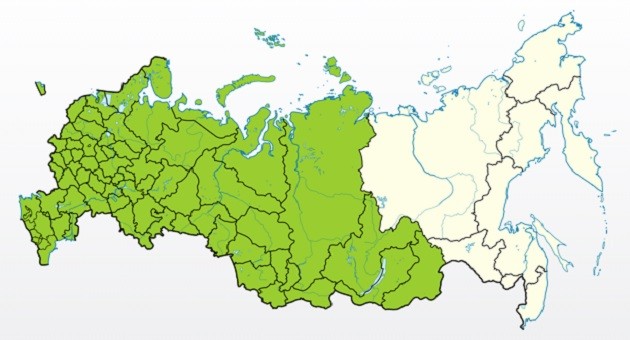
Growing regions
- North Caucasus.
- Crimea.
- Northern regions (partially).
- Moscow region.
- Middle zone.
- Leningrad region.
- Ural.
- Siberia.
Origin
Breeding highly winter-hardy columns became the primary goal of many research groups, including the Michurin All-Russian Research Institute of Genetics and Breeding of Fruit Crops. In the early 2000s, a new hybrid was developed, later named Geyser for its suitable appearance. The European apple tree Charlotte (Malus Charlottae) and the domestic winter-hardy variety Karpovskoye served as the source of the columnar shape.
Official testing of the new apple tree began around 2010, but it was only five years later that an application for its inclusion in the official register was submitted. In 2015, it was added to the State Register and zoned for two regions: the Central Black Earth Region and the Central Black Earth Region. In reality, the crop can be grown over a much larger area. It thrives not only in temperate climates but also in the south and more northern latitudes; it can even be planted in Siberia and the Urals.
Content
Description of the Geyser apple variety
 A small tree growing from a single trunk attracts the attention of gardeners limited by space for an orchard. Geyser is ideal for anyone who wants to get the most out of a small space. The trees are undemanding, rarely suffer from fungal infections, are frost-resistant, and tolerate drought and excessive rainfall well. They grow quickly and begin to bear fruit.
The fruits are delicious, very attractive, and easily stored for long periods of time and transported over long distances. Despite the apple tree's short lifespan, it is recommended for cultivation not only in small garden plots but also in intensive commercial and industrial orchards.
Apples: What do they look like?
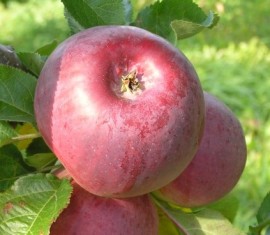
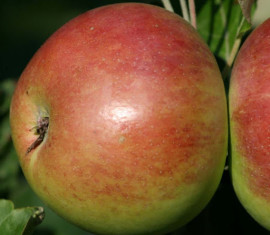
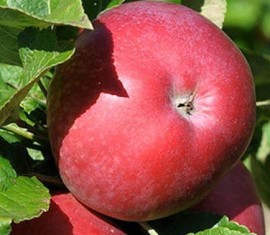
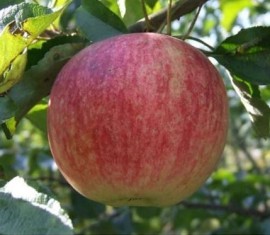
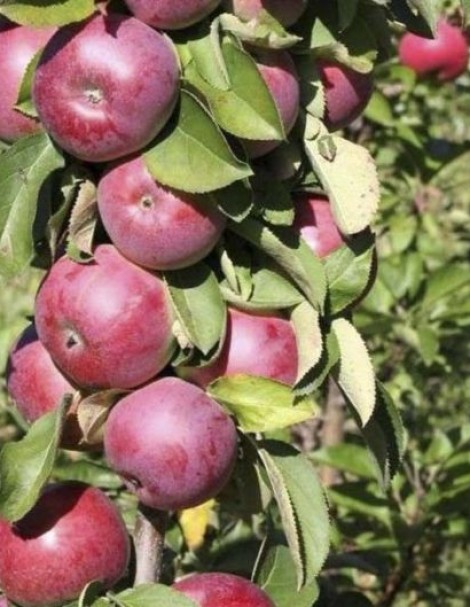
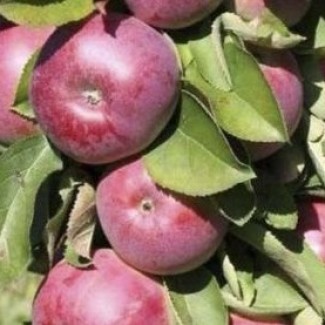
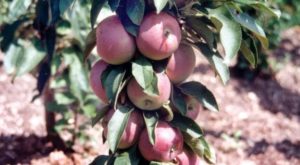 The fruits are large to very large, mostly uniform in size. With proper care, timely watering, feeding, and fertilizing, they can grow to 180-250 grams and even up to 300 grams. They are round, sometimes slightly flattened or conical, with barely smoothed ribbing and a distinct lateral seam clearly visible on the outer surface near the calyx.
The skin is firm but not thick; it's elastic, strong, and smooth, mostly matte, green or light green in color. The blush is dark red or beetroot-colored, diffusely mottled, and dense, covering up to 75-90% of the surface, depending on weather and lighting conditions. By the time the apples ripen, a dense, grayish-blue waxy coating appears. Subcutaneous punctures are small but numerous and barely visible. The chemical composition is most easily determined by assessing the following parameters:
- P-active substances – 189 milligrams.
- Ascorbic acid (vitamin C) – 8.9 grams.
- Sugar (fructose) – 14.1%.
- Titratable acids – 0.38%.
- Pectins (fiber) – 15.8%.
The flesh is fairly dense, fine-grained, and full of juice. It has a yellowish, creamy, or slightly greenish hue and can be slightly prickly, crisp, and aromatic. The flavor is sweet and sour, and is considered balanced and harmonious. The apple receives a tasting score of 4.5-4.7 out of 5 possible points for taste and appearance.
Geyser apple tree: characteristics
Crown and root system
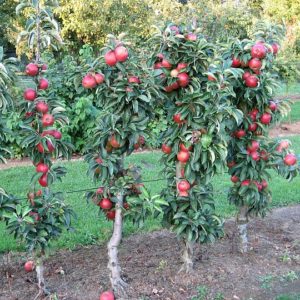 The Geyser variety is a true, classic, vigorous columnar plant. It grows as a single trunk and can stretch out over its entire short life no more than 2.7-3 meters, even if never pruned. The trunk is strong, thick, covered with brown or greenish-brown bark, which may be pubescent. Fruiting occurs on spurs, one- or two-year-old fruiting canes.
The leaves are quite large, leathery, and dense, with a glossy, shiny surface. They are oval to elliptical in shape, slightly oblong, and short-pointed, with a serrate-crenate serrated edge. The tip can be twisted, and the leaf itself can fold into a boat. The root system is quite robust, fibrous, and branched; depending on the rootstock, it may or may not have a central taproot. It is moderately adapted to the search for water and nutrients.
Productivity and pollination
The variety is considered productive, which is why many choose Geyser among the columns.
With a standard planting scheme (up to 20,000 trees per hectare), this area can yield approximately 320-340 tons of delicious, aromatic fruit. A single mature tree can yield up to 19-22 kilograms, and sometimes even more..
The hybrid is considered self-fertile, but only conditionally. This means it will produce a harvest even without suitable pollinators within 45-80 meters. However, the orchard's productivity will be much higher if the apple trees are planted interspersed, remembering to match their flowering times. Gardeners often spray the trees with sugar or honey dissolved in water to attract more bees. A mobile apiary can be brought directly to the blooming apple trees.
Winter hardiness and disease resistance
Apple trees are rightfully considered winter-hardy varieties. They can easily tolerate temperatures down to -27-35°C for quite long periods, but only with proper winter preparation. Standard measures suitable for all apple trees will suffice. Hybrids are best protected during extended cold periods under tent-like shelter.
Geyser is quite resistant to scab and other diseases that commonly affect apple trees. They are rarely affected, and the leaves are usually more affected, even during the most severe epidemics, while the fruit remains perfectly suitable for eating or processing. However, it's still important not to neglect preventative measures; this will ensure the safety and high productivity of your orchard.
Rootstocks and subspecies
Geyser is a very new variety, only just gaining popularity among Russian gardeners. Therefore, it's too early to talk about subspecies and varieties. However, it can be grown on a variety of rootstocks, slightly altering the tree's characteristics. On seedlings, it will grow to 3-3.5 meters, while on dwarf and semi-dwarf varieties, it will be shorter, which will provide advantages in harvesting, although the fruit yield will decrease accordingly.
Features of growing Geyser
 Landing
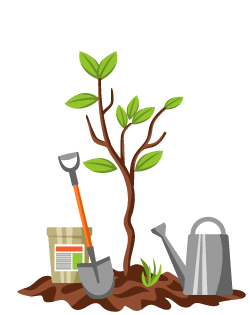 Landing
Basic conditions
- All apple trees, without exception, prefer open, sunny locations. Geyser is planted where its compact crown will receive sunlight for most of the day. In the shade, it will grow and even bear fruit, but the apples will become small and sometimes even sour.
- Drafts can cause disease and death in early-stage seedlings. Therefore, the site should be protected from them as much as possible, but good crown ventilation is essential. Stagnant air can lead to rot and mold due to increased humidity and lack of oxygen.
- The apple tree's root system is extensive and can penetrate very deep into the soil. Therefore, it's not recommended to plant it where the groundwater is close to the surface. It's not recommended to plant an orchard near a river, spring, pond, stream, or lake, in a swamp or floodplain meadow, in a lowland, or anywhere where water can stagnate. This often leads to the death of seedlings while they're still young.
- Holes for columnar varieties can be prepared in advance, a season before planting, but it's also acceptable to dig them 2-4 weeks in advance. The holes are 60-80 centimeters deep and up to 80-90 centimeters in diameter to allow for adequate root space. Topsoil is mixed with fertilizer and added to the bottom, followed by drainage and 35-50 liters of water. The holes don't need to be covered.
- It's a good idea to immediately drive stakes into the holes to support the apple trees. Ideally, they should be positioned on the north side of the tree trunk.
- The distance between trees in a row is approximately 1-1.2 meters, and between rows up to 2 meters, to make it convenient to harvest from tall columns.
- The root collar must not be buried below the horizon, otherwise all the properties of the rootstock will be lost, as the apple tree will take root higher.
- The seedling is held vertically, covered with soil, compacted by hand, watered with plenty of water up to 2-5 buckets, and mulched on top with compost or humus.
Landing dates
Autumn planting is preferred for this variety. Choose a warm, dry day in late September or early October to transplant the apple trees outdoors. Make sure the leaves have finished falling by then, and there are at least 3-5 weeks left before frost. However, in more northern regions, such as the Urals, spring planting is still preferable. The best time to plant is late March or early April, before bud break.
Tree care
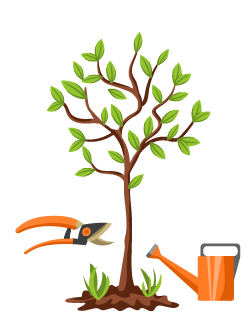 Tree care
Protection from frost and pests
Geyser is frost-resistant, but it may not withstand drafts, icing, or prolonged periods of severe cold. Therefore, it needs to be carefully prepared for winter, especially if the growing region is relatively harsh. It's best to pile spruce branches, straw, dry leaves, or even pile up soil around the root area. Wrap the trunks with burlap, roofing felt, roofing felt, or any other fabric, and ideally, cover them with plastic or tarpaulin from root to tip, like a tent.
Whitewashing the trunks with diluted lime to a height of no more than 1 meter is effective against insects. Whitewashing can be done in spring and fall, making your garden look neat and tidy. Rendered animal fat, fuel oil, grease, drying oil, and other pungent-smelling substances that won't harm apple trees are good for repelling rodents.
Loosening the soil, watering: proper agricultural technology
Trees are dug up twice a year, but carefully so as not to damage the shallow roots. As the trees grow, the soil should be hoeed, removing all weeds and shoots of various plants that interfere with the normal growth of the apple trees. For added benefit, the root zone can be seeded with herbs such as parsley, dill, mint, and lemon balm. These herbs will not deprive the tree of nutrients, but will provide natural aeration.
It wouldn't hurt to water the trees. They are considered moderately tolerant of dry climates, so it's best to water them at least once every 10 days during hot weather, when there's no natural precipitation. If it rains, count the days from the rainfall and apply 35-50 liters of water in two doses, morning and evening.
Pruning: simple crown shaping
The Geyser variety is easy to prune, as it typically grows as a single trunk, without producing skeletal side shoots. If any do appear, they should be cut off immediately before they become woody, and the cuts should be sealed with garden pitch. You can form a column with 2-3 branches growing at an acute angle upward, but this will require annual pruning.
There won't be much sanitary pruning required, other than removing dry and broken fruiting shoots. The key is to do this in a timely manner, either in early spring before bud break or later in the season after leaf fall.
Pollinator varieties
- Vazhak.
- Gin.
- Currency.
- Malyukha.
- Barguzin.
- Chervonets.
- Ostankino.
- Korobovka.
- Ranets.
Reproduction
- Rooting.
- Kidney grafting.
- Growing from seeds.
- Cuttings.
Diseases and pests
- Scab.
- Black crayfish.
- Bacterial burn.
- Powdery mildew.
- Green aphid.
- Codling moth.
- Leaf roller.
- Hawthorn.
Ripening and fruiting of Geyser
The beginning of fruiting
 The beginning of fruiting
This is a very early-bearing variety, and the first flowers can be seen on the branches already in the nursery. However, it's best to pluck them completely in the first and second years. The first harvest (4-6 kilograms) can be collected in the third or fourth year, when the tree has already developed a root system, fully adapted to its new location, and reached the desired height.
Flowering time
The apple tree blooms in mid-season, beginning roughly in the second half of May and continuing until the end of the month. However, the timing can vary significantly depending on weather conditions. Geyser's flowers are large, with delicate, large, pinkish-white petals, and are very fragrant. Blooming lasts for about two weeks, sometimes a little longer.
Fruiting and growth
The tree grows quite rapidly, reaching 50-70 centimeters a year before fruiting. After this, the extreme growth slows somewhat, but only slightly, to 35-50 centimeters. The hybrid quickly reaches its peak, increasing its fruiting exponentially. By the sixth to eighth year, a full harvest of 20 kilograms of high-quality fruit can be harvested.
The fruits begin to ripen around late September or early October, but there's no need to rush the harvest. If there are prolonged rains, the weather is cold and gloomy, and the trees were also frost-bitten in the spring, the apples won't ripen until early October or even mid-October. They hold tightly to the branches, so there's no need to worry about them falling. Geyser apples are easy to transport, and their shelf life is considered average. In a well-conditioned cellar or refrigerator, the fruit can retain all its qualities until spring. However, it's best to eat or process the entire harvest before February.
Top dressing
- Peat.
- Compost.
- Ammonium nitrate.
- Humus.
- Superphosphate.
- Manure.
- Mineral complexes.
What to do if it doesn't bloom or bear fruit
- Check for pests or diseases.
- Transplant into the sun.
- Water.
- Fertilize.
Why do apples fall?
- Wind, hail, hurricane, rain.
- Pest damage.
- Diseases.
Please leave your feedback on the Geyser variety, as many gardeners would like to grow similar varieties in their gardens.