Striped Anise Apple Tree: Variety and Care Features
| Color | Reds , Striped |
|---|---|
| Ripening season | Autumn |
| Size of apples | Average |
| Taste | Sweet and sour |
| Crown type | Average tree height |
| Shelf life | Average shelf life |
| Application | Fresh , For recycling |
| Winter hardiness | High winter hardiness |
| Fruiting age | From 5 years old |
 History of origin and regions of growth
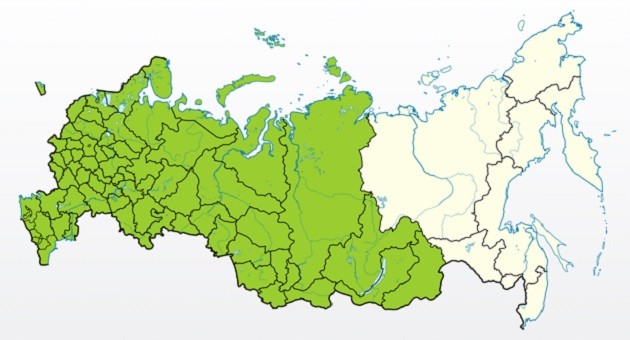
Growing regions
- Middle zone.
- North Caucasus.
- Crimea.
- Some northern regions.
- Ural.
- Western Siberia.
Origin
These apple trees are folk-bred varieties that spontaneously emerged from the cross-pollination of various ancient subspecies. The tree was first described by Sergei Ivanovich Isaev, a renowned Russian scientist and plant breeder. He believed it belonged to the Anise clone. He also claimed that the striped subspecies arose earlier than the scarlet one, as he found references to it in earlier documents dating back to the eighteenth century.
Striped anise has several common names, all well known in the areas where it is most commonly grown. It is also called gray anise, old anise, and rootless anise.
The decision to include the tree in the State Register of Breeding Achievements was made only after the end of WWII. In 1945, it was classified as an elite variety, and two years later, it was added to the State Register and zoned for the Volga-Vyatka, Central, Ural, Northwestern, and Middle Volga regions.
Content
Description of the striped anise apple variety
 Apple trees of this variety always delight with their enviable resistance to low temperatures and sudden temperature fluctuations, longevity, and abundant annual fruiting. But these are far from all the virtues of the good old striped anise. It is renowned for its undemanding growing conditions, undemanding soil, light, and humidity, high marketability and flavor, attractive appearance, and unique, pleasant spicy aroma.
These powerful, century-old giants, still bearing abundant fruit, often amaze foreign gardeners. Despite the apples' small size and limited shelf life, this Anise variety is recommended for growing in small garden plots, as well as in intensive commercial orchards.
Apples: What they look like
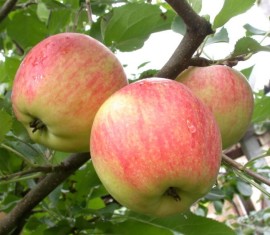
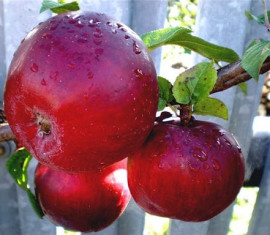
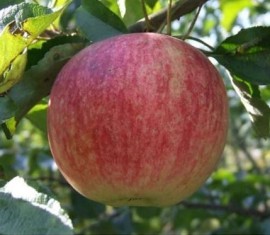
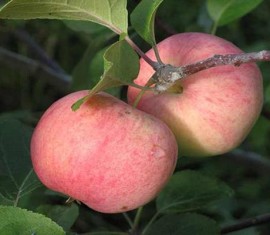
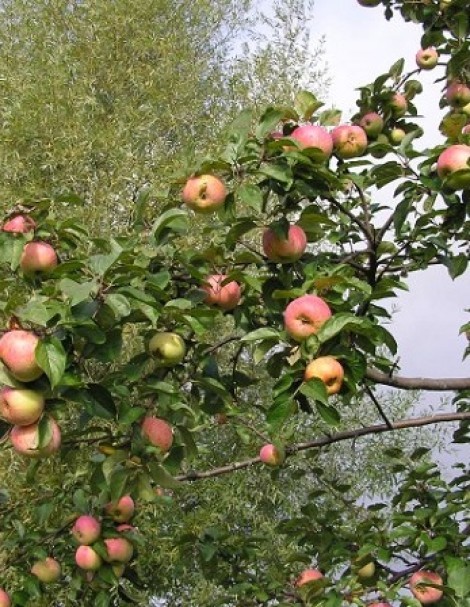
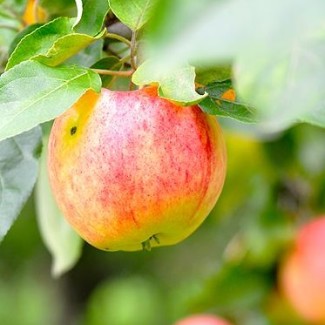
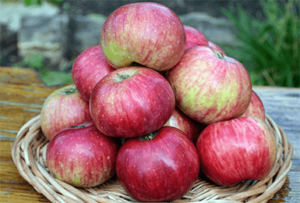 The fruits of this variety are typically medium or slightly smaller than medium, but still larger than those of its direct relative, the scarlet anise. They reach a maximum weight of 90-130 grams, but are more often somewhat smaller, weighing only 75-100 grams. The apples are round, flattened along the central axis, and can be slightly conical toward the calyx, smooth or with barely noticeable, smooth ribbing.
The fruit skin is glossy, shiny, smooth, light green or light green. During ripening, it becomes covered with a rich waxy coating, giving the fruit a glaucous appearance. The blush is mottled and striped, bright scarlet or simply red, and covers approximately 65-85% of the surface. Subcutaneous spots are light gray or greenish, large, few in number, and clearly visible. The chemical composition is most easily assessed by the following indicators:
- P-active substances (catechins) – 268 milligrams.
- Ascorbic acid (vitamin C) – 8.4 milligrams.
- Total sugars (fructose) – 11.5%.
- Pectins (fiber) – 14.8%.
- Titratable acids – 0.64%.
The pulp is pleasantly firm, fine-grained, and moderately juicy. It has a distinctive, recognizable aroma and a sweet and sour flavor considered dessert-like, balanced, and harmonious. Professional tasters have rated the Striped Anise (Gray) variety 4.6 out of 5.
Apple tree Anise striped: characteristics
Crown and root system
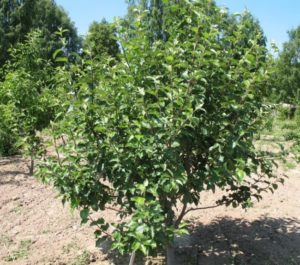 The tree is considered medium-sized, although it can easily grow up to 4.5-5 meters, and sometimes even more.However, most gardeners practice pruning to prevent excessive growth. The crown, when young, is conical, oval, or broom-shaped, and tends to become dense. The shoots are medium-thick, geniculate, and curved, covered in brown or tan-brown bark, sometimes slightly pubescent. Fruiting occurs on rhizomes and spears.
The leaves are medium-sized, rounded, elongated, leathery, and dense, somewhat larger than those of the scarlet anise. They are slightly shiny, though not glossy, and slightly pubescent, dark green or even emerald in hue, with coarse ribbing. The tips are long-pointed, and the margins are finely serrated, crenate, and can be wavy. The root system is extensive, fairly robust, and medium-deep, well adapted to seeking water.
Productivity and pollination
This subspecies of Anise, according to experts, is the most productive of all the existing varieties.
Under favorable conditions and proper care, a single mature tree can yield even more fruit in the fall than a regular Antonovka, up to 220-260 kilograms of aromatic fruit. However, in some years, or in the absence of suitable climate, weather, fertilizers, and watering, the yield can drop to 80-100 kilograms..
The variety is considered conditionally self-fertile, meaning you'll get some fruit even if there's no other apple tree nearby with a suitable flowering time. Bees and wind are sufficient for Anise, but it's better if there are trees nearby. Then, you can increase your yield to the desired 100%. Many also recommend using mobile apiaries and spraying the garden with diluted honey or sugar during the flowering period.
Winter hardiness and disease resistance
All anise varieties respond very well to relatively low temperatures. They show no particular signs of freezing at temperatures of -37-40°C. However, even if buds, young shoots, or wood are damaged, the tree recovers very quickly and continues to bear fruit as if nothing had happened. Therefore, this variety is highly prized in particularly harsh regions, such as Urals. But to be grown in Siberia the tree cannot, due to its height and the impossibility of covering it for the winter.
Anise is not immune to powdery mildew, scab, or other fungal infections. However, experts rate its resistance as average; it's not prone to these diseases, but can be affected. During severe epidemics, diseases can be severe and widespread, so preventative measures must be taken promptly. Insects are also a common problem for this variety, so insecticides should always be in your arsenal.
Rootstocks and subspecies
There are a huge number of diverse anise subspecies, some of which are already described on our website. If they aren't yet available, such material will be available soon. It's worth mentioning that today there are many subspecies that are quite suitable for cultivation in the Far East, Siberia, the Urals, Tatarstan, Kazakhstan, Bashkiria, and other regions with equally challenging weather and climate conditions. Striped anise is not yet suitable for these regions, but work with it is ongoing.
Features of growing striped anise
 Landing
 Landing
Basic conditions
- Anise trees love plenty of sun and air, so choose a location with good ventilation and full sun for most of the day. In the shade, apple trees grow weak, produce small fruit, are prone to disease, and may even die.
- It's not recommended to plant this variety where the groundwater level rises above 2.5-3 meters, as it will inevitably reach it with its extensive, powerful roots. For this reason, avoid planting these trees near rivers, springs, ponds, lakes, or even shallow wells, in lowlands, or in marshy areas.
- Apple trees need light and airy soil, with fertility being a secondary concern. Therefore, black soil should be diluted with river sand. The tree thrives in loam and sandy loam, but it should be fertilized regularly.
- The holes are dug in advance of the season, in spring or fall, but if you missed the opportunity, you can prepare them 2-4 weeks in advance. Fertile topsoil is mixed with organic matter and mineral fertilizers, then filled into the bottom of the holes. Drainage is added on top of this mixture; gravel, any rocks, crushed stone, broken brick, or even nutshells can serve as drainage. The holes are watered generously and left outdoors.
- Leave enough space between trees to ensure they don't interfere with each other's growth with roots or branches. Approximately 4.5-5 meters should be sufficient, provided regular formative pruning is performed.
- When planting, the tree's root collar should be left 6-12 centimeters above the surface. If it roots higher, all the rootstock's properties will be completely lost.
- It would be a good idea to immediately drive supports into the holes to support the young seedlings; it is advisable to place them on the north side of the tree trunks.
- Inspect the root system before planting. If the roots are dry, it's best to place the tree in a container of water to rehydrate. Any damaged or diseased roots can be ruthlessly pruned with pruning shears.
- Place the seedling on a drainage trench, spreading the roots out so they can lie freely. Cover with soil, shaking the trunk constantly to prevent air pockets and air pockets. Compact the soil by hand, being careful not to pack the soil into a compacted mass. Water with 25-40 liters of water, and mulch the surface.
Landing dates
This variety can be planted outdoors in both spring and fall. The further north the growing region, the more likely it is to be planted in the former direction. It's best to wait until the danger of frost has passed, or until the first frost arrives within 3-4 weeks. All garden planting should be done when the sap in the trunks is still stagnant or has completely stopped flowing.
Protection from frost and rodents
This Anise subspecies is truly frost-resistant, but winter preparation is still crucial. All irrigation, even drip irrigation, should be stopped promptly, around mid-September, to allow the tree time to prepare for the cold. The root zone is covered with grass mats or straw bales, and in the northernmost regions, it is covered with 15-25 centimeters of soil. The trunks are wrapped in burlap or roofing felt, roofing felt, agrofibre, or tarpaulin. Dwarf and creeping subspecies can be covered with a tent.
Tree trunks are whitewashed to prevent insects from nesting in cracks and crevices. To protect against hungry rodents that come to gnaw on the bark and young shoots during the winter, they are coated with lard, grease, and other strong-smelling substances.
Tree care
 Tree care
Loosening the soil, watering: proper agricultural technology
It's a good idea to loosen the soil around the apple tree, especially in its early years. It prefers to have free access to oxygen to its roots. Dig the soil twice a year, but hoe it 3-5 times per season. After 15-18 years, you can cover the area around the tree's trunk with sod, which will significantly simplify maintenance.
Watering anise plants isn't generally necessary, except when they're young and haven't yet developed a strong root system. Then, watering can be done once every 2-3 weeks, especially during dry and hot weather. It's a good idea to add various fertilizers and supplements along with the water, as this will help them be absorbed better.
Pruning: simple crown shaping
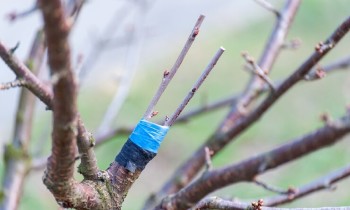
Striped anise is a vigorous, tall tree, so experts recommend a sparse, tiered crown. However, this pliable "material" can be shaped into almost any desired form. In the first year, the central conductor is pruned by a third, and two or three skeletal branches are left spaced widely apart. Subsequently, you'll need to maintain the desired shape, also removing suckers (shoots that stick up vertically) and those growing inward.
Don't forget about sanitary pruning; it's very important. All dry and damaged branches must be trimmed regularly. After this cleanup, seal the cuts with garden pitch or drying oil. It's best to inspect and prune in late autumn, when the sap has stopped flowing in the trunks.
Pollinator varieties
Reproduction
- Rooting cuttings.
- Grafting by buds or cuttings.
- Growing from seeds.
- Clones (layering).
Diseases and pests
- Cytosporosis.
- Scab.
- Powdery mildew.
- Black crayfish.
- Pit bitterness.
- Green aphid.
- Hawthorn.
- Codling moth.
Ripening and fruiting of striped anise
The beginning of fruiting
 The beginning of fruiting
All Anise subvarieties begin bearing fruit at different times, but the striped variety can be considered "average." It may first produce a few buds in the third or fourth year, but the first fruits will appear in the fifth or sixth year. You can harvest a small number of apples at this point, but that's enough for a sample.
Flowering time
Even the most experienced gardener can't predict the exact flowering time of the striped anise, as it fluctuates depending on changing environmental conditions. Climate and weather, soil, growing location and region, shade and light—all these factors can accelerate or delay flowering. This typically begins in the second half of May, but in colder regions, buds may not open until early June.
Fruiting and growth
This variety isn't considered fast-growing, as it barely reaches 8-14 centimeters per year. Therefore, you'll have to wait quite a while before the tree reaches its full height. Therefore, you'll have to wait until the tree reaches its full height, which won't be significant until the 12th to 15th year. However, this is fully compensated by the regularity of fruiting and its very long lifespan.
Like the flowering period, the ripening of the fruit can vary significantly. In more southern regions, the fruit ripens around the end of August, but in colder regions, they are typically harvested no earlier than the end of September. Only in the southern Volga region are these apples considered summer apples. Generally, all Anise apples acquire all the qualities of winter apples as they move north. Storage also depends directly on ripening. The earlier the apples ripen, the shorter their shelf life. In northern regions, growers can preserve the fruit until March or even April.
Top dressing
- Mineral complexes.
- Chicken manure.
- Ammonium nitrate.
- Manure.
- Compost.
What to do if it doesn't bloom or bear fruit
- Provide watering.
- Check for pests and diseases.
- Transplant to a sunnier location.
- Fertilize.
Why do apples fall?
- Natural factors.
- Pests.
- Diseases.
Please leave your feedback on the Striped Anise variety so that other gardeners can learn about your experiences growing these trees.