Miron Sugar Apple Tree: Variety Features and Care
| Color | Reds |
|---|---|
| Ripening season | Summer |
| Size of apples | Average |
| Taste | Sweet |
| Crown type | Average tree height |
| Shelf life | Low shelf life |
| Application | Fresh , For recycling |
| Winter hardiness | High winter hardiness |
| Fruiting age | Up to 5 years |
 History of origin and regions of growth
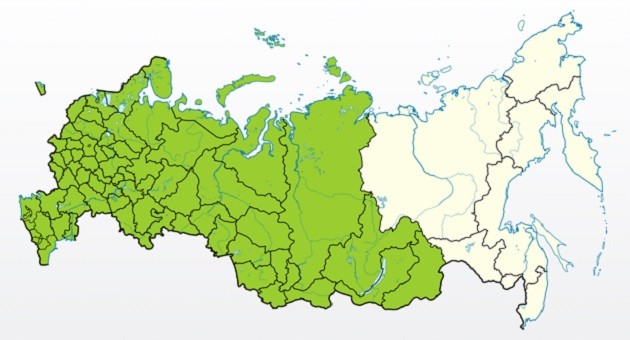
Growing regions
- Crimea.
- Middle zone.
- Leningrad region.
- Ural.
- North Caucasus.
- Siberia.
- Moscow region.
- Far East.
Origin
This ancient Russian variety, bred for folk culture and boasting high yields, is common in the orchards of Russian gardeners. Despite the abundance of newer and more promising apple trees, it has remained popular for over two hundred years. The origins of this apple tree remain unknown.
This apple tree has many different names known in different regions of our country: Mironchik, Lipovka, Vyaznikovka, etc..
There's no information about the Miron Sakharny variety in the state register of breeding achievements. The apple tree also has no official regionalization. However, it is cultivated throughout virtually all of Russia, from the western borders to the Far East.
Content
Description of the Sugar Miron variety
 This early-ripening variety boasts a number of advantages that distinguish it from others. The tree is compact, has a beautiful, neat crown, requires little attention, and is unpretentious and undemanding in terms of growing conditions. It is naturally resistant to low temperatures and various diseases, and is environmentally friendly.
The fruits are large, sweet, and attractive. They have a strong, distinctive aroma and are suitable for processing. However, they are difficult to transport and store, which is considered the variety's main drawback. It is recommended for cultivation in small private gardens and is not suitable for intensive commercial orchards.
Apples: What do they look like?
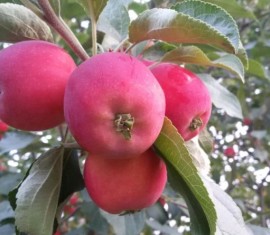
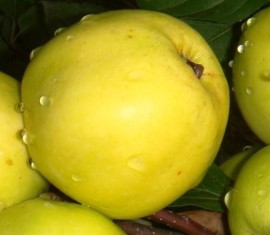
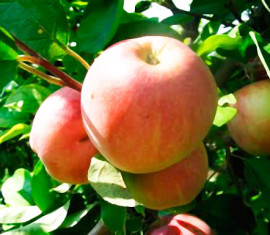
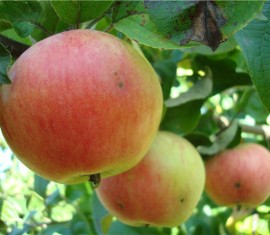
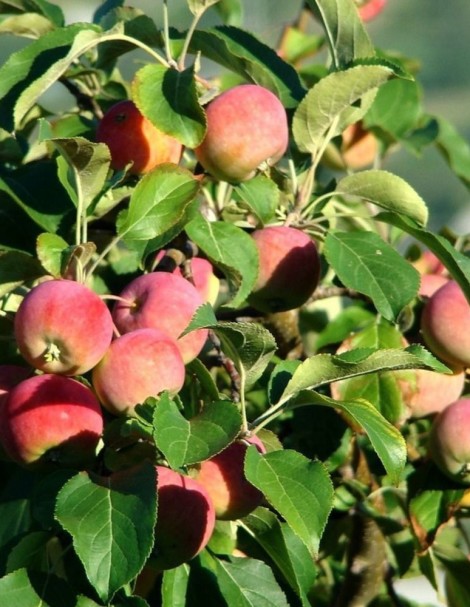
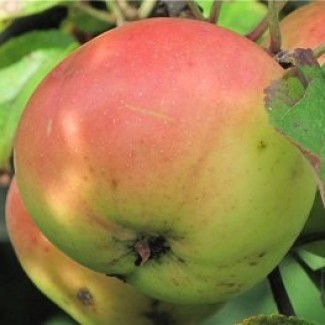
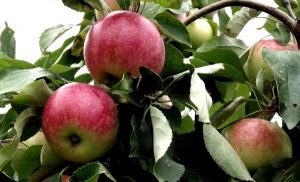 The fruits are medium to smaller than average in size, weighing barely 60-90 grams in good years. They have a slightly rounded, cup-shaped, and slightly conical shape, are not symmetrical, uneven, or uniform in size. Ribbing is distinct and noticeable, and the fruits may be slanted to one side, slightly flattened, with a barely visible lateral seam.
Apples have a dense, even fairly thick, skin that's firm and elastic, but not very flexible, prone to cracking when overripe or mechanically damaged. When ripe, it develops a thick, oily coating. The base color is light green or light green-yellow. The blush occupies approximately 45-60% of the surface and can be speckled, striped, blurred, reddish-brown, burgundy, or bright red. There are quite a few subcutaneous spots, but due to the variegated surface, they are difficult to see. Experts recommend examining the chemical composition of apples based on the following criteria:
- P-active substances (catechins) – 112 milligrams.
- Ascorbic acid (vitamin C) – 6.8 milligrams.
- Total sugars (fructose) – 15.3%.
- Pectins (fiber) – 9.1%.
- Titratable acids – 0.43%.
Miron has a pleasantly textured, albeit slightly coarse, flesh. It's tender, not overly juicy, but not entirely dry, easy to bite into, and has a pleasant apple aroma. The flavor is generally considered unbalanced and unharmonious; it's sweet, without the characteristic sourness in the aftertaste, slightly spicy, rich, and sometimes even cloying.
Apple tree Miron sugar: characteristics
Crown and root system
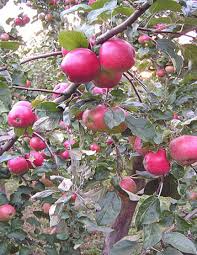 Trees of this variety are considered medium-sized. They grow up to 4.5-5 meters without formative pruning.The crown shape is predominantly compact and rounded, moderately dense when young, and densely foliated, broadly oval, vigorous, spreading, and sometimes even drooping when mature. The branches are rounded in cross-section, long, and slender, covered in brown or greenish-brown bark, and often extend from the main stem at an acute angle.
The leaves of the sugar myron are medium-sized, elongated, oval, or even lanceolate, on long, slender petioles. They are dense and leathery, with rough nervation and finely serrated, crenate, and serrated margins, sometimes slightly wavy. The color is green, light green, or deep green. The root system is well-developed and can be fibrous or taproot, depending on the rootstock. It is well adapted to the search for nutrients and moisture, with some small shoots extending very close to the surface.
Productivity and pollination
The variety is considered medium-yielding, although in some years it can reach high yields. There is no pronounced periodicity in fruiting, but some fluctuations can occur from year to year.
One mature Myron sugar tree produces 100-180 kilograms of small but sweet fruits per season..
This variety is self-fertile, meaning it doesn't need other apple trees to produce fruit. However, if other trees are present within 150-200 meters, yields typically increase.
Winter hardiness and disease resistance
The tree's resistance to low temperatures is truly high. It can withstand winter frosts down to -35-37°C without significant damage. Sometimes the buds freeze slightly, but they recover very quickly. Myron can even survive late spring frosts, which demonstrates its resilience. However, it's still undesirable to neglect standard measures for covering and preparing for winter, especially for relatively young 1- and 2-year-old trees.
The tree has no genetic immunity. However, its natural resistance to diseases is high. The variety is only susceptible to disease during the most severe epidemics. The leaves are primarily affected, and the apples can be eaten without concern.
Rootstocks and subspecies
The variety has no subspecies, but many other apple trees have been grown on it, using it as a rootstock. Sugar Myron can be grown on a variety of rootstocks, from dwarf to vegetative. This changes the tree's characteristics slightly, but has virtually no effect on the size, flavor, or quality of the fruit. There are no trailing or columnar varieties, although a creeping tree can be formed by pruning and tying branches to stakes driven into the ground.
Features of growing Myron saccharum
 Landing
 Landing
Basic conditions
- Apple trees should be planted in sunny, open areas. In the shade, they grow poorly and may refuse to bloom or bear fruit.
- A dense, leafy crown can lead to air stagnation. Therefore, a well-ventilated location is recommended. Apple trees can tolerate even slight drafts, but it's best to avoid them; finding the right balance is crucial.
- The groundwater level must be monitored, as high water levels can cause the rhizome to rot, resulting in the tree's death. For the same reason, Mironchik should not be planted near ponds, rivers, lakes, streams, marshy areas, or floodplain meadows.
- The tree thrives in any soil, as long as it's not overly acidic or salty. Apple trees grow well in sandy loam, black soil, loamy soil, and even on rocky mountain slopes.
- Experienced gardeners dig the holes in advance; they're planted in the spring. They should be 90-100 centimeters in diameter, and 60-70 centimeters deep is sufficient. Fertilizer is added to the bottom, then the entire hole is covered with stones or broken brick, watered generously, and left uncovered.
- If it's important to preserve the rootstock's properties, it's best to leave the root collar of the seedling 5-7 centimeters above the surface. This way, even if the soil settles, it can be replenished without the risk of rooting above the graft.
- Before planting, inspect the seedlings and trim off any dry or broken shoots. You can soak them upside down in water to soak them up and promote rooting.
- Between the trees, leave approximately 4-4.5 meters, and between the rows, 3.5-4, for ease of further care and harvesting of fruits.
- Place the seedling on the drainage, spreading out the roots so that they do not bend or get tangled anywhere, sprinkle with soil, compact with hands or feet, water with 40-45 liters of water, and mulch the surface.
Landing dates
The sugar myronchik is so resilient to low temperatures and their fluctuations that it can be planted in either spring or fall. Even young trees easily tolerate frosts and recover very quickly from severe damage. If no more than a third of the buds are damaged, the tree recovers within a year and begins growing with renewed vigor, eventually bearing fruit. The best time to plant is a warm, dry day in March-April or September-October, when the sap is still in the trunks.
Tree care
 Tree care
Protection from frost and pests
In warmer climates, trees require no protection at all from the first year. However, more northern regions still require careful preparation for winter to avoid creating unnecessary risks to the garden. Therefore, trunks are usually wrapped in burlap, old tights, or roofing felt, and in the coldest regions, the root zone is covered with spruce branches, straw, or hay. It's crucial that all this is thoroughly dried, otherwise rotting can occur, which can destroy even the most resilient tree.
Whitewash tree trunks with a thick lime solution, 1-1.2 meters deep, annually, in spring and fall. This will not only add neatness and tidiness to the garden but also repel insects nesting in cracks and chipped bark. To prevent rodent damage, trunks can be coated with melted lard, old drying oil, fuel oil, grease, or other commercially available products.
Loosening the soil, watering: proper agricultural technology
The soil around the trunks is dug in the spring and fall, but once a year is sufficient. Weeds, root suckers, and shoots from other plants should be removed at the same time. In the summer, the soil can be loosened additionally, for example, the day after glazeTo prevent it from forming a dense lump, cutting off oxygen to the rhizomes. Over the years, you can avoid digging altogether by sowing the root circles with grasses, from lawn grasses to herbs, which will provide natural aeration of the soil.
Watering During severe drought, watering is essential, but excessive moisture will increase the risk of fungal growth. Therefore, it's crucial not to overdo it, especially since the tree is capable of extracting moisture from the soil itself. Therefore, it's best to simply monitor the soil around the trunk and apply moisture only when it dries out completely. It's a good idea to add various fertilizers along with water, but not until the third year after planting.
Pruning: simple crown shaping
The sugar Myron has a very dense and branched crown, so it will take some effort to ensure good ventilation and sun exposure for the fruit. The optimal shape is a sparse, tiered form, with shoots spaced widely apart at different heights. Three to four skeletal branches are sufficient; they will ensure natural branching within normal limits if maintained and regularly pruned, removing suckers, shoots protruding into the crown, and parallel or crossing branches.
Sanitary pruning is usually done in the fall, but you can also inspect the apple tree in the spring if needed. Then, all broken, dry, or diseased shoots are pruned. Rejuvenation can be carried out as early as 12-15 years, pruning several mature branches to allow new ones to develop.
Pollinator varieties
- Pepinka.
- Korobovka.
- Autumn striped.
- Minusnskoe.
- Borovinka.
- Gala.
- Spartan.
- Aelita.
- Antonovka.
- Rennet.
- Simirenko.
Diseases and pests
- Cytosporosis.
- Pit rot.
- Powdery mildew.
- Scab.
- Scale insect.
- Green aphid.
- Hawthorn.
Ripening and fruiting of Myron saccharum
The beginning of fruiting
 The beginning of fruiting
Miron's main advantage over other older varieties is its enviable early fruiting. Buds may bloom in the first or second year, but these will most likely be barren flowers. Fruiting begins approximately two to three years after planting in open ground. Yields in the first few years leave much to be desired, but the fruits are then the largest.
Flowering time
Flowering is considered early, although this directly depends on the growing region, its climate, and weather conditions. The period can range from early to late May. The flowers themselves are densely covered with branches; they are medium-sized, delicate, pure white or slightly pinkish, and intensely fragrant. The flowering period lasts 12-16 days, providing ample time for pollination, and finding pollinators is easy.
Fruiting and growth
The tree grows quite quickly, adding approximately 35-60 centimeters per year. It grows faster before fruiting begins, then slows slightly, but still reaches its full size very quickly. It also increases its yield, and by the 6th to 8th year, the fruit production is so abundant that it can be considered the maximum.
The fruits ripen towards the end August, and in cold northern regions, sometimes as early as early September. They ripen uniformly, all at once, and if overripe, they can fall to the ground, making them completely unsuitable for storage. Consumer maturity coincides with technical maturity; they can be consumed and processed immediately after picking. Apples can be transported in boxes, with no more than two or three layers, but they will not last longer than 25-35 days. After this time, they acquire a loose, juicy texture and a sour-bitter flavor.
Top dressing
- Peat.
- Superphosphate.
- Humus.
- Bor.
- Calcium.
- Manure.
- Compost.
- Ammonium nitrate.
What to do if it doesn't bloom or bear fruit
- Limit or strengthen watering.
- Eliminate insects.
- Cure diseases.
- Feed.
- Transplant to a sunny place.
Why do apples fall?
- Wind, frost, rain, hail.
- Overripe.
- Pests or diseases.
Leave a review of the Miron Sugar apple tree variety so that even a novice gardener can receive useful information firsthand.