
Yunga apple tree: characteristics of the variety and care
| Color | Greens , Whites |
|---|---|
| Ripening season | Summer |
| Size of apples | Average |
| Taste | Sweet and sour |
| Crown type | Average tree height |
| Shelf life | Low shelf life |
| Application | For recycling , Fresh |
| Winter hardiness | High winter hardiness |
| Fruiting age | Up to 5 years |
 History of origin and regions of growth
Growing regions
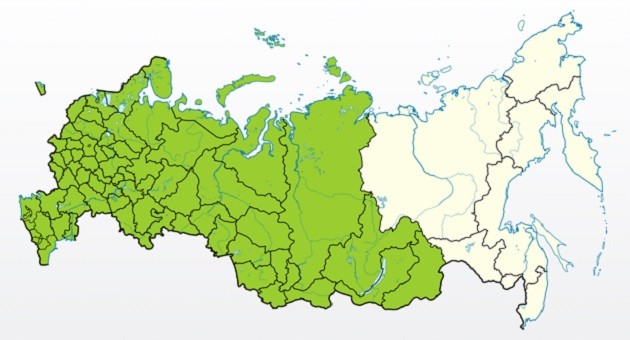
The Yunga apple tree has increased winter hardiness, which is why it is recommended for cultivation throughout almost the entire territory of Russia, including Altai, the Far East, and Siberia, with the exception of some regions.
Origin
Soviet breeders spent decades developing an unpretentious apple variety that would be resilient to the harsh Russian climate, and, most importantly, productive. In 1994, the Lisavenko Research Institute of Seed Crops in Barnaul produced a completely new specimen, which they decided to name "Yunga." Pomologists succeeded in crossing the widely popular early variety "Bely Naliv" with "Nepobedimaya Grellya," resulting in a semi-cultivated hybrid.
The Jung apple tree has another common name. Its beautiful light green skin and crisp white flesh earned it the nickname "Snow White."
In 2001, seedlings of the new variety were sent to various farms in Altai and far beyond for experimental research. Four years later, the variety was added to the State Register and zoned throughout virtually the entire territory of Western Siberia.
Content
Description of the Yunga apple variety
 Not all apple trees survive in our climate, so every gardener seeks varieties that can easily withstand the rigors of long, frosty winters. One suitable variety that can be grown in northern latitudes is Yunga.
The tree is completely low-maintenance, extremely winter-hardy, produces high yields annually, and its fruits have excellent consumer and commercial qualities. Add to this the apples' pleasant taste, aroma, and versatility, and these apple trees will become welcome additions to any homestead.
Apples: What it looks like
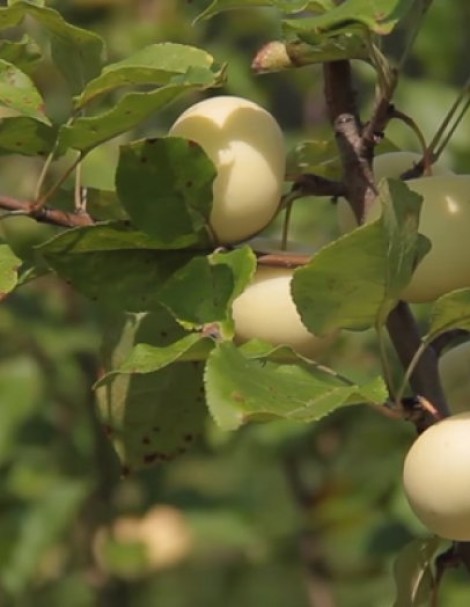
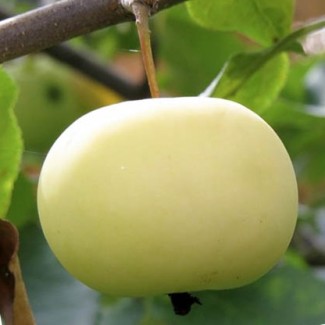
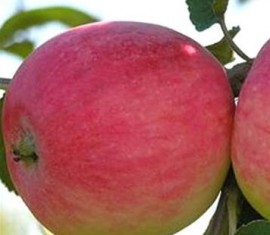
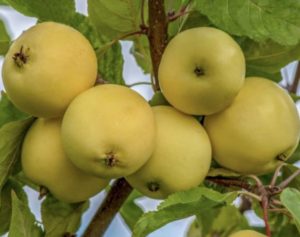 Siberian frost-hardy apple trees typically don't produce large fruits. This variety produces medium-sized fruits, ranging from 60 to 110 grams, which is quite good, but most fruits weigh around 70 grams. They are round, mostly uniform, with barely noticeable ribbing, and may be slightly flattened.
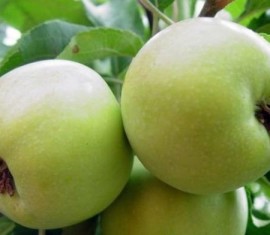
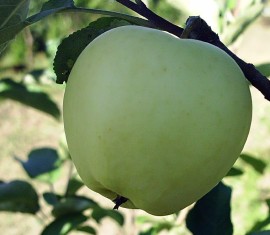
Apple skin is smooth, glossy, thin, and very tender. When unripe, it is a rich green color, becoming white or slightly yellowish, sometimes even translucent, as it ripens. It is covered with a waxy coating that is almost invisible and easily rubbed off. In sunny years, a very transparent, washed-out pink blush may appear on the surface. The fruit's stalks are thin and long, and the subcutaneous spots are few and lighter in color than the skin, making them almost invisible on the surface. The chemical composition can be characterized by the following indicators per 100 grams of product:
- P-active substances (catechins) – 210 milligrams.
- Ascorbic acid (vitamin C) – 18 milligrams.
- Total sugars (fructose) – 11%.
- Titratable acids – 0.8%.
The fruit's flesh is very crisp, crunchy, and delicately creamy. It is fine-grained, juicy, and medium-dense. When overripe, it becomes plump and translucent, allowing the seed pod to be visible. The flavor is considered balanced, sweet and sour, dessert-like, and harmonious. The tasting score is 4.8 out of 5.
Jung's apple tree: characteristics
Crown and root system
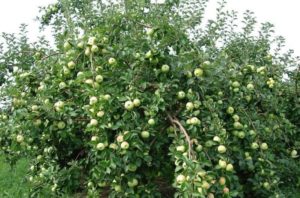 The tree is considered a dwarf, but in fact, under favorable conditions it can grow up to 5-6 meters without much difficulty. However, it grows very slowly, and in harsh conditions it may barely reach 2.5-3 meters in height by the 8th to 12th year. However, with timely pruning, keeping Snow White at a manageable size is not difficult at all. Crown Broadly pyramidal when young, it becomes spreading and even weeping with age. The branches grow almost at a right angle to the trunk. The shoots are straight, slightly pubescent, and have greenish-brown roots.
The leaves are dense, medium-sized, light green, thick, leathery, and glossy. They are serrated at the edges, curl slightly inward, and have a pointed tip. The undersides are slightly pubescent. The root system is deep, highly branched, and extends several meters into the soil.
Productivity and pollination
The tree is considered precocious, as it begins bearing fruit around the age of 4-5 years. This isn't exactly a high yield, as even by the age of 8-10 years, the apple tree can only produce 7-10 kilograms of apples.
But the yield will increase each year. Snow White has a cyclical fruiting pattern. That is, if it yields a good harvest this year, you can expect no more than half as much the following year. Subsequently, the apples will increase again, and so on, until old age.
The variety is considered self-fertile, meaning it doesn't require other pollinators to produce a certain number of apples annually. However, experienced gardeners note that if other varieties with suitable flowering times are nearby for cross-pollination, the yield increases significantly, sometimes doubling or more.
Winter hardiness and disease resistance
This variety boasts incredible winter hardiness and easily tolerates temperatures as low as -40°C. It doesn't even require any additional shelter. However, if the winds are strong and the temperature fluctuates significantly, it's better to be on the safe side. To achieve this, the tree's root zone is covered with spruce branches, straw, or hay, and the trunks are wrapped in roofing felt, tights, or agrofibre.
After the snow melts, traces of damage are often immediately visible on Siberian apple trees. scabies On the trunks, this doesn't happen with Yunga. The variety is almost completely resistant to moisture, making it immune to virtually all fungal apple infections. If spots appear on the leaves, they don't bother the apple trees in any way, and with regular care, they disappear on their own. However, even if the disease does appear on the apples, they are simply removed from the tree and immediately disposed of.
Rootstocks and subspecies
Currently, only one subspecies of the Belosnezhka cultivar is known: the dwarf 'Yunga'. It is distinguished by a maximum height of 2-2.5 meters with a distinctive compact crown. It is most popular in the Tula region, where it was developed.
Features of growing Yunga
 Landing
 Landing
Basic conditions
- For the Junga, you need to choose a location that is well-lit from all sides. In the shade, the tree grows and bears fruit very poorly; the apples constantly shrink and may disappear altogether.
- The variety also does not like drafts; if there is no suitable place, you can protect the seedling with hedges or fences, plant them near the walls of buildings, but so that they do not block the sun.
- It's important to avoid planting in areas where the groundwater level is too high (up to 2-2.5 meters). The apple tree will inevitably reach the water table with its roots and begin to rot. However, if you have no choice, you can create a special barrier. To do this, dig a sheet of slate or a layer of roofing felt into the ground at a depth of 2 meters, and then plant the tree on top.
- The holes are dug in a square pattern, spaced 3-4 meters apart, and should be 50-60 centimeters deep and the same in diameter. It's best to prepare them in advance, at least a few weeks in advance. To do this, mix some of the fertile soil from above with fertilizer, return it to the hole, and fill it with several buckets of water. Leave it uncovered.
- It is customary to lay a drainage layer of broken brick, vermiculite or gravel at the bottom, no more than 10-15 centimeters thick.
- Don't forget to immediately dig stakes into the holes for tying on the north side of the seedling.
- The tree's root collar must protrude above the soil surface by at least 5-8 centimeters, otherwise the tree will take much longer to develop and will begin to bear fruit later.
- The tree is planted vertically and covered with soil, compacting it thoroughly. You can even tamp the soil down with your feet, then water with 30-40 liters of water. Mulch the surface with chopped grass or compost.
For your garden, it's best to buy Snow White seedlings from large, well-known nurseries or at least from trusted, familiar sellers. The best choice would be robust, two-year-old plants with closed root systemMake sure your apple trees are grafted, as you might be given a wild apple, which will take a long time to produce fruit, and the quality of the fruit will be poor.
Landing dates
These apple trees are completely unpretentious about planting timing. Therefore, they can be planted both in the spring, before the buds open, and in the fall after the leaves have fallen. The trees are in special pots that require no disposal (closed root system) can be planted in open ground throughout the growing season.
Protection from frost and rodents
Although the tree is winter-hardy, it still needs some care. In the fall, cover the root zone with spruce branches, hay, or straw bales, and wrap the trunks with roofing felt, agrofibre, roofing felt, or nylon tights. In very harsh conditions, apple trees can be covered with burlap, using a tent-like technique.
To prevent insects from attacking the tree trunks, whitewash them with lime to prevent them from damaging the bark and wood. To repel hungry rodents during the winter, it's best to coat the trunks with lard, grease, or a special commercially available product.
Tree care
 Tree care
Loosening the soil, watering: proper agricultural technology
The Yunga succulent is undemanding of soil, especially soft soil, so digging the area around the trunk once a year is more than enough. However, frequent watering is necessary during dry weather. soil If it dries out, the apple tree will feel uncomfortable and may even lose its blossoms or unripe fruit.
It would be a good idea to regularly remove fallen leaves, grass, rotting fruit, shoots of other plants, and root suckers from under the tree.
Pruning: simple crown shaping
Neglecting pruning, assuming the tree isn't too prone to becoming overgrown, is a bad idea. Otherwise, the crown will be poorly ventilated, and the fruit may not receive enough light in the dense foliage. The central stem is shortened for the first time by one-third in the first year after planting. All lateral branches are planted in tiers, preferably spaced far apart.
The Yunga tree should be regularly cleared of dry, diseased, or damaged branches, and all cuts should be immediately sealed with garden pitch or painted with water-based paint. To rejuvenate the tree after 15-20 years of age, remove 2-3 mature branches annually, allowing space for new growth.
Pollinator varieties
- Kate.
- Arkad.
- Mantet.
- Quinti.
- White filling.
- Erliest.
Reproduction
- Clones (layering).
- Rooting by cuttings.
- Grafting by cuttings or buds.
- Growing from seeds.
Diseases and pests
- Black crayfish.
- Cytosporosis.
- Fruit rot.
- Leaf roller.
- Green aphid.
- Flower beetle.
- Codling moth.
Ripening and fruiting of the Yunga apple tree
The beginning of fruiting
 The beginning of fruiting
It's believed that all semi-cultivated varieties begin bearing fruit quite early. The Belosnezhka produces its first few apples by the third year, but the harvest can only be harvested in the fourth or fifth year. Even then, the yield is modest, only a few kilograms of fragrant, plump fruit.
Flowering time
The yarrow blooms in the first half of May, around the tenth. However, depending on the weather, it can linger until mid- or even late May. Therefore, it's best to choose pollinators with a similar blooming period. Its buds are large, densely covering the branches, and are quite fragrant.
Fruiting and growth
Apple trees of this variety, as mentioned earlier, increase their yield gradually, producing increasingly larger quantities of apples each year until they reach their peak. However, the tree's growth is very minimal, no more than 5-20 centimeters per season.
The fruits ripen in mid-August, and it's best to pick them from the branches immediately, as they can simply fall to the ground. It's important to carefully time the fruit's ripening period, as, for example, in a rainy summer, they may not ripen until mid-September. The fruit doesn't keep very long, no more than 30-40 days in suitable conditions. By this time, it's best to process them completely into compotes, jams, preserves, and other dishes.
Top dressing
- Superphosphate.
- Mineral complexes.
- Ammonium sulfate.
- Potash fertilizers.
- Peat.
- Compost.
- Manure.
- Humus.
- Urea.
What to do if it doesn't bloom or bear fruit
- Check for pests and diseases.
- Transplant.
- Limit watering.
- Feed.
- Thin out the crown.
Why do apples fall?
- Overripe.
- Natural factors.
- Pests.
- Diseases.
- Excess moisture.
Leave your own reviews about the variety Jonathanto share my experience and knowledge with other gardeners.





Comments
Such a beautiful variety. I've always wondered if they're too sour. My mom and I are trying to figure out what other variety to buy for our dacha.