Apple tree "Prizemlennye": characteristics of the variety and care
| Color | Reds |
|---|---|
| Ripening season | Autumn |
| Size of apples | Average |
| Taste | Sweet and sour |
| Crown type | Dwarf |
| Shelf life | Low shelf life |
| Application | For recycling , Fresh |
| Winter hardiness | High winter hardiness |
| Fruiting age | Up to 5 years |
 History of origin and regions of growth
Growing regions
- Ural.
- Western Siberia.
Origin
Breeding small trees that take up minimal space in gardens has been a challenge for domestic breeders at the South Ural Research Institute of Fruit, Vegetable, and Potato Growing since the beginning of the last century. A team of breeders, led by Mikhail Aleksandrovich Mazunin, his wife Nadezhda Fedorovna, and agricultural and biochemical scientist Vladimir Ilyich Putyatin, developed an entirely new variety between 1969 and 1973.
The "Prizemlenny" variety was bred based on the hybrid form 1-63-197 and the Vydubetskaya weeping apple tree. Around the mid-1970s, this naturally occurring dwarf variety was classified as an elite variety and sent for field trials across the country. A short time later, it was added to the State Register and zoned for the Ural region.
Content
Description of the apple tree variety "Prizemlennye"
 This autumn apple variety, which exhibits good resistance to low temperatures and high yields with a short growing season, is always in demand in the harsh conditions of our country. Combined with its early fruiting, ease of cultivation and care, and pleasant dessert flavor, Prizemlennye becomes a perfect choice. The trees' compact size allows for space-saving gardening, making them recommended for both commercial intensive orchards and small garden plots.
Apples: What they look like
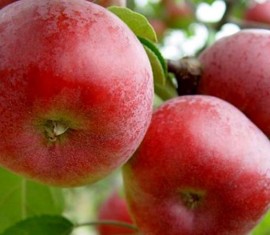
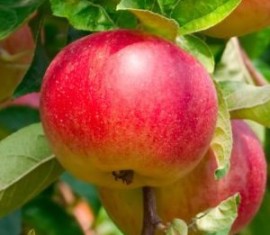
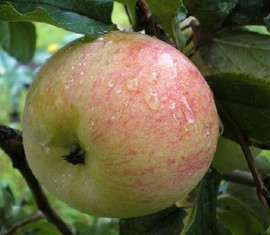
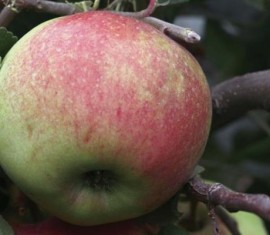
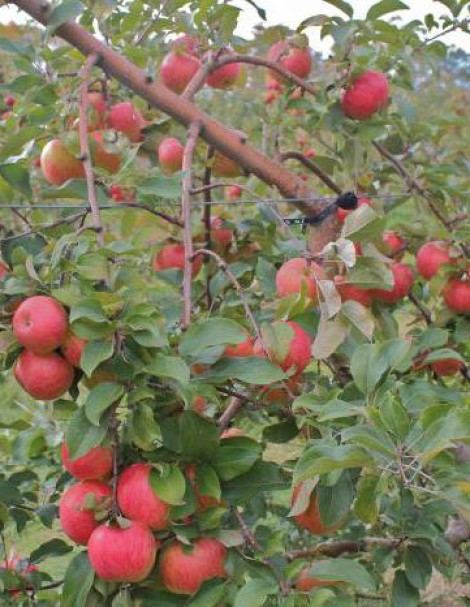
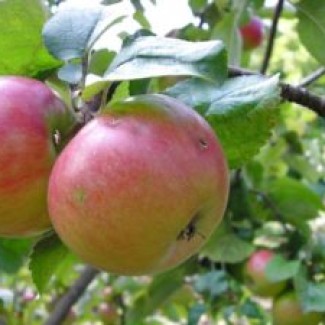
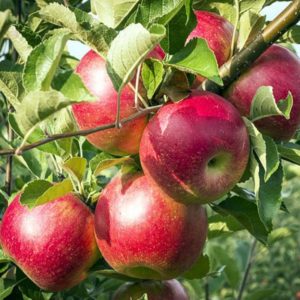 The fruits of this variety are small, medium, or slightly smaller than average. They are predominantly uniform in size, growing to a maximum weight of approximately 85-120 grams. The fruits are round, sometimes slightly flattened and slanted to one side, with subtle ribbing that is completely invisible to the naked eye.
The fruit skin is dense, smooth, glossy, and shiny, covered with a dense oily coating. Green when unripe, it turns yellowish-green or yellow as it ripens. The blush occupies approximately 55-70% of the surface; it is red or dark red, blurred, streaked, and spotted. Subcutaneous dots, light gray or slightly light green in color, are numerous and clearly visible on the surface. The chemical composition is characterized by the following indicators per 100 grams:
- P-active substances (catechins) – 247 milligrams.
- Ascorbic acid (vitamin C) – 19 milligrams.
- Total sugars (fructose) – 10.7%.
- Pectins (fiber) – 14.5%.
- Titratable acids – 0.7%.
The fruit's flesh is dense, crisp, prickly, fine-grained, quite juicy, and has a strong, distinctive aroma. It's green, turning greenish-yellow or lemon-colored as it ripens. It's sweet and sour, with a predominantly sour note, and the flavor is considered a harmonious dessert. According to a tasting score for appearance and taste, the "Prizemlennye" berry scores 4.2 out of 5 possible points.
Apple tree "Prizemlennye": characteristics
Crown and root system
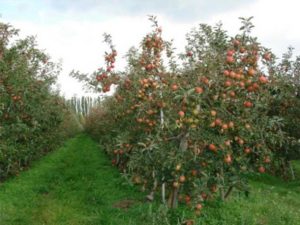 Since the variety is considered a natural dwarf, its height is small. Without pruning, trees can grow up to 2-2.5 meters., and even less on vegetative rootstock. The crown is oval or even pyramidal when young. However, with age, it becomes increasingly rounded or broadly rounded. The standard shoots extend from the trunk at a right angle; they are thin or medium-thick, straight, not long, with green bark, which with age turns greenish-nutty, turning brown, smooth, and glossy. Over time, this bark may crack and crumble. The tree bears fruit on last year's twigs and shoots.
The leaves are fairly large, elongated, elliptical, and short-pointed. They have finely ridged, serrated, wavy margins, are light green or green in color, and are leathery, dense, and matte, with noticeable pubescence on the back. The root system is superficial, shallow, and branched; depending on the rootstock, it may or may not have a central taproot.
Productivity and pollination
Despite the tree's compact size, professionals say its yield is high.
A mature tree can yield approximately 85-135 kilograms of delicious and aromatic apples in a single season, depending on care, climate, and weather conditions. The record yield is considered to be 168 kilograms of fruit, harvested from a Prizemlennoye tree in the Chelyabinsk region in 2011.
The variety is considered conditionally self-fertile, meaning it can pollinate itself to some extent. However, this will yield no more than 12-15% of the maximum possible yield. Therefore, to maximize apple production, it's essential to plant them close to other varieties, approximately 50-150 meters away. Experienced gardeners use mobile apiaries for planting during the flowering period or even locate their orchards in close proximity to bee farms.
Winter hardiness and disease resistance
The dwarf variety was specifically bred to be grown not so much in warmer regions as in the harsh conditions of the Ural climate zone. Therefore, the trees are highly frost-resistant. They tolerate temperatures down to -35-39°C with virtually no damage, while lower temperatures will require sheltering.
In years of the most severe epiphytotics, it can be affected scab By about 2 points, which is quite low. Apple trees are also moderately susceptible to other infectious fungal diseases and pest attacks. With timely preventative measures, the risk of disease is significantly reduced and minimized.
Rootstocks and subspecies
Trees are most often grown on standard and clonal rootstocks, though dwarf and semi-dwarf rootstocks are also used. There are several subspecies of the "Prizemlennye" cultivar, which are worth discussing in more detail.
| Subspecies | Description |
| Dwarf | Although the tree is already considered a natural dwarf, some prefer to grow it on similar, but more robust, rootstocks. This results in stronger, more winter-hardy trees that begin bearing fruit even earlier and produce higher yields. |
| slate | Any chosen rootstock from the Prizemlenny variety can be used to develop a good creeping apple tree, which is ideal for growing even in the Far East or the Far North, with their short warm spells and long, cold winters. This requires properly pruning the central basal shoot while simultaneously straightening the scaffold branches just below the soil surface. Subsequently, such a tree can be protected from frost by covering it with soil or mats of dry grass and covered with snow. |
Features of growing Grounded
 Landing
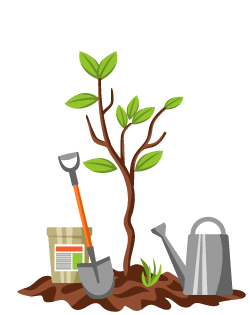 Landing
Key Features
- The down-to-earth apple tree prefers open, sunny areas. The tree's crown should be illuminated for most of the day, so planting apple trees in the shade of other plants, hedges, or building walls is unproductive. The fruit will be small, and the tree itself will be weak.
- When choosing a site, consider the groundwater level. It shouldn't be higher than 2-2.5 meters, so that the plants don't reach it with their roots, which would inevitably cause rot and kill the apple tree.
- The holes can be prepared in advance, in spring or fall, or just 2-3 weeks in advance. To do this, dig holes 70-80 centimeters deep and one meter in diameter. Add topsoil and fertilizer to the bottom, then add drainage (rocks, broken brick, vermiculite), and fill with 35-40 liters of clean water. Leave these holes outdoors until planting time.
- It is enough to leave 2-2.5 meters between trees in a row, and even less between rows.
- It is advisable to immediately dig or drive pegs into the holes for tying, which can be removed no earlier than 2-3 years after the start of fruiting.
- Root collar The trunk should be left approximately 7-10 centimeters above the soil surface so that the tree does not take root higher and lose the original qualities of the rootstock.
- Place the seedling upright, support it with your hand, and fill it with soil, compacting it layer by layer. Be careful not to overpack the root ball, otherwise the tree will feel uncomfortable. Create a small mound of soil around the perimeter of the hole, and pour 35-40 liters of water into it. The surface mulch compost or chopped grass.
Landing dates
Trees respond well to both spring and fall plantings in open ground. However, experienced specialists recommend the former when dealing with harsh weather and climate conditions, and the latter when planting in mild climates. In spring, it's best to wait until night frosts have completely ended, around mid- to late April. In autumn, it's best to carry out gardening in late September or mid-October, before the cold weather sets in.
Protection from frost and rodents
Young trunks must be protected from frost, despite their remarkable hardiness. Until the tree has adapted to the new conditions, it is very vulnerable. Therefore, it's best to cover the root zone with straw mats, wrap the trunks with agrofibre, burlap, roofing felt, or even old women's tights. Due to their low height, it's possible to cover the trees with a tent-like covering using any suitable material.
To prevent insects from settling at the tree's roots in the fall and then damaging the foliage, bark, and wood in the spring, the trunks are whitewashed with lime for approximately 1.2-1.5 meters. Greasing the trunk with lard or grease will help repel rodent pests, which often feast on the delicate bark in winter.
Tree care
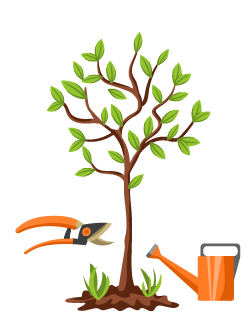 Tree care
Loosening the soil, watering: proper agricultural technology
All trees love oxygen-rich soil, so the area around the tree trunk should be dug at least twice a year. It's important to be careful not to damage the roots, which are located just below the surface. In between, you can use a hoe to loosen the soil. At the same time, you can remove any weeds, shoots, and root suckers that rob the apple tree of nutrients.
It's customary to water the Prizemlennye fairly frequently throughout the growing season. It's recommended to begin around the time the tree begins to bud, and to finish around mid- to late September, allowing the trunk time to prepare for winter. If the summer is hot and dry, watering every 10-14 days is sufficient. Fertilizers and other fertilizers are also added, as they are absorbed much better with water.
Pruning: simple crown shaping
The key to pruning dwarf trees is to create a proper crown that receives even sunlight for most of the day. Therefore, it's most often done in sparse tiers, with the skeletal branches spaced widely apart. In the first year, at least one-fifth to one-quarter of the shoots should be removed, and then the desired shape should be maintained.
Every spring and fall, the tree undergoes an inspection and sanitary pruning, during which all dry, diseased, or damaged shoots are removed. All cut areas are then coated with garden pitch to reduce stress on the tree. Around 12-15 years of age, rejuvenation pruning can be performed, removing 2-3 mature branches.
Pollinator varieties
- Autumn low-growing.
- Brotherchud.
- Gloucester.
- Carpet.
- Borovinka.
- Wonderful.
Reproduction
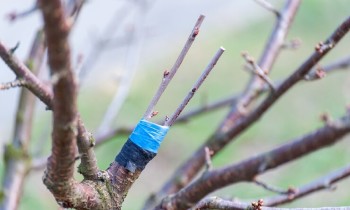
- Grafting by cuttings and buds.
- Growing from seeds.
- Layers (clones).
Diseases and pests
- Scab.
- Powdery mildew.
- Moniliosis.
- Codling moth.
- Green aphid.
- Weevil.
- Leaf roller.
Ripening and fruiting of the Grounded
The beginning of fruiting
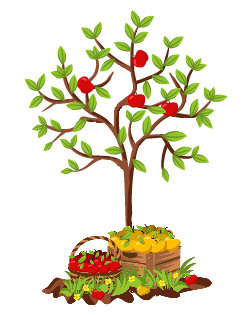 The beginning of fruiting
The apple tree is considered an early fruiting tree, bearing its first fruits within 2-3 years of planting in open ground. You'll have to wait a bit longer to see harvests of more than 5-15 kilograms, but that's still a good start.
Flowering time
Like most apple trees, this variety begins blooming in mid-May. Depending on the weather and overall climate, the blooming period may be slightly longer, even until early June. A characteristic feature of this variety is that it begins blooming on the lower branches, gradually moving upward. The process lasts at least 12-18 days. The tree produces medium-sized flowers, abundantly covering the branches, with a bright, distinctive fragrance, and a pure white or slightly pinkish hue.
Fruiting and growth
A normal harvest can be achieved starting around the sixth or seventh year after planting in open ground. By then, the tree will have developed its green mass, as annual growth is at least 25-40 centimeters. A hundred or more kilograms of aromatic apples can be harvested no earlier than the ninth or twelfth year, but this isn't particularly long.
A characteristic of this variety is that the apple flesh darkens when stored for too long. Therefore, it's best to leave the fruit for no more than the time period specified below, and then use them to make jam, compotes, juice, or preserves.
Harvesting is usually scheduled for late September or early October, when the fruit is fully ripe. Apples are firmly attached to the branches and can be harvested gradually as they ripen, but don't delay too long. With the first frost, or sometimes even a little earlier, they fall to the ground and must then be processed immediately. They can be stored in a cellar for up to 45-60 days without losing their flavor, where the temperature does not rise above 10-15°C and humidity is moderate.
Top dressing
- Ammonium nitrate.
- Superphosphate.
- Nitrogen fertilizers.
- Mineral complexes.
- Phosphorus-potassium fertilizers.
- Manure.
What to do if it doesn't bloom or bear fruit
- Check for pests and diseases.
- Transplant.
- Limit or add watering and feeding.
Why do apples fall?
- Overripe.
- Natural factors.
- Pests.
- Diseases.
Leave your feedback on the winter-hardy apple variety "Prizemlennye" to share your experience and knowledge with others.