Apple tree Pospekh: characteristics of the variety and care
| Color | Reds |
|---|---|
| Ripening season | Autumn |
| Size of apples | Large |
| Taste | Sweet and sour |
| Crown type | Dwarf |
| Shelf life | High shelf life |
| Application | Universal variety |
| Winter hardiness | High winter hardiness |
| Fruiting age | Up to 5 years |
 History of origin and regions of growth
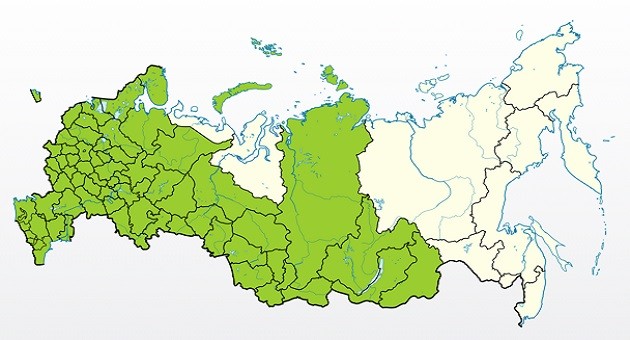
Growing regions
- Middle zone.
- South.
- Moscow region.
- Leningrad region.
- Ural.
- Siberia.
- North Caucasus.
- Trans-Urals.
Origin
This relatively new apple tree was developed by the Republican Scientific and Practical Development Unitary Enterprise "Institute of Fruit Growing" in the late twentieth century. The Pospekh variety is credited to renowned Belarusian breeders Galina Mikhailovna Marudo, Dmitry Vikentyevich Grakovich, Grigory Kondratyevich Kovalenko, and Viktor Mikhailovich Evdokimenko, working under the supervision of Zoya Arkadyevna Kozlovskaya.
The 72-41/94 hybrid was used as the parent variety, force-pollinated with a mixture of BM41497 and Antey pollen. The application for state registration was first submitted in 2006, but it was only in 2013 that it was included. Pospekh was tested at an experimental farm in the village of Samokhvalovichi in the Minsk region. It is zoned for the Central region, but can be grown throughout virtually the entire European part of Russia, some northern and southern regions, and even the Urals and Trans-Urals.
Content
Description of the Pospekh variety
 This late-autumn variety is quickly spreading among gardeners in our country and far beyond. It's a compact, small tree with a neat crown and dense foliage. It's winter-hardy enough to easily withstand harsh and variable climates. Moscow region and the Leningrad region.
The fruit on Pospekha ripens large and beautifully, and there are quite a few of them. The apples are tasty, aromatic, and juicy, have good nutritional value, and can be stored for quite a long time in the cellar or refrigerator. These trees are recommended for small garden plots and intensive commercial orchards.
Apples: What do they look like?
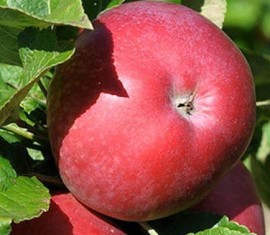
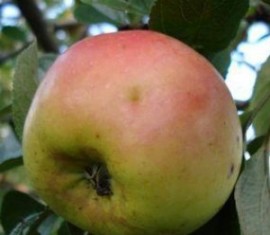
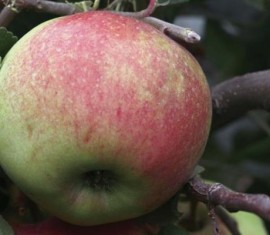
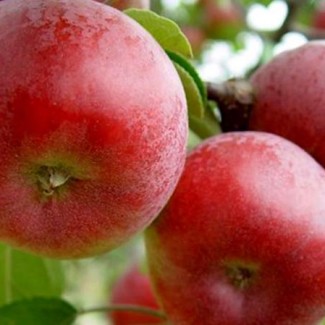
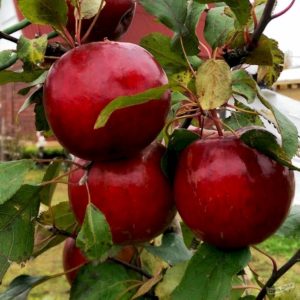 The fruits of this variety are generally large or even larger than large. They grow to approximately 180-250 grams, but with good care and favorable weather and climate conditions, they can reach 260-300 grams. The fruits are round, smooth, and can be spherical or slightly flattened or conical. They are most often uniform, symmetrical, with barely noticeable ribbing and no lateral seam.
The skin is smooth, shiny, dense, but not hard; it cracks easily when bitten. The base color is green or light green, but when fully ripe, it becomes almost completely covered with a deep, red, crimson, or deep red blush. This blush is dense, vaguely mottled, and may be slightly streaked. Subcutaneous spots are gray-green, small, few in number, and almost invisible. Experts recommend assessing the chemical composition based on the following known values per 100 grams of product:
- P-active substances (catechins) – 284 milligrams.
- Ascorbic acid (vitamin C) – 11.2 milligrams.
- Fructose (total sugars) – 8.28%.
- Pectins – 0.8%.
- Titratable acids – 0.69%.
- Dry matter – 11.6%.
The flesh is firm, crisp, easy to bite into, prickly, fine-grained, and very juicy. It has a greenish-cream or lemon-green hue and a pleasant, sweet-and-sour flavor with a winey undertone. Professional tasters rate Pospekh 4.1-4.2 points on a 5-point scale for taste and appearance.
Apple tree Pospekh: characteristics
Crown and root system
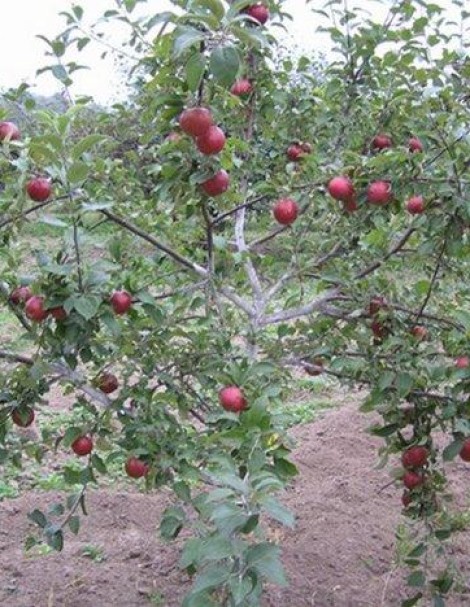
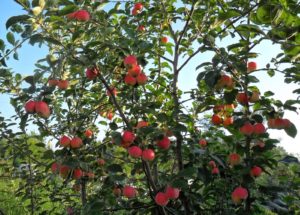 The tree is considered to be low-growing and slow-growing. Its maximum height is approximately 2.6-3.4 meters.The crown is usually moderately dense, rounded or spherical, and can be pyramidal, oval, or broadly oval, becoming more drooping and spreading with age. The branches are thin, long, and straight, directed upward, extending from the trunk at right angles, and covered with reddish-brown or brownish-gray bark.
The leaves are medium-sized, oval-elongated, sometimes lanceolate, leathery, dense, and glossy. They are long-pointed, and may be pubescent on the underside. The edges are serrate-crenate and serrated. The root system of the seedling is taproot, while that of the grafted hybrid is fibrous; this should be taken into account when choosing planting material. The root system is highly branched, but not deeply embedded.
Productivity and pollination
Pospekh's fertility rates are considered high.
Under favorable climate and weather conditions, a single mature tree typically yields 115-130 kilograms of aromatic fruit per year. With dense planting, professionals can harvest approximately 35-40 tons of fruit per hectare.
The variety is conditionally self-fertile. This means that some of the fruit, quite a significant amount, is produced by self-pollination, but to significantly increase the yield, it will be necessary to plant other apple varieties within 45-70 meters of the plant, with suitable flowering times. The most advanced apple growers spray the trees with a syrup made of sugar and honey and also use mobile apiaries in the spring.
Winter hardiness and disease resistance
The tree is quite resistant to low temperatures, easily surviving temperatures down to -22-25°C, without requiring any special shelter. Pospesh is also resistant to unexpected, recurring spring frosts, recovering quickly even if damaged, with minimal impact on fruiting. However, proper care and winter shelter are essential. The better the care, the more apples you'll ultimately produce, and the trees will continue to delight you with abundant harvests for a long time.
The variety has a strong immune response to scab, as it carries the Vf gene, which prevents the trees from being infected. Average resistance to powdery mildew, rust, pitted bitterness, and other fungal and bacterial diseases makes the apple trees a welcome addition to any garden. Pests also rarely damage the trees, but regular preventative measures are necessary to avoid putting your garden at risk.
Rootstocks and subspecies
This is a very young variety, and research into its properties hasn't been fully completed. Therefore, it doesn't yet have any subspecies, but it can be grown on a wide variety of rootstocks. This can impart some of the apple tree's characteristics and qualities. For example, dwarf trees grow even more compact and neat, while vegetative rootstocks make them frost-resistant.
Features of growing Pospeha
 Landing
 Landing
Basic conditions
- The variety thrives best in sunny, open areas or lightly shaded areas. In the shade, apple trees can grow weak, become susceptible to disease, and eventually die.
- Ideally, choose a site where the groundwater level is no closer than 1.4-1.6 meters to the surface. It's not common to plant Pospekh in a swamp, near a river, pond, lake, or even a shallow well.
- Trees tolerate any soil, but they thrive in loose, light, and moisture-rich loam. However, both black soil and sand can produce good crops. In the former case, you can dilute the overly rich soil with sand and clay, and in the latter, you can fertilize it.
- Planting holes for this variety should be prepared at least 4-5 weeks in advance, but those dug 5-8 months in advance are also suitable. Dig holes 55-70 centimeters deep and up to 70-80 centimeters in diameter, fill the bottom with soil and fertilizer, add drainage or a thin layer of soil on top, and then fill with water (25-45 liters). Leave them outdoors to dry thoroughly, otherwise the roots can burn.
- Leave approximately 2.8-3 meters of space between trees and the same amount between rows. This will allow the trees to grow freely and the owner to harvest the crop.
- Stake stakes or planks are inserted into the holes immediately to support the young seedlings. It's best to leave them in place until 3-4 years after planting. Placing them on the north side will provide additional protection during cold weather.
- To preserve the properties of the rootstock, root collar The apple tree should protrude 5-9 centimeters above the soil surface.
- Place the tree on a mound of soil or drainage material, carefully arrange the roots so they have ample space, cover with soil, lightly compact it with your hands or feet, being careful not to overdo it, and water with 35-50 liters of water. The surface can be mulched with any suitable material available to retain moisture.
Landing dates
This tree can be planted either in early spring, before the buds begin to open, or in late fall, after the leaves have completely fallen. Choose a dry, warm day, preferably in the afternoon or evening, especially if the weather is hot. In harsher regions, the first option is preferable, as it will give the apple trees time to adapt to the growing conditions before the onset of severe cold.
Tree care
 Tree care
Protection from frost and pests
To prevent damage to trees during the winter, it's customary to cover them properly. Trunks are wrapped in any fabric: burlap, agrofibre, roofing felt, roofing felt, or old nylon tights. In the harshest regions, the tree can be completely wrapped, right up to the very top, creating a makeshift shelter from available materials. The root zone is covered with soil and covered with straw, hay, or spruce branches.
Regular use helps a lot against insects whitewash Spray the trunks up to 1-1.2 meters high with a lime and water solution. This caustic solution will not only repel pesky pests but also give the garden a neat and tidy appearance. To combat rodents, you can coat apple tree trunks with grease, fuel oil, or lard.
Loosening the soil, watering: proper agricultural technology
Pospekh apple trees prefer loose, airy, oxygen-rich soil. However, digging too deep around the trunk is not recommended. Digging a maximum circle of 5-7 centimeters twice a year is sufficient. During these intervals, you can hoe the soil throughout the summer, removing weeds, shoots from other plants, and root suckers.
Watering Trees need regular watering, especially during hot and dry weather. Approximately every 8-12 days, apply 25-40 liters of water under each apple tree if there is no natural precipitation. The following day, loosen the root ball thoroughly, otherwise it may become too compact.
Pruning: simple crown shaping
Apple trees usually arrive from nurseries already trained in a sparse, tiered style. This is the most suitable form for Pospesh, ensuring maximum yield and abundant fruiting. After 2-4 years, formative pruning should begin, maintaining the chosen crown style.
Sanitary pruning is done annually, in the fall and spring. All broken, dry, diseased, and damaged shoots are removed. The cut areas should be immediately sealed with garden varnish, water-based paint, or at least marsh muck to reduce stress on the tree.
Reproduction
- Grafting by cuttings.
- Growing from seeds.
- Layers.
Diseases and pests
- Cytosporosis.
- Rust
- Powdery mildew.
- Fuzziness.
- Green aphid.
- Copperhead.
- Flower beetle.
- Codling moth.
- Scale insect.
Ripening and fruiting of Pospeha
The beginning of fruiting
 The beginning of fruiting
The variety is early-bearing, so you can harvest it quite quickly. By the third or fourth year, the tree is already producing beautiful buds and ripening fruit. While the first fruiting season is difficult to call a full harvest, it's certainly possible to taste the apples.
Flowering time
This variety has a mid- to late-blooming season, beginning around the end of May or the beginning of June. It blooms at the same time as many other varieties, so finding additional pollinators, which Pospekh doesn't particularly need, won't be a problem. In warm climates, it opens its large, beautiful buds earlier, and a little later in harsher conditions. Its flowers are large, fragrant, and snow-white or soft pink. The process lasts approximately 12-18 days.
Fruiting and growth
The tree grows quite slowly, gaining no more than 15-25 centimeters per year. However, its maximum height is not very high, so you won't have to wait long for the tree to reach its full height or begin producing full fruit. By the 8th or 9th year, Pospesh reaches its peak fruiting stage, where it will remain for 50 years or more with proper care.
Apples ripen in early to mid-October, when they reach technical maturity. Consumer maturity is generally considered to occur a little later, after the fruit has been stored for 45-80 days. However, their shelf life more than compensates for the wait, as apples can be stored in a cellar or refrigerator until mid- to late spring without losing their attractive appearance, flavor, or aroma.
Top dressing
- Peat.
- Compost.
- Manure.
- Chicken manure.
- Humus.
- Superphosphate.
- Ammonium nitrate.
- Wood ash.
What to do if it doesn't bloom or bear fruit
- Inspect for diseases or pests.
- Limit or activate watering.
- Fertilize.
- Transplant to another location.
Why do apples fall?
- Natural weather conditions (wind, rain, hurricane, hail).
- Pest damage.
- Various diseases.
Share your own experience with the Pospekh apple variety so that every gardener can learn more about it before planting and achieve maximum results.