Ural Souvenir apple tree: characteristics of the variety and care
| Color | Reds |
|---|---|
| Ripening season | Autumn |
| Size of apples | Average |
| Taste | Sweet and sour |
| Crown type | Average tree height |
| Shelf life | Average shelf life |
| Application | For recycling , Fresh |
| Winter hardiness | High winter hardiness |
| Fruiting age | Up to 5 years |
 History of origin and regions of growth
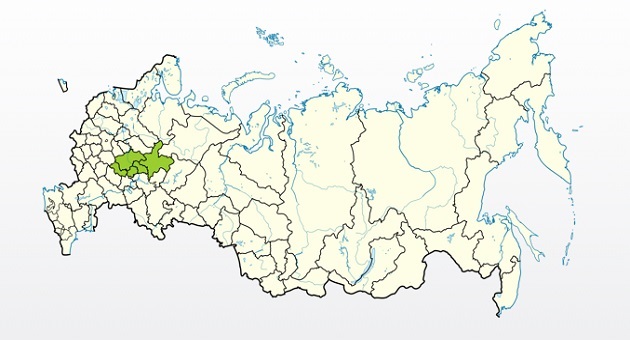
Growing regions
- Kirov region.
- Chuvashia.
- Republic of Mari El.
- Nizhny Novgorod region.
- Mordovia.
Origin
Development of the variety began in the 1950s at the Sverdlovsk Horticultural Breeding Station of the Russian Academy of Agricultural Sciences under the guidance of the distinguished Russian biologist and breeder Leonid Andrianovich Kotov. In 1957, the first seedling was obtained from a cross between the Uralskoye Bolshe and Udarnitsa varieties, but it was not included among the elite varieties until 15 years later.
In 1986, an application for official variety testing was submitted. It was completed in 1988, and at that time, the Ural Souvenir was included in the State Register of Breeding Achievements. It was zoned for the Volga-Vyatka region, but in reality, trees can be grown in much larger areas.
Content
Description of the Ural Souvenir variety
 This winter-hardy apple tree, easily withstanding various weather and climate conditions, has attracted the attention of gardeners across the country for many years, especially in relatively harsh regions. The Ural Souvenir is hardy, resistant to strong winds, undemanding of soil, frequent watering, and dry periods, requiring little special care.
The fruit, although medium-sized, is of high commercial quality. They are abundant, attractive, easy to transport, have a long shelf life, and are suitable for processing. Although the variety is susceptible to the most common apple disease, it is recommended for cultivation in both small private plots and commercial orchards.
Apples: What do they look like?
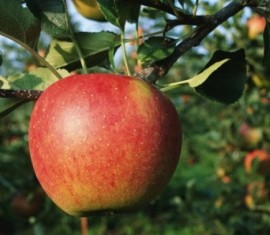
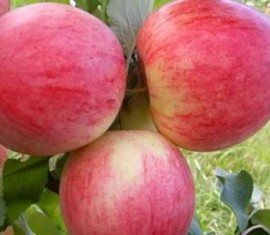
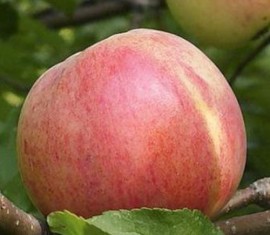
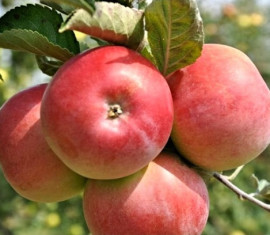
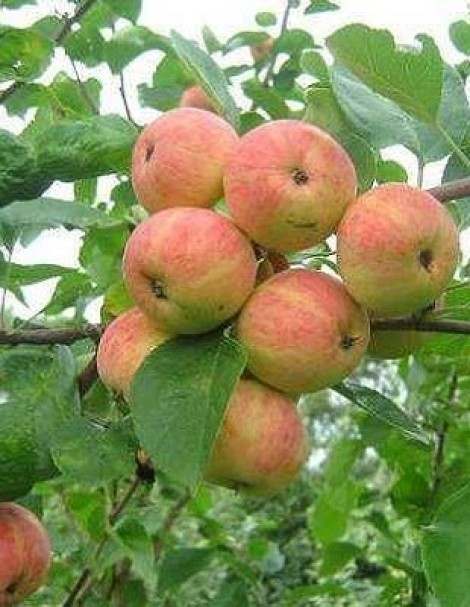
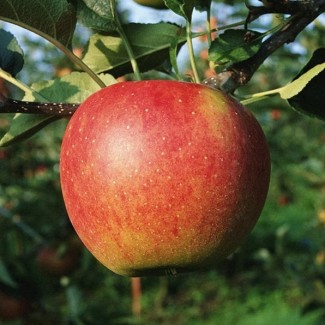
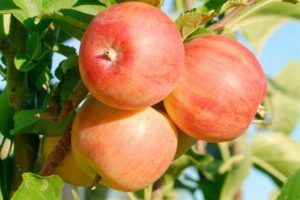 The fruits of the Ural Souvenir are medium to smaller than average. They barely reach a weight of 110-130 grams, and even then, in the best years with proper care. The fruits are round and regular in shape, often spherical, smooth, uniform, and symmetrical. The ribbing is barely noticeable near the calyx and completely smoothed out on the rest of the fruit; there is no lateral seam.
The skin is clean, smooth, glossy, and highly shiny. It is a distinct yellowish-green color, but as it ripens, it becomes almost golden, sometimes plump. The blush is bright red or carmine, sometimes slightly pinkish-crimson. It is mottled, striped, and diffuse, occupying at least 65-80% of the surface. Subcutaneous dots are small, light, and relatively clearly visible. The chemical composition is easiest to assess by learning the characteristic data:
- Sugar (fructose) – 12.4%.
- Ascorbic acid (vitamin C) – 23.9 grams.
- Pectins (fiber) – 17%.
- P-active substances (catechins) – 245.2 milligrams.
- Titratable acids – 0.87%.
The flesh is dense, fine-grained, crisp, refreshing, and can be slightly prickly with a pleasant texture. It has a beautiful greenish color that turns creamy yellow as it ripens, with a slight pink tint near the skin due to red veins. Its flavor is sweet and sour, with a strong sweetness. Experts rate it 4.5 out of 5 possible points.
Ural Souvenir apple tree: characteristics
Crown and root system
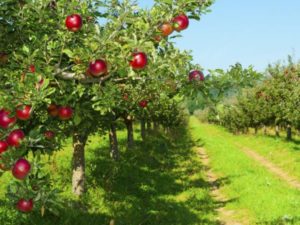 Trees are considered medium-sized, as they can grow no more than 2-2.8 meters, sometimes up to 3-3.5, but extremely rarelyThey have a beautiful, highly pyramidal crown of medium density, which over the years becomes rounded, spreading, and sometimes even drooping. The branches are geniculate, medium thick, and set at right angles to the trunk, with their tips pointing upward. They are covered with reddish-cherry or brown bark without pubescence. Fruiting occurs on shoots (twigs) and spurs.
The leaves are bright green or rich green, glossy, highly shiny, and pubescent on the back, leathery and dense. They are elongated lanceolate, oval-oval, with a serrate-crenate margin, serrated, and long-pointed. The root system is moderately deep and branched, mostly fibrous, and well adapted to water-seeking.
Productivity and pollination
High fertility is crucial for Ural Sverdlovsk apple trees. They are quite difficult to grow in harsh conditions, and gardeners want to ensure a corresponding return.
One mature Ural Souvenir tree can easily yield 65-90 kilograms of beautiful and fragrant fruit per season. In some cases, with truly high-quality care and suitable weather and climate conditions, yields can be slightly increased, by approximately 15-25% maximum..
This variety is completely self-fertile, which is another factor that appeals to gardeners. It doesn't require pollinators to produce a good harvest, but they certainly won't hurt. Experienced growers estimate that pollinators increase fertility by 5-10%.
Winter hardiness and disease resistance
This apple tree's low-temperature tolerance is quite impressive. It can easily withstand temperatures as low as -32°C to -35°C, even without special shelter or winter preparation. This is why many people manage to grow Souvenir even in Siberia and the Far East. However, providing shelter in such challenging conditions requires much more effort.
Officially, the tree's resistance to scab is considered average. However, in reality, it often attacks during years of severe epiphytotics and high humidity. Other diseases, such as bacterial, fungal, or parasitic ones, can also be detrimental to gardeners. Therefore, it is recommended to carry out preventative cleaning and spraying with specialized products on a timely and regular basis.
Rootstocks and subspecies
This apple variety is grown on different rootstocks, imparting slightly different properties and qualities. For example, dwarf varieties create a more compact and neat crown, while standard varieties provide greater winter hardiness. There are no columnar or creeping varieties of the Ural Souvenir, so it's worth paying attention to this when purchasing.
Peculiarities of growing the Ural souvenir
 Landing
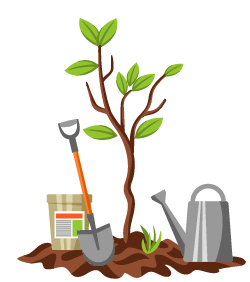 Landing
Basic conditions
- It's best to choose an open, sunny site for these apple trees. The crowns need good light and ventilation, otherwise the trees will quickly become susceptible to various diseases and likely won't survive long.
- Proximity to groundwater can be fatal for a garden, as tree roots begin to rot from excessive moisture. For the same reason, avoid planting apple trees in low-lying areas where water typically accumulates in the spring or after rain, or directly near rivers or lakes, ponds, wells, or swamps. If other sites are unavailable, consider creating artificial mounds for the apple trees, providing drainage, and creating a water baffle using a sheet of slate or a layer of roofing felt buried at a depth of 2-2.2 meters.
- Planting holes are prepared in advance, dug 60-75 centimeters deep and up to 1 meter in diameter. The bottom is lined with soil and fertilizer, followed by drainage of stones or nut shells, then filled with water and left for at least 3-4 weeks.
- You can leave about 3-3.5 meters between trees, but 4-5 meters between rows is better. This will prevent their crowns and roots from clashing as they mature.
- A special stake is dug into the hole on the north side of the seedling for tying. This stake can be made of not only wooden planks, but also plastic or even metal rods. This device will serve not only support for a tender young tree, but will also provide additional protection in the cold.
- For a Ural souvenir it is enough that root collar was 3-5 centimeters above the surface so that it would not take root higher, leveling out all the properties of the rootstock.
- Place the seedling in the hole so that the roots lie freely, without interfering with each other or bending. Lightly shake the tree by the trunk, then cover it with soil and compact it. Create a 7-9 cm high earthen bank around the perimeter of the trunk circle, add 25-30 liters of water, and then top off the soil. mulch.
Landing dates
For all apple trees, as well as other fruit crops that grow in relatively harsh climates and weather conditions, spring is the best time to plant them outdoors. Over the summer, they will have time to adapt, get used to the weather, and prepare for winter. In milder regions, Souvenir can be planted in the fall, after the leaves have fallen, but make sure there are at least 4-5 weeks before frost.
Tree care
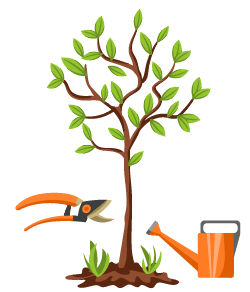 Tree care
Protection from frost and pests
A month before autumn, you should begin reducing watering if you do it regularly. By early September, any watering of the apple trees should be completely stopped. Otherwise, the trees simply won't have time to prepare for winter and will die. Tree trunks are wrapped for the winter with various materials: burlap, roofing felt, agrofibre, roofing felt, and old women's tights. Small trees can be covered using a tent-like method.
To prevent insects from breeding in the cracks of the bark, you need to whiten Trunks are pruned twice a year. This is usually done in the spring and fall, during or after pruning. Lubricating the trunk with lard, grease, or fuel oil is effective against rodents, who are eager to chew young bark and tender shoots.
Loosening the soil, watering: proper agricultural technology
Dig around the trunk twice a year as well. Carefully loosen the soil, not going deeper than 7-8 centimeters, otherwise you could damage the branches passing near the surface. Hoeing can be done more frequently, approximately 4-6 times per season, if needed. However, as trees mature, they no longer require such careful maintenance, so the root zone can be covered with sod or seeded with grass to provide natural aeration and suppress weed growth.
The tree has high drought resistance and is well adapted to independently search for water in the soil. However, 3-4 glaze Even for a mature tree, it will still be necessary, especially if the weather is extremely hot and dry. It is good to organize drip irrigation watering or sprinkling if possible, but not required.
Pruning: simple crown shaping
The natural pyramidal crown shape begs to be sparsely layered. This allows branches to be spaced widely apart at varying heights. However, other forms, such as broom-shaped, can also be created, which can complicate maintenance and harvesting. Pruning begins in the first year, as the tree grows rapidly and can become overly dense in just one year.
Remove all shoots that protrude into the crown or grow vertically upward in spring or fall. Remove dry, diseased, and damaged branches. They will simply suck sap, thicken the tree, and provide no benefit, so they are unnecessary.
Pollinator varieties
- Silver hoof.
- On-screen.
- Beauty of Sverdlovsk.
- Bugler.
- Ural pink.
- Solntsedar.
- Dreamer.
- The aroma of Uktus.
Reproduction
- Grafting.
- Rooting.
- Layers.
- Growing from seeds.
Diseases and pests
- Scab.
- Cytosporosis.
- Green aphid.
- Powdery mildew.
- Fruit rot.
- Bacterial burn.
- Scale insect.
- Codling moth.
- Leaf roller.
- Scale insect.
- Hawthorn.
Ripening and fruiting of the Ural souvenir
The beginning of fruiting
 The beginning of fruiting
This variety is very early-bearing, making it a favorite among gardeners. The first harvests can be reaped around the third or fourth year, and flowers often appear as early as the second or third. It's recommended to pluck the blossoms in the first few years, as they likely won't develop into ovaries, and the tree will drain excess sap. In the first few years, harvests typically range from 4 to 8 kilograms of apples. Not a huge amount, but enough to sample.
Flowering time
Like most apple trees, the Ural Souvenir blooms in May, but whether it blooms early, mid, or late depends on the situation. The timing is directly influenced by climate, soil, care, and the prevailing weather conditions in a given year. In harsher climates, flowering is usually delayed until later, while in warmer climates, it occurs much earlier. There's no way to determine this except through experimentation. The apple tree produces abundant, large, and intensely fragrant flowers, gathered in clusters of 4-6.
Fruiting and growth
By the sixth to eighth year, the tree reaches its full size, easily growing 45-60 centimeters per season. By this time, fruiting has also reached its peak, and continues to do so until the very end of the tree's active life (50-75 years). With proper care, regular fertilizing, watering, and proper winter wrapping, yields of over 100 kilograms can be achieved.
Apples begin to ripen around mid- to late-September. This can also depend on the weather. You can gauge this by the apples' taste and the formation of a thick, waxy, oily, bluish-gray coating on the surface. Apples store well, for about 3-4 months; some gardeners claim they can even store until mid-spring, with virtually no loss of marketability.
Top dressing
- Mineral complexes.
- Peat.
- Compost.
- Manure.
- Chicken manure.
- Humus.
- Humus.
What to do if it doesn't bloom or bear fruit
- Inspect for diseases or pests.
- Arrange regular watering.
- Fertilize.
- Transplant to a more suitable location.
Why do apples fall?
- Natural weather conditions (wind, rain, hurricane, hail).
- Pest damage.
- Various diseases.
Share your own experience with the Ural Souvenir apple variety so everyone can get to know it and get maximum yields with minimal effort.