Apple tree Marina: characteristics of the variety and care
| Color | Reds |
|---|---|
| Ripening season | Autumn |
| Size of apples | Small ones , Average |
| Taste | Sweet and sour |
| Crown type | Average tree height |
| Shelf life | Average shelf life |
| Application | For recycling , Fresh , Storage |
| Winter hardiness | High winter hardiness |
| Fruiting age | Up to 5 years |
 History of origin and regions of growth
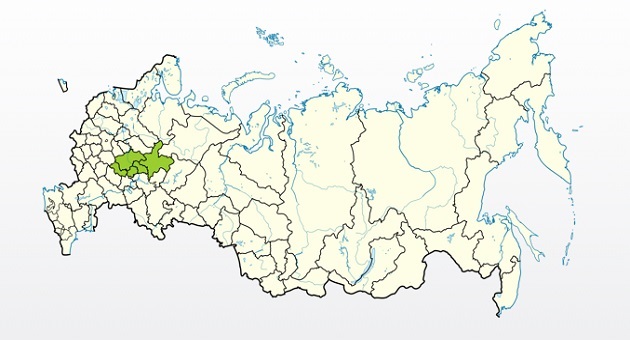
Growing regions
- Mari El.
- Nizhny Novgorod region.
- Chuvashia.
- Kirov region.
- Mordovia.
Origin
This variety was developed by Leonid Andrianovich Kotov, a distinguished Russian Ural plant breeder and biologist who has created numerous new varieties. Marina was created by crossing Sladkaya Nega with Samotsvet, combining the best qualities of both parents. Kotov worked at the All-Russian Research Institute of Genetics and Fruit Plant Breeding in Michurinsk, where most of the new developments were tested.
Marina was included in the State Register of Breeding Achievements around the late 1960s. It was zoned for the Volga-Vyatka region. Over the years, the variety was increasingly replaced by new, more advanced varieties. Currently, no data is available in the register.
Content
Description of the Marina variety
 This autumn-bearing apple tree has a rounded or rounded-oval crown. It is undemanding of soil conditions, tolerant of various growing conditions, and requires little fertilizing or watering. Marina is highly resistant to low temperatures, and its flowers are resistant even to severe recurrent frosts. Scab This tree is not at all afraid of it, and other apple diseases are also extremely rare.
The fruits are medium-sized, very attractive, aromatic, and delicious. Their only drawback is their rather loose texture, making them difficult to transport over long distances. Recommended for individual cultivation in the home garden or for industrial production of preserves, marmalades, juices, and compotes.
Apples: What do they look like?
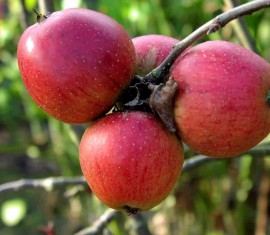
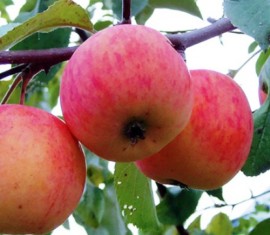
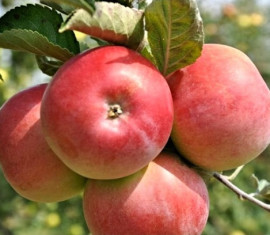
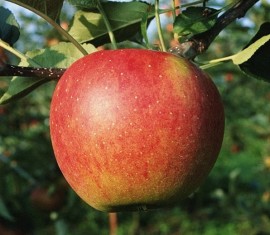
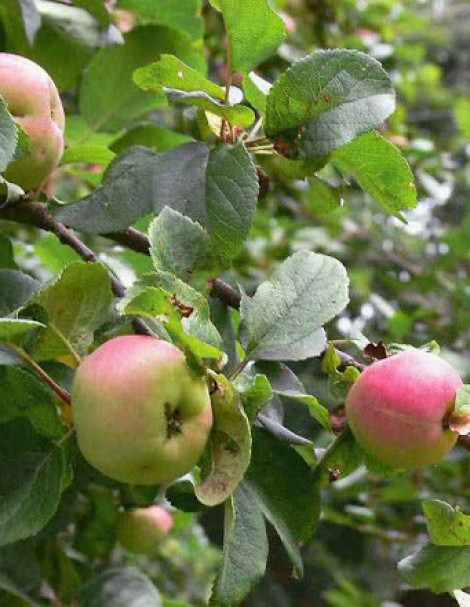
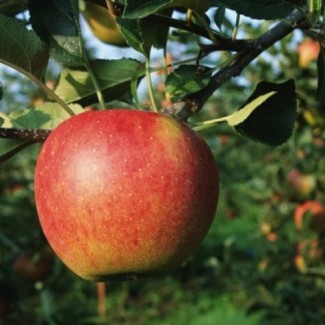
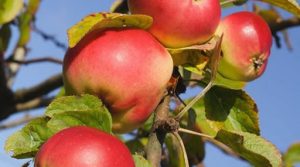 The fruits are medium or smaller than average in size. They can reach a maximum weight of 75-120 (140) grams, and even then, with good care and in favorable years. Their shape is rounded-truncated, slightly flattened, and can be slanted to one side or symmetrical. The apples are uniform in size, with a smooth surface and rounded ribs, and no lateral seam.
The fruit skin is medium thick but very fragile and prone to cracking. It is dry, smooth, shiny, and glossy, with a green or yellow-green base color when fully ripe. The blush is pinkish-crimson, blurred and mottled, and can have a carmine-red or ruby-colored speckled and striped pattern, occupying approximately 75-90% of the surface. Numerous, medium- to large-sized, light-colored subcutaneous dots are very visible. Professionals recommend reviewing the following data to assess the chemical composition:
- P-active substances (catechins) – 324 milligrams.
- Ascorbic acid (vitamin C) – 16.5 milligrams.
- Fructose (total sugars) – 13.2%.
- Pectins – 6.2%.
- Titratable acids – 1.32%.
The flesh is loose, crumbly, and coarse-grained, yet intensely aromatic and juicy. It is snow-white or slightly creamy in color and has a pleasant sweet and sour flavor with spicy notes. Professional tasters have given it a 4.1 and 4.7 points on a 5-point scale for taste and appearance, respectively.
Apple tree Marina: characteristics
Crown and root system
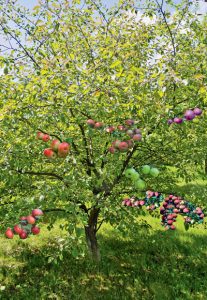 The trees are of medium height and grow at an average speed. Without formative pruning they can grow to a maximum height of 3.5-4.2 meters.Gardeners can limit this growth to 2.5-3 meters to make it easier to harvest apples and care for the trees. The crown has a distinct rounded outline, sometimes broadly oval, and becomes drooping, even weeping, in old age. The shoots are set at right angles, round in cross-section, thin, long, straight, and covered with gray-brown bark. The crown diameter does not exceed 2.8-3.1 meters.
The leaves are medium to large, curved downwards, flat, matte, and heavily pubescent on the underside. They are dark green or emerald in color, short-pointed, with serrate-crenate, heavily serrated, and wrinkled margins, and coarse nervation. The root system is medium-deep, branched, and fibrous, but on some rootstocks it can be taproot. It is well adapted to seeking moisture in the soil.
Productivity and pollination
Despite the fact that the apples that ripen on the tree are small, the overall yield of the tree, given its compact size, is quite high.
In a single season, the Marina apple tree can yield at least 100-130 kilograms of aromatic fruit. With proper, timely care, and in favorable years, these figures can almost double..
The variety is considered completely self-sterile, meaning that if there are no other apple trees within 100-150 meters of the tree that bloom at the same time, there will be no harvest. Therefore, experienced gardeners interplant the crops to ensure high-quality cross-pollination. They also use mobile apiaries, and treat the trees with sugar syrup to further attract bees.
Winter hardiness and disease resistance
The variety is quite frost-resistant, easily surviving temperatures down to -35-37°C. The tree is resistant to sudden changes in temperature, from severe frosts to thaws, and even high humidity. Even if severe frosts return in May, which is common in Eastern Siberia, the variety retains its blooms and may not affect fruit production.
Marina has a strong genetic immunity to scab, the most dangerous and widespread apple disease. She doesn't get it even during the most severe epidemics. Other diseases also rarely affect trees, whether bacterial, fungal, or parasitic. Preventive measures taken promptly and regularly will significantly reduce the risk of any problems.
Rootstocks and subspecies
There are no official records of any subspecies of the Marina apple tree, and there are no columnar or creeping varieties. However, the variety can be grown on dwarf, vegetative, or semi-dwarf rootstocks, imparting some unique qualities. For example, on dwarf rootstocks, the tree becomes even more compact, the fruit grows larger, and fruiting begins much earlier, as early as one to two years after planting.
Peculiarities of growing Marina
 Landing
 Landing
Basic conditions
- Marina prefers open spaces, well-lit for most of the day. In the shade, it can grow quite vigorously, but it won't begin flowering until 5-8 years. The fruits produced are even smaller, literally tiny, sour, and few in number.
- Good crown ventilation ensures that trees are not affected by fungi and other diseases. However, it's important to always ensure there are no drafts, as strong winds can destroy the tree.
- Apple trees should not grow in soil that is excessively acidic or saline. Otherwise, there are no special requirements; the trees grow well in sand, clay, podzolic, stony, or rich chernozem soils.
- It's common to prepare the holes the season beforehand, but if you're pressed for time, you can dig them 4-5 weeks before planting. Dig 60-70 centimeters deep and up to 1 meter in diameter, leaving 3-4 meters between holes within a row and 4-5 meters between rows. Add topsoil to the bottom, mixing it with fertilizer. Add a drainage layer (rocks, gravel, pebbles, nutshells, vermiculite), and add plenty of water (30-40 liters).
- Stakelines or stakes should be inserted (dug or driven) into the holes to support the seedlings. If placed on the north side, they will also provide additional frost protection in winter.
- The tree's root collar should remain above the soil surface under any circumstances to prevent the tree from rooting higher and compromising the rootstock's properties. Allowance should be made for soil subsidence and a height of 10-12 centimeters should be maintained between the surface and the root collar.
- The seedling is inspected, diseased or dry roots are immediately cut off and soaked in water for 5-8 hours.
- Place the tree in the hole, straighten the shoots so that they lie freely, sprinkle with soil, tamp it down with your hands, water with 35-50 liters of water, and mulch the surface.
- The seedling is tied to the support with twine in a figure-eight pattern. This will prevent wind damage to the bark and will also help it hold up better.
Landing dates
In the Urals, Marina apple trees are planted in the fall, from mid-September to the 10th of October. It's best to wait at least 21 days before the first frost, and it's important to keep an eye on weather forecasts. An even better time to plant is in the spring, around mid-May, when the soil has fully recovered from the winter cold.
Tree care
 Tree care
Protection from frost and pests
Trees, no matter how sturdy, still need to be covered. Trunks are wrapped with spunbond, agrofibre, burlap, or old tights, and mats of straw, hay, or spruce branches are placed around the roots. Trees can be wrapped with plastic film using the tent method while they are still small.
To prevent insects from damaging trunks and branches, fruits, leaves, and even wood, trees should be regularly whitewashed with lime twice a year. Preventative treatments with insecticides, fungicides, and other commercially available products are also helpful. The key is to avoid overdoing it and follow the instructions. Consult a professional when purchasing.
Loosening the soil, watering: proper agricultural technology
Dig around the trunks twice a year, in early spring and fall, removing unwanted shoots, weeds, and other debris. This should be done carefully and gently, as part of the rhizome extends shallowly beneath the surface. Hoeing can be done approximately 4-7 times during the growing season. After 6-10 years, it's acceptable to cover the root zone with sod or sow herbs and flowers there. This will eliminate unnecessary work and also ensure natural aeration of the soil.
Watering Marina needs regular watering when young, every 7-10 days if there is no natural precipitation. If it rains, the time until the next watering is counted from that point. The final watering is done mid-season. August Or a little closer to the end of the month, but that's not all. When the apple tree's leaves fall, add another 10-15 liters of water to the soil along the crown to "recharge" the soil. Fertilizer should be added no earlier than 2-3 years; until then, the tree will be satisfied with what it received when it was planted.
Pruning: simple crown shaping
Crown shaping should begin in the first year, but only if the trees arrived from the nursery as is. The most suitable form is a sparse, tiered style, with shoots spaced at different heights and widely separated. It's best to prune unwanted branches in the spring, in March or April, before the sap begins to flow in the trunks.
Pruning is also a necessary procedure, but it's best to postpone it until autumn, after the last leaf has fallen. Prune off all thickening shoots, those growing inward or vertically upward, and remove any dead, broken, or diseased ones.
Pollinator varieties
- Uralsk resident.
- Nastenka.
- Anise Sverdlovsk.
- Antonovka.
- Ural bulk.
- Korobovka.
- Lada.
- Flashlight.
- Bellefleur the Chinese.
Reproduction
- Layers.
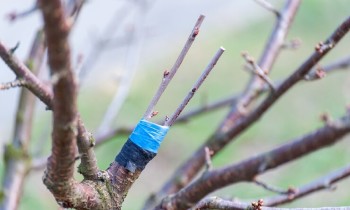
- Grafting cuttings.
- Clones.
- Growing from seeds.
Diseases and pests
- Rust.
- Powdery mildew.
- Spider mite.
- Green aphid.
- Weevil.
- Flower beetle.
- Fleas.
- Codling moth.
Ripening and fruiting of Marina
The beginning of fruiting
 The beginning of fruiting
The variety is considered to be early-fruiting, especially on dwarf or semi-dwarf rootstocks. Therefore, it can produce its first, albeit small, harvests as early as 2-3 years after planting. On tall rootstocks, the tree blooms for the first time in 4-5 years, which is when you'll be able to enjoy its fragrant fruits.
Flowering time
The flowers of this variety are distinctive: small but distinctly conical, with heavily pubescent pistils and delicate yet fleshy, snow-white petals. The unopened buds themselves have a distinct pinkish-lilac hue. They bloom in mid-May, sometimes a little earlier or later, depending on regional conditions, climate, and weather. Flowering lasts 14-18 days, during which time bees and wind must complete the task of pollination.
Fruiting and growth
Marina trees grow quickly, reaching at least 50-65 centimeters in height per year. However, this is only until fruiting begins; after that, the growth rate slows significantly. Even at 35-340 centimeters per year, the apple trees quickly reach their full height. Along with this growth, the yield increases. While yields are modest in the first few years, by the 10th to 12th year they reach their full potential, yielding over 200-210 centners per hectare at standard planting density.
Apples ripen late, around early October, usually all at once. There's no need to rush, as they can hang on the tree for quite a while, until the first frost, after which they fall to the ground. They must be picked with extreme care, as they are easily bruised, which can cause them to spoil immediately. However, if picked gently, they can be stored in a cellar, covered in sand or sawdust, for 150-170 days without losing their flavor or appearance.
Top dressing
- Compost.
- Peat.
- Manure.
- Humus.
- Superphosphate.
- Chicken manure.
- Wood ash.
- Ammonium nitrate.
What to do if it doesn't bloom or bear fruit
- Inspect for diseases or pests.
- Limit or increase watering.
- Feed or apply fertilizer.
- Transplant to a sunny place.
Why do apples fall?
- Natural weather conditions (wind, rain, hurricane, hail).
- Pest damage.
- Diseases.
Share your own experience with the Marina apple variety so that any gardener can learn about it before planting and achieve maximum results.