Orlovim apple tree: characteristics of the variety and care
| Color | Reds , Striped |
|---|---|
| Ripening season | Autumn |
| Size of apples | Average |
| Taste | Sweet and sour |
| Crown type | Average tree height |
| Shelf life | Average shelf life |
| Application | For recycling , Fresh |
| Winter hardiness | High winter hardiness |
| Fruiting age | Up to 5 years |
 History of origin and regions of growth
Growing regions
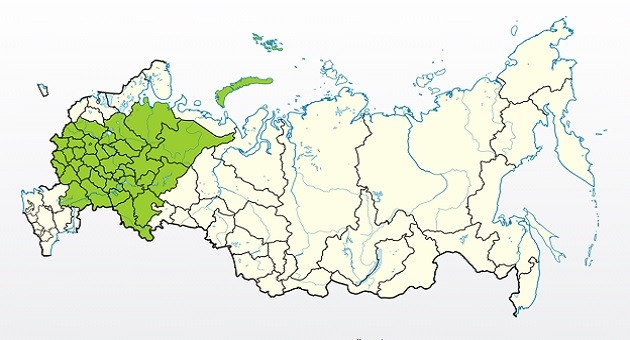
The variety is zoned for cultivation in the Central Russian region. However, it also grows successfully in the Central Black Earth Region, the Volga Region, and even the Far East and Siberia.
Origin
This is a relatively young apple variety, developed through the hard work of the All-Russian Research Institute of Fruit Crop Breeding. In 1977, a group of Russian breeders from Oryol crossed the SR0523 seedling with the Antonovka Obyknovennaya apple tree and finally produced a variety that carried the Vm gene, which provided exceptional scab resistance.
In 1989, the variety was accepted for testing in central Russia, where it performed very well. By 1999, it had already been entered into the state register and zoned.
Content
 Description of the Orlovim apple variety
 Description of the Orlovim apple variety
This table apple variety has recently begun to spread rapidly throughout almost the entire country. It possesses the necessary resistance to scab and various pests, a unique flavor, juiciness, and a distinctive, vibrant aroma. Therefore, Orlovim is a welcome guest in both large commercial orchards and smaller home gardens.
Apples: color, size, weight
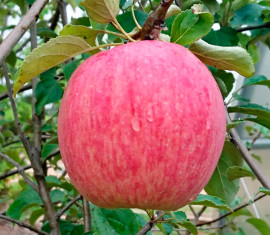
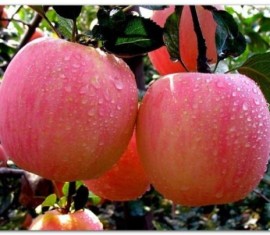
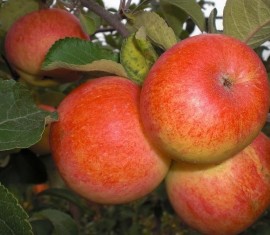
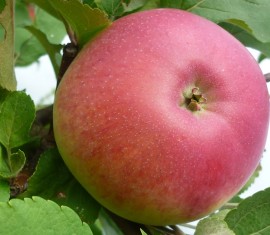
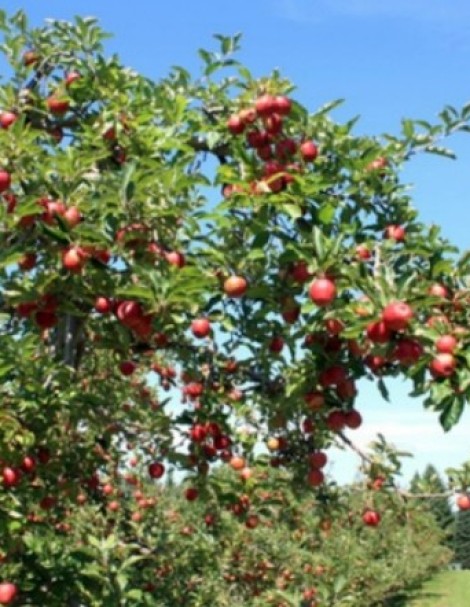
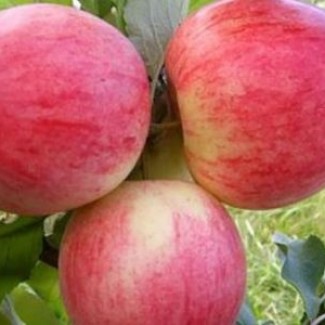
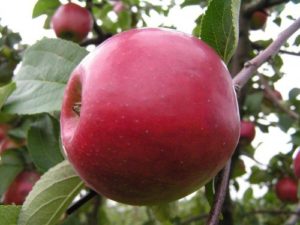 The Orlovim variety produces medium-sized fruits weighing 130 to 150 grams. They are slightly conical and flattened, sometimes slightly beveled on one side. Their surface may be slightly ribbed, but this is hardly noticeable on ripe apples. The skin is very smooth, without an oily or bluish-grey waxy coating. Initially, it has a green and yellow-greenish tint, but later develops a large, stippled, reddish-purple blush. The chemical composition of the fruits, based on 100 grams of product:
- P-active compounds – 186 milligrams.
- Ascorbic acid (vitamin C) – 10.3 milligrams.
- Total sugars (fructose) 10.2%.
- Titratable acids – 0.72%.
- Pectins (fiber) – 13.6-14%.
When fully ripe, the flesh takes on a light creamy hue. It's very juicy, with a sweet and sour flavor, and a powerful apple aroma. It's noted for its prickly, crisp texture, yet fine-grained and quite tender. The apples' appearance scores reach 4.6 out of 5, while their taste score is only 4.4.
Orlovim apple tree: characteristics
Crown and root system
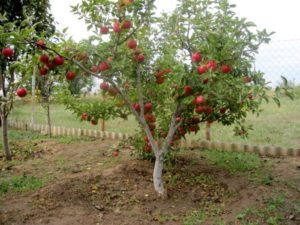 Orlovim trees are considered medium-sized, even when grown on vigorous rootstocks. This means they grow no more than five meters in height, and quite quickly. However, most experienced gardeners limit the growth to 3-4 meters for ease of care and harvesting. The crown shape of young trees can be pyramidal, but with age it becomes rounded and spherical. It is moderately dense and can grow up to 5-6 meters in diameter.
The apple tree's shoots are slender, geniculate, and characteristically green-brown to brown. When young, they are smooth and shiny, but over time they become cracked and brown. The leaves are medium-sized, elongated oval, with pointed edges and slightly spiral tips. The tree's roots are highly branched and, depending on the rootstock, may or may not have a central taproot.
Productivity and pollination
Orlovim bears fruit every year at any age, and quite abundantly.
The average yield from a mature tree is 90-110 kilograms of aromatic fruit. Young three-year-old trees can yield 1-3 kilograms of apples. Yields increase gradually, reaching their peak in the 9th to 10th year.
The variety is completely self-sterile. If there are no suitable trees within reach for cross-pollination, no fruit can be expected. To maximize the yield, it's best to plant Orlovim near an apiary and apple trees of early autumn or late summer varieties.
Winter hardiness and disease resistance
This variety's frost resistance is legendary among gardeners. It's believed that apple trees can easily withstand temperatures as low as -38-40°C. Only young trees are protected from freezing temperatures, and then only in the first few years after planting. However, good gardeners take care of their orchards at all times, and if all safety precautions are taken, the risk of tree death is minimized.
Orlovim exhibits high resistance to various apple diseases. However, it has developed a special immunity to the most dangerous of these—scab. However, this immunity is best demonstrated only on vigorous rootstocks. It does not exhibit similar resistance on dwarf or semi-dwarf rootstocks, much less on creeping varieties. Furthermore, resistance and immunity gradually decline over time, and in older trees (over 50 years old), it may disappear entirely.
Subspecies and rootstocks
| Subspecies | Description |
| Summer | This subtype is most common in northern regions, where rapid ripening is crucial in the short but hot summers. The fruits ripen as early as mid- to late August, and by early September they should be picked from the branches to prevent them from falling. |
| Autumn | The second option ripens a little longer, until about mid-September, and it is best to harvest it before the beginning of October. |
Rootstocks
The Orlovim variety is most often grown on a dwarf rootstock. Its growth habit depends on the specific variety. For example, on Dusen, it will grow semi-dwarf, while on Paradise, it will grow completely dwarf.
These varieties have their advantages: fruiting begins much earlier, they are resistant to high groundwater, and they require less space. However, the most serious work has been done on creeping rootstocks. These trees can be grown in the northernmost regions. Columnar Orlovims do not exist.
Features of growing Orlovim
Landing
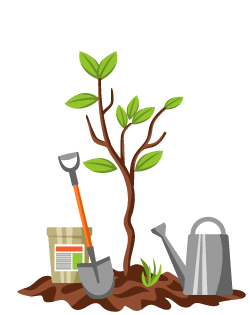 Landing
Key Features
- The planting location should be very sunny, not shaded. Remember that apple trees prefer open space and good ventilation, but avoid drafts.
- It is optimal to choose loamy and sandy loam soils for planting, as seedlings feel best in them.
- An apple tree on a vigorous rootstock is very sensitive to high groundwater levels, and its rootstock can rot. Therefore, for such varieties, you'll need to choose a higher location or create a special drainage or embankment. Orlovim is also not planted near bodies of water. An exception might be a dwarf variety, which is not sensitive to moisture.
- Planting holes should be prepared in advance: 3-5 weeks in advance for fall planting, and from autumn onwards for spring planting. They should be 50-70 centimeters deep and up to 1 meter wide. Place a portion of soil mixed with humus, ash, nitrophoska, and urea at the bottom of each hole, then add 20 liters of water.
- Between rows of trees you need to leave up to 4-6 meters, and between the trees themselves in a row 3-4 meters will be quite enough.
- If the rhizomes have dried out, the apple trees are placed in a bucket of water 6-8 hours before planting, after cutting off the dry roots.
- Stakes for tying are immediately driven into the holes, preferably on the north side.
- The root collar should protrude above the soil surface by at least 6-10 centimeters.
- After planting, lightly compact the soil around the tree without tamping it down, water it with 20-30 liters of water, and mulch with chopped grass, humus, or compost.
You can purchase Orlov seedlings almost anywhere in the country, but you may come across other varieties that are often passed off as Orlov. It's best to contact nurseries in Central Russia, for example, in the Moscow region.
Landing dates
The tree takes root well when planted in both spring and fall. In spring, it's best to do this in April, before the sap starts to flow, but after soil It will warm up well, and the risk of frost on the ground will pass.
In the fall, it's important to remember that the tree needs at least three weeks to root, and it's best to give it four weeks to spare. Therefore, the maximum planting time is mid- to late October, depending on the region.
Protection from frost and rodents
Seedlings require protection from low temperatures only in northern regions, and also in the first few years after planting. Mature trees easily tolerate even fairly severe frosts without losing their fruit. Young shoots can be surrounded with spruce branches or straw bundles, wrapped in roofing felt, or nylon tights.
To discourage rodents from eating the bark of young trees, you can coat the trunks with lard or grease in the fall. Regular treatments with specialized chemicals or whitewashing the trunks and lower skeletal branches with lime will also help repel insects.
Tree care
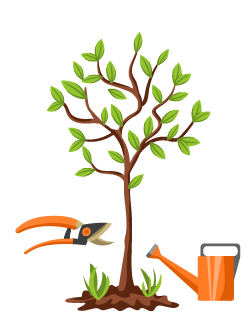 Tree care
Loosening the soil, watering: proper agricultural technology
Loosening and mulching the soil regularly should be done at least twice a season, in the fall and spring. Weeds, root suckers, and shoots from other trees should be constantly removed from the area around the tree trunk. All of these will interfere with the apple tree's normal growth.
Watering is usually done no more than 3-5 times per season. This is sufficient even in the driest years. Watering should be generous, using at least 4-6 buckets of water for a mature tree. If natural precipitation is regular, watering may not be necessary at all.
Pruning: simple crown shaping
What will it become? crown The Orlovim's appearance in your garden depends directly on the pruning method you use. It can be formed into a palmette, spindle, tiered, or sparsely tiered. Any method is suitable for this variety. When pruning, leave branches that extend from the trunk at a right angle, and prune those that grow at a sharp angle. These branches may split off, which will shock the tree, and the yield will suffer.
Before undertaking any type of pruning, allow the tree to grow freely for a year. Pruning should only begin in the second year of life.
Sanitary pruning should be performed annually, removing all dead, damaged, or diseased branches. The central trunk should be left untouched during any pruning, and the main skeletal branches should be trimmed back by only a few centimeters. Ideally, all pruning should be done in the spring, before the sap begins to flow.
Experts recommend using artificial pollination, which produces quite decent results.
Pollinator varieties
- Scarlet anise.
- Saffron pepin.
- Antonovka.
- Welsey.
Reproduction
- Growing from seeds (rarely).
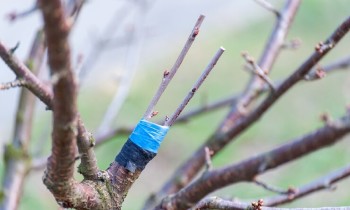
- Grafting by cuttings or buds.
- Layers (clones).
Diseases and pests
- Cytosporosis.
- Fruit rot.
- Powdery mildew.
- Green aphid.
- Codling moth.
Ripening and fruiting of apple trees in Orlovim
The beginning of fruiting
 The beginning of fruiting
In the first few years, the apple tree doesn't produce large harvests, but by the third year, you can harvest up to 5 kilograms of aromatic fruit. However, you'll have to wait until you get a full harvest.
Flowering time
Orlovim apple trees bloom earlier than most other varieties, so take this into account when selecting pollinators. Flowering begins as early as early or mid-May. The tree's flowers are large, white with a slight pink tint. The aroma of this apple tree extends far beyond the tree itself, making it a popular honey bee lover.
Fruiting and growth
The fruits don't ripen all at once, but gradually. Therefore, harvesting can be organized in two main stages:
- The second half of August marks the so-called harvest maturity. The apples themselves then acquire only a light blush, remaining greenish. These apples are well suited for long-distance transport and can be stored in a cellar under suitable conditions for at least 4-6 months.
- In early to mid-September, apples reach consumer maturity. The skin becomes 60-80% blushed, turning more yellow than green. Apples picked during this period no longer store well, so they are best processed into jams, preserves, compotes, or juice.
These apple trees grow very rapidly, reaching 20-50 centimeters in a year. By the 8th to 10th year, they begin to produce full harvests of 100 kilograms or more of aromatic fruit annually. The average lifespan of the variety is 60-70 years, but this is an estimate; precise data is not yet available, and research is ongoing.
Top dressing
- Humus.
- Manure.
- Urea.
- Mineral fertilizers.
What to do if it doesn't bloom or bear fruit
- Stop watering.
- Check for pests or diseases.
- Perform pruning.
Why do apples fall?
- Excess moisture.
- Excessive thickening of the crown.
- Natural causes (wind, rain, hail.
- Pests.
- Diseases.
Share your experiences with Orlovim in the comments below to share your experiences with other gardeners.