Apple tree Utes: characteristics of the variety and care
| Color | Reds |
|---|---|
| Ripening season | Autumn |
| Size of apples | Average |
| Taste | Sweet and sour |
| Crown type | Average tree height |
| Shelf life | High shelf life |
| Application | Universal variety |
| Winter hardiness | High winter hardiness |
| Fruiting age | From 5 years old |
 History of origin and regions of growth
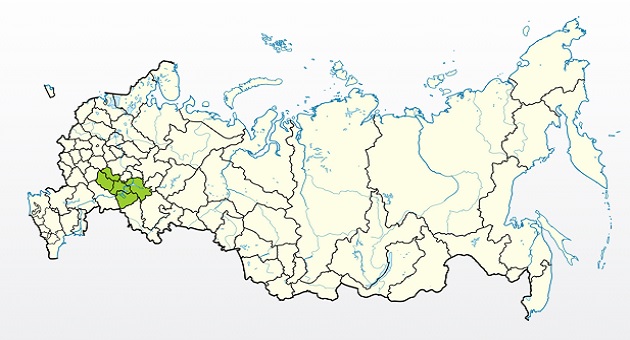
Growing regions
- Penza region.
- Tatarstan.
- Mordovia.
- Ulyanovsk region.
- Samara region.
Origin
This apple tree was developed by the Samara Horticultural Station, now known as the Samara Zonal Horticultural Station "Zhigulevskie Sady" of the Department of Agriculture and Food. It was developed back in the 1960s by crossing and hybridizing the Zhigulevskoye and Zheltoe Ribbed varieties. The authors were Anatoly Aleksandrovich Kuznetsov, and Sergei Pavlovich and Taisiya Mikhailovna Kedrin.
The first seedling was obtained in 1977 and immediately sent for field trials. The first application for approval and inclusion in the State Register of Breeding Achievements was submitted only in 1991, and the variety was only added to the list in 2005. Utes is zoned for the Middle Volga region, but it can grow in wider areas.
Description of the Utes variety
 Gardeners immediately took notice of this variety's tall, large apple trees due to their many positive qualities. The trees exhibit enviable resistance to winter cold, are not particularly sensitive to high humidity and sudden temperature fluctuations, and exhibit good environmental sustainability. They can grow even in polluted large cities, require no special care, and thrive in any soil conditions with minimal supervision.
The fruit ripens beautifully on the tree, large and of high commercial and consumer quality. They are delicious, transport well over long distances, and can be stored in a cellar practically until the next harvest. Utes is recommended for individual cultivation in summer cottages and for intensive industrial gardens.
Apples: What do they look like?
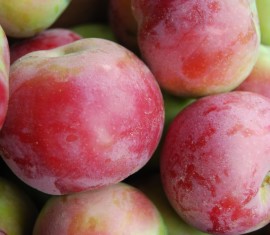
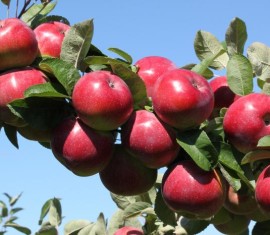
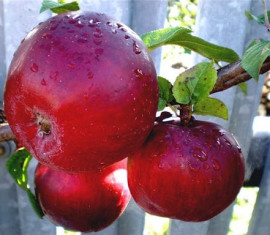
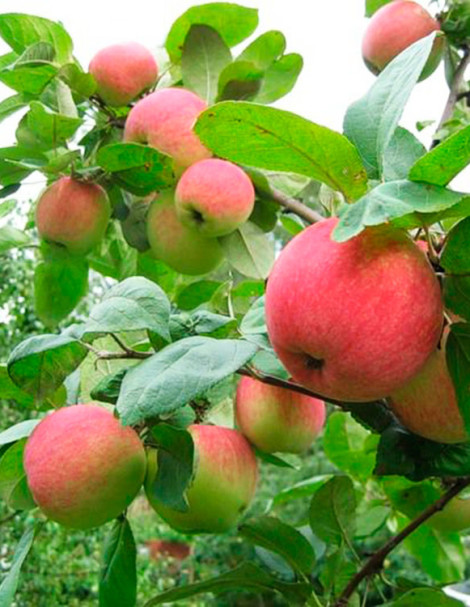
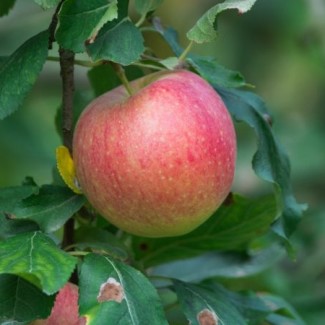
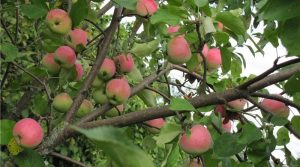 The fruits are medium to often above average in size, and can be large with proper, timely care, regular feeding, and watering. They average 120-140 grams in weight, but can reach 250-290 grams. They are rounded with subtle ribbing, symmetrical, smooth or slightly bumpy, and may be flattened. They have no lateral seam.
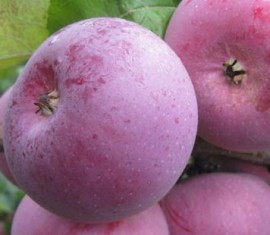
The skin is dense, elastic, and strong, capable of protecting the flesh from significant mechanical damage. The base color is grassy green, becoming lemon-colored or even slightly golden over time. The blush is streaked, mottled, carmine, or bright red, and may have a brownish undertone of diffuse spots. Subcutaneous spots are medium-sized and numerous; they are gray-white or greenish in color and are not very visible against the variegated and decorative surface of a ripe apple. The chemical composition should be assessed using the following parameters:
- P-active substances (catechins) – 386 milligrams.
- Ascorbic acid (vitamin C) – 12.8 milligrams.
- Fructose (total sugars) – 13.9%.
- Pectins – 12.2%.
- Titratable acids – 0.47%.
The Utes variety has medium-density flesh that's tender, unusually juicy, fine-grained, and has a pleasant consistency and texture. It breaks easily when bitten into and has a strong, spicy, lemonade-like aroma. The flavor is considered dessert-like; it's sweeter, but still retains a distinctive tartness. On a professional 5-point tasting scale, the variety scores 4.3 points for both flavor and appearance.
Apple tree Utes: characteristics
Crown and root system
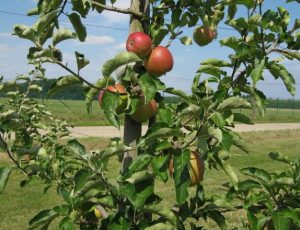 Trees are vigorous or medium-sized, depending on the rootstock and growing conditions. They can stretch up to 4-5 meters, and sometimes even reach 6-9At an early age, the crown is pyramidal, later becoming oval or even broadly oval. The shoots are thick, straight, round in cross-section, and can extend from the trunk at either an acute or a right angle. They are covered with brown or fulvous-brown bark without pubescence. Fruiting is mixed (rings, fruiting shoots, and spears).
The leaves are medium to large, oval or oval-elongated, oblong, and short-pointed, with tips that curl like propellers. The edges of the blade are serrated, jagged, and may be slightly wavy and curved downward. They are green or bright green, not shiny, but matte, and may have a slight tomentose pubescence on the underside. The root system is medium-deep, fibrous on most rootstocks, and well adapted to seeking moisture in the soil.
Productivity and pollination
The cliff is called high-yielding, although many apple trees can easily surpass it.
One adult tree can produce approximately 60-70 kilograms of fruit per year. Even in the most favorable years, with the highest quality and timely care, feeding and fertilizers, the fertility of standard trees hardly exceeds one hundred kilograms..
This variety is considered self-fertile, so to produce apples, you don't need to have other varieties nearby that are suitable for their budding period. However, experienced professionals note that fertility rates increase significantly if the trees are interspersed. You can set up a mobile apiary in the garden during flowering, and also spray the trees with sugar or honey diluted with water.
Winter hardiness and disease resistance
For apple trees in the Middle Volga region, and indeed the Volga region as a whole, this variety exhibits remarkable resistance to low temperatures and sudden temperature fluctuations. They are quite tolerant of prolonged winter cold spells, when temperatures drop below -25-30°C, even for extended periods. They are also not affected by sudden cold snaps after thaws, especially if winter preparation is completed promptly and correctly.
The tree's resistance to various fungal, bacterial, and parasitic diseases is above average. It only becomes infected in the most unfavorable years, when all the surrounding trees suffer and even die. If preventative measures are taken promptly, the risks are significantly reduced, and you can rest assured that your tree will be safe.
Rootstocks and subspecies
In fact, the Utes apple tree is currently undergoing official variety testing, which has been ongoing for over three decades. Therefore, it's too early to talk about subspecies. However, it is already being grown on a wide variety of rootstocks, imparting some of its unique characteristics to the trees. For example, on dwarf rootstocks, the height will be noticeably reduced and the fruit larger, while cold resistance will be significantly reduced.
Features of growing Utes
 Landing
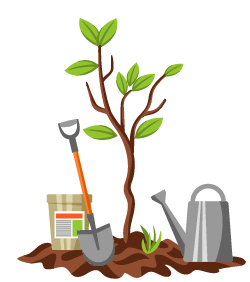 Landing
Basic conditions
- Standard trees should be planted only in open, well-ventilated areas. They should be sunny for most of the day, and their crowns should be well-ventilated. In the shade, trees grow weak and may die immediately, or they may linger and struggle for a long time without producing buds.
- Stagnant air increases the risk of fungal attack significantly. However, drafts should be avoided under any circumstances; young trees simply won't withstand the stress.
- Gardeners begin preparing holes for apple trees 5-8 months before planting. They dig standard-sized holes, add fertilizer to the bottom, add drainage (rocks, bricks, or vermiculite), and fill with as much clean water as they want. The holes are left uncovered and should be left to dry outdoors.
- Leave enough space between trees to allow for the crown and rhizome to grow freely. For smaller trees, 2-3 meters is sufficient, while vegetative rootstocks require 4-6 meters.
- The grafting site (root collar) of the tree, if the rootstock's properties are to be preserved, must always remain above the soil surface. If the soil is deepened, the roots may emerge higher, and the rootstock's properties will be lost.
- Rods, stakes, or stakes are immediately dug or driven into the holes to support the young seedlings. If left unattended, they may fall in strong winds. Furthermore, the support will provide additional frost protection if installed on the north side, where the strongest and coldest winds blow.
- Trees are inspected before planting, all dried or broken shoots are cut off, and the rhizomes are immersed in warm water for 6-8 hours.
- Place the seedling directly on the drainage hole, allowing the roots to grow freely. Cover with soil, lightly tamp it down with your feet, water with 20-35 liters of water, and mulch the surface. It's a good idea to ensure that no air pockets or voids form in the hole around the rhizome, which could lead to future rot.
Landing dates
The rock tree is quite resilient to any conditions, so in a moderate climate with warm and pleasant weather, planting it in the fall or spring makes little difference. However, if winters are harsh, with frosts arriving early and unpredictably, spring is a better choice. This way, the trees won't be damaged by early frosts, and they're less susceptible to subsequent frosts. Moreover, you can choose a time for planting when the risk of frost has completely passed and the soil has warmed up.
Tree care
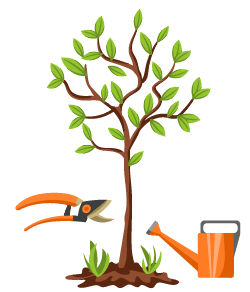 Tree care
Protection from frost and pests
Standard protection methods work perfectly with Utes. Watering should be stopped in September to allow the trunks to mature and stop the sap from flowing. Wrap the tree in burlap, roofing felt, tar paper, or other suitable materials. During the most severe frosts, you can pile a 15-20 cm layer of soil onto the rhizome and add spruce branches and straw.
Cleaning the bark with a stiff brush in spring and fall, followed by whitewashing with lime, helps repel insects. The solution should be fairly concentrated, about the consistency of thin sour cream. Rendered lard, fuel oil, or old vegetable oil applied to the trunk will also help repel rodents; the pests can't stand the smell.
Loosening the soil, watering: proper agricultural technology
Apple tree trunks are typically dug up twice a year, but Utes will only require this care in the early years of its life. Between diggings, you can also hoe the soil, removing weeds and root suckers that will hinder the tree's normal development. After a couple of years, you can sow grass or flowers around the apple trees and lay down sod.
Apple trees need to be watered regularly to ensure high-quality and abundant fruit production. Young apple trees require watering 2-3 times a month, while mature trees can be watered 6-9 times per season. During extremely dry weather, you can reduce watering to once every 10-12 days. It's a good idea to set up a drip irrigation system or sprinkler system.
Pruning: simple crown shaping
The best form for this type of tree is considered to be a sparse or sparsely layered one. This will allow the crown to receive adequate light and ventilation. After the initial training, shoots will need to be pruned annually by about 20 percent to prevent the tree from becoming overgrown. Maintaining natural branching is also important; we have a separate guide on this topic on our website.
In the fall, and sometimes even in the spring if absolutely necessary, the trunks are inspected for broken, dry, or unhealthy-looking shoots. These should be cut off immediately to prevent them from drawing sap from the tree, which could then use it to produce fruit. Cuts should never be left unsealed with garden pitch or other suitable sealants.
Pollinator varieties
- Zhigulevskoe.
- Antonovka.
- Ribbed yellow.
- Gala.
- Korobovka.
- Ligol.
- Korea.
- Braeburn.
Reproduction
- Grafting cuttings.
- Clones.
- Growing from seeds.
- Kidney grafting.
- Layers.
Diseases and pests
- Scab.
- Monililosis.
- Powdery mildew.
- Spotting.
- Rust.
- Cytosporosis.
- Copperhead.
- Flower beetle.
- Weevil.
- Codling moth.
- Hawthorn.
Ripening and fruiting of the Cliff
The beginning of fruiting
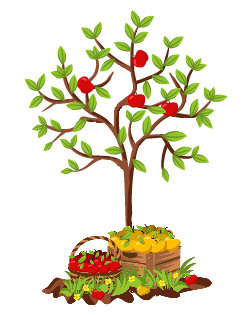 The beginning of fruiting
The variety can't be called early-bearing, as the first flowers appear only in the fifth or sixth year. Even then, the apples likely won't ripen, as the first barren flower rarely produces ovaries. Fruiting begins in the seventh or eighth year, and it's immediate and abundant. Even then, you can harvest approximately 7-10 kilograms of fragrant, sweet fruit.
Flowering time
The tree blooms early, like its parent variety, Zhigulevskoye. Therefore, both are excellent pollinators for each other. It blooms profusely and uniformly, opening all its pink buds at once. The flowers themselves are white-pink or pure white, gathered in small, fragrant clusters, and cover the branches quite densely. In some cases, blooming must be stunted by 15-35% to maximize the size of the resulting fruit.
Fruiting and growth
The tree grows quickly, but not exceptionally. It gradually builds up its foliage, also increasing its fertility. It will take 10-12 years to reach a full harvest, but this is not a problem, given the tree's long, active lifespan of over 70-80 years. Utes does not exhibit any periodicity in fruiting, regularly producing its maximum number of fruits. If yield declines, diseases and pests should be considered as the cause.
Apples begin to ripen as early as the beginning of autumn. Harvestable ripeness occurs around the 15th or 20th. This can vary slightly, up to a week, either way. It's best to store the fruit in special refrigerators, but you can also use a regular cellar, covered with sawdust or sand. The shelf life is 6-8 months, but sometimes the fruit can be stored until the next harvest without losing its quality.
Top dressing
- Nitrogen fertilizers.
- Superphosphate.
- Ammonium nitrate.
- Manure.
- Compost.
- Humus.
- Chicken, pigeon droppings.
- Urea.
- Minerals.
What to do if it doesn't bloom or bear fruit
- Believe in parasites.
- Increase watering.
- Feed.
- Transplant.
Why do apples fall?
- Wind, hail, hurricane, frost, snow.
- Parasitic lesions.
Share your own experience with the Utes apple variety so that any gardener can learn about it before planting and achieve maximum results.