Apple tree Alesya: characteristics of the variety and care
| Color | Reds |
|---|---|
| Ripening season | Autumn |
| Size of apples | Average |
| Taste | Sweet and sour |
| Crown type | Average tree height |
| Shelf life | High shelf life |
| Application | Universal variety |
| Winter hardiness | High winter hardiness |
| Fruiting age | Up to 5 years |
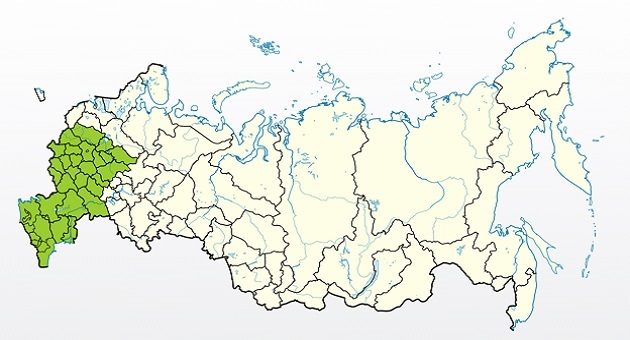 History of origin and regions of growth
Growing regions
- Middle zone.
- North-West region.
- North Caucasus.
Origin
Alesya is a young Belarusian variety, having been developed at the Belarusian Research Institute of Fruit Growing in the late 1980s. In 1989, it was distributed to farms in the Mogilev, Minsk, Brest, Grodno, and several other regions, where it performed very well. The parent varieties were Belarusian Malinovoye and Bananovoye.
Alesya was added to the State Register of Belarus only 20 years later. The variety was also tested in Russia for a long time, according to the Scientific and Practical Development Committee of the Unitary Enterprise "Institute of Fruit Growing," and it was finally added to our country's register in 2002. However, it was only zoned for two regions—the Northwest and Central. In reality, the apple tree can grow almost anywhere, even as far as the Urals.
Description of the apple tree variety Alesya
 The primary goal of cultivating this variety was to impart exceptional scab resistance and winter hardiness to the apple trees, without sacrificing consumer and commercial qualities. As a result, Alesya is rarely affected by fungal infections, easily tolerates severe frosts, produces fruit reliably throughout its life, and the apples do not fall off even when overripe. Given the tree's exceptional compactness, all these qualities make it suitable for both small garden plots and commercial intensive orchards.
Apples: the appearance of the fruit
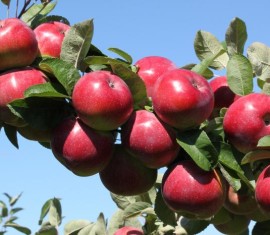
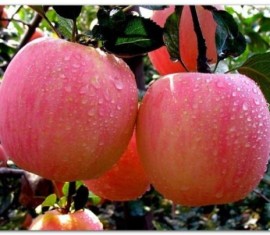
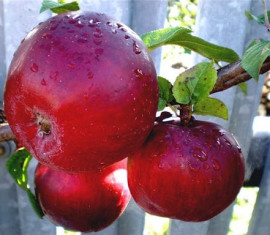
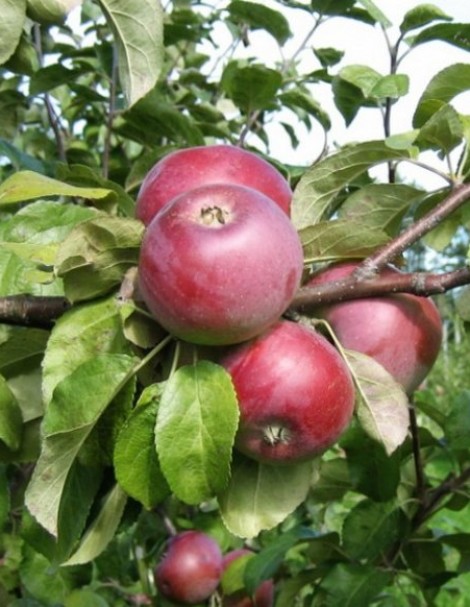
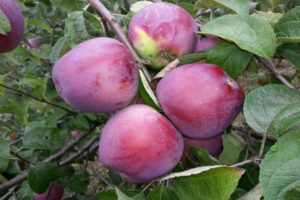 The fruits are generally uniform, medium-sized or slightly larger than average, weighing approximately 130-180 grams. Their shape is flattened and round, sometimes slightly flattened or, conversely, elongated, resembling a cylinder.
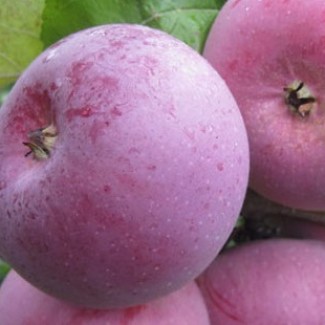
The skin is very dense yet thin, delicate, elastic, yet strong. It is smooth and shiny, with a light oily coating on top, which sometimes makes the apples appear greasy. It is primarily green, but becomes more yellow-green as it ripens. However, this color is virtually invisible, as it is covered by a diffuse, dense blush of red or even dark burgundy, which covers at least 75-90% of the surface. The chemical composition is best characterized by the following parameters:
- P-active substances (catechins) – 268 milligrams.
- Ascorbic acid (vitamin C) – 8.4 milligrams.
- Total sugars (fructose) – 11.9%.
- Pectins (fiber) – 12.1%.
- Titratable acids – 0.4%.
The fruit's flesh is white, sometimes slightly creamy. It is dense, fine-grained, and juicy, with a medium-strength, distinctive aroma. The flavor is rated as dessert-like, sweet and sour, harmonious, and balanced. The fruit's tasting score is 4.3 out of 5.
Apple tree Alesya: characteristics
Crown and root system
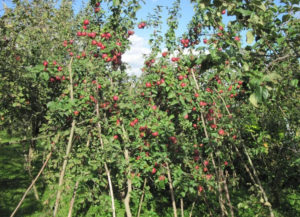 This is a medium-sized tree, which is most often classified as a natural semi-dwarf. The maximum height of a tree without formative pruning is 3-3.5 meters. The crown is compact, naturally assuming a round or oval shape, composed of sparsely branched shoots and not prone to crowding. Branches extend from the trunk at or near right angles, creating strong connections with the trunk and preventing the wood from splitting or breaking off, even with fairly heavy harvests. The shoots are generally straight, long, and thick, directed upward, covered in smooth, light-brown bark that turns brown with age.
The leaves are small to medium-sized, oval, slightly elongated toward the pointed tip, green or deep green. They are dense, leathery, covered with a network of wrinkles, and have a matte finish. The leaf margins are finely serrated and slightly wavy. The root system depends entirely on the rootstock, but is most often highly branched, superficial, and may or may not have a central taproot.
Productivity and pollination
Alesya is considered quite productive, but final data has not yet been entered into the State Register. Opinions on yield figures vary. Some gardeners say a mature 10-year-old apple tree can easily yield 70-90 kilograms of delicious fruit, while others say only 40-60. This largely depends on care, timely watering, and fertilizing.
This variety is considered conditionally self-fertile, meaning it will produce fruit even without pollinators. This means that 25-40% of the ovaries can develop into fruit, so it's recommended to plant Alesya interspersed with varieties that bloom at a similar time. It's a good idea to plant the garden in close proximity to the apiary or use mobile varieties to ensure a sufficient supply of pollinating insects.
Winter hardiness and disease resistance
The apple tree copes well with low winter temperatures. It thrives in the mild continental climate of the central part of the country. Many gardeners even report growing this variety in the Urals. However, in harsh climates, the Alesya requires protection during cold periods.
In 2016-2017, scientists recorded abnormally low temperatures of down to -39.2°C in the Yaroslavl region. The Alesya apple trees growing there suffered damage rated at 3 on a 5-point scale. This means that not only the bark, young shoots, and buds were frost-damaged, but also the wood. However, the variety recovered very quickly, with only a slight delay in development.
Apple trees have moderate resistance to fungal infections, such as milky shine or scab. Pests also rarely attack apple trees, but only with timely prevention. Timely treatment with fungicides and insecticides is essential. However, many recommend replacing them with natural remedies: regularly removing fallen leaves and fruit from under the trees, whitewashing trunks with lime in spring and fall, sprinkling the area around the trunk with ash, and weeding.
Rootstocks and subspecies
This new variety doesn't yet have any subspecies, but it can be grown on a variety of rootstocks. On a tall vegetative rootstock, Alesya can grow up to 4.5 meters, although its frost resistance may decrease. On dwarf and semi-dwarf rootstocks, the tree grows compact, making this the most common choice. The apple tree also lends itself easily to shaping into a creeping variety, making it suitable for cultivation even in Siberia and the Far East.
Features of growing Alesya
 Landing
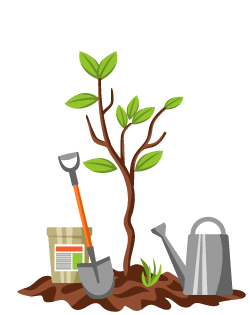 Landing
Basic conditions
- For planting, it's best to choose sunny, elevated sites. If slopes are the only options, then a south-facing site is best. In the shade, the tree will grow slowly, and the fruit will be small, if it blooms at all.
- Pay attention to the groundwater level, which should be at least 1.5 meters deep. Otherwise, Alesya's roots may reach the groundwater and cause rot.
- The holes should be prepared in advance according to the standard plan, ideally in the fall, but if the deadline has already been missed, then at least 3-4 weeks before planting. Dig holes 60 centimeters deep and 80 centimeters in diameter. Mix some of the fertile topsoil with fertilizer and fill it back in, add 30 liters of water, and leave it outdoors. Leave up to 5 meters between trees in a row, and 3 meters between rows is sufficient.
- Stakes are driven into the holes immediately, to which the trees will be tied. They can be removed no earlier than the fifth year, when the apple tree begins to bear fruit.
- A 10-15 centimeter drainage layer is poured onto the bottom, which can be vermiculite, gravel, broken brick, or even nut shells.
- Place the seedling vertically on top, allowing its root collar to protrude 5-7 centimeters above the surface. Hold it by the trunk and carefully sprinkle soil over it, compacting it lightly with your hands. Next, create a border of soil around the trunk circle, add 30-40 liters of water, and mulch the surface with humus, chopped grass, or manure.
Landing dates
Acquired from closed root system Saplings can be planted at any time during the growing season. However, in other cases, more specific timeframes should be followed. In the spring, apple trees are planted before the buds begin to open, around April, and in the fall, after the leaves have fallen, around late September or October. Trees planted in the fall have the best survival rate.
Protection from frost and rodents
In temperate climates, standard frost protection measures for apple trees are sufficient. I cover the area around the trunks with spruce branches, hay, or straw mats. The trunks themselves are wrapped in burlap, agrofibre, roofing felt, or roofing felt. However, in harsher climates, it's better to rake 10-15 centimeters of soil onto the roots in the fall, and the trees can even be covered with a tent-like covering. Creeping varieties are completely covered with snow.
Tree care
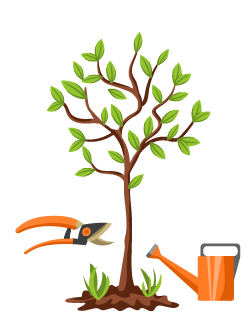 Tree care
Loosening the soil, watering: proper agricultural technology
All trees love it when soil The soil is rich in oxygen, so regular loosening will be necessary for Alesya as well. Twice a year, in spring and fall, it is recommended to dig up the area around the tree trunk, but very carefully so as not to damage the roots located close to the surface. You can hoe the soil regularly, while also removing weeds and other unwanted vegetation that robs the apple tree of nutrients.
Watering is done as needed. However, experienced gardeners say that under normal conditions, three waterings per season are optimal: during fruit set, flowering, and ripening. If the year is particularly dry, watering can be increased. Along with watering, you can fertilize and feed the apple trees.
Pruning: simple crown shaping
The first formative pruning is performed in the second year after planting outdoors, preferably in the spring. The central conductor is cut back by one-third, and the skeletal branches are shortened so that they are arranged in tiers. These procedures are repeated regularly.
Sanitary pruning is usually performed in the fall. This involves removing all dead, diseased, or damaged shoots. After 10-15 years, rejuvenation pruning can begin. This involves removing 2-3 mature shoots to allow room for new growth.
Reproduction
- Clones (layering).
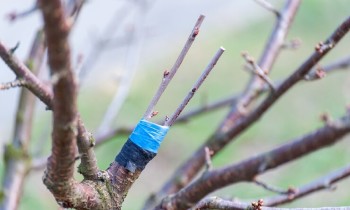
- Grafting by cuttings or buds.
- Rooting cuttings.
- Growing from seeds.
Diseases and pests
- Cytosporosis.
- Moniliosis.
- Scale insect.
- Green aphid.
- Codling moth.
Ripening and fruiting
The beginning of fruiting
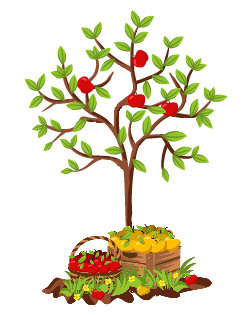 The beginning of fruiting
Apple trees begin bearing fruit at different times, depending on the rootstock. Trees on dwarf and semi-dwarf rootstocks begin bearing fruit earliest (in the 3rd or 4th year). On seed rootstocks, the first fruiting occurs later, only in the 5th or 6th year. The harvest at this time isn't considered full-fledged, but it yields 5-15 flavorful apples.
Flowering time
Alesya blooms in late April or early May, but weather conditions (temperature, late frosts, prolonged rains) may delay this slightly. Flowering lasts approximately 8-11 days. The flowers are small, white, fragrant, and borne in clusters.
Fruiting and growth
Apple trees grow quite rapidly in the first few years, reaching up to half a meter per season, but growth slows as the years go by. Full fruiting will take at least 7-9 years. From this point on, the tree begins to build up its turnover. It bears fruit reliably every year, with no dormant periods throughout its lifespan.
The fruits begin to ripen only after mid-October or even early October if the summer is cool and rainy. However, this is only the technical maturity, at which point the fruits are typically harvested and stored in the cellar. Consumer maturity does not occur until late December, when the apples have matured, accumulated sugars, and become more flavorful, juicy, and aromatic. In a humid, well-ventilated room where the temperature does not rise above 4-10°C, they can be stored without losing their quality until late spring or until the next harvest.
Top dressing
- Peat.
- Compost.
- Mineral complexes.
- Bird droppings.
- Ammonium sulfate.
- Urea.
- Humus.
- Manure
- Superphosphate.
What to do if it doesn't bloom or bear fruit
- Check for pests and diseases.
- Feed.
- Transplant to a sunnier area.
- Provide regular watering.
Why do apples fall?
- Natural factors.
- Excessive humidity.
- Pests.
- Diseases.
Please leave your own reviews of the Alesya variety so that other gardeners can learn from your experience.