Mackintosh Apple Tree: Variety and Care Features
| Color | Greens |
|---|---|
| Ripening season | Autumn |
| Size of apples | Average |
| Taste | Sweet and sour |
| Crown type | Average tree height |
| Shelf life | High shelf life |
| Application | Universal variety |
| Winter hardiness | Average winter hardiness |
| Fruiting age | From 5 years old |
History of origin and regions of growth
 Growing regions
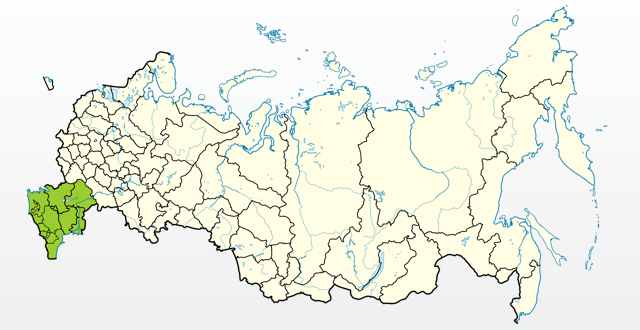
This variety is most often recommended for planting in the southern regions of our country due to its average and even below-average winter hardiness. It is included in the State Register (zoned) for the Lower Volga and North Caucasus regions.
Origin
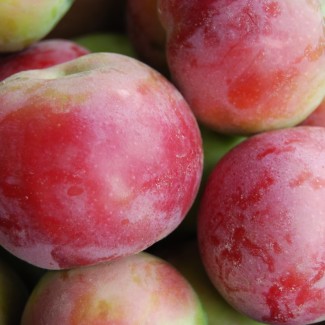
The origin story of the McIntosh apple variety is fascinating, full of mysteries and secrets. No one knows what kind of selective breeding or natural crossing it was created through. In 1811, an American farmer of Scottish descent purchased a farm in what is now South Dundas, Canada. While clearing the land, he discovered several young apple trees, which he regretted cutting down and moved to another location.
He eventually harvested a good crop of beautiful, aromatic red apples from one of them, which he decided to name after himself. He liked the apples so much that he began cultivating them. His son, Alan, took up his father's business and widely promoted the variety around the world. By 1910, the trees had spread throughout North America and British Columbia, and a little later, they were brought to Europe. In Russia, this apple is especially beloved by the people, and has several common names:
- Khoroshovka.
- Autumn.
- Excellent.
- Red autumn.
- Red-sided.
Content
Description of the Mackintosh apple variety
 The State Register adds more and more new varieties every year, but there are also those that have remained popular among gardeners for years. One such foreign variety is the Mackintosh, which, thanks to its high yield, ease of growing conditions, and the taste and aroma of its fruit, has earned the love and respect of gardeners worldwide.
Apples: size, color, weight
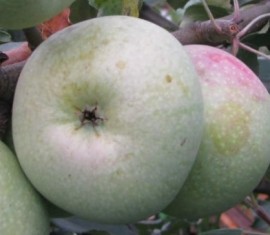
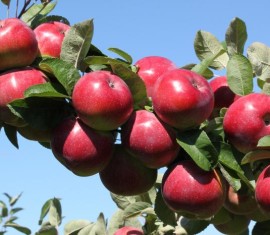
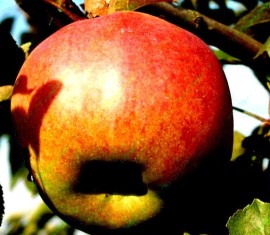
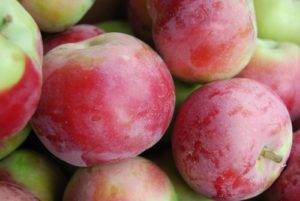 Mackintosh apples are typically medium to medium-large (145-210 grams). They are arranged randomly on the tree and can vary greatly in size. They are typically conical and round, slightly flattened at the top and ribbed at the bottom. The skin is very smooth and glossy, with a predominantly white-green or yellow-green hue. At maturity, the skin becomes 85-90% covered with a streaky purple blush on a bright red background. The skin is quite firm and can be easily peeled away from the flesh. The chemical composition is characterized by the following indicators per 100 grams of product:
- P-active substances – 196 milligrams.
- Ascorbic acid (vitamin C) – 3.8 milligrams.
- Total sugars (fructose) – 10.8%.
- Pectins (fiber) – 10.7%.
- Titratable acids – 0.57%.
The apple flesh is predominantly white, sometimes with reddish or pink veins. It is very juicy, tender, and crisp, with a distinct sweet-and-sour flavor and a powerful aroma, reminiscent of candy. The apples are rated 4.8 out of 5 for appearance, and 5 for taste.
Mackintosh apple tree: characteristics
Crown and root system
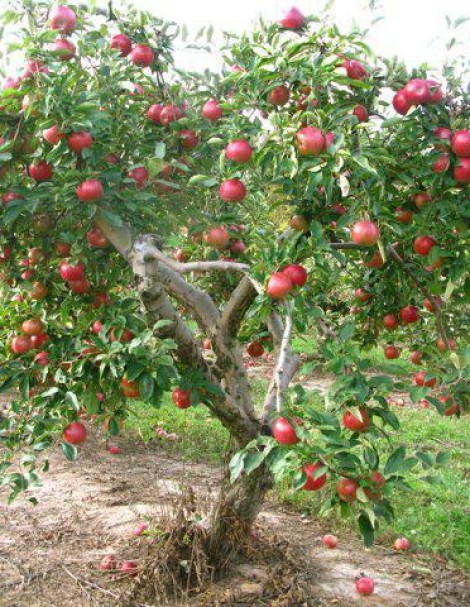
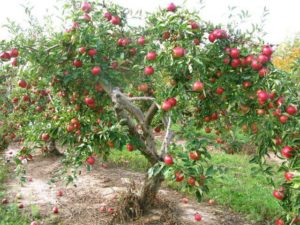 This tree is considered medium-sized, although if left unpruned, it can grow to fairly large heights of up to 5-6 meters, and in exceptional cases, up to 8 meters. However, most gardeners don't allow the Macintosh to grow this large. The variety's crown shape is typically pyramidal, which is considered its main distinguishing feature. Over the years, it becomes spreading and moderately dense, occupying an area of approximately 4-5 meters.
Apple tree shoots are typically thin to medium thick, with gray or grayish-brown bark. The leaves are medium-sized, rounded, smoothly textured, with a smooth and slightly serrated edge, and a light green hue. The Mackintosh root system has thick skeletal roots and numerous second- and third-order branches. Young, thin roots are typically covered with a network of so-called hairs, which serve one purpose: they "seek out" and absorb moisture.
Productivity and pollination
No irregularities in the fruiting of these apple trees have been observed, but they may reduce their productivity under unfavorable weather conditions.
On average, one mature tree can yield at least 180-200 kilograms. However, there are officially recorded results 300-350 kilograms, however, these are isolated cases.
The McIntosh variety is considered self-fertile, so it doesn't require special pollinators. However, experienced gardeners say that by alternately planting varieties that bloom at the same time, higher yields can be achieved.
Winter hardiness and disease resistance
This variety has average frost resistance, so it cannot be grown throughout our country. At approximately -20-25°C, the apple trees' fruiting shoots begin to freeze, and the ovaries begin to fall off, which inevitably negatively impacts the yield of the following year's fruit.
The Mackintosh variety doesn't exhibit any particular resistance to common apple tree diseases. It's equally susceptible to powdery mildew and scab, and is easily damaged by codling moths and green aphids. However, it responds very well to preventative measures. By regularly clearing the area around the tree of fallen leaves and fruit and spraying with natural and chemical remedies, you can avoid virtually any problems.
Macintosh computers, or "Mac" for short, produced by the American megacorporation Apple, got their name from this apple variety. However, by the time they were invented, the variety's name had already been patented, so the manufacturers decided to slightly alter the spelling while still retaining a recognizable name. As everyone knows, the company's logo is a bitten apple.
Subspecies and rootstocks
Many different subspecies of the McIntosh variety have been developed using rootstocks.
| Subspecies | Description |
|---|---|
| Mackintosh's daughter | This winter subspecies was developed by Russian pomologists in the Oryol region by crossing it with the Kulon-Kitayka variety. It is particularly frost-resistant, as it was bred specifically for the harsh climate. At the same time, the trees produce fairly high yields of apples with enviable shelf life. The fruits are slightly smaller, barely reaching 160 grams, and have greenish skin with a red blush. |
| American | This dwarf-growing variety, a late-season apple, is grown on a dwarf rootstock. The blush on these apples is a bright scarlet. But the main advantage of the fruit is its truly powerful vitamin content. This subvariety is often used in baby food. |
| Columnar | The accidentally created Mackintosh variety has a distinctive structure—a strong central trunk and a virtual absence of lateral scaffold branches. The apples are typically medium-sized, with a deep burgundy blush, and are comparable in flavor to the original variety. This type of tree allows for time-saving harvesting and allows for various maintenance procedures. However, it does have a drawback: a short lifespan. On average, a columnar Mackintosh lives and bears fruit for 11-15 years, after which it must be replaced with younger trees. |
| Black | This is the most frost-hardy, late-ripening variety, grown on a semi-dwarf rootstock, the fruit of which is harvested only in late October. It is particularly tolerant of drought, requiring virtually no watering. The apples are green with a dark purple blush. They store very well and have excellent transportability. They are sweeter than other subvarieties and the main variety. |
| Cortland | This subspecies was developed in New York in 1898 by Mackintosh and Ben Davis. In early 1915, the apple tree was brought to Russia, where it thrived due to its late ripening, vibrant red-orange color, and excellent shelf life. Its main drawback is considered to be its low resistance to apple diseases, particularly scab. |
Features of growing Macintosh
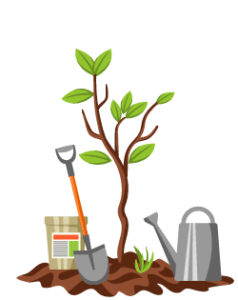
Landing
Key Features
- The Macintosh isn't particularly picky about soil, but it especially likes loam and sandy loam. If you only have sand, you'll need to bring in and add some black soil and clay.
- The Mackintosh doesn't like close groundwater or open water, so planting it on the shore of a pond or lake isn't ideal. If you have no choice, ensure good drainage by adding gravel, broken brick, or nut shells to the ground.
- The variety doesn't like drafts or shade, although it will produce fruit. However, more abundant harvests are obtained in well-lit, quiet areas.
- Planting holes are dug 60-70 centimeters deep and up to 1 meter in diameter. It's best to prepare them in advance by adding a mixture of soil and fertilizer to the bottom and filling with two buckets of water. For fall planting, this should be done at least 2-3 weeks in advance, and for spring planting, in the fall.
- Please ensure that the distance between seedlings of the same variety is at least 3 meters, and between McIntosh and other trees – 4 meters.
- Stake stakes are driven into the holes immediately and should not be removed for the next 3-4 years. They are placed primarily on the north side.
- The root collar should remain on the soil surface at a height of approximately 5-8 centimeters.
- The soil around the seedling should be lightly compacted, but care should be taken to ensure that it does not turn into a solid lump.
- All trees are watered with 40 liters of water immediately after planting, and the root zone is mulched with manure and chopped grass.
Proper planting timing, timely, high-quality care, and agricultural practices directly impact the lifespan of your apple tree.
Landing dates
It is best to plant this variety in the spring in April, when soil It's already warmed up well, but the sap hasn't yet begun to flow. However, if the seedlings were purchased in the fall, it's best to plant them a month before the onset of frost. Failure to follow these guidelines may result in the young tree dying.
Protection from frost and rodents
Only the McIntosh's Daughter, Black, and Cortland subvarieties are particularly frost-resistant. All others are very delicate and will require proper protection. Even the hardy subvarieties need to be covered for the winter with spruce branches, straw bales, roofing felt, tar paper, or hay. If seedlings freeze, they may take several years to recover. Of course, they will bear little or no fruit during this period.
To protect against insects, trees should be treated annually with special compounds, as well as the central trunk and lower branches should be whitewashed with lime. To repel mice, hares, and other rodents, the trunks can be coated with grease or lard.
Tree care
 Loosening the soil, watering: proper agricultural technology
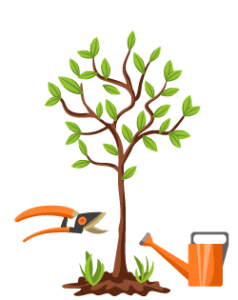 Loosening the soil, watering: proper agricultural technology
All trees appreciate airy, oxygen-rich soil, so it needs to be loosened frequently. This can be accomplished by combining loosening and watering. Water the variety only if there has been no rain for more than ten days. After this, watering is temporarily stopped and resumed only 10 days after the onset of the dry period.
A single watering typically requires 30-40 liters of water. It all depends on the size and age of the tree. For young trees, 10-20 liters is sufficient, but for older trees, it's best to water as much as possible, but in small amounts, and after sunset.
Pruning: simple crown shaping
It's best to perform the first formative pruning immediately after planting the Mackintosh apple tree. This will allow it to properly develop its lateral scaffold branches. The main trunk is trimmed back by approximately one-third, and the remaining branches are trimmed 4-6 centimeters shorter. After this, in the second and third years, all blossoms are removed from the tree, and the ovaries are carefully trimmed. This allows the tree to develop and immediately begin bearing fruit abundantly.
Regular sanitary pruning is required, removing dead, diseased, or damaged branches. It's also a good idea to prune branches that make the crown too dense, which will help prevent them from breaking off. Rejuvenation pruning involves removing two or three mature shoots to allow new growth to develop.
Reproduction
- Layers (clones).
- Grafting by cuttings or buds.
- Growing from seeds.
Diseases and pests
- Powdery mildew.
- Scab.
- Cytosporosis.
- Green aphid.
- Codling moth.
The tree does not require cross-pollination, but if it is present, the harvest will be more abundant.
Ripening and fruiting of Mackintosh apple trees
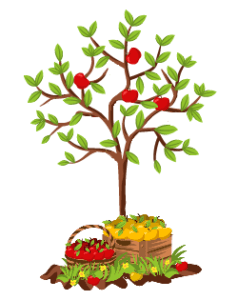
The beginning of fruiting
By the second year, flowers appear on the tree, which may well develop into apples. However, it's customary to pluck them to ensure larger harvests in the future. Experienced gardeners recommend not allowing the tree to bear fruit for 5-7 years.
Flowering time
The Mackintosh apple tree typically blooms quite early, in early May, although it's not considered an early-ripening apple tree. Its flowers are large, white, and sometimes slightly pink. They cling tightly to the branches and rarely fall off, even in frost.
Fruiting and growth
The variety begins to bear fruit at full capacity only in the 8th to 10th year. In the 6th to 7th year, approximately 10-15 kilograms of apples can be harvested. However, later, in good years, it is possible to obtain at least 150-200 kilograms of aromatic fruit from a single tree. Fruit production does not decline cyclically, although it may drop slightly in unfavorable years.
Apples have excellent shelf life. Under the right conditions (a cellar), they can be stored for 4-5 months without losing their flavor or aroma. Apple trees grow slowly, growing only 7-10 centimeters per year.
Top dressing
- Nitrogen-phosphate fertilizers.
- Urea.
- Manure.
- Peat.
- Humus.
- Mineral mixtures.
What to do if it doesn't bloom or bear fruit
- Provide watering.
- Transplant.
- Check for fungal diseases or pests.
- Perform pruning.
Why do apples fall?
- Natural phenomena (rain, wind, hail).
- Diseases.
- Pests.
- Too thick crown.
- Lack or excess of moisture.
Please leave your feedback on the McIntosh variety in the comments to our article to share your experience with other gardeners.