Favorite apple tree: characteristics of the variety and care
| Color | Reds |
|---|---|
| Ripening season | Autumn |
| Size of apples | Large |
| Taste | Sweet and sour |
| Crown type | Columnar tree |
| Shelf life | Average shelf life |
| Application | Fresh , For recycling |
| Winter hardiness | Average winter hardiness |
| Fruiting age | Up to 5 years |
 History of origin and regions of growth
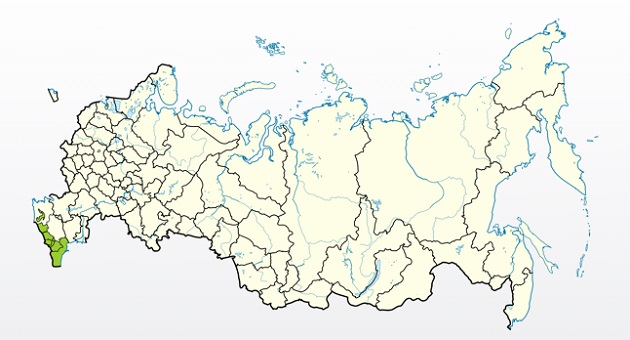
Growing regions
- North Caucasus.
- Crimea.
Origin
This new variety of columnar apple trees was developed in Crimea, specifically in Yalta, home to the Nikitsky Botanical Garden, Order of the Red Banner of Labor, National Scientific Center of the Russian Academy of Sciences. The hybrid was first isolated in the early twenty-first century, in the Nikita urban-type settlement. The variety was immediately sent for field trials, and just 203 years later, the first harvest was obtained, which proved to be of very high quality.
In 2014, an official application was submitted for inclusion of the new Favorit variety in the State Register of Breeding Achievements, which was immediately approved. That same year, the apple tree was zoned for the North Caucasus region.
Content
Description of the Favorite apple variety
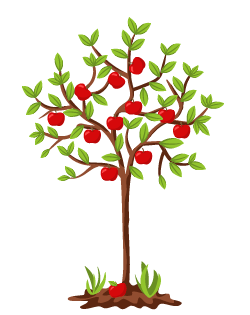 This new apple tree has immediately caught the attention of many gardeners, and for good reason. Its list of advantages is truly impressive. It tolerates winter cold well, is resistant to various fungal infections, is not particularly fussy about soil and moisture, quickly reaches fruiting age, and produces consistently high yields of delicious, sweet, and beautiful apples year after year.
Despite the relatively high cost of seedlings, as well as their short lifespan, the crop can be recommended for both small garden plots and large, intensive industrial plantings.
Apples: What do they look like?
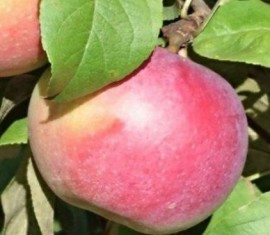
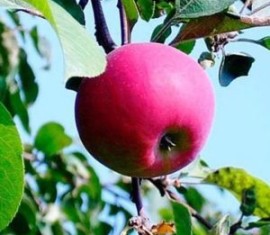
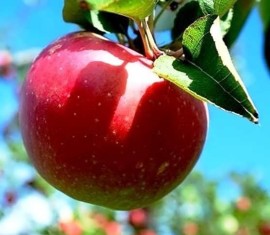
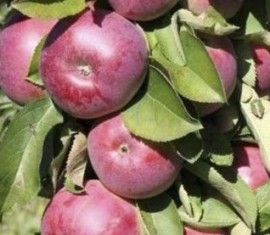
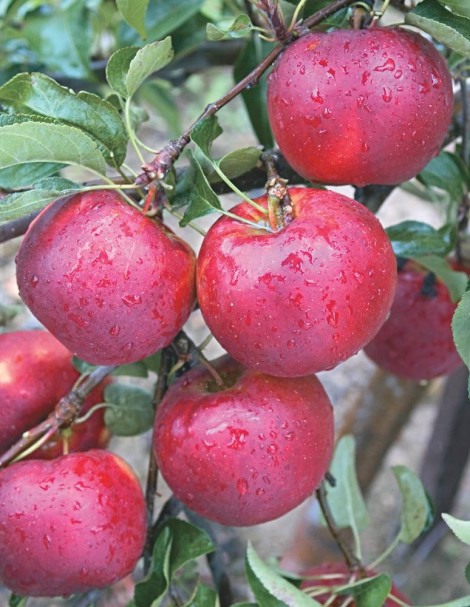
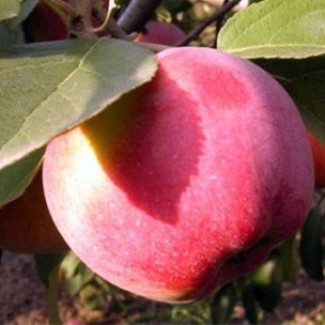
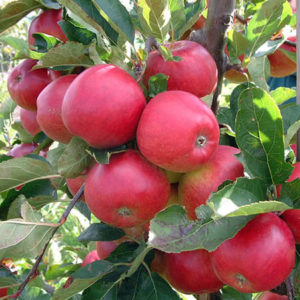 The fruits are round, most often spherical, but can be slightly conical. They are symmetrical, smooth, with little ribbing, and have no lateral seam. They are generally uniform in size, large to medium-large, and reach 130-180 grams, but can reach 190-220 grams in good years and with proper care.
The fruit skin is dense, elastic, and strong, providing excellent protection against various damages. It is bright green or light green, and may turn slightly yellow as it ripens, becoming covered with a thick, bluish-gray waxy coating. The blush is dark red, sometimes beetroot-colored or even with a slight violet tint, dense, blurred, and mottled, and may be streaked. Subcutaneous punctures are medium in diameter, light in color, densely spaced, and clearly visible against the dark surface. Chemical composition is typically assessed based on the following factors:
- P-active substances – 284 milligrams.
- Ascorbic acid (vitamin C) – 12.9 grams.
- Sugar (fructose) – 13.4%.
- Titratable acids – 0.47%.
- Pectins (fiber) – 11.6%.
The flesh is white or slightly creamy, and can be slightly greenish or lemon-colored, depending on the chosen rootstock, care, and light conditions. It is firm, very juicy, crisp, and prickly, with a pleasant, distinctive aroma. The flavor is considered dessert-like, harmonious, delicate, and balanced. Professionals give the variety a tasting score of 4.6-4.7 for both taste and appearance.
Apple tree Favorite: characteristics
Crown and root system
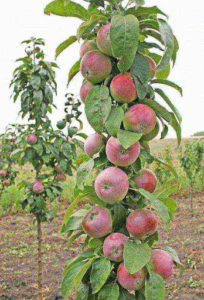 This column is considered tall, because can easily stretch up to 3.5 and even 4 meters, if not pruned in time. The crown can be formed into a single trunk, but most experienced gardeners prefer to create two or three skeletal shoots growing at a very sharp upward angle. This adds some pruning work, but the yield can be raised to a whole new level. The internodes are very close together, the branches are thick and strong, covered with smooth reddish-brown bark with a slight green tint, and sometimes even brown.
The leaves are medium-sized, dense, rich green or bright green, and densely arranged. They are glossy, delicately nerved, and have low rugosity. The blade is uneven and wavy, with finely serrated, serrated, and serrated margins. The tip is long and pointed, and can curl in a helical fashion. The root system is fibrous, superficial, yet shallowly branched. The roots themselves are thin, lacking a central taproot, and cannot penetrate deeply to find water and nutrients.
Productivity and pollination
The variety is considered medium-yielding, but good growers achieve maximum fruiting through good care and timely implementation of all necessary procedures for watering, feeding, and fertilizing.
Up to 10,000 trees can be planted on a single hectare, resulting in a high yield of up to 180-200 tons of apples. However, a single tree can yield only 9-14 kilograms, and even then, only in favorable years and in a good location.
The variety is completely self-sterile, and no apples will be produced unless there are varieties within 80-90 meters of each other with suitable flowering periods for cross-pollination. Therefore, it's essential to plant the trees interspersed, otherwise all your efforts will be wasted.
Winter hardiness and disease resistance
The average winter hardiness of the Favorit apple tree allows it to be grown throughout almost all of central Russia and even in more northern regions. However, it's important to remember that they can tolerate frosts down to -20-22°C fairly well, but only for short periods. If frosts persist for two or three consecutive periods or longer, the trees should be properly wrapped. They also don't tolerate sudden temperature fluctuations or strong, gusty winds; they must be protected for the winter.
Rootstocks and subspecies
There are no subspecies of Favorit, so be careful when purchasing at the market. However, this variety is grown on a variety of rootstocks. On vegetative rootstocks, they grow tall, robust, and more winter-hardy. On dwarf rootstocks, they require protection from cold, grow more compact, never exceeding 2-2.2 meters in height, and also produce larger fruits.
Features of growing Favorite
 Landing
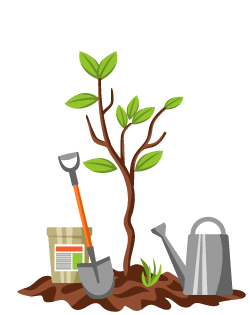 Landing
Basic conditions
- For planting, select airy, moderately moist, and fertile soil. It doesn't grow well in pure black soil; it's best to dilute the soil with washed river sand. Favorit performs well in sandy loam or clay loam with timely fertilization and feeding.
- High groundwater levels can only damage the tree if they rise above 2-2.3 meters. Otherwise, the millet roots won't be able to reach the moisture and won't have any effect on growth. In some cases, planting apple trees directly near ponds is not recommended, and swampy areas and floodplain meadows are not ideal locations.
- A sunny, open area where the apple tree branches receive full sun for most of the day is the best choice for planting. Preferably, there should be no shade, but some shade is fine.
- The favorite doesn't tolerate drafts, but without good ventilation, it becomes susceptible to various fungal infections. Therefore, it can be difficult to find a location where strong winds won't damage the trunks, but the crowns are well ventilated, but it will take some effort.
- Leave at least 1-1.1 meters between trees, and up to 1.5-2 meters between rows. This will ensure they're not crowded, making it much easier to harvest and tend to the garden.
- Preparing the holes in advance isn't necessary; they can be done 2-4 weeks before planting. Dig 80x90 cm holes, fill the bottom with soil and fertilizer, add drainage, and fill with water. Then, let the holes sit outdoors.
- Root collar must be left above the horizon level if the properties of the rootstock need to be preserved.
- Place the seedling level, spread the roots on a pile of drainage material or soil, cover with soil, and compact it by hand, being careful not to compact the soil around the root ball to a granite consistency. Water the top with 30-40 liters of water, and mulch the surface with sawdust.
Landing dates
This variety can be planted in either spring or fall. The main criteria will be the region and its climate. In more southern regions with mild conditions and warm winters, it's best to plant in September-October, when the leaves have finished falling and there are still 3-4 weeks before the cold weather sets in. In harsher areas, a spring planting is preferable.
You can choose a warm, dry day in late March or early April, before the buds begin to grow. Trees purchased with a closed root system (with a root ball) can be transplanted into open soil at any point during the growing season, even in the height of summer. These trees are more likely to thrive.
Tree care
 Tree care
Protection from frost and pests
Proper preparation for winter is crucial for the Favorit, so devote sufficient time and effort to this. Start by reducing watering in mid-August and reduce it to zero by early or at least mid-September. Otherwise, the tree may not have time to prepare and stop sap flow. Wrap the trunks with agrofibre, roofing felt, burlap, or any other fabric, and place spruce branches, foam, or straw bales on the root zone. Covering the trees with a tent-like covering is also an option; this works well even in relatively harsh regions.
To repel hungry rodents, smearing the trunk with some strong-smelling substance, such as grease, rendered animal fat, fuel oil, or old drying oil, will help. whitewash trunks with lime twice a year, in early spring and late autumn.
Loosening the soil, watering: proper agricultural technology
For most columns, aeration and soil moisture around the trunk are crucial. It should be dug at least twice a year, and hoeing can be done much more frequently. At the same time, weeds, root suckers, and shoots from various plants should be removed. To promote natural aeration, herbs such as lemon balm, mint, calendula, basil, parsley, and dill are sown around the roots.
Water the Favorit as needed, that is, when the soil dries out. If the weather is hot and dry, you can water it twice a week when the soil becomes very dry. After rain, wait a little longer to avoid overwatering the trees. Fertilize and hoe the surface well the day after watering.
Pruning: simple crown shaping
Depending on your preference and available space, you can train your apple tree to have a single trunk or two or three shoots, like a broom. This will affect not only the space required but also the yield; the latter will yield more fruit. However, pruning will be much more labor-intensive. While a trunk tree requires simply cutting off all shoots before they become woody, a broom tree requires selecting the larger shoots annually, trimming the weaker ones, and allowing the young shoots to develop again, year after year.
Sanitary procedures include pruning away dead, diseased, and broken shoots. These can be removed even in midsummer, but it's best to schedule pruning for spring and fall, when the sap in the trunks has subsided. Wounds are sealed with garden pitch. The trees won't need rejuvenation, as their overall lifespan is only 20-25 years, and their active fruiting period is even shorter.
Pollinator varieties
- Currency.
- In memory of Ulyanishchev.
- Vazhak.
- Conference.
- Geyser.
- Memory of Isaev.
- Idol.
- Korobovka.
Reproduction
- Rooting.
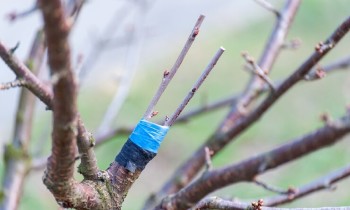
- Kidney grafting.
- Growing from seeds.
- Cuttings.
Diseases and pests
- Black crayfish.
- Scab.
- Bacterial burn.
- Powdery mildew.
- Green aphid.
- Codling moth.
- Leaf roller.
- Hawthorn.
Ripening and fruiting of Favorit
The beginning of fruiting
 The beginning of fruiting
This variety is very early-bearing, as are the vast majority of columnar apples. Already in the first year in the nursery, buds and ovaries can be found on the branches. These are usually picked immediately, before they develop into apples. If this is not done, the apple tree will take a very long time to increase its yield until it reaches its maximum. Harvesting is recommended in the second or third year, but later is better than earlier. This yield will be around 3-5 kilograms of apples, but this is just enough for a sample.
Flowering time
The tree blooms quite early. Around mid-April, ovaries begin to appear, and by the end of the month, the flowers bloom. They are large, gathered in clusters of 6-9, beautiful, and intensely fragrant. The flowers are predominantly white and pink, cup-shaped, with slightly ruffled petals. The process lasts approximately 12-14 days.
Fruiting and growth
The tree is fast-growing. It can easily reach at least a meter in height in just one year. However, after fruiting begins, growth slows slightly. Nevertheless, Favorit quickly reaches its maximum height, simultaneously increasing its fruitfulness. By approximately 5-7 years, it can begin harvesting a full crop.
Apples begin to ripen in September, beginning mid-September in the southernmost regions and ending late in the northernmost ones. The colder the weather, the later you should pick the fruit from the branches; you can tell when it's ripe by the thick waxy coating on its surface. Apples don't usually fall off the branches, so there's no need to rush. Apples have a moderate shelf life; they can be kept until almost early spring, but it's best to eat them completely or process them over the winter.
Top dressing
- Compost.
- Ammonium nitrate.
- Humus.
- Superphosphate.
- Manure.
- Peat.
- Mineral complexes.
- Chicken manure.
What to do if it doesn't bloom or bear fruit
- Check for pests or diseases.
- Transplant into the sun.
- Water.
- Fertilize.
Why do apples fall?
- Wind, hail, hurricane, rain.
- Pest damage.
- Diseases.
Please leave your feedback on the Favorite variety, as many gardeners would like to grow similar varieties in their gardens.