Kumir apple tree: characteristics of the variety and care
| Color | Reds |
|---|---|
| Ripening season | Autumn |
| Size of apples | Large |
| Taste | Sweet and sour |
| Crown type | Columnar tree |
| Shelf life | Average shelf life |
| Application | Fresh , For recycling |
| Winter hardiness | Average winter hardiness |
| Fruiting age | Up to 5 years |
 History of origin and regions of growth
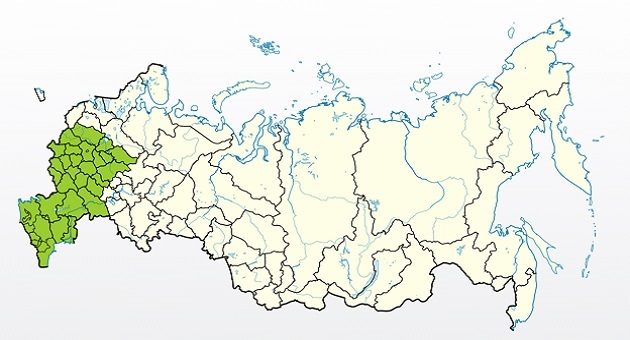
Growing regions
- North Caucasus.
- Crimea.
- Northern regions (partially).
- Moscow region.
- Middle zone.
- Leningrad region.
Origin
Columnar apple trees appeared on the market only in the mid-twentieth century, after which they began to confidently win their place in the orchards of apple lovers worldwide. The Idol was developed by the renowned Russian breeder Viktor Valerianovich Kichina, who worked for many years at the Federal State Budgetary Scientific Institution VSTISP. There is no exact date for the hybrid's development, but the variety has already taken its place among dozens and hundreds of others.
It is believed that the KV-103 hybrid may have been used as the source of the columnar shape, and the winter hardiness was derived from the Brusnichnoe variety. However, it's better to wait for official information than to speculate. Kumir has not yet been included in the State Register and has not been officially zoned. However, experts recommend planting it in regions with a milder climate and fertile, airy soil.
Content
Description of the Kumir apple variety
 The variety is highly valued due to its exceptional ability to thrive in virtually any region of our country, except the harshest. With proper soil moisture regulation, Kumir can grow in the difficult conditions of the Moscow region and the Leningrad region, on the rocky slopes of the North Caucasus and Crimea, and in the fertile black soils of the central zone it feels great.
The columnar trunks are compact, frost-tolerant, and produce fruit consistently throughout their active life. They are resistant to various apple tree diseases. Kumir's fruit is large, has high marketable quality, is easy to transport, and has a relatively good shelf life. It is recommended for intensive commercial plantings and small private gardens.
Apples: What do they look like?
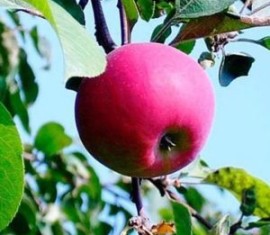
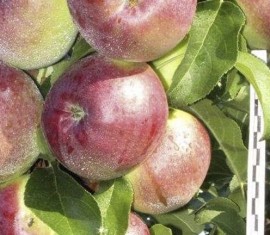
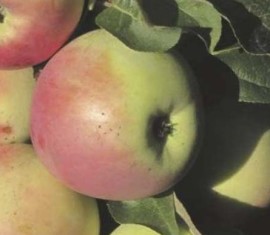
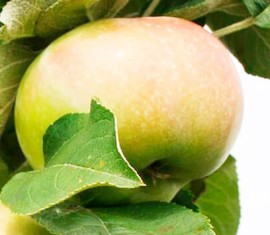
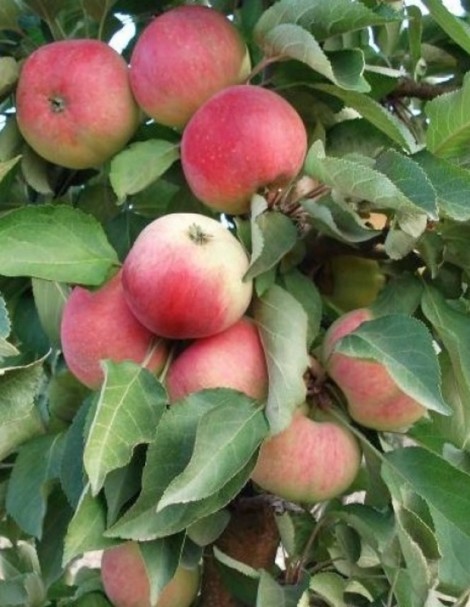
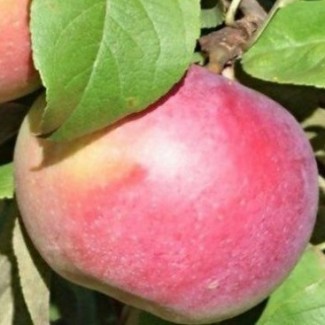
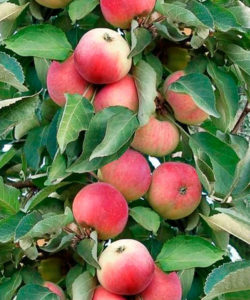 The fruits are round or slightly conical, sometimes slightly slanted to one side, but are generally symmetrical and slightly ribbed. They are large or medium-large, and with proper care and favorable weather conditions, can reach 230-260 grams, but most often range from 140-200 grams.
The skin is dense and strong, glossy, shiny, and elastic, protecting the fruit well from mechanical damage and not cracking in excessive moisture. It is green, but as it ripens, it acquires an increasingly pronounced yellowish or even golden hue. The blush is raspberry-red, pinkish, or carmine, and can even be dark red or beetroot red. At full maturity, it becomes covered with a bluish, waxy coating of medium density. Subcutaneous dots are very light, even whitish, numerous, densely spaced, and clearly visible. Professionals evaluate the chemical composition based on several parameters:
- P-active substances – 264 milligrams.
- Ascorbic acid (vitamin C) – 13.6 grams.
- Sugar (fructose) – 11.5%.
- Titratable acids – 0.83%.
- Pectins (fiber) – 9.8%.
The flesh is firm but not hard, crisp, brittle, refreshing, slightly prickly, and very juicy. Its color is usually pure white, without any impurities, and the taste is sweet and sour, considered a dessert-like, balanced, and harmonious. Tasting scores range from 4.7 to 4.8 out of 5.
Kumir apple tree: characteristics
Crown and root system
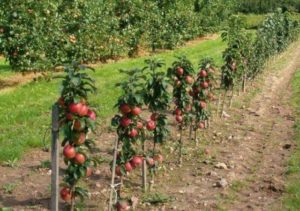 The tree is considered a medium-sized columnar tree, reaching a height of just 2.4-2.7 meters. The crown is compact, but not composed of a single conductor; it typically consists of two or three branches, only one of which bears fruit. The average circumference of the tree does not exceed half a meter, but it is best to leave at least 1-1.5 meters between other plants. The branches are strong, thick, grow at a very sharp angle, almost vertically, and are covered with greenish-brown or brownish bark, smooth, matte, and pubescent.
The leaves are medium-sized, rich green, leathery, dense, and glossy. The leaf blade is uneven and wavy, the ribbing is rough, and the rugosity is strong. The edges are serrate-crenate and serrated, and the tip is long and pointed, capable of being twisted like a propeller. The root system is superficial, fibrous, highly branched, and tangled, lacking a central taproot and unable to penetrate deeply into the soil.
Productivity and pollination
The tree begins to bear fruit early, and the yield is stable from the beginning until the end of fruiting.
From one mature Kumira tree, skilled gardeners who provide quality care for their apple trees can harvest at least 7-9 kilograms of aromatic, delicious, and long-lasting fruit per year. At a planting density of 10,000 per hectare, approximately 550-600 centners can be harvested from such an area..
One of the apple tree's most important advantages is its self-fertility. The Idol requires no outside pollinators to form ovaries and produce apples. However, some gardeners say that if such pollinators are available, the overall yield can be increased to 10-12 kilograms per tree. Spraying apple trees with sugar or honey syrup during flowering is always a good idea.
Winter hardiness and disease resistance
Apple trees are quite resistant to low temperatures, and frosts down to -22-27°C usually have no effect on them. However, proper winter preparation should not be neglected. If the cold weather persists for 2-3 weeks, or if temperatures drop below that, the trees will suffer serious damage from which they may not recover.
Kumir is very resistant to diseases. It's rarely affected by fungal infections. However, in years with high humidity and warm temperatures, it can still become infected. Typically, only the leaves are affected, and the fruit can be processed and eaten. But why risk it when you can treat it with fungicides and insecticides in a timely manner and avoid any worries?
Rootstocks and subspecies
Official sources provide no reliable information about any subspecies of the Kumir variety, suggesting they don't exist. The variety is grown on various rootstocks, from tall seedlings to semi-dwarf and dwarf varieties. This doesn't affect the quality of the fruit, but the trees can be more or less compact. The former are more winter-hardy, which is why residents of the Leningrad Region and the Moscow Region usually prefer them.
Features of growing Idol
 Landing
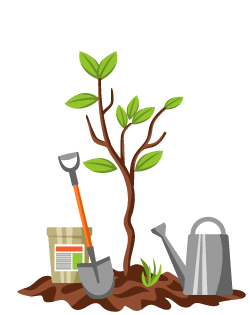 Landing
Basic conditions
- All fruit crops are best planted in open, sunny areas. However, Kumir can tolerate even moderate shade without stopping flowering and fruiting. This is another advantage of this variety. The key is to ensure it receives at least half a day of sunlight, otherwise the tree will be weak and may stop producing fruit.
- Good ventilation is essential for apple trees, but it's also advisable to protect them from drafts. If possible, plant the trees under the protection of larger trees, but be careful not to allow air to stagnate within the Kumira's crown, as this can lead to fungal infections.
- Groundwater levels generally don't play a role in site selection if they're located 1.5-1.7 meters below the surface. The tree's roots can't reach them, so there's no risk of rot. Because of this, apple trees can be planted near a stream, river, or pond.
- Experienced gardeners dig holes the season before planting, but two weeks of soaking is enough for Idol. Dig a round hole 60x80 centimeters (24x32 inches), fill the bottom with soil and fertilizer, top with another layer of soil or drainage material, add 25-30 liters of water, and leave it outdoors.
- Leave at least 1 meter of space between trees in a row to prevent branches or roots from interfering with each other in the future. Leave 1.5-2 meters between rows for ease of harvesting and maintenance.
- If the properties of the rootstock are planned to be preserved, then root collar leave it above the surface by about 5-9 centimeters to prevent the tree from taking root higher.
- We must not forget about the stakes for tying, which are optimally placed on the north side of the trunk.
- The seedling is placed in a hole on a pile of soil or drainage, the roots are spread out so that they lie completely freely, sprinkled with soil, trying not to leave air pockets, watered with water (25-45 liters), and the surface is mulched.
Landing dates
All trees with closed root systems (in bags, pots, or containers) can be planted at any time during the growing season. They can be planted in spring, summer, and even fall. In warmer climates, planting is best done in September-October, and in colder climates, in March-April.
Tree care
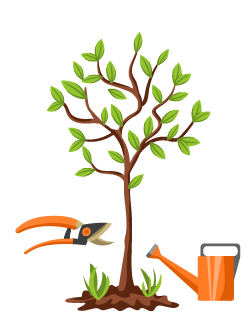 Tree care
Protection from frost and pests
Any standard frost protection method is suitable for Idol, but it must first be properly prepared. Watering is reduced from mid-July onward, continued throughout August, and by September, no further watering is required. This allows the trees time to prepare for winter and stop the sap flow in their trunks.
The root zone must be covered with suitable materials: spruce branches, bundles of dry leaves, straw, foam, and hay. The trunks are wrapped in burlap, and sometimes the trees are covered with a tent-like structure.
In cold climates, it's sometimes common to protect gardens with smoke. For example, this can help during early frosts in the fall or recurrent frosts in the spring. To do this, fires are lit between the rows, blanketing the entire garden in clouds of smoke, like fog.
Insects are controlled with insecticides, as well as whitewashing Tree trunks in spring and fall with ordinary lime. Rodents can be repelled by lubricating the trunks with rendered animal fat, fuel oil, or grease.
Loosening the soil, watering: proper agricultural technology
Loosening the soil and watering are essential for the Idol, as its shallow roots cannot obtain enough water and nutrients on their own. Therefore, under normal conditions, watering should be done at least once a week. However, if the weather is dry and very hot, you can increase the frequency of watering to 3-5 times a week.
You can dig around the trunk and hoe, removing weeds and shoots from other plants, once or twice a month, but be careful not to disturb the roots. It's best to do this the day after watering. It's common to add various fertilizers and supplements along with the water. For Idol, it's best to feed it with minerals in the spring and summer, leaving heavy organic matter for later.
Pruning: simple crown shaping
The variety doesn't grow as a single trunk, but regularly produces lateral scaffold shoots, so you'll need to become more familiar with pruning. Typically, two or three branches are left, with the strongest and central conductor being retained in the fall. In the spring, the most vigorous shoots are again selected, and the rest are pruned. This process is repeated year after year, throughout the apple tree's 15-20 years.
All damaged, broken, diseased, or dead shoots are also pruned. The tree won't need rejuvenation; it simply won't have time to age sufficiently.
Pollinator varieties
- Currency.
- Conference.
- Geyser.
- Prioskoe.
- Beam.
- Ostankino.
Reproduction
- Rooting.
- Kidney grafting.
- Growing from seeds.
- Cuttings.
Diseases and pests
- Black crayfish.
- Scab.
- Bacterial burn.
- Powdery mildew.
- Green aphid.
- Codling moth.
- Leaf roller.
- Hawthorn.
Ripening and fruiting of the Idol
The beginning of fruiting
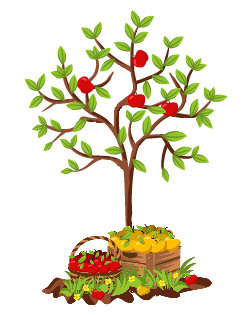 The beginning of fruiting
Almost all columnar trees are fruitful, and this variety is no exception. Already in the first year, you'll see flowers, which are best plucked without hesitation. This will give the tree time to grow foliage and establish roots before the apples begin to draw juices from it. But as early as the second or third year, you'll be able to harvest the first 3-5 kilograms of fragrant fruit, just the thing to discover what kind of apples they are.
Flowering time
The Idol variety blooms mid-season, around mid-May, like most other apple trees. This significantly simplifies the task of finding pollinators, which, however, it practically doesn't need. In cold and rainy weather, the process can be delayed until the end of the month or even early June. Idol produces beautiful, large flowers, gathered in large inflorescences of 7-9. They are snow-white or slightly pinkish at the base, and have a powerful, recognizable spicy aroma.
Fruiting and growth
The tree is fast-growing and reaches its full height very quickly, reaching over 60-80 centimeters per year. Once fruiting begins, the growth rate slows slightly, but not significantly. Similarly, the yield increases very quickly, and by the sixth or seventh year, a full harvest can be achieved.
The fruit begins to ripen around mid-October, but it's best to postpone harvesting until later in the month. These apples don't reach marketable and consumer maturity at the same time, and they cling tightly to the branches, so there's no need to rush. After picking and storing, the sugars caramelize only after 4-6 weeks, which is when the apples reach their peak flavor. Their shelf life is average, reaching 5-6 months, and under high-quality conditions, 6-7.
Top dressing
- Peat.
- Compost.
- Ammonium nitrate.
- Humus.
- Chicken manure.
- Superphosphate.
- Manure.
- Mineral complexes.
What to do if it doesn't bloom or bear fruit
- Check for pests or diseases.
- Transplant into the sun.
- Water.
- Fertilize.
Why do apples fall?
- Wind, hail, hurricane, rain.
- Pest damage.
- Diseases.
Please leave your feedback on the Kumir variety, as many gardeners would like to grow similar varieties in their gardens.