Apple tree Firebird: characteristics of the variety and care
| Color | Reds |
|---|---|
| Ripening season | Summer |
| Size of apples | Small ones |
| Taste | Sweet and sour |
| Crown type | Average tree height |
| Shelf life | Low shelf life |
| Application | Fresh , For recycling |
| Winter hardiness | High winter hardiness |
| Fruiting age | From 5 years old |
 History of origin and regions of growth
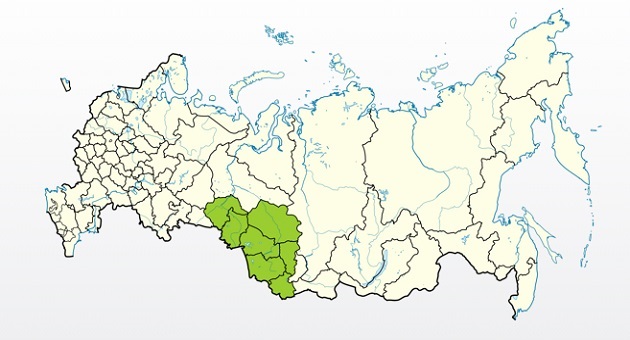
Growing regions
- Altai Republic.
- Omsk region.
- Altai Krai.
- Kemerovo region.
- Tomsk region.
- Novosibirsk region.
- Tyumen Oblast.
Origin
Siberian apple trees, especially those recently developed, are something special, radically different from anything previously known to biologists and gardeners. One of these unusual trees, capable of surviving a wide variety of weather and climate "jokes," is the Zhar-ptitsa variety. It was developed at the M.A. Lisavenko Siberian Research Institute of Horticulture, with the outstanding biologist and breeder Mikhail Afanasyevich Lisavenko himself working on it, along with T.F. Kornienko, I.P. Kalinina, Z.A. Grankina, and E.S. Orekhova.
The first seedling was obtained in 1963 by crossing Gornoaltaiskoe and Osennaya Radost Altaya, two winter-hardy and productive varieties. In 1977, the seedling was sent to the Barnaul Experimental Production Farm for field testing. Testing was completed in 1993, after which an official application for inclusion in the State Register and zoning was submitted, which was accepted five years later.
Content
Description of the Firebird variety
 Summer apple trees, which begin bearing fruit fairly quickly, immediately caught the attention of Siberian and Ural gardeners. These trees require no special attention, requiring neither intensive watering nor fertilizing, and are highly disease-resistant. They are compact, with a neat crown, high frost resistance, and excellent self-healing properties.
The Firebird's fruits are small and ripen in summer, so they don't store well. Furthermore, when left on the tree, they fall off and lose all their commercial qualities. This is considered the variety's biggest drawback. However, the apple tree is still recommended for commercial cultivation, for example, for juice, compote, or jam production, as well as for small home gardens.
Apples: What do they look like?
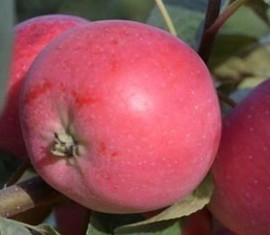
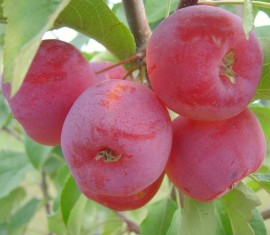
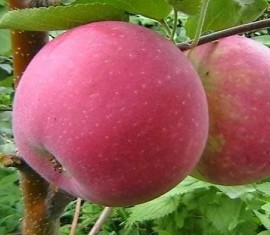
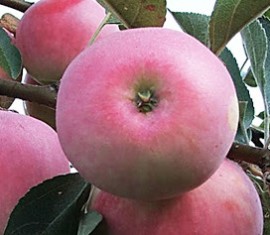
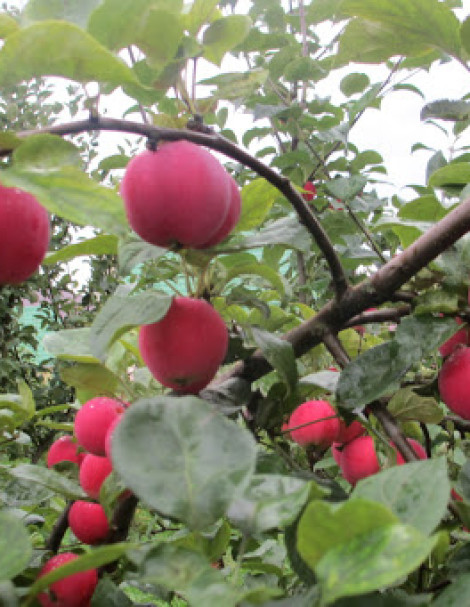
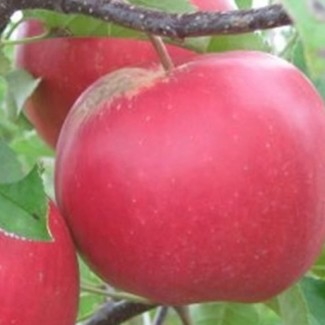
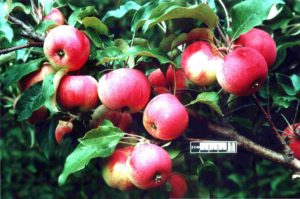 The fruits are round or slightly flattened, smooth, irregular, and generally symmetrical, but may be slightly slanted to one side. They are usually small and very rarely reach medium size, reaching a maximum weight of 35-40 grams. The ribbing is wide, but noticeable only at the calyx; the lateral suture is usually invisible.
The skin is fairly dense, smooth, glossy, shiny, brittle, and easily peels off when bitten. The base color is green or greenish-yellow, or lemon-colored. The blush occupies more than 65-80% of the surface; it is red, dark red, or burgundy-red, vaguely mottled, spotted, and may be slightly striped. At full consumer maturity, it becomes covered with a dense, silvery-blue waxy coating. Subcutaneous punctures are numerous, large, light gray or greenish-green, and clearly visible. Experts suggest assessing the chemical composition using the following markers:
- Sugar (fructose) – 9.2-9.5%.
- Ascorbic acid (vitamin C) – 14.6 grams.
- Pectins (fiber) – 10.1%.
- P-active substances – 216 milligrams.
- Titratable acids – 1.43%.
The apple flesh is medium-firm, crisp, and pleasantly textured, refreshing, very tender, and juicy. The flavor is considered table-like, sweet and sour, with a strong tartness, and harmonious. Professional tasters give the Firebird 4.1 and 4.4 points out of 5 for taste and appearance.
Apple tree Firebird: characteristics
Crown and root system
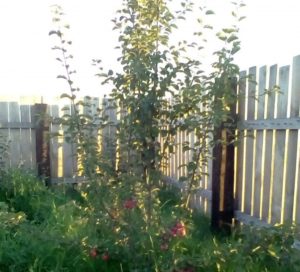 It is officially accepted to classify the variety as medium, but in fact it is a true natural semi-dwarf. Without any pruning it grows up to 3.1-3.5 meters.In most cases, gardeners limit tree growth to 2.5-2.8 meters to facilitate care and fruit harvesting. The crown is rounded or broadly oval, with shoots branching off at an acute angle, so they may require staking or support to prevent them from breaking off during the heavy fruiting period. Fruiting occurs on both complex and simple ring-shaped stems.
The leaves are round, leathery, dense, and wrinkled, with coarse nervation. They are glossy and shiny, with a beautiful, rich green hue; the underside may be slightly pubescent. The tip is short and pointed, and the margins are serrate-crenate and finely serrated. The root system is predominantly fibrous, but on some rootstocks it can be taproot-like, branching, and fairly well-developed.
Productivity and pollination
Among Siberian apple trees, the Firebird is quite suitable as a high-yielding, early-bearing variety. However, it can safely be considered average, and even slightly below average, when compared to European varieties.
In normal years, gardeners harvest 20-25 kilograms of apples from one tree. However, when the weather is favorable and the care is excellent, these figures can increase to 40-55..
The variety is completely self-sterile, meaning it is unable to pollinate itself. Apple trees with suitable flowering times should be located within 45-70 meters. It's also a good idea to ensure bees have access to flowering plants. This can be accomplished by bringing mobile apiaries into orchards and treating the trees with sugar syrup.
Winter hardiness and disease resistance
According to its localization, the tree can be considered moderately frost-resistant. In fact, the Firebird can easily tolerate temperatures below -32 to -35°C. Even if damaged in winter, it recovers very quickly within a year and bears fruit with virtually no problems.
Information on this variety's resistance to apple parasitic, bacterial, or fungal diseases is very limited. It is known to be very resistant to scab. But for many gardeners, this is sufficient. If all preventative measures are taken promptly, there will be no other concerns. The main thing is to avoid excessive moisture and the root zone becoming cluttered with fallen, rotting leaves or fruit.
Rootstocks and subspecies
The variety has no subspecies, but it is grown on various rootstocks, which can impart specific characteristics. For example, dwarf and semi-dwarf varieties create an even more compact crown with overall lower winter hardiness. Standard vegetative rootstocks, on the other hand, allow the tree to grow taller and be more cold-resistant.
Features of growing the Firebird
 Landing
 Landing
Basic conditions
- It is advisable to plant this variety in areas that are well-warmed by the sun, otherwise it will grow frail, weak, often get sick, and may even die.
- It's best to choose a well-ventilated space for planting, free of stagnant air. However, you'll also need to protect your garden from drafts, as they negatively impact the health of seedlings, especially young ones.
- Groundwater level is an important factor when choosing a planting site. It should be no higher than 2.1-2.4 meters, otherwise the tree's rootstock will begin to rot.
- Almost any soil will do, as long as it's airy, moisture-retentive, and nutritious. Black soil can be enriched with river sand, clay and sandy loam can be fertilized, and overly acidic soils can be mitigated with lime and dolomite flour.
- Planting holes should be prepared at least 2-4 weeks in advance, but it's best to do this the previous season, as experienced gardeners do. Dig holes 70-80 centimeters deep and the same in diameter, fill the bottom with fertile soil mixed with wood ash, minerals, and organic fertilizer, cover with another thin layer of soil or drainage material (gravel, broken brick, or crushed nutshells), and add 25-40 liters of water. There's no need to cover the holes.
- A distance of 2.6-3 meters between trees in a row is sufficient, and up to 3-3.4 meters between rows. This will ensure the trees are comfortable and won't clash with their roots or crowns.
- Root collar It is customary to leave it above the surface in order to preserve the properties of the rootstock.
- Place the seedling in the prepared hole, cover it with soil, compact it, add a 12-15 cm mound of soil around the perimeter of the hole, and pour 25-30 liters of water inside.
Landing dates
Almost all northern apple trees are best planted in the spring, when the soil has warmed up well but the sap has not yet begun to flow in the trunks. This allows them to better adapt to the surrounding conditions and prepare for winter. If the region's climate is mild, planting can also be done in the fall. Trees with closed root systems can be transplanted into the garden at any time during the growing season.
Tree care
 Tree care
Protection from frost and pests
Trees need to be prepared for winter even before August, gradually reducing watering and eliminating it completely by early September. The trunks can be wrapped in burlap, hay or straw can be placed on the roots, and the Firebird can be covered with a tent. In particularly harsh conditions, a 15-20 centimeter layer of soil can be added to the root area, which is removed in early spring.
Helps get rid of insects whitewash In the fall and spring, this should be done with lime, to a height of approximately 1-1.1 meters. Rodents can be repelled by simply coating the trunks with a thick layer of rendered animal lard, fuel oil, or grease.
Loosening the soil, watering: proper agricultural technology
Twice a year, gardeners should dig around the tree trunks to loosen the soil, turn it over, apply fertilizer, and remove particularly thick shoots from other plants, weeds, and root suckers. Hoeing can be done between diggings 6-8 times, or less, depending on specific growing conditions. Some simply cover the trunks with sod to provide natural aeration.
It wouldn't hurt to provide apple trees with regular and timely watering. watering, which will help them cope with the short, hot, and dry summer. It's a good idea to install a dedicated sprinkler system in the garden or arrange for drip irrigation. If this isn't possible, water It’s good to water once every 10-14 days, twice a day, 25-40 liters per adult tree.
Pruning: simple crown shaping
Shaping the crown of the Firebird is easy, as its branches are not very dense. Typically, in Siberia and the Urals, a prostrate-bush form is cultivated, but depending on the conditions and the owner's preference, a sparsely tiered form is also suitable. Shaping should begin in the first year after planting, otherwise, nothing can be done later.
Sanitary pruning is performed in a timely manner, during which all dry, diseased, and broken shoots are removed. Rejuvenation is usually not necessary, but between the 14th and 18th years, 2-3 mature branches can be removed to allow new, fresher, and stronger ones to develop in their place.
Pollinator varieties
- Mantet.
- Gorno-Altaisk.
- Kate.
- Melba.
- Altai ruddy.
- A gift for gardeners.
- Lungwort.
- Cherished.
Reproduction
- Grafting.
- Rooting.
- Layers.
- Growing from seeds.
Diseases and pests
- Cytosporosis.
- Green aphid.
- Powdery mildew.
- Fruit rot.
- Bacterial burn.
- Scale insect.
- Codling moth.
- Leaf roller.
- Scale insect.
- Hawthorn.
Ripening and fruiting of the Firebird
The beginning of fruiting
 The beginning of fruiting
The variety is considered early-bearing, but the first harvest is usually only possible 5-6 years after planting. Flowers sometimes appear earlier, but most often they are barren flowers that do not develop into full-fledged ovaries. Therefore, it's best to pluck all the buds immediately; they won't be of any use anyway. In the first few years of fruiting, you can harvest several dozen apples.
Flowering time
Similar varieties also bloom very early, and the Firebird is no exception. Its fragrant flowers bloom as early as late April or early May. They are snow-white or slightly pinkish, medium-sized, with delicate, thin petals, saucer-shaped, and clustered in clusters of 4-6, the branches densely covered.
Fruiting and growth
The tree fits the definition of fast-growing, as it can easily grow at least 25-45 centimeters per year. Considering its modest maximum growth rate, this is a very rapid rate. Fertility also increases at a similar rate. By the 8th to 10th year, harvests are already full-fledged.
Apples ripen on the Firebird by mid-August, but in poor weather, they can be delayed until the end of the month. It's important to monitor their ripeness very carefully, otherwise the harvest will fall to the ground, losing most of its commercial and consumer qualities. Ripeness can be determined by taste and a waxy, dense, silvery-blue coating. Storing the fruit in a cellar or even a special refrigerator won't last long, no more than 20-30 days.
Top dressing
- Mineral complexes.
- Peat.
- Superphosphate.
- Compost.
- Manure.
- Chicken manure.
- Humus.
- Ammonium nitrate.
- Humus.
What to do if it doesn't bloom or bear fruit
- Inspect for diseases or pests.
- Arrange regular watering.
- Fertilize.
- Transplant to a more suitable location.
Why do apples fall?
- Natural weather conditions (wind, rain, hurricane, hail).
- Pest damage.
- Various diseases.
- Overripe.
Share your own experience with the Firebird apple variety so everyone can get to know it and get maximum yields with minimal effort.