Zhebrovskoye apple tree: characteristics of the variety and care
| Color | Reds |
|---|---|
| Ripening season | Summer |
| Size of apples | Small ones |
| Taste | Sweet and sour |
| Crown type | Average tree height |
| Shelf life | Low shelf life |
| Application | For recycling , Fresh |
| Winter hardiness | High winter hardiness |
| Fruiting age | Up to 5 years |
 History of origin and regions of growth
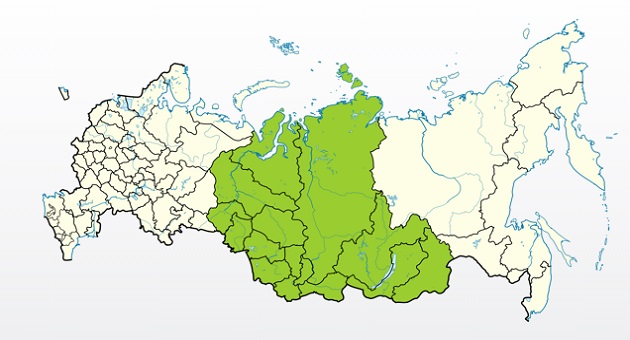
Growing regions
- Western Siberia.
- Ural.
- Altai.
Origin
Siberian apple trees are truly unique plants, possessing a number of unique properties and qualities, producing fruit in extreme conditions of prolonged, cold winters and short, rapid warm spells. Therefore, the development of new varieties is always a significant event. One such example was the Zhebrovskoye apple tree, developed and tested at the breeding station of the M.A. Lisovenko Siberian Research Institute of Horticulture, under the direction of L.A. Zhebrovskaya, which gave it its "surname."
Another hybrid variety, Gornoaltayskoye, was used in the breeding process, as were frost-resistant Renets and apple trees that remain unknown. Around the late 1970s, the variety acquired its final form and acquired all the necessary qualities. In 1984, an application was submitted for its classification as an elite variety. In 1999, the Zhebrovskoye variety was included in the State Register and also zoned for the West Siberian region.
Content
Description of the Zhebrovskoe apple tree variety
 The variety has gained wide popularity in just a few decades. Siberia And this is no coincidence. The trees turned out to be quite hardy, easily surviving the most severe frosts, requiring no special care, tolerant of soil deficiencies, low or high humidity, and are not afraid of sudden temperature changes over a short period.
The variety's fruits are tasty and juicy, and can be easily transported even over the longest distances with minimal losses. They ripen almost earlier than all others in Siberia and Urals, are virtually immune to scab or other fungal infections. Despite the tiny size of the fruit, they are recommended for growing not only in small home gardens but also in large, intensive commercial gardens.
Apples: What they look like
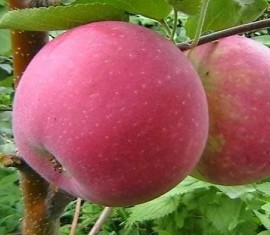
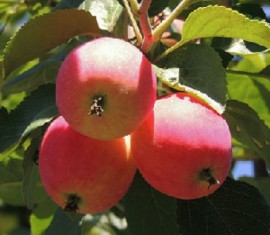
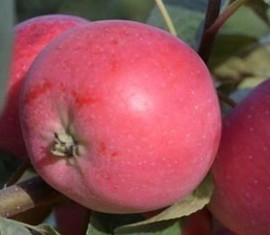
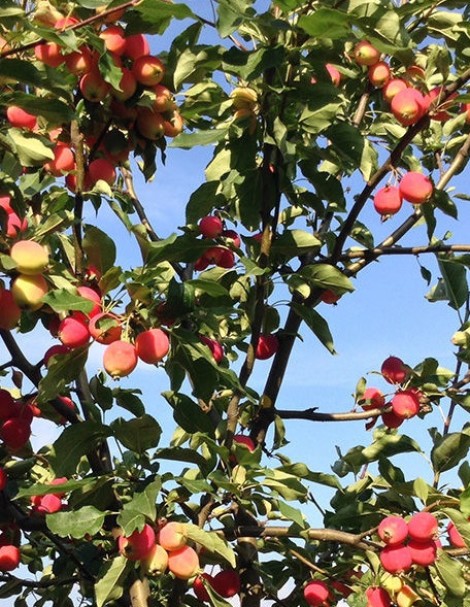
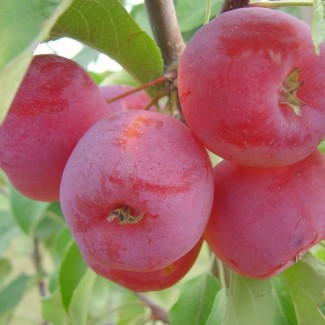
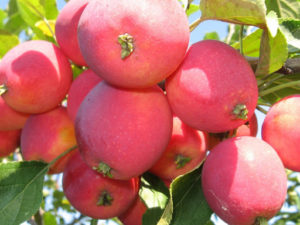 All fruits are small, if not tiny, in size. At their maximum, they can reach no more than 30-45 grams, but more often they barely reach 25-30. They are round and smooth, with clearly visible ribs and a lateral seam, often slightly elongated, conical or turnip-shaped. Upon reaching maturity, they become covered with a waxy coating, which is easily rubbed off by mechanical action.
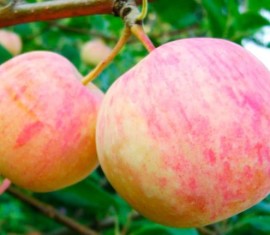
The fruit skin is firm, elastic, and thick, though hardly hard. It is shiny and has a distinct yellow-green hue. More than 84-90% of the fruit surface is covered with a bright red, slightly raspberry-burgundy, beetroot, or carmine-red blush. It is quite dense, mottled and diffuse, and can be somewhat translucent at the edges. Subcutaneous punctures are frequent, quite numerous, and light in color, clearly visible on the apples. The chemical composition is rich and characterized by the following indicators:
- P-active substances (catechins) – 112 milligrams.
- Ascorbic acid (vitamin C) – 16.4 milligrams.
- Sugars (fructose) – 14.4%.
- Pectins (fiber) – 3.17%.
- Titratable acids – 1.21%.
The fruit's flesh is quite dense, crisp, fine-grained, and juicy, with a good consistency. It has a delicate creamy or sometimes slightly yellowish hue, and may have a thin layer of pinkish veins beneath the skin. The flavor is sweet and sour, considered balanced and suitable for table use. The aroma is rich, "thick," easily recognizable, and distinctive. Professional tasters rate the fruit 4.4 out of a possible 5.
Zhebrovskoye apple tree: characteristics
Crown and root system
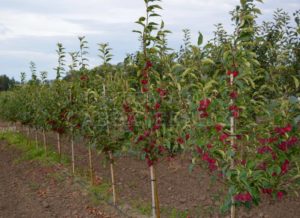 The tree is considered to be of medium height, although some experts call it a natural semi-dwarf. The maximum height of the trunks barely reaches 4-4.5 meters., and even then, with a complete lack of formative pruning. The crown at a young age is most often pyramidal or oval, and remains so. Branches extend from the central conductor at right or wide angles. They are long, straight, with a round or slightly oval cross-section. They are covered with grayish or steel-gray bark, which may be slightly pubescent in places. Fruit ripens on fruiting canes, spurs, and one-year-old growth.
The leaves are oval, slightly elongated, elliptical, leathery, and dense, with a short, pointed tip. They are light green, sometimes even yellowish, matte, and delicately ribbed. The leaf margins are serrated, crenate, and can be deeply serrated, folded like a boat, often with a slight pubescence on the underside. The root system is moderately deep, highly branched, and usually has a central (main) root.
Productivity and pollination
The Zhebrovsky variety's yield is considered average. This is because the number of fruits produced is truly impressive, but their weight leaves much to be desired.
During the growing season, a single tree can yield approximately 16.5-18 kilograms of tiny, aromatic apples. The absolute record is 21.4 kilograms, harvested by a private gardener in the Chelyabinsk region in 2004..
Zhebrovskoe is a self-sterile tree, so within a radius of no more than 50-110 meters, there must be some apple trees growing at the right time for cross-pollination. Bees and wind alone won't help, although attracting them is helpful. This can be achieved by using mobile apiaries and spraying the trees with sugar or honey syrup.
Winter hardiness and disease resistance
The variety is considered a semi-cultivated variety, which is known to cope very well with harsh climates, low temperatures, and sudden temperature fluctuations. Even in temperatures as low as -37-40°C, the apple trees show no signs of frost damage. When they do suffer, they quickly regain their former shape, returning to their normal fruiting pattern within just a year.
The variety is highly resistant to various fungal infections, particularly the most common, scab. Trees are rarely affected, even during the most severe epidemics. Typically, only the leaves are affected, while the fruit remains suitable for consumption and eating. Insects can pose a threat, so regular insecticide treatments are necessary.
Rootstocks and subspecies
This is a new variety, so no subspecies are known. It is grown on a variety of rootstocks. For example, on semi-dwarf or dwarf rootstocks, it can become quite compact, no more than 2-2.5 meters tall, but its winter hardiness suffers. There is no columnar 'Zhebrovsky' variety, so be careful when purchasing.
Features of growing Zhebrovsky
 Landing
 Landing
Basic conditions
- If yield is important to you, you'll need to choose the location carefully. It should be sunny and protected from drafts.
- It's best to have groundwater at least 2.5 meters deep. The tree won't tolerate excessive moisture and may die. Planting Zhebrovskoe near a shallow well, river, spring, pond, or lake isn't a good idea. Swamps, floodplain meadows, lowlands, and other areas with high moisture accumulation are best avoided. A hillock or other elevated location would be a good choice.
- The soil can be anything from fertile black soil to stony loam or sandy loam. The main thing is to loosen it regularly, and fertilizing the trees wouldn't hurt either.
- You can prepare the holes in advance of the planting season, but if you haven't done so yet, you'll need at least 4-6 weeks to let them mature. Dig holes 55-65 centimeters deep and 75-80 centimeters in diameter. Fill them one-third full with fertile soil, additionally mixed with fertilizer. Place any drainage material (stones, bricks, nutshells) on top and leave them outdoors. You can water them, but this is not necessary—nature and natural precipitation will do the rest.
- It is worth immediately driving in a stake for tying, which cannot be removed until the tree gets stronger.
- It is better to leave at least 4.5-5.5 meters between trees so that they do not interfere with each other’s growth in the future.
- Immediately before planting, form a mound inside the hole, and place the seedling on it, spreading its roots. Cover the entire area with soil, water with 25-30 liters of water, and mulch the surface.
Landing dates
There's one simple rule for planting all Siberian apple trees: the further north and the harsher the climate, the preferable spring. If the weather is warm and fairly mild, then Zhebrovskoe can be planted in the fall, after the leaves have fallen, but make sure there are still 3-5 weeks before frost. Otherwise, wait until the soil has warmed completely before planting, for example, in March or April.
Protection from frost and rodents
Trees are very resilient to low temperatures, but proper winter preparation is essential. Watering should be stopped around early or mid-September to allow the sap to settle in the trunks before frost sets in, otherwise the trunks may be damaged. Grass or straw mats are typically placed around the root zone, and the trunks are wrapped with roofing felt, agrofibre, roofing felt, or burlap. Dwarf and semi-dwarf varieties can easily be wrapped like a tent.
To prevent rodents from gnawing the bark or young branches, you can coat the lower part of the trunk with lard or grease. This will repel the pests and drive them away. It's effective against insects. whitewash lime, thick solution, to a height of approximately 1-1.3 meters.
Tree care
 Tree care
Loosening the soil, watering: proper agricultural technology
Dig the root zone twice a year, carefully, being careful not to disturb the roots that run shallowly beneath the soil surface. The rest of the year, simply hoeing the soil, removing weeds and root shoots, is sufficient.
Trees should be watered regularly immediately after planting, approximately once every six to eight weeks. But only if it's not raining. If precipitation does occur, count at least 10 days until the next watering. Mature trees don't need to be watered at all, unless there's extreme heat, but you'll still need to add water along with fertilizers.
Pruning: simple crown shaping
The most common form is a sparse, tiered trunk, which is the most suitable for Zhebrovsky's genus. To achieve this, the central basal shoot is cut back by a third in the first year, and two to three skeletal shoots are left at different heights and spaced apart. These shoots should be 5-7 centimeters shorter than the trunk. Subsequently, the tree should be thinned, maintaining the desired dimensions, and any upward-protruding shoots and inward-growing branches should be removed.
Sanitary pruning requires no less attention. Every fall and spring, you'll need to inspect the trees, removing damaged, dead, broken, and diseased shoots. This will ensure high-quality fruiting the following year. Around 18-20 years old, you can begin rejuvenation by cutting off 2-3 mature shoots and allowing the new shoots to develop.
Pollinator varieties
- Melba.
- Gorno-Altaisk.
- Ranetka Ermolaeva.
- Alyonushka.
- Mantet.
- Minusinsk.
Reproduction
- Rooting.
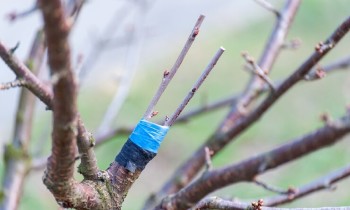
- Grafting.
- Layers (clones).
Diseases and pests
- Rust.
- Scab.
- Powdery mildew.
- Green aphid.
- Codling moth.
- Hawthorn.
Ripening and fruiting of Zhebrovsky
The beginning of fruiting
 The beginning of fruiting
The first fruits can be harvested approximately 4-5 years after planting in open ground. However, they bloom in 2-3 years. To allow the tree time to develop a crown and rhizome before devoting energy to fruiting, all buds are first removed; they must not be allowed to develop into apples.
Flowering period
Almost all Siberian apple trees open their buds fairly early to allow time for fruit production during the short warm spell. By mid-May, the tree is covered in abundant blooms, gathered in small inflorescences. The flowers have weightless, light petals of white or slightly pinkish hue, are very fragrant, and medium in size, though sometimes small. Depending on the weather, the process can last from 10 to 16 days.
Fruiting and growth
Zhebrovskoe is considered fast-growing and early-bearing. It can reach 65-70 centimeters in just one season. The process is much faster until fruiting begins, and then slows down somewhat, but not significantly. Fruit production also increases gradually, and a full harvest can be expected no earlier than 8-10 years after planting. To obtain larger apples, if fruits weighing 45-50 grams can be considered that, the buds should be thinned considerably (by half) during flowering.
Apples are harvested as early as mid- or late August, depending largely on the weather. However, there's no need to rush; the apples can hang freely until frost sets in, as they cling tightly to the branches. However, their flavor may be significantly affected: they'll become soft, crumbly, and sour. Their shelf life is extremely short, no more than 14-20 days, during which time the entire harvest must be completely processed.
Top dressing
- Mineral complexes.
- Manure.
- Humus.
- Superphosphate.
- Compost.
What to do if it doesn't bloom or bear fruit
- Provide watering.
- Check for pests or diseases.
- Transplant.
- Fertilize.
Why do apples fall?
- Natural factors (hail, hurricane, rain).
- Pest damage.
- Diseases.
Please leave your feedback on the Zhebrovskoe variety so that other gardeners can learn something similar from it to enhance their experience.