Gornoaltaiskoe apple tree: characteristics of the variety and care
| Color | Reds |
|---|---|
| Ripening season | Summer |
| Size of apples | Small ones |
| Taste | Sweet and sour |
| Crown type | Average tree height |
| Shelf life | Low shelf life |
| Application | Fresh , For recycling |
| Winter hardiness | High winter hardiness |
| Fruiting age | Up to 5 years |
 History of origin and regions of growth
Growing regions
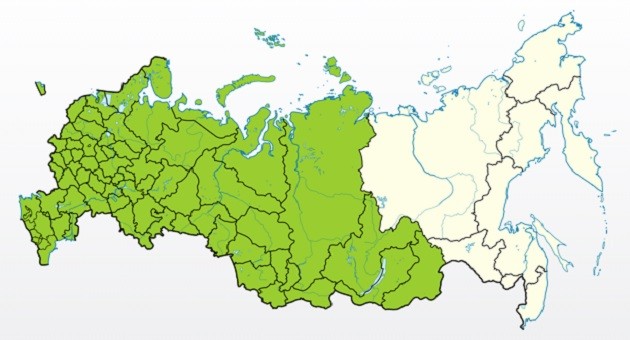
- Middle zone.
- North Caucasus.
- Crimea.
- Some northern regions.
- Ural.
- Siberia.
Origin
For regions with harsh climates, frosty winters, and short, irregular warm spells, it's crucial to breed apple trees that are able to withstand the elements. In 1937, at the Siberian Horticulture Research Institute, under the guidance of the great Russian biologist and breeder Mikhail Afanasyevich Lisavenko, a hybrid was developed, named Gornoaltaysky. M. A. Kukharsky, V. A. Sirokina, and V. A. Sizemova participated in the work. The parents were Pepin saffronii and Ranetka purpurovaya.
The variety inherited the best qualities of its parents, becoming extremely winter-hardy and resilient. After the end of World War II, it was decided to send the hybrid for official trials at various farms across the country, where it performed extremely well. In 1959, the variety was first classified as an elite variety, then entered into the State Register of Breeding Achievements and zoned for the Northern, Central, Volga-Vyatka, Northwestern, and West Siberian regions. It is also available for cultivation in warm southern regions, as well as in Karelia, Primorye, and the Urals.
Content
Description of the Gornoaltaiskoe apple tree variety
 This variety appeared over half a century ago and for many decades was considered a true benchmark for resistance to fungal infections in general, and scab in particular. For this reason alone, it has become a favorite among many gardeners across the country, who grow their gardens in high humidity and cool climates. But this is not the only advantage of the Gornoaltaisk variety: the trees are exceptionally frost-resistant and bear fruit throughout their entire lifespan without resting.
The fruits, although not very large, are beautiful and tasty, contain many vitamins and minerals, keep well, and are suitable for long-distance transport. However, if exposed to excessive moisture, they can crack, which is considered the main drawback of the variety. It is recommended for growing in small household plots or in intensive orchards for commercial juice production.
Apples: What they look like
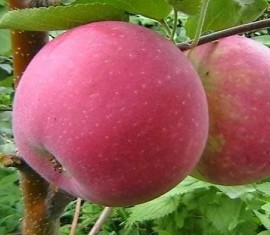
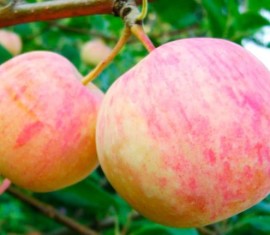
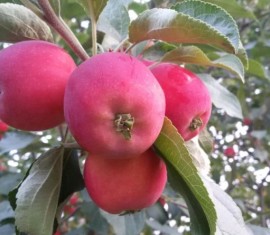
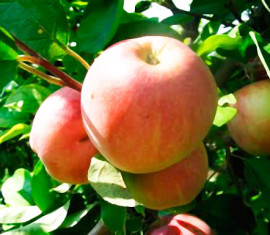
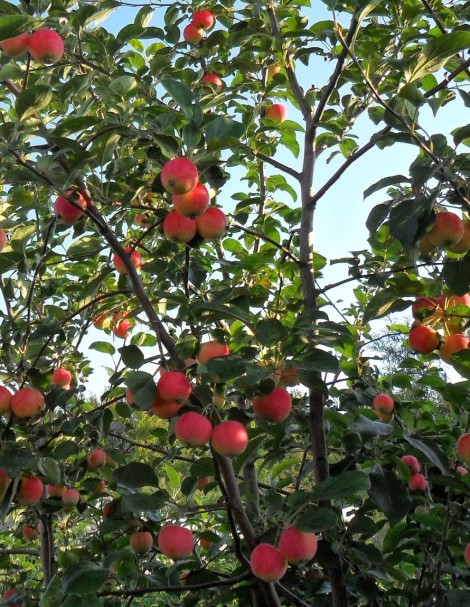
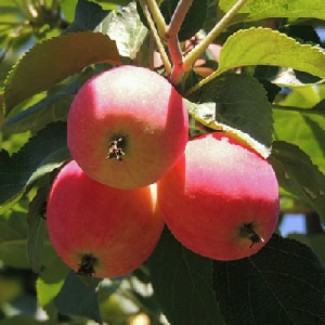
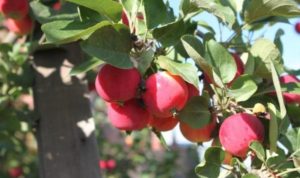 This semi-cultivated variety produces small, sometimes slightly larger, fruits. They can reach a maximum weight of approximately 35-55 grams, and sometimes even 50-75 grams, but no more. They are round, sometimes slightly rounded-conical, elongated, or turnip-shaped. The ribbing, especially at the top, is very noticeable, and the side seam is often clearly visible.
The skin is smooth, dense, but not hard, often glossy, and becomes covered with a thick, dense waxy coating as it ripens. It is green or greenish-yellow in color, but 75-90% is covered with a blush of bright red, crimson, or carmine. When fully ripe, apples can become translucent, almost plump. The blush spots are clearly visible; they are quite large, light green or grayish, numerous, and evenly spaced. It is recommended to assess the chemical composition by comparing several indicators:
- P-active substances (catechins) – 289 milligrams.
- Ascorbic acid (vitamin C) – 24.6 milligrams.
- Sugar (fructose) – 11.4%.
- Pectins (fiber) – 5.1%.
- Titratable acids – 0.99%.
The fruit's flesh is very dense but not hard, with a pleasant texture, crisp, and not prickle-like. It is fine-grained, highly juicy, and creamy or slightly yellowish in color. The flavor is considered a table-like, balanced, harmonious, and pleasant, with a sweet and sour balance, leaning heavily toward the tart. The fruit's tasting score is 4.4 out of 5 for flavor and 4.7 for appearance.
Gornoaltaiskoe apple tree: characteristics
Crown and root system
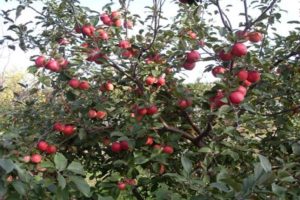 The trees are considered to be of medium height and also fast-growing, although they can safely be classified as natural semi-dwarfs. They stretch to a maximum of 3-3.5 meters, and in warm regions they can grow up to 4This suggests ease of harvesting and care, as well as significantly simplified winter shelter. The crown is oval or rounded, not prone to excessive thickening. The shoots are thick and vigorous, extending from the trunk at an angle close to right angles. They are covered with light gray or even steel-colored bark and are virtually pubescent. Fruiting is concentrated on the fruiting twigs (1-3 years) and ringlets.
The leaves are medium-sized, oval-ovate, rounded, and long-pointed, with a spirally curled tip. They are leathery but not shiny, but matte, with coarse ribbing, a greenish-gray hue, and lightly pubescent on the underside. The root system is moderately deep, but mostly superficial, and branched. A central taproot may or may not be present, depending on the rootstock.
Productivity and pollination
Fruiting is abundant, with apples literally covering the branches during ripening. This variety bears fruit regularly, without any rest periods, making it highly prized by gardeners. Its active lifespan reaches 45-60 years.
The Gornoaltaisk apple tree's yield is considered average, although when measured in terms of the number of fruits per square centimeter of surface area, it's quite impressive. However, due to its small size, the tree can only produce a maximum of 35-40 kilograms of beautiful, ripe apples in a single season..
Gorno-Altaiskoe is considered conditionally self-sterile. This means that several apples, and sometimes even a large number (up to 50% of the harvest), can be produced when there are absolutely no nearby apple trees with suitable flowering times. Therefore, it is better to have varieties suitable for cross-pollination growing nearby.
Winter hardiness and disease resistance
Trees of this variety tolerate even very low temperatures of -40-42°C with flying colors. They don't particularly need shelter, as they tend to recover very quickly from frost damage. However, it's imperative to take cold-weather preparations. It's better to protect the future harvest than to lose it.
Trees are highly resistant to scab, powdery mildew, and other diseases. They can remain untouched by disease, even during years of severe epidemics. However, if they do become infected, only the leaves will be damaged, and the fruit can be eaten and processed.
Rootstocks and subspecies
While no subspecies of Gornoaltaisk are known yet, and they likely won't be bred, they can be grown on various rootstocks. For example, standard rootstocks produce trees that grow quite tall and produce smaller fruits. Dwarf and semi-dwarf rootstocks can produce compact crowns, but at the cost of some winter hardiness. However, these rootstocks can easily be covered, like tents or marquees. The choice should be based on the desired goals and the growing region, with all its peculiarities.
Features of growing Gornoaltaisk
 Landing
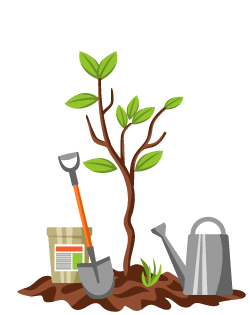 Landing
Basic conditions
- Like all apple trees, this variety thrives in warmth, space, and sun. Therefore, it's best planted in an open, well-ventilated area. However, it can also produce a good harvest in the shade; the tree is very easy to grow.
- Gornoaltaiskoe has no soil requirements and grows well in sandy loam, chernozem, or loamy soil. However, it cannot tolerate excessive acidity; it will become diseased and likely die. To prevent this, neutralize the soil with lime.
- The tree's root system does not penetrate deep, so it is possible to grow trees even where groundwater rises quite high.
- It's not necessary to dig holes for apple trees in advance; you can do so just 4-6 days before planting. To do this, dig a hole 60-75 centimeters deep and 85-90 centimeters in diameter. Add fertilizer to the bottom, cover with a drainage layer, then fill with water and let sit.
- It is enough to leave about 2.5-3 meters between trees; this is just enough to prevent them from clashing with roots or branches.
- It's customary to leave the root collar of the seedling above the ground level to prevent the tree from sending roots higher. If this happens, the rootstock's properties will be compromised.
- Place the seedling on the drainage hole, hold it with your hand and fill it up, compact the surface, water it (25-45 liters), mulch with compost or regular sawdust to retain moisture.
Landing dates
In warm regions it doesn't matter at all when you plant apple trees, in spring or autumn, they take root equally well. However, in Siberia In other harsh climates, it's best to choose the first option. Choose a sunny spring day when the threat of frost has passed and the soil has warmed up completely (late March or mid-April), and then everything will be fine.
Protection from frost and rodents
Despite the tree's resistance to low temperatures, winter preparations are necessary. First and foremost, watering should be stopped no later than mid-September to allow the tree time to prepare for the cold. You can pile soil onto the root zone, or cover it with straw or hay mats. Wrap the trunks with burlap, roofing felt, tarpaulin, or tarpaulin, and, if necessary, cover the trees with a tent.
To protect seedlings from attacks by hungry rodents that come looking for food near human habitation in winter, the easiest way is to coat the trunks with melted animal fat, but you can also use solid oil, drying oil, and other pungent-smelling substances. whitewash standard trees to a height of 1-1.2 meters.
Tree care
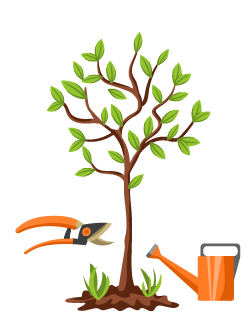 Tree care
Loosening the soil, watering: proper agricultural technology
The tree's trunk area should be dug up approximately once or twice a year; the tree doesn't require more than that. Careful and gentle digging is essential to avoid damaging the roots that run close to the surface. The optimal time for this is late fall and early spring, and the rest of the year, hoe the soil, removing weeds and root suckers. Over time, after approximately 5-8 years, you can cover the tree with sod to make maintenance easier.
Trees should be watered generously and frequently after planting, then stop and apply water no more than 4-6 times during the growing season, and only in very dry and hot weather. Approximately 25-35 liters per mature tree is sufficient. The main thing is not to overwater; if possible, you can use drip irrigation.
Pruning: simple crown shaping
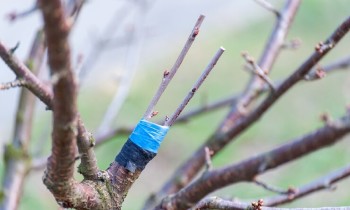
Immediately after planting, it is recommended to prune the seedling by one-third. This means removing both the central trunk and the height of the skeletal lateral branches formed in the nursery. This won't be a problem later, as the tree isn't prone to overgrowth. Regular maintenance pruning in early spring or late fall is sufficient.
It's a good idea to regularly inspect your trees for damage. If there are any dead shoots, cut them off, leaving no stubs, that is, all the way to the next branch, and seal the cuts with a mixture of water and soil (bog) or garden pitch. hares or mice have already gnawed the bark of the trunk, you can prune the tree more, so it will recover faster.
Pollinator varieties
Reproduction
- Rooting.
- Grafting.
- Clones.
- Layers.
Diseases and pests
- Cytosporosis.
- Scab.
- Powdery mildew.
- Black crayfish.
- Green aphid.
- Codling moth.
Ripening and fruiting of Gornoaltaisk
The beginning of fruiting
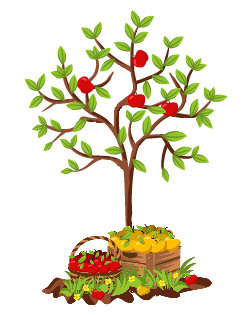 The beginning of fruiting
The apple tree begins to bear fruit for the first time approximately 4-5 years after planting in the garden. However, you'll only get 2-5 kilograms of small, but tasty and beautiful fruits. This isn't a full harvest, but it's enough for a sample.
Flowering time
Siberian apple trees, including the Gorno-Altai variety, begin to open their buds no earlier than mid-May. The process is short, lasting only 6-11 days, after which the petals quickly fall, revealing small green apples. The flowers themselves are beautiful, medium-sized, with delicate, weightless petals of white or slightly pinkish hue. They have a very strong, distinctive, spicy aroma that is unmistakable.
Fruiting and growth
Gornoaltaiskoye is considered a fast-growing variety, capable of growing up to 45-60 centimeters per year. Thus, the trunk reaches its maximum height by the sixth to eighth year, and by the seventh to tenth year, it begins to bear fruit abundantly. By then, each tree can produce half a hundredweight or more of fruit, which produces excellent juice.
The variety is called a late-summer variety because by the end of August, the ripened fruits are usually ready to be picked. However, you'll have to hurry, as if you don't pick them from the branches in time, they can become spongy, have a cottony taste, become sour, and are no longer good for anything. Their shelf life is short, only 60-75 days at most, but it's best to process them all within a month or a month and a half.
Top dressing
- Mineral complexes.
- Humus.
- Superphosphate.
- Manure.
- Compost.
- Peat.
- Ammonium nitrate.
- Chicken manure.
What to do if it doesn't bloom or bear fruit
- Ensure proper watering.
- Check for pests or diseases.
- Transplant to a sunny place.
- Feed.
Why do apples fall?
- Natural factors.
- Pest damage.
- As a result of illness.
- Overripe.
Please leave your feedback on the Gornoaltaiskoe variety so that other gardeners can learn about your experiences growing these trees.