Apple tree Smuglyanochka: characteristics of the variety and care
| Color | Reds |
|---|---|
| Ripening season | Summer |
| Size of apples | Small ones |
| Taste | Sweet and sour |
| Crown type | Average tree height |
| Shelf life | Low shelf life |
| Application | For recycling , Fresh |
| Winter hardiness | High winter hardiness |
| Fruiting age | Up to 5 years |
 History of origin and regions of growth
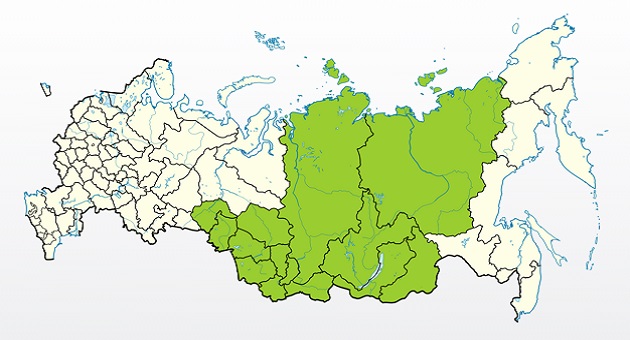
Growing regions
- Buryatia.
- Altai and Altai Krai.
- Kemerovo region.
- Irkutsk region.
- Transbaikal Territory.
- Omsk and Tomsk regions.
- Khakassia.
- Sakha.
- Novosibirsk region.
- Tyumen Oblast.
- Tuva.
- Krasnoyarsk Krai.
Origin
The development of the new variety began at the M.A. Lisavenko Siberian Research Institute of Horticulture (Federal Altai Scientific Center for Agrobiotechnology) in the early 1950s. In 1959, breeders Ida Pavlovna Kalinina, Zoya Aleksandrovna Grankina, Tamara Fedorovna Kornienko, and Ekaterina Semyonovna Orekhova, under the supervision of Mikhail Afanasyevich Lisavenko, crossed the Altayskiy Dessertny and Gornoaltayskoye varieties. The result was a new summer apple tree, named Smuglyanochka.
The variety had a long journey before it was finally included in official lists. It was only in 1991 that it was classified as an elite variety and sent for variety testing to farms near Barnaul. In 2001, the Smuglyanochka apple variety was added to the State Register of Breeding Achievements and zoned for the West Siberian and East Siberian regions.
Content
Description of the Smuglyanochka variety
 The apple tree is considered a semi-cultivated variety and, like all apple trees, is highly ecologically resilient and winter-hardy. It has a neat, compact, and uncluttered crown, is easy to maintain and requires little soil selection, and doesn't require frequent fertilizing, watering, or fertilizer. Smuglyanochka bears fruit regularly, without taking breaks, and is resistant to scab and many other apple tree diseases.
The fruit on the tree is small, but very attractive, tasty, and aromatic. The main drawback is the fruit's size and poor shelf life. Transporting the apples is possible, but also difficult. This variety is recommended for individual garden plots and commercial orchards producing juice, preserves, compotes, and jams.
Apples: What do they look like?
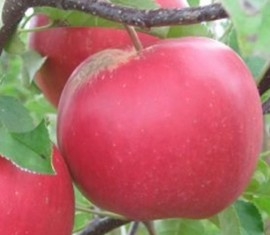
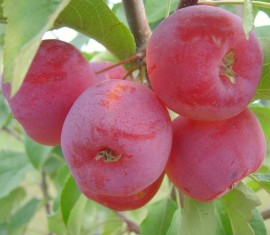
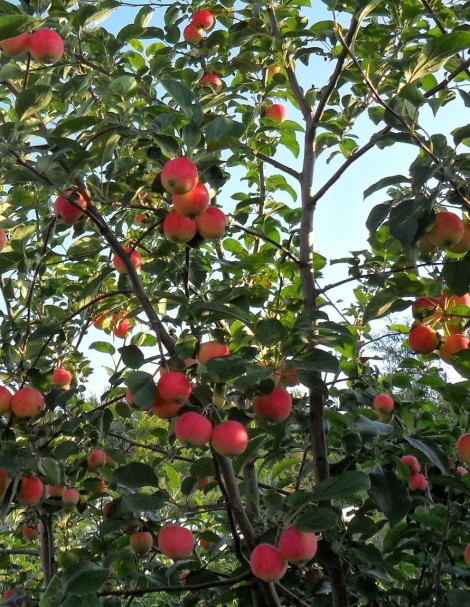
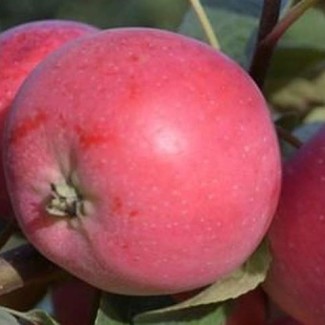
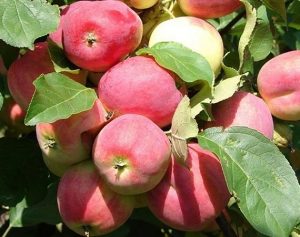 The fruits are small or very small, and can reach 45-60 grams with difficulty, but most weigh between 25-40 grams. They are uniform in size, symmetrical or slightly slanted, round, oval-elongated, conical, and sometimes even cylindrical, with smooth ribbing and no lateral seam.
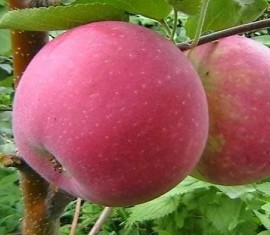
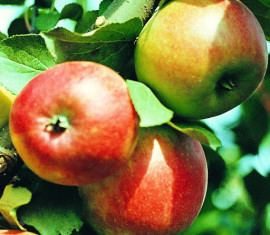
The skin is dense, smooth, and shiny, often covered with a very dense silvery-blue waxy coating during ripening. It is green, becoming greenish-yellow or even yellow-gold over time. The blush covers more than 65-80% of the surface and is dense, thick, mottled, and speckled, purple-red or dark red. Subcutaneous dots are dark gray, numerous, and clearly visible. Experts recommend assessing the chemical composition based on the following data:
- P-active substances (catechins) – 133 milligrams.
- Ascorbic acid (vitamin C) – 18.4 milligrams.
- Fructose (total sugars) – 12.8%.
- Pectins – 4.9%.
- Titratable acids – 0.7%.
The flesh is medium-firm when ripe, crisp, fine-grained, very juicy, and aromatic. It has a distinct creamy or creamy-lemon color, with the skin sometimes featuring dark red veins that give it a pink tint. The flavor is considered harmonious, sweeter, slightly astringent, with a characteristic tartness and a spicy undertone. The official tasting score for the fruit is 4.4 out of 5 for both flavor and appearance.
Apple tree Smuglyanochka: characteristics
Crown and root system
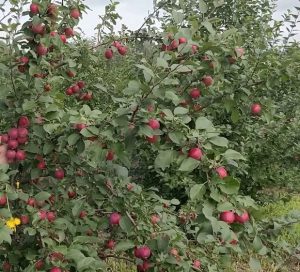 This is a medium-sized tree with a compact, moderately dense crown. It can reach a maximum height of 5-6 meters without pruning.Most gardeners prune the tree in a timely manner to keep its height below 3.5-4.5 meters, as this makes it easier to tend to the garden and harvest the fruit. The crown shape is round or round-oval, broadly oval, with sparsely spaced branches. It bears fruit on one- and two-year-old growth and ring shoots.
The leaves are small, leathery, and dense, with a sharp, serrate-crenate edge and short, pointed tips. They are flattened and matte, with a coarse nervation. Their color ranges from green to dark emerald, rarely yellow-green, and they have a felty pubescence on the underside. The root system is deeply rooted and fibrous, but depending on the rootstock, it may have a central taproot. It is well adapted to seeking water.
Productivity and pollination
Among Siberian apple trees, Smuglyanochka appears to be highly productive, but objectively its fertility can be considered average.
A single mature tree typically yields 70-90 kilograms of delicious fruit per season under standard care. Despite the small size of the fruit, there are indeed a lot of them, which is what enables such a high yield..
The variety is considered conditionally self-fertile, meaning it can bear fruit even in the complete absence of other apple varieties nearby that bloom at the appropriate time. However, this will yield no more than 15-35% of the maximum possible yield. Varieties are interspersed within 45-100 meters of each other to ensure cross-pollination, beehives are brought into the orchards, and the crowns are sprayed with sugar syrup.
Winter hardiness and disease resistance
The Smuglyanochka is an extremely frost-resistant tree. It can survive winters without damage, even when temperatures drop to -35-37°C (-22-99°F) and even lower. It's not afraid of sudden changes from bitter frost to thaws and above-zero temperatures, even when the daily temperature fluctuations are several dozen degrees. However, proper winter preparation and shelter should be carefully considered, so the tree doesn't suffer and waste energy on recovery processes instead of fruiting.
The variety is resistant to scab, although not genetically. Trees are rarely affected by it, and only during years of severe epidemics can leaves become infected. The fruit, however, remains edible. Other diseases are also rare in apple trees, and preventative measures can reduce the risk of their development by at least 85% or more. Insecticide and fungicide treatments should be carried out promptly and regularly.
Rootstocks and subspecies
The Sumglyanochka variety doesn't have any subspecies, but it can be grown on a wide variety of rootstocks. This gives the apple tree some of its unique qualities. For example, tall rootstocks produce the most frost-resistant trees. Dwarf rootstocks are more compact and produce much larger fruit, but they may not be able to withstand the harsh Siberian winters.
Features of growing Smuglyanochka
 Landing
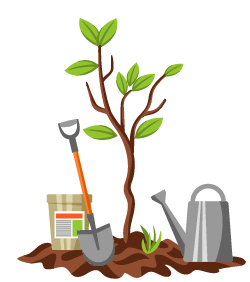 Landing
Basic conditions
- Apple trees need to be planted in open, sunny locations, otherwise they will grow poorly and may even die. Ideally, even if shade falls on the trunks, it should "disappear" by midday.
- It's not recommended to plant Smuglyanochka where groundwater is close to the surface. It should be 2-2.4 meters deep, otherwise the tree will reach the water and begin to rot. Therefore, it's not recommended to plant trees in marshy areas, lowlands, or directly near bodies of water or shallow wells.
- Ensuring good crown ventilation is crucial. The planting areas should be well-ventilated, but without drafts.
- Preparing holes for Smuglyanochka in advance is helpful, but not necessary. This can be done 3-4 weeks in advance, giving them plenty of time to mature. Dig holes 60-80 centimeters deep, fill the bottom with soil mixed with fertilizer, then add another layer of soil or drainage, fill with water, and leave outdoors.
- Leave 4-5 meters between trees, and 4.5-5.5 meters between rows for tall rootstocks. 2-3 meters will suffice for dwarf rootstocks.
- It's common to immediately dig or hammer stakes or planks into the holes to tie the trees down. This is done with regular twine, such as garden twine or mail twine, in a figure-eight pattern to prevent damage to the trees (bark) in windy conditions.
- The seedlings are inspected to ensure the rhizome is intact and alive, and any damaged or dry shoots are trimmed off. For better survival, soak them in water for 6-8 hours before planting.
- When planting, the root collar should remain 6-8 centimeters above the surface to preserve the rootstock's properties. Keep in mind that over time, the soil around the trunk will settle and will need to be replenished.
- Place the Smuglyanochka plant on a mound of soil or drainage material in the center of the hole, spread the roots out so they lie freely and don't bend, and cover with soil, lightly compacting it in layers. A small mound of soil is placed around the perimeter of the hole, 35-40 liters of water is poured inside, and the surface is mulched to improve moisture retention.
Landing dates
Trees with closed root systems can be transplanted into open soil at any time. They thrive in their root ball, but even in open soil, apple trees do not die, as they are unpretentious and hardy. It is preferable to plant them in the spring, around the second ten days of April, so that the soil has time to warm up completely. In the harshest regions, where spring arrives late and late frosts threaten, planting is possible until mid-May.
Tree care
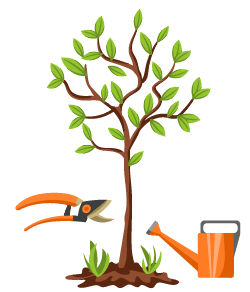 Tree care
Protection from frost and pests
Apple trees are well adapted to frost, but it's important to remember to prepare for winter and provide shelter. Watering should be stopped by mid-season. August, and then perform another, "control," irrigation when the leaves have fallen. If it rains during this time, there's no need to worry about adding moisture. The trunks are wrapped in rags, old tights, or burlap, and the roots are covered with spruce branches, straw, or hay. Low-growing trees can be covered with a tent-like covering.
To prevent pest damage to trees, they should be regularly treated with insecticides and other similar antiparasitic products. Trunks should be whitewashed with lime up to a height of 1-1.2 meters and also coated with grease, fuel oil, or lard to repel rodents.
Loosening the soil, watering: proper agricultural technology
It's recommended to dig around the tree trunk no more than twice a year, in early spring and late fall. It's important not to dig too deep with a shovel, as some roots may be near the surface. Throughout the summer, you can lightly hoe the soil, loosening it and removing weeds and other plant shoots. It's best to do this the day after watering, so the soil doesn't become compacted into a solid layer.
Water Smuglyanochka regularly, especially in the early stages until it's fully established. Initially, water once every 10-12 days, but after one or two years, you can reduce the frequency to three to six times per growing season. These waterings can be timed to coincide with flowering, bud formation, and harvest ripening. Fertilizers and groundbait can also be dissolved in the water.
Pruning: simple crown shaping
To achieve the desired compact size, pruning should begin in the first year after planting. A sparse, tiered crown, with the skeletal branches spaced widely apart and at varying heights, is considered the most suitable. However, any other shape, such as a bowl-shaped one, can be created if desired.
In spring and fall, the crown is also thinned, removing unnecessary, upward-protruding shoots, called water sprouts, as well as those growing inward. Dry, diseased, and broken branches are also cut off, and all wounds are sealed. garden pitch, paint, or at least a swamp.
Pollinator varieties
Reproduction
- Layers.
- Grafting cuttings.
- Clones.
- Growing from seeds.
Ripening and fruiting of Smuglyanochka
The beginning of fruiting
 The beginning of fruiting
Apple trees don't begin to bloom their first buds very early, only in the fourth or fifth year after planting in open ground. However, on dwarf or semi-dwarf rootstocks, the first fruiting can occur even earlier, as early as the second or third year. Of course, you'll have to wait a bit longer for a full harvest, but it's enough to figure out what kind of variety it is.
Flowering time
The Smuglyanochka variety blooms just as the region's apple trees begin to bloom en masse. This typically occurs in May, from early to late May, depending on climate and weather. In temperate regions, the buds typically open around the 5th to 10th, and the process lasts approximately 14 to 18 days. The flowers themselves are medium to medium-large, beautiful, soft pink, and fragrant, gathered in clusters of 5 to 9.
Fruiting and growth
Because the tree rapidly grows foliage, fruit production also increases quite quickly. While fruit production in the early years is only a few kilograms, it reaches full production by the 8th to 10th year. When young, it bears fruit approximately every year, sometimes for 2-3 years in a row, after which it takes a resting period. When mature, it produces fruit every other year, and in old age, it may bear fruit only occasionally, every 3-4 years.
Apples ripen in the summer, around August. This also depends on the weather and regional conditions. In most cases, the entire harvest can be harvested by mid-month, preventing it from falling to the ground. While some say the fruit has a medium shelf life, this isn't entirely true. In a cellar or even in a special refrigerator, in wax, sawdust, or sand, they can be stored for no more than 30-45 days. After that, they wilt, lose flavor and appearance, become soft, crumbly, and lacking in juice, and begin to rot and taste bitter.
Top dressing
- Manure.
- Peat.
- Humus.
- Superphosphate.
- Compost.
- Chicken manure.
- Wood ash.
- Dolomite flour.
What to do if it doesn't bloom or bear fruit
- Inspect for diseases or pests.
- Limit or increase watering.
- Feed or apply fertilizer.
- Transplant to a sunny place.
Why do apples fall?
- Natural weather conditions (wind, rain, hurricane, hail).
- Overripe.
- Pest damage.
- Diseases.
Share your own experience with the Smuglyanochka apple variety so that any gardener can learn about it before planting and achieve maximum results.