Russian Beauty Apple Tree: Variety Features and Care
| Color | Reds |
|---|---|
| Ripening season | Summer |
| Size of apples | Average |
| Taste | Sweet and sour |
| Crown type | Average tree height |
| Shelf life | Low shelf life |
| Application | Fresh , For recycling |
| Winter hardiness | High winter hardiness |
| Fruiting age | From 5 years old |
 History of origin and regions of growth
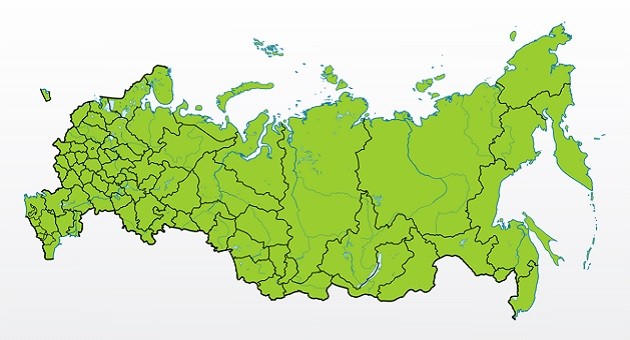
Growing regions
- Middle zone.
- North Caucasus.
- Ural.
- Moscow region.
- Leningrad region.
- Far East.
- Crimea.
- Northern regions.
- Siberia.
Origin
Most likely, the variety belongs to the Ural, Oryol, Far Eastern, or Altai breeding groups. There is no information about it in the State Register, and it has not undergone official zoning. However, the apple tree is grown practically throughout our country, including even the most inhospitable regions, such as Primorsky and Khabarovsk Krai.
Content
Description of the Russian Beauty variety
 This fast-growing, compact, and beautiful tree is particularly easy to maintain. It begins bearing fruit early, produces fruit regularly without resting, and requires little maintenance, frequent watering, feeding, or fertilizing.
The standard apple trees easily withstand even severe frosts and are highly resistant to fungal infections. The fruits are very beautiful, aromatic, and delicious. Despite the short lifespan of the apple trees, the Russian Beauty is recommended for growing both in commercial intensive orchards and in small home gardens.
Apples: What do they look like?
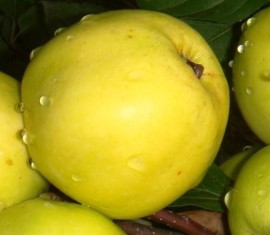
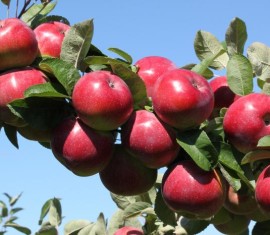
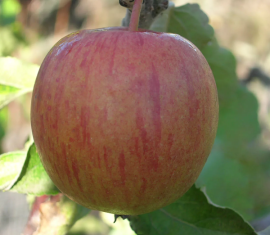
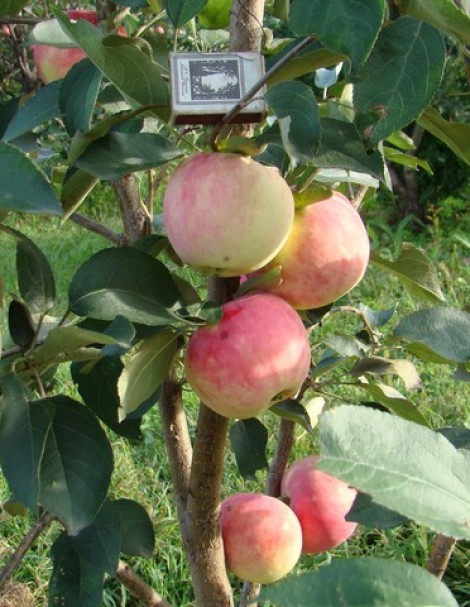
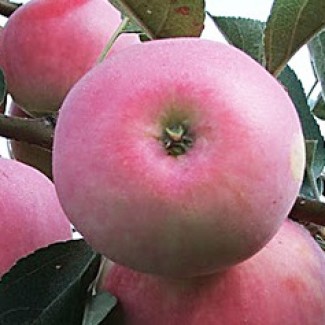
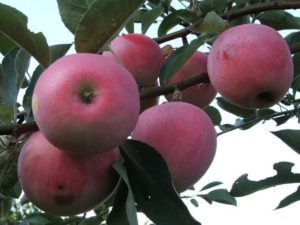 The fruits are usually medium or slightly larger than average in size. In favorable years, with intensive fertilizing and timely, proper care, they can grow to 130-160 grams in weight, and in some cases up to 170-190 grams, but these are solitary specimens. The fruits are generally uniform, symmetrical, spherical or slightly flattened on one side and conical on the other. The ribbing is virtually invisible.
The skin is firm but not thick, elastic, and protects the flesh well from mechanical damage. It is smooth and glossy, but during ripening, it becomes covered with a very dense waxy coating, giving the apples a matte, bluish-gray appearance. The base color is light green or white-green. The blush is mottled, streaked, spotted, and diffuse, raspberry, red-pink, or cherry red, and covers 75-90% of the surface. Subcutaneous punctures are small and numerous, but grayish and difficult to see against the variegated surface. The chemical composition is usually assessed based on the following data:
- P-active substances – 325 milligrams.
- Ascorbic acid (vitamin C) – 11.2 grams.
- Sugar (fructose) – 12.1%.
- Titratable acids – 0.47%.
- Pectins (fiber) – 9.8%.
The flesh is quite dense, fine-grained, crisp, and even slightly prickly, yet tender. It is very juicy and aromatic, with a distinctive, distinctive aroma. The flavor is sweet and sour, slightly wine-like or lemonade-like, and is considered a dessert fruit, though it has not been officially rated by a professional taster.
Apple tree Russian Beauty: characteristics
Crown and root system
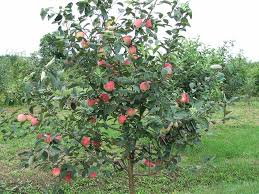 The tree is considered medium-sized, as it cannot grow more than 3.5-4 meters even without any formative pruning.The crown is compact, rounded or rounded-oval in shape, and moderately dense. Branches extend from the trunk at a nearly right angle; they are thin, long, and straight, covered with dark brown or tawny-brown bark. Fruiting occurs on spurs and rings.
The leaves are medium-sized, oval, elongated, and pointed. They are thick and leathery, glossy, dark green or emerald in color, shiny, and pubescent on the underside, with coarse ribbing. The root system is medium-deep, branched, and well adapted to penetrating deep into the soil to search for water. Depending on the rootstock, it may or may not have a central sucker.
Productivity and pollination
This variety is early-fruiting and fast-growing, but its yield is average. Its performance is good for Siberian and Far Eastern apple trees, but in temperate climates, this apple tree won't impress with its fruit production.
From one fully mature tree trunk, thrifty owners can collect 55-70 kilograms of very fragrant, tasty fruits per season..
The Russian Beauty doesn't require pollinators to produce a harvest, which is what makes it so appealing to gardeners. It's self-pollinating, requiring only wind and bees. Therefore, it's common to bring mobile apiaries into the garden during flowering and spray the trees with honey or sugar syrup.
Winter hardiness and disease resistance
The tree is completely immune to severe frosts. It easily tolerates temperatures down to -40-42°C, without requiring any extraordinary sheltering measures. However, experienced gardeners still advise remembering to prepare apple trees for winter to preserve your orchard and maintain a consistently high yield.
Beauty is fairly tolerant of fungal infections and other common apple tree diseases. It only gets sick during years with severe epiphytotics, but when it does, it's severe and rapid. Therefore, it's best to carry out preventative measures promptly and regularly.
Rootstocks and subspecies
Official sources provide minimal information about the apple tree itself, let alone its subspecies. It is known for certain that the variety can be grown on different rootstocks, slightly altering some of its qualities. For example, dwarf rootstocks produce larger fruits, but their frost resistance decreases.
Peculiarities of growing Russian Beauty
 Landing
 Landing
Basic conditions
- Apple trees appreciate good ventilation, but drafts can kill them. Therefore, the planting site for Beauty should be chosen appropriately. Stagnant air should be avoided, but drafts should be avoided as well.
- A sunny, open space should allow sunlight to reach the trees for most of the day. In the shade, they grow weak and may not bloom or bear fruit.
- The groundwater level should be no higher than 2.5-3 meters, otherwise the apple tree will reach it and begin to rot. If there's no other place to plant, you can dig a sheet of slate or a layer of roofing felt at a depth of about two meters to direct the roots away from the water.
- Holes are prepared in advance, dug 6-9 months before planting. However, not everyone plans their garden plantings in advance, so if necessary, holes can be dug 2-4 weeks in advance. They are dug 70-80 centimeters deep and up to 1 meter in diameter, filled with fertilizer or a soil-mixed mixture at the bottom, lined with drainage, and filled with 50-60 liters of water.
- It is customary to leave 2.5-3 meters between apple trees in a row, and a little more between rows, approximately 3-3.5. This will prevent mature trees from interfering with each other and competing for water and nutrients.
- Stakeboards or stakes are immediately driven into the holes to support the trees. These can be plastic, metal, or wood. If placed on the north side, they will not only provide support but also provide additional protection from the winter cold.
- Before planting, the roots of the seedlings are inspected, any excess (broken, rotten, dry) is cut off, and they are placed in warm water for 6-8 hours so that they are saturated with moisture and take root better.
- The root collar should always be left above the surface if the qualities of the rootstock need to be preserved.
- Place the seedling on a drainage platform, spread the roots out by hand, cover with soil, and compact the soil, ensuring no air pockets or voids form. This can cause root rot. However, over-tampdown is also not recommended, as this will cause discomfort for the roots. Water from above with 35-50 liters of water. mulch when moisture retention is required (dry climate and/or weather).
Landing dates
Apple trees can be transplanted into open ground in spring and fall, and those with closed root systems can be transplanted at any time during the growing season. In moderate and warm climates, there's little difference between March-April and September-October, but in harsher regions, spring is a better choice.
Tree care
 Tree care
Protection from frost and pests
Despite the plant's resistance to low temperatures, it can die without proper preparation and protection. Watering is reduced in August, and by September, any moisture other than natural precipitation is completely eliminated. Mats of straw or hay, dried leaves, and spruce branches are placed around the root zone. Trunks are wrapped with burlap, old tights, or roofing felt. If possible, trees can be covered with a tent-like covering, especially for young and vulnerable trees.
Whitewashing tree trunks with lime is effective against insects. It's best to do this twice a year, as spring insects tend to wash away by fall, and vice versa. Repellent for rodents include lard, fuel oil, grease, and other pungent substances, generously applied to the lower part of the trunk.
Loosening the soil, watering: proper agricultural technology
Dig the soil around the apple tree at least once a year, but twice is recommended to improve aeration. In between, it's a good idea to hoe the soil, removing any weeds, root suckers, shoots, and other debris. You can lay sod around the root zone in the sixth or seventh year of the tree's life or sow the area with herbs. This will ensure natural aeration, reducing the time required for maintenance.
Apple trees only need watering when they're young or during the driest and hottest years. Even then, it's recommended to water no more than 4-6 times per season, even in extreme conditions when there's been no rain for extended periods. Watering can be timed to coincide with flowering, fruit set, and fruit growth and ripening. Fertilizers are added at this time; they are absorbed much more easily with water.
Pruning: simple crown shaping
Trees are not prone to excessive thickening, but shaping is essential. During the first year, the tree is left alone, allowing it to develop foliage, and in the second year, about a third of the central shoot is removed. All lateral skeletal shoots are pruned, leaving two to four main, strongest shoots, spaced well apart. These shoots should be 5 to 8 centimeters shorter than the trunk and their upper "neighbors."
In spring and fall, inspect the crown for dry, diseased, or broken branches. These should also be removed immediately, and the wounds sealed with garden pitch. To prevent excessive overgrowth, remove all shoots growing inward or sticking up vertically.spinning tops).
Pollinator varieties
- Folder.
- Melba.
- Wine.
- Aborigine.
- Glory of Primorye.
- Ostankino.
- Mantet.
- Borovinka.
Reproduction
- Rooting.
- Kidney grafting.
- Cuttings.
Diseases and pests
- Scab.
- Bacterial burn.
- Powdery mildew.
- Green aphid.
- Codling moth.
- Leaf roller.
- Hawthorn.
Ripening and fruiting of Russian beauty
The beginning of fruiting
 The beginning of fruiting
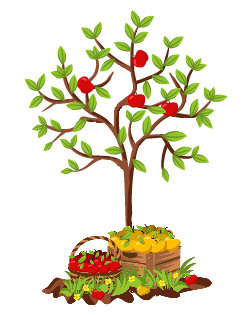
This delicate, slender tree begins to bloom for the first time in its third or fourth year, but it will likely bear no fruit, as no apples will form. To avoid wasting energy, it's best to pluck off these barren flowers immediately. In its fifth or sixth year, you'll be able to harvest your first crop. It won't be large, only 4-7 kilograms of fragrant fruit, but the scent of ripening apples will be detectable from several hundred meters away, and they have a corresponding flavor—a taste worth trying.
Flowering time
This beauty is one of those apple trees that manages to bloom and ripen its fruit during the very short, albeit hot, Far Eastern summer. Therefore, it begins blooming significantly earlier than other varieties. By late April or early May, the trees are bursting with beautiful, large, snow-white or slightly pink buds. These saucer-shaped, intensely fragrant blossoms are gathered in clusters of 5-8, densely covering the branches, giving the tree a beautiful appearance.
Fruiting and growth
The tree grows very quickly, reaching 55-60 centimeters per season before bearing fruit. After the Russian Beauty begins bearing fruit, growth slows slightly, by about a third. However, the apple tree reaches its maximum size in just a few years. Fruiting increases proportionally with growth, and by the 8th to 11th year, harvests are fully realized. This tree never rests, making it even more beloved by gardeners.
The fruits begin to ripen as early as August. In warmer climates, this happens by the very beginning of the month; in harsher climates, it can be slightly delayed, until mid- or even late-season. They ripen uniformly, so they can be picked all at once. Ripeness is most easily determined by the thick, waxy coating that covers the surface. Apples shouldn't be stored for long; in a cellar or a special refrigerator, they will last no more than 30-45 days, or 60 at the most. By then, it's best to completely process them or eat them; otherwise, they will become soft, chewy, and sour.
Top dressing
- Peat.
- Compost.
- Ammonium nitrate.
- Humus.
- Chicken manure.
- Superphosphate.
- Manure.
- Mineral complexes.
What to do if it doesn't bloom or bear fruit
- Check for pests or diseases.
- Transplant into the sun.
- Water.
- Fertilize.
Why do apples fall?
- Wind, hail, hurricane, rain.
- Pest damage.
- Diseases.
Please leave your feedback on the Russian Beauty variety so that other gardeners can learn from your experience and draw conclusions from it.