
Planting an apple tree in open ground in spring: step-by-step instructions on when and how to plant seedlings
Every garden in Russia grows apple trees. They are the most popular fruit tree. Gardeners typically plant several varieties and varieties with different ripening times to ensure they and their families have enough fruit to last the entire year.
This is a zoned variety; timely and correct planting will provide your family with delicious fruits for many years, even a lifetime.
Content
- When to plant an apple tree in spring
- When is it better to plant – in spring or autumn?
- Benefits of spring planting
- Spring planting dates in different regions
- According to the lunar calendar 2020
- Spring apple tree planting algorithm: a step-by-step guide on how to plant a seedling correctly
- Planting an apple tree with a closed root system
- Planting an apple tree with a high groundwater level
- Caring for an apple tree after planting in spring
When to plant an apple tree in spring
The timing of apple tree planting in spring is determined by the region's climate. However, two rules remain constant:
- The tree must be in a dormant state, that is, until the buds open.
- Optimal daytime and nighttime temperatures for planting are +3 – +5 degrees, throughout the week.
The soil does not necessarily have to be warm, it is desirable that it thaws to the depth of a shovel blade.
Planting should be done on a windless, cloudy evening, because in the morning soil cold, and warmer in the evening. When planted in the evening, the seedling is less susceptible to stress, since there is more night, and not a bright day.
When is it better to plant – in spring or autumn?
Apple trees are planted as in autumn, and in the spring.
Traditionally, it's best to do this in the fall. The plant doesn't vegetate, but merely develops roots, then goes into winter dormancy. However, after planting, there should be 3-4 weeks before the first frost, allowing the seedling to take root and become strong. Often in the northern regions In the temperate and temperate climates, frosts come unexpectedly. Under these conditions, a young tree can die, and its root system can freeze. Therefore, spring planting is preferable in these regions. In the southern regions It is better to plant apple trees in the fall.
Benefits of spring planting
Planting in open ground in spring is carried out before the growing season begins and has several undeniable advantages.
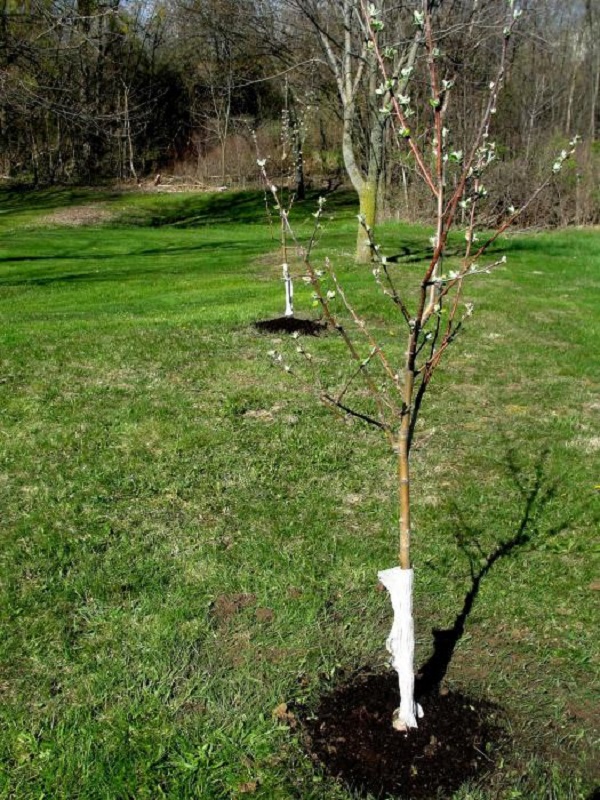
- Throughout the growing season, you can monitor the plant: how it develops, for diseases, and take the necessary measures in a timely manner.
- A seedling planted in spring takes root faster because there is more moisture in the soil in spring and vegetation is more active if the planting time is chosen correctly.
- Planting holes can be prepared in the fall to allow the soil to settle. This is important for proper placement. root collarThe development of the tree depends on this.
Over the summer, under supervision, the tree will strengthen and be ready for the coming winter.
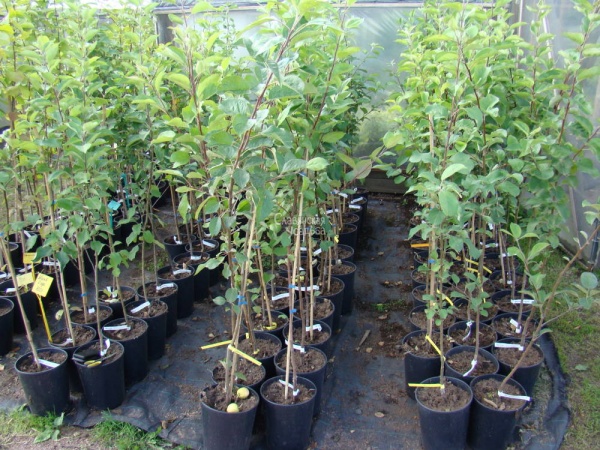
Seedlings with closed root system (Container-grown) can be planted throughout the growing season, from spring to fall. The key is to choose suitable, cool weather.
Spring planting dates in different regions
Compliance with the timing of spring planting is the most important condition for the successful survival of the seedling.
These periods vary in different climate zones:
- Northern regions of Russia, Ural, north of the Leningrad region, Siberia – approximate dates for planting apple trees are from April 20 to May 15.
- Central and Southern regions – from March 15 to April 15.
- Central Russia – from April 10 to May 10.
If the spring is early and warm, the timing may shift. Temperature and soil conditions should be taken into account.
According to the lunar calendar 2020
No one doubts anymore that the phases of the moon play a crucial role in plant growth. Years of gardening experience confirm this, and it's recommended to choose specific dates for planting when the moon is favorable for a particular crop.
To determine the date of planting apple tree seedlings will help Lunar calendar for 2020.
Favorable days
- March 26–29;
- April 11–15, 24, 25;
- May 2–10.
It is advisable to choose one of these dates.
During the full moon and new moon, plants stop growing, as these days are said to be barren.
Unfavorable days:
- March 9, 19–21, 24;
- 8, 15–17, 23 April;
- May 7, 13, 14, 22.
You need to pay attention to these dates and try to choose favorable days for planting apple trees.
Spring apple tree planting algorithm: a step-by-step guide on how to plant a seedling correctly
Dreaming of growing a beautiful apple orchard, a gardener must take several necessary steps and follow a few rules. All this will ensure high-quality work and successful seedling survival.
Selecting a seedling and preparing it for planting
When purchasing a seedling, you should take into account the size of the garden and the proximity of groundwater.
The apple tree's root system cannot tolerate stagnant water and the tree dies.
- If the groundwater level is above 2.5 meters, choose medium- or low-growing apple varieties. Tall trees (6–8 meters) have roots that extend deep into the soil and won't tolerate standing water.
- It is best to select seedlings from a local nursery, where the plants are grafted and adapted to the local climate.
- Two-year-old plants are ideal for planting. Two-year-old plants have 2-3 lateral shoots branching off from the main trunk at an angle of 45 to 90 degrees.
- The trunk must be smooth, without growths and scratches, up to 1.5 m high.
- The roots are elastic, about 40 cm long. If you pull gently, the root will begin to stretch, but will not break.
- The bark should be green when scraped with a fingernail.
- Seedlings with an open root system should not have unfurled leaves.
When transporting seedlings with bare roots, wrap them in a wet cloth and cover with film; carefully tie the branches to the trunk with rope or tape.
You can buy seedlings for spring planting in the fall. To preserve the planting material until spring, you can place them in boxes in the basement, covering the roots with soil, or bury them in the garden at a 45-degree angle and cover them with an additional layer of soil and dry leaves for the winter.
Preparing for planting seedlings:
- Before planting, you should carefully inspect and cut off rotten roots.
- Place the tree in a container of water for 12 hours before planting; you can add root growth stimulants to the water.
- If the above-ground part is large and the root system seems weak, the branches should be trimmed and shortened before planting.
The most important thing about a seedling is a well-developed and healthy root system. It's better to choose a plant with a large root system and a small above-ground part, rather than the other way around.
A suitable place in the garden
Apple trees love the sun and elevated areas where water does not accumulate or stagnate after rain or melting snow.
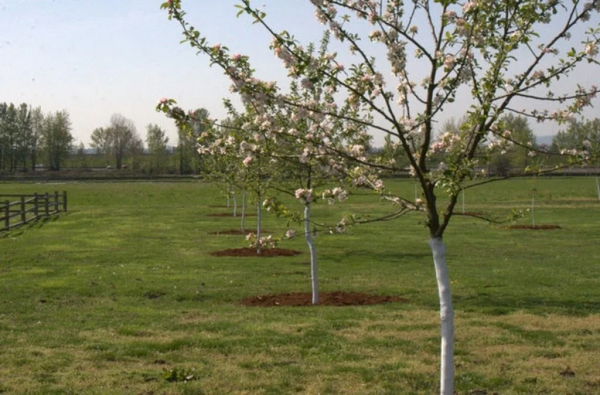
If the site is low-lying and has a high groundwater table, an artificial embankment should be created before planting the trees. The site should be protected from strong north-facing winds by a house or fence. Steep slopes and swampy areas should be avoided for planting.
At what distance should I plant?
If you plan to plant several trees, it's important to create a garden plan before planting. Mistakes will be almost impossible to correct later.
Overcrowding will lead to a lack of light and a reduction in yield, and will also create conditions for the development of fungal diseases.
- Tall varieties are planted at a distance of 5–7 m from each other.
- Medium-sized, 3–4 m.
- Low-growing and dwarf species are placed at 3–1.5 m between seedlings.
- Columnar varieties can be planted at a distance of 0.5 m.
A proper garden plan ensures its development for many years.
Necessary soil
Apple trees are unpretentious and undemanding to soil if:
- these are not salt marshes;
- all necessary agricultural measures were carried out during planting;
- Regular care of the plantings is carried out, fertilizers are added to the soil.
The ideal soil for an apple orchard is light loam. Therefore, when digging, dilute clay soil with sand at a ratio of 2:1, and sandy soil with peat. humus in a ratio of 2:1:1. Learn more about soil preparation.
Preparing the planting hole: when to dig and what size
For spring planting, the hole is prepared 2 weeks in advance or in the fall.
| Type of apple tree | Depth of planting hole, cm | Planting hole diameter, cm |
| Tall varieties | 70 | 100–110 |
| Medium-sized varieties | 60 | 100 |
| Low-growing varieties | 50 | 90 |
When digging a hole, you need to separate and store the top, more fertile, and bottom layers of soil separately.
How to prepare a nutrient mixture (substrate) for a planting hole
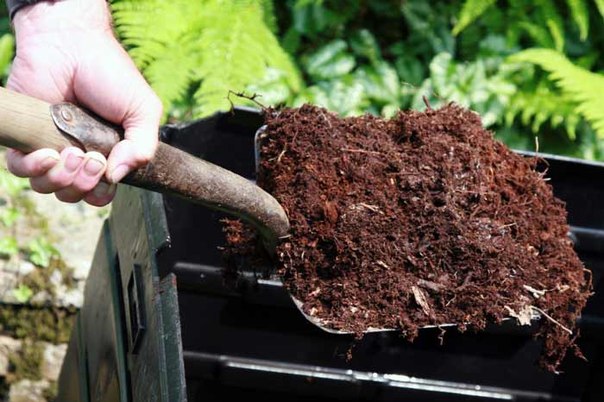
For planting, you need to prepare a nutrient mixture of the following composition:
- 6 kg of compost;
- 200 g superphosphate;
- 150 g potassium chloride;
- 1 kg of dolomite flour if the soil is acidic.
Or an alternative could be this type of soil mixture:
- compost bucket;
- a bucket of non-acidic peat;
- a bucket of sand;
- 400 g of nitroammophoska.
You can't use fresh manureWhen decomposing, it releases ammonia and hydrogen sulfide, poisoning the roots.
Landing
To the bottom of the pit a drainage layer is laid; this could be broken bricks, shards of ceramic dishes, or nut shells.
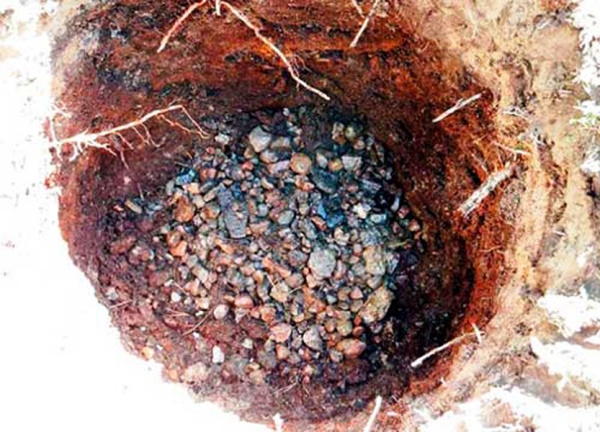
Next, fill the hole 1/2 full with soil, alternating layers of fertile soil and nutrient mixture.
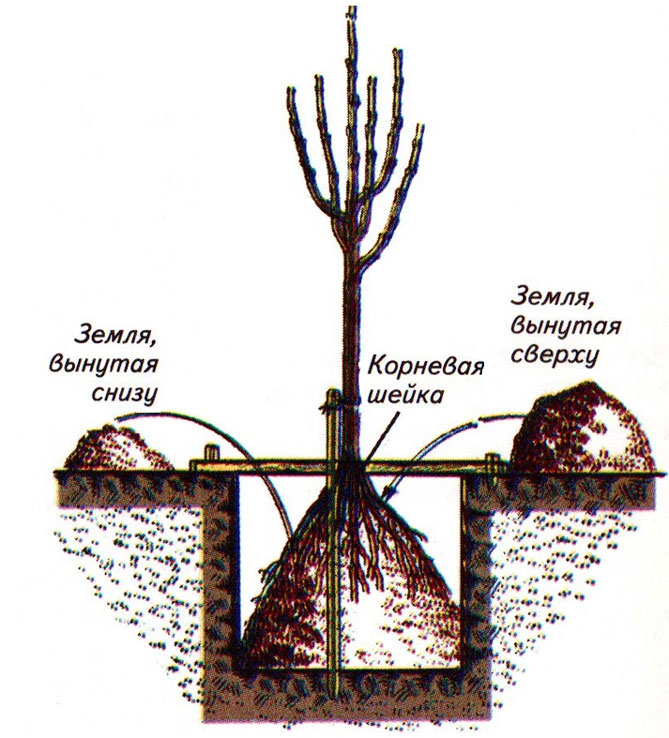
A mound is formed in the hole, into which, slightly retreating from the center, a 2 m high stake is driven in. It will serve support for a seedling.
The seedling is placed on the mound, the roots are spread out, and it is filled with the remaining soil and fertile soil mixture. Care must be taken to ensure that no voids remain between the roots. Root collar and the grafting site should remain 2–5 cm above ground level.
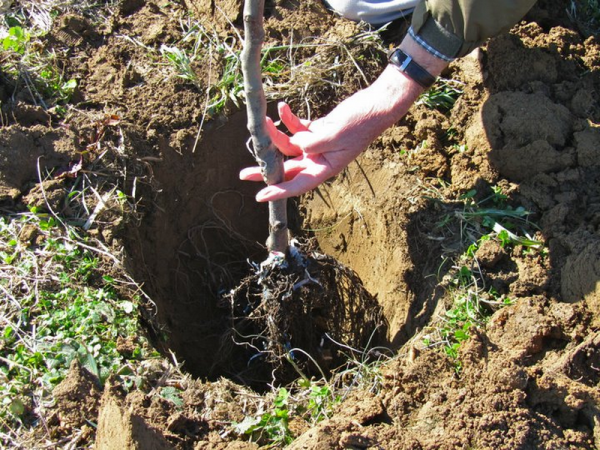
The soil around the tree should be trampled down and a watering hole with a diameter of 1–1.3 m should be formed.
After landing you need to water the tree is watered abundantly – 20–25 liters of water.
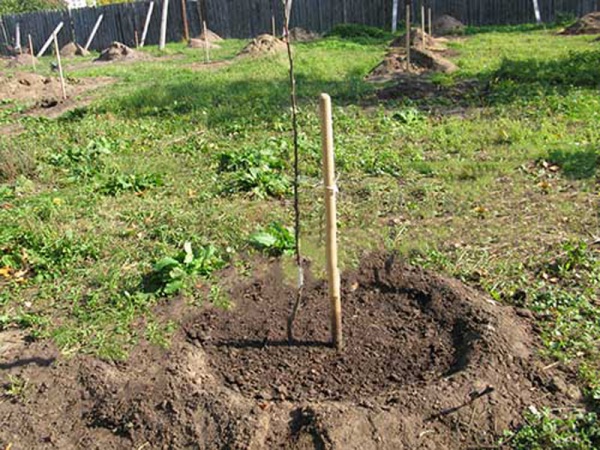
The tree should be tied to a peg with a ribbon in the shape of a figure eight.
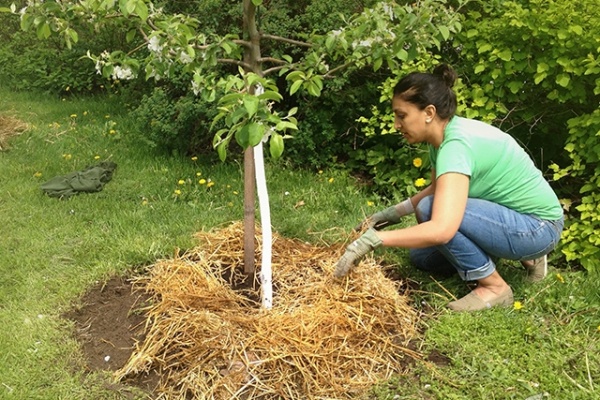
It's best to mulch the area around the tree trunk to help retain moisture in the soil. When mulching, avoid covering the trunk, as this can cause the bark to rot.
Planting an apple tree with a closed root system
Seedlings with a closed root system Can be planted at any time from spring to autumn.
They are grown in containers, protecting their root system and preventing damage. These plants don't experience stress when transplanted into open ground, as they are planted with the root ball, or, if the container is made of peat, directly with the container.
In the first year after transplantation, their growth slows down a little due to acclimatization, but then recovers.
The planting technology is no different from that for regular seedlings.
If the seedlings were kept indoors in a nursery, they need to be hardened off outdoors for three days. They should be brought into the sun for two to three hours, then placed in the shade, and then brought indoors at night.
When planting a seedling with ZKS It is important to remove it from the container correctly:
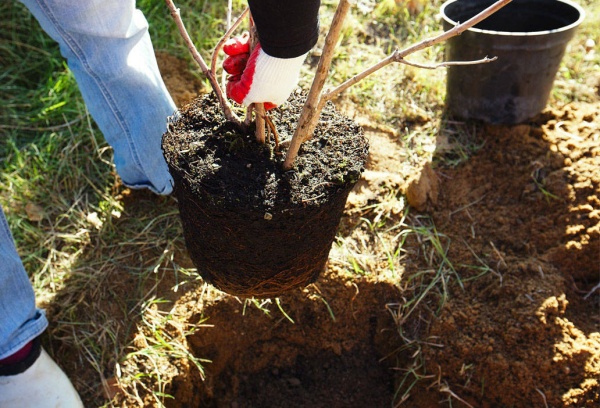
- The day before planting, the root ball must be completely soaked.
- When removing the plant from the container, be careful not to damage the small roots, as they are responsible for feeding the plant.
- If the roots have grown into the container, you should carefully cut it off with a sharp knife.
If, instead of a container, the root ball is wrapped in a metal mesh, the seedling is planted together with the mesh.
Planting an apple tree with a high groundwater level
What should I do? Apple trees don't tolerate standing water.
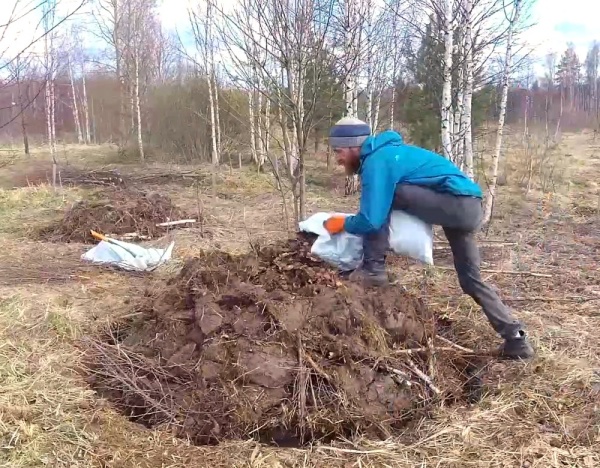
The only way out is to land on an artificial hill:
- At the highest point, dig up the ground – a 2*2 m area.
- Place a wooden box in this place, 80 cm high and 1 m wide.
- Fill the box with soil and potting mix and plant the seedling, following all planting guidelines. Don't forget the stake.
- Cover the entire structure with soil so that the box is hidden from view. You'll need to regularly add soil to this mound to prevent the roots from becoming exposed.
Nowadays, modern breeders have developed apple tree varieties with a horizontal, superficial root system, perfect for areas with stagnant water close to the surface.
Caring for an apple tree after planting in spring
Care for seedlings consists of:
- Watering. Water generously every 2 weeks, 4–5 buckets at a time, until the soil stops absorbing water.
- Mulching the tree trunk area will help retain moisture in the soil.
- In pruning unnecessary branches for the correct formation of the crown.
After planting, the seedlings do not need to be fed, since the planting hole contains a two-year supply of fertilizer.
If the apple tree suddenly blossoms, the flowers need to be picked off; the time for fruiting will come at the age of 4–5 years.
For those who dream of an apple orchard, it won't be difficult to plant the garden correctly so that it will bring joy for many years to come.



Comments
If a seedling was purchased in the fall, it shouldn't be planted that way. It's best to dig it in and plant it in the spring. A seedling dug in will survive well until spring, and if planted in the spring, it will immediately start growing. However, seedlings planted in the fall, as I've noticed in practice, don't take root well. I don't prepare the planting hole this way, of course. Instead, I fill it with good soil mixed with manure and compact it thoroughly as I backfill, about every 20-30 cm of the mixture. This compacts the soil better and reduces settling. If the soil isn't compacted, the seedling will quickly end up back in the hole.
Thanks for the useful material.