Important Summer Gardening Tasks: What You Shouldn't Forget to Do in June, July, and August
Summer is no less a busy time for gardeners than fall. During this period, everything planted in the spring begins to take root and grow. Therefore, gardeners need to take the utmost care of their plants. To avoid missing anything, it's important to properly schedule summer gardening chores.
In June
June is the best time to plant seedlings outdoors. This is also a good time to plant heat-loving annuals in flowerbeds and flower gardens:
- If you are growing dahlias, then in June you should plant them in a permanent location, install stakes and tie up the bushes.
- Perennial seedlings also need to be transplanted into open soil.
- If there are already planted perennials, roses and other flowering plants on the site, then they need to be weeded, fertilized and the soil around them needs to be loosened.
- The side shoots should be cut off, and the tops of the pink shoots should be pinched.
Then you should move on to trees and shrubs. In June, they need high-quality nutrition and moisture. Too often water no need, however everyone watering should be abundant.
Fertilizing and watering should not be done near the trunk. They should be done at or beyond the crown projection. Applying fertilizer directly to the trunk and watering the soil there is downright harmful. The trunk may become covered in moss or lichens, damage was caused to the bark.
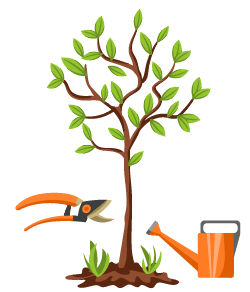 Basic work for fruit trees and shrubs:
- Many gardeners perform formative pruning of trees and shrubs during the summer. This helps improve fruit production. However, crown shaping is only necessary for those plants that have begun to bear fruit poorly.
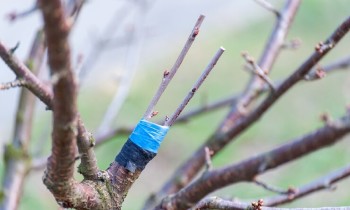
- Particular attention should be paid to vaccinations in June. (especially apple trees). Those shoots that grew from buds grafted at the end of the previous summer season using budding, should be tied to the remaining stumps on the rootstock (if they've already reached 15–20 cm in length). The ties should be placed just above the graft. If the graft was made this year, the bands around the plants should be loosened periodically to prevent damage to the bark.
- It is essential to protect the growing shoots of the scions from parasites and possible diseases (they are most vulnerable at this time).
- Then you should take care that the soil in the tree trunk circles was always moderately moistTrees require the most moisture when they are actively forming fruit and growing foliage. If a drought occurs during this phase, water the trees generously, but not too frequently.
- Berry bushes also respond well to watering: currants, raspberries, gooseberries, and blackberries. If they aren't watered enough in June, you might never get a good harvest.
- If June is rainy, be careful not to let a soil crust form. Loosen the soil as often as possible, but only to a shallow depth (this is especially true for apple trees, whose shallow root systems are easily damaged). If the garden is sown with grass, mow it to speed up moisture evaporation.
- In June, garden plants need fertilizing. This is especially true for trees and shrubs growing on light sandy loams. Fertilize at the very beginning of fruit and berry growth. To do this, dilute an organic fertilizer in water (for example, slurry at a ratio of 1:2, mullein at a ratio of 1:8, or bird droppings at a ratio of 1:20). If you don't have organic fertilizer, substitute it with ammonium nitrate (25–30 g is sufficient) or urea (25–30 g per square meter). Fruiting currant and gooseberry bushes will require approximately 10 liters of solution. Raspberry bushes require 5 liters of solution per square meter.
- Trees are also treated with 10 liters of solution per linear meter, and this should be done in holes dug along the outer perimeter of the crown. After application, the holes should be filled with soil.
- Root suckers, which begin to grow vigorously in early summer, must be removed. Cherries, plums, rose hips, chokeberries, and sea buckthorn are most often affected. It is essential to remove any growth that has invaded frost-damaged trees.
- In June you can safely continue the fight against diseases and pests. Young shoots should be kept free of aphids, ringed silkworms, caterpillars, and codling moths. If pest infestations are few, mechanical and biological control methods should be used. Herbal infusions and decoctions can be used. If pest infestations are severe and chemical treatments are required, be sure to cover the surrounding plantings with covering material to prevent exposure to toxins.
Special attention should be paid to apple trees in June:
- If your apple trees are experiencing consistent fruit loss or smaller fruit sizes, remove the central fruit from each cluster of already formed ovaries in June. Leave 1–2 fruit in each cluster. If necessary, secure the branching shoots with rope or special clamps to prevent the branches from breaking under their own weight.
- If fruit drop was observed in early summer, the apple trees need to be fertilized. You can use organic fertilizer, as described above, as well as mineral fertilizers, either dry or dissolved. Be sure to apply the fertilizer into furrows and holes dug in rings around the tree trunk. No more than 100 liters of solution should be applied per tree.
- Before watering, loosen the soil to ensure the root system receives sufficient moisture. Typically, water no more than once a week, using settled water. The amount of water applied will depend on the age of the apple tree: for trees 2–3 years old, frequent watering is sufficient. glaze in small portions.
In July
 July is considered the most relaxed month for gardening. During this time, it's enough to simply keep the plants healthy and ensure they're free of weeds and pests.
- For tall perennials in flower beds, stakes should be installed. Faded blooms should be removed.
- As a standard, you should regularly weed, loosen the soil and water the plants.
- You can carry out preventative spraying of ornamental plantings with herbal infusions that have fungicidal properties.
- Closer to mid-summer, you need to trim the hedge if it consists of deciduous shrubs.
- Apple trees require foliar feeding in July, as this is the time of intense fruiting, which means they absorb more nutrients. For this type of feeding, you can use mineral fertilizers containing manganese, copper, magnesium, and boron.
- Apple trees older than three years shouldn't be watered frequently during this period. This can lead to a reduced yield. Water them once a month, but generously (approximately 40 buckets per tree).
- During hot summers and dry Julys, young seedlings should be sprayed with water. Spraying should be done in conjunction with watering. All procedures should be carried out only in cloudy weather or early in the morning to avoid the occurrence of burns on leaf blades.
Weather conditions should also be considered when applying fertilizer. In dry and hot weather, the concentration of nutrient solutions should be reduced significantly to prevent burning. The undersides of apple tree leaves respond best to foliar feeding.
In July, a new portion of fertilizer is applied to berry bushes:
- Raspberries require mineral fertilizers at this time. Therefore, for every 10 liters of water, add 10 g of potassium chloride, 40 g of superphosphate, and 20 g of urea. Mix this with water and apply it to the plants. This amount should be enough for 6 bushes. Be sure to loosen the soil.
- Currants don't tolerate chlorine, so you need to carefully calculate the dose of potassium fertilizer. Follow the instructions carefully. If you want to improve the taste of the berries, fertilize the bushes with specialized commercial fertilizers (for example, "Ideal," "Berry Giant," or "Yagodka"). The first feeding should be done before flowering, and the second and third should be done at intervals of 14-21 days. It's also worth fertilizing currant plantings with nitrogen-rich organic and mineral fertilizers. Dilute in water. manure (3:1), then add 10 g of urea. Pour the resulting mixture under the bushes. Nitrogenous mixtures are prepared using water (10 l), calcium nitrate, urea, and ammonium nitrate (35, 12, and 15 g of fertilizer, respectively, are sufficient).
- Gooseberries need potassium and nitrogen in July. Apply 400 g of wood ash and 40 g of ammonium sulfate under each bush.
At the end of July – beginning August we complete all feeding to avoid the appearance powdery mildew and increasing the fragility of young shoots.
In August
 In August, everyone is already gradually preparing for fall and winter. At this time, special attention should be paid to those plants that will be overwintering:
- All climbing plants are tied up in August.
- It is essential to remove all wild shoots that form on trees grafted in July.
- The hedge needs to be trimmed, pruned, and all dried and broken parts removed.
- Both perennials and annuals need to be inspected. Chinese asters, for example, should be dug up along with the soil at the budding stage and replanted in flower beds. Hydrangeas should be potted, small-flowered chrysanthemums should be pinched, and lily bulbs should be dug up (if they are intended for propagation).
- In August (but at the end) you can apply mineral fertilizers for the last time.
- During the last month of summer, the lawn is mowed, watered thoroughly, and fallen leaves are removed. Fertilizer can be added, such as a balanced mixture containing nitrogen and potassium.
- Many people spend their holidays in August mulching Soil. Summer mulch should be lighter (straw or dry sawdust work well). This will help retain moisture in the soil and protect the rhizome from overheating.
Conclusion
Many people underestimate the summer season in gardening. It's no less hot than spring or fall. Summer heat and drought pose a serious threat to fruit trees and shrubs, as well as ornamental plants. Therefore, it's important to pay special attention to your garden in summer to ensure it delights you with lush blooms and a bountiful harvest.