Altai Yantarnoye apple tree: characteristics of the variety and care
| Color | Yellow |
|---|---|
| Ripening season | Summer |
| Size of apples | Average |
| Taste | Sweet and sour |
| Crown type | Average tree height |
| Shelf life | Low shelf life |
| Application | For recycling , Fresh |
| Winter hardiness | High winter hardiness |
| Fruiting age | Up to 5 years |
 History of origin and regions of growth
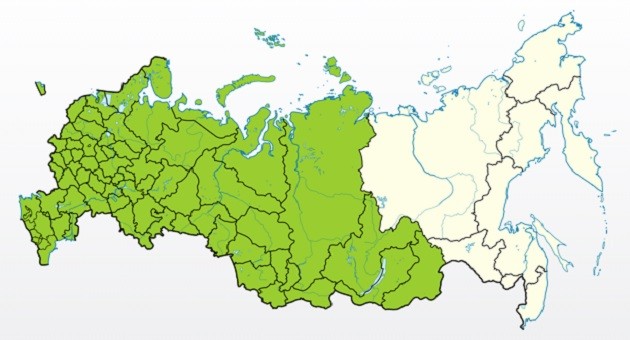
Growing regions
- Altai Krai.
- Siberia.
- Crimea.
- Ural.
- Middle zone.
- Tyumen Oblast.
- Far East.
- Leningrad region.
- Bashkortostan.
- Kemerovo region.
- North Caucasus.
- Moscow region.
Origin
This winter-hardy variety has a long and rich history. It was developed by pomologists at the Federal Altai Scientific Center of Agrobiotechnology's research campus near Baranaul. In 1975, a new apple tree was created by crossing the Pepinka Altaiskaya and Yunga varieties. The new variety was developed by a group of distinguished research and breeders:
- Galina Vasilievna Chupina.
- Ida Pavlovna Kalinina.
- Nina Ivanovna Dorokhina.
- Tamara Fedorovna Kornienko.
- Ekaterina Semenovna Orekhova.
- Zoya Alexandrovna Grankina.
Field trials of the new apple tree took quite a while, and the first application for official inclusion in the State Register of Breeding Achievements was only submitted in 2009. By 2010, the new variety had been confirmed and zoned for the West Siberian region. In fact, it is easily cultivated throughout virtually the entire country.
Content
Description of the Altai Amber variety
 New winter-hardy apple trees always attract the attention of residents of harsh regions, and this variety is one of them. Altai Yantarnoye is a summer-ripening variety with high tolerance to low temperatures, sudden fluctuations, and temperature changes. The trees are completely undemanding and can grow in virtually any, even the harshest, conditions. They have compact crowns, produce good fruit annually without marked regularity, and are resistant to apple tree diseases.
Despite their small size, the fruits are very attractive and tasty, possessing a strong, pleasant aroma. However, they are difficult to transport and don't keep for long. However, they are well suited for processing into juices, compotes, and dried fruits. These trees are recommended for commercial plantings and individual cultivation.
Apples: What do they look like?
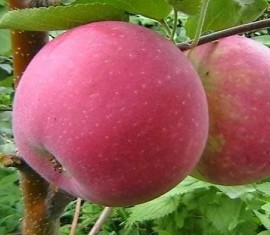
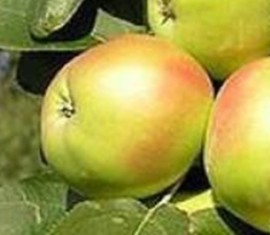
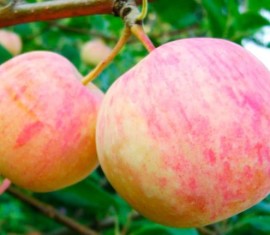
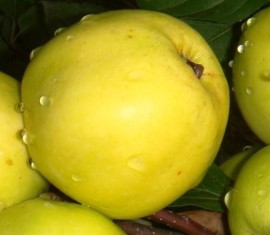
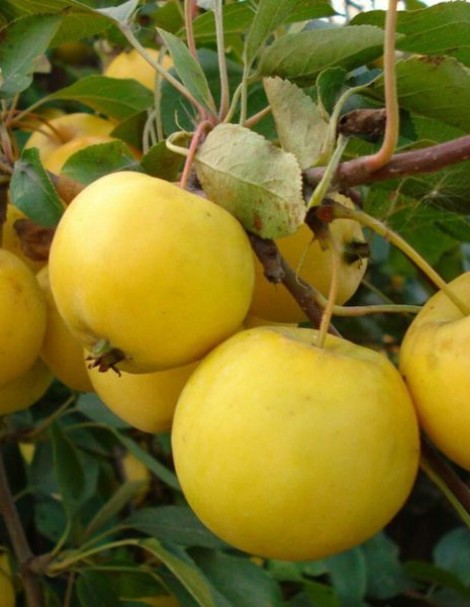
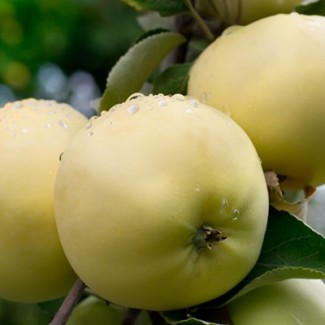
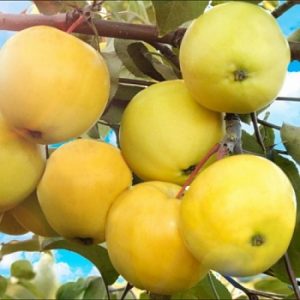 The Altai Yantarnoye variety produces small to medium-sized fruits, reaching a maximum weight of 60-90 grams, depending on weather, climate, and care. The fruits are round, smooth, uniform, generally symmetrical, and slightly ovoid. Ribbing is slightly visible, a lateral seam may be present, and the stem is long and slender.
The skin is fairly dense but thin, elastic, not overly strong, and can split right on the tree if exposed to excess moisture. The base color is uniform, light yellow, with a slight amber tint. The blush is completely absent, but sometimes a slight amber-pink glow may appear on the sunny side. Subcutaneous spots are light, subtle, but numerous. It is recommended to evaluate the chemical composition using a few selected indicators:
- P-active substances (catechins) – 144 milligrams.
- Ascorbic acid (vitamin C) – 31.8 milligrams.
- Total sugars (fructose) – 12.5%.
- Pectins (fiber) – 11.3%.
- Titratable acids – 0.9%.
The variety has fairly fine-grained flesh with a pleasant consistency, refreshing, juicy, easy to peel, crisp, and crunchy. It is snow-white or slightly creamy in color, and can have a slightly light green color near the core. The flavor is considered sweet and sour, dessert-like, balanced, and harmonious, with a distinct tartness. Fresh fruits receive a tasting score of 4.5 points, and juices 4.7 points out of a possible 5.
Altai Amber Apple Tree: Characteristics
Crown and root system
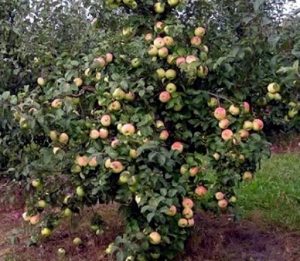 The breeders' main pride is the compact crown of this variety, which makes it easy to cover before winter. Trees can grow to a maximum height of approximately 2.5-3 meters., but usually barely reach 2.2-2.5. The crown shape is usually round or spherical, with moderate density. Branches are of medium length and thickness, directed upward, grow at a right angle, and are covered with brown or greenish-brown bark.
The leaves are oval, elongated, and can be slightly ovate. They are leathery, dense, glossy, fairly large, wrinkled, and short-pointed. The edges are serrated, the ribbing is rough, and the color ranges from green to emerald or dark green. The root system is moderately deep, mostly fibrous, highly branched, and moderately adapted to the search for nutrients and water.
Productivity and pollination
Compared to many Siberian or northern apple trees, Altai Yantarnoye has an average yield.
During the season, one apple tree of this variety, when fully ripe, can produce 42-55 kilograms of fragrant and beautiful small fruits..
This variety is completely self-fertile and requires no external pollinators to produce good harvests year after year. However, interplanting it is still preferable. Firstly, this can slightly increase fertility, and secondly, it is an excellent pollinator for other varieties.
Winter hardiness and disease resistance
Yantarnoye was specially bred for excellent resistance to low temperatures. Trees can easily withstand temperatures as low as -37-42°C, and if they do sustain damage, it's no more than 0.5 degrees below zero. They recover quickly, returning to their original shape in just one year. However, to avoid risks, apple trees need to be covered and prepared for winter properly and in a timely manner.
The variety isn't immune to diseases, but it has a naturally high resistance to various diseases. It rarely gets sick, only during years of severe epiphytotics. Almost only the leaves are affected, while the fruit remains edible. All preventative measures should still be taken promptly, including spraying with insecticides against parasites.
Rootstocks and subspecies
The variety is relatively new, so it doesn't yet have any distinct subspecies, but work is underway to create them. It's grown on various rootstocks, which imparts some unique properties but has little impact on the quality, size, or flavor of the fruit. There are no columnar varieties; the Altai Yantarnoye vine can be shaped by pruning and tying the branches to stakes driven into the soil.
Features of growing Altai amber
 Landing
 Landing
Basic conditions
- In northern regions, where this variety is most often planted, it's crucial to select a sunny, open location. Apple trees' crowns should be exposed to sunlight for most of the day. In the shade, they grow poorly and may refuse to bear fruit or even die.
- It's best to avoid excessive moisture in the planting site. It's not recommended to plant trees near rivers, streams, lakes, shallow wells, or where groundwater is too close to the surface.
- Ventilation of tree crowns prevents excessive fungal growth, so stagnant air should be avoided. However, planting trees in drafty areas is also not an option; they often become diseased and die, so you'll have to work hard to maintain a balance.
- Prepare planting holes in advance, either a season or at least 3-5 weeks in advance. Dig holes up to 1 meter in diameter, and 60-70 centimeters deep. Fill the bottom with richly fertilized soil, then fill with the chosen drainage material (vermiculite, nut shells, stones, or broken brick), and then fill with 3-4 buckets of water.
- Leave approximately 2.5-3 meters of space between trees to prevent future root or branch conflicts. A similar distance is acceptable between rows.
- It's a good idea to immediately dig trellises, or at least planks and stakes for tying, into the holes. This will not only provide support for the young trees and increase their wind resistance, but also protect them from frost and cold if they are placed on the north side.
- When planting, ensure that the root collar of the tree does not extend below the soil surface. It should protrude 7-9 centimeters; otherwise, roots extending above will neutralize all the properties of the rootstock, rendering it useless.
- Inside the hole, rake the drainage material into a pile, place the seedling on it, and spread its roots. Cover the soil layer by layer, compacting it by hand, but be careful not to overdo it. Water the surface and then mulch to ensure additional moisture retention.
Landing dates
In harsh northern regions, spring planting of apple trees and other fruit crops is always preferable. In the fall, it can be difficult to predict when the first frost will arrive, and trees can be damaged. It's best to choose a warm, dry day in April, when the soil has already warmed up completely and frost is unlikely to return. In warmer climates, Altai Yantarnoye can be planted in September-October, but it may not thrive without severe winter frosts.
Tree care
 Tree care
Protection from frost and pests
The variety's resistance to cold is remarkable, but that doesn't mean you can forget about proper winter preparation or shelter. The trunks are small, so even in adulthood, they can be covered with a tent-like covering. The root area is covered with straw, hay, spruce branches, and soil to a depth of 15-20 centimeters. However, this isn't always practical; in temperate regions, wrapping the trunks with burlap or roofing felt, old tights, or roofing felt is sufficient.
Diseases rarely bother owners of this apple tree, but preventative treatments are essential. Regularly spray with insecticides and fungicides to avoid risking your orchard and harvest. Whitewashing the trunks in spring and fall is a good idea to eliminate insects from the bark cracks. To repel rodents, it's a good idea to coat the trunks with foul-smelling substances such as grease, lard, fuel oil, or tallow.
Loosening the soil, watering: proper agricultural technology
You should dig the area around the trunk twice a year, and it's best to do this regularly for at least the first few years. Over the years, you can stop digging, but then the area should be seeded with lawn or herbs. It's best to hoe the soil the day after glazeso that it does not form into an overly dense lump.
Trees are watered infrequently, only 3-6 times per season. Watering can be timed to coincide with flowering, fruit set, and fruit ripening. It's crucial not to overdo it and allow the tree to suffer from dehydration. Maintain the right balance so the soil doesn't dry out completely, but also avoids excess moisture. It's a good idea to dilute a suitable fertilizer with water, but not earlier than 4-5 years after planting.
Pruning: simple crown shaping
Nurseries most often cultivate a sparse or sparsely tiered form. This suits the tree perfectly. However, the tree is so pliable that it can be made into anything, from a cordon to a spindle. The main thing is not to cut more than one-third of the green mass at a time, otherwise the apple tree may become diseased and even die.
It's also essential to perform a sanitary crown trim every fall. At this time, all broken, old, dry, and diseased branches are pruned. They provide no benefit, but they drain the tree's sap. Cuts should not be ignored; they must be sealed. garden pitch or other suitable materials.
Diseases and pests
- Rust.
- Powdery mildew.
- Black crayfish.
- Scab.
- Rust.
- Scale insect.
- Green aphid.
Pollinator varieties
- Purple apple.
- Siberian.
- Alyonushka.
- Minusinsk.
- Youth.
- Zhebrovsky.
- Shevchenko's favorite.
- Cabin boy.
- Aborigine.
- Ural bulk.
- Milena.
Ripening and fruiting of Altai amber
The beginning of fruiting
 The beginning of fruiting
Although the apple tree is not considered an early fruiting variety, the first fruits can be harvested as early as 4-5 years after planting in open ground. As early as 2-3 years, buds can sometimes be found on the trees, but it's best to remove them completely to allow the tree to gain strength, develop rhizomes, and develop foliage. The variety doesn't offer a bountiful harvest in the first few years; typically, no more than 2-3 dozen small apples are harvested.
Flowering time
Many northern apple varieties have a mid-season bloom period. They are adapted to blooming at a time when the threat of frost has completely passed. The Altai Yantarnoye apple tree blooms around mid-May, with new apples set by the end of the month. The tree's flowers are beautiful, small, with delicate, snow-white petals and are very fragrant.
Fruiting and growth
The tree grows 35-50 centimeters per year, so by the time it begins bearing fruit, it can easily reach its maximum height. However, yield increases more slowly, and peak fruiting can only be expected after 8-10 years. At that point, it will be possible to harvest up to 50 kilograms or more of fruit.
Apples ripen in the middle or end August, long before the onset of autumn, in a single, avalanche-like burst. They remain on the branches for some time, but must be picked quickly to prevent them from falling off. Such fruits can be transported in crates without significant loss, but they can be stored in a regular cellar for no more than 45-60 days. After that, they will lose their aroma and flavor, becoming sour, cottony, crumbly, and lacking in juice.
Top dressing
- Superphosphate.
- Humus.
- Peat.
- Calcium.
- Manure.
- Compost.
- Ammonium nitrate.
Why do apples fall?
- Wind, frost, rain, hail.
- Overripe.
- Pests or diseases.
What to do if it doesn't bloom or bear fruit
- Limit or strengthen watering.
- Eliminate insects.
- Cure diseases.
- Feed.
- Transplant to a sunny place.
Leave your review of the Altai Yantarnoye apple tree variety to ensure that even novice gardeners don't run into any problems.