Iksha apple tree: characteristics of the variety and care
| Color | Yellow , Greens |
|---|---|
| Ripening season | Summer |
| Size of apples | Average , Large |
| Taste | Sweet and sour |
| Crown type | Columnar tree |
| Shelf life | Low shelf life |
| Application | Fresh , For recycling |
| Winter hardiness | High winter hardiness |
| Fruiting age | Up to 5 years |
 History of origin and regions of growth
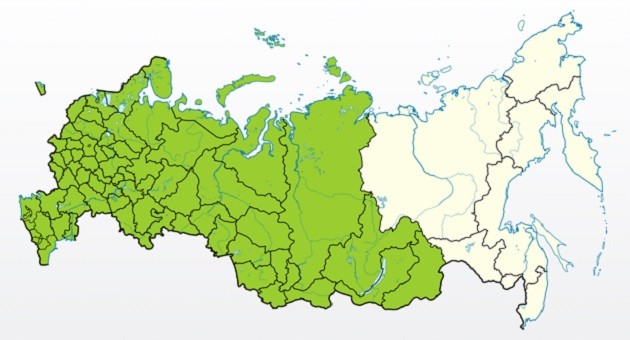
Growing regions
- Some northern regions.
- Ural.
- Western Siberia.
- North Caucasus.
- Altai Krai.
- Crimea.
- European part of Russia.
Origin
For many years, work was underway to develop winter-hardy, columnar apple trees suitable for cultivation in harsh climates, such as the Urals and Western Siberia. In 1985, at the All-Russian Selection and Technological Institute of Horticulture and Nursery, under the direction of Viktor Valeryanovich Kichina, the low-temperature-resistant Brusnichnoe variety was crossed with the standard columnar donor KV-102 (based on Vazhak and Cinnamon Striped).
Just five years later, a hybrid was selected for the elite, given its own number 330/62, and later named Iksha. This name is no coincidence; it was given in honor of the village of the same name, located on the Ikshanka River, in whose bed gold sand was discovered.
In 1996, the variety was recommended for propagation, and around the same time, an application for inclusion in the official lists was submitted. Unfortunately, the apple tree was never included in the State Register of Breeding Achievements, despite being actively cultivated in many regions of our country.
Content
Description of the apple tree variety Iksha
 These early-ripening apple trees have one distinctive feature: among columnar varieties, they are the clear leaders in low-temperature tolerance. They can be grown without much difficulty even in the Urals and much of Siberia. These compact, very fast-growing trees produce a substantial harvest each year long before other varieties begin to ripen.
The fruits grown in Iksha ripen beautifully and are large, with a unique flavor and attractive appearance. Despite their short shelf life and difficulties in transportation, they are recommended for large, intensive commercial orchards.
Apples: What they look like
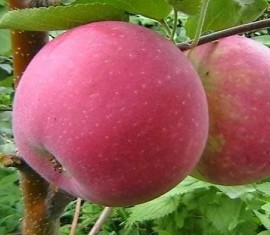
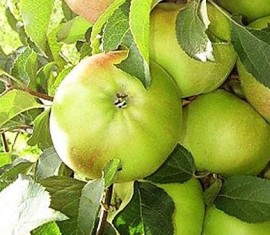
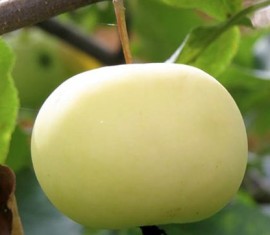
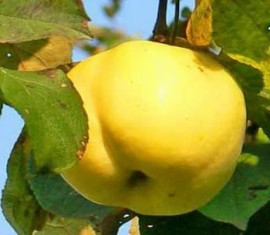
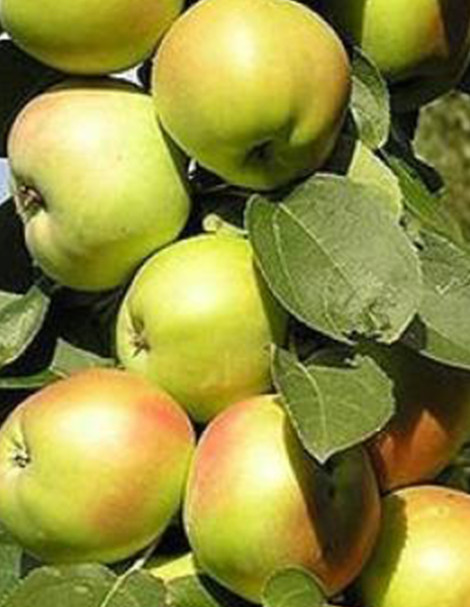
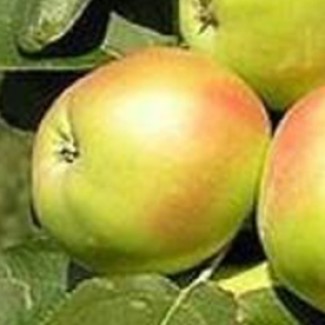
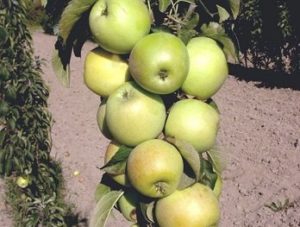 Iksha fruits are generally medium to above average in size. They can grow up to 90-120 grams, but in favorable years, and with proper, timely care, they can reach as much as 170-210 grams. They are round in shape, but can be slightly flattened at the base and elongated at the tip, turning into a turnip. Ribbing is slightly visible on the calyx side, but is smoothed and subtle, and there is no lateral suture.
The skin is dense but not elastic enough, brittle, and has a greenish-yellow or golden-yellow hue when ripe. It is smooth, fairly glossy, and dry, but may develop a loose waxy-oily coating when fully ripe. The blush occupies no more than 35-60% of the surface; it is striped and mottled, diffuse, and may have a pinkish, crimson, or slightly orange hue. Small, closely spaced subcutaneous dots are barely noticeable against the fruit's variegated surface. To accurately assess the chemical composition, the following parameters can be used:
- P-active substances – 337 milligrams.
- Ascorbic acid (vitamin C) – 13.9 grams.
- Sugar (fructose) – 10.8%.
- Titratable acids – 0.47%.
- Pectins (fiber) – 11.2%.
The flesh is dense, crisp, and extremely juicy, with fine grains giving it a pleasant texture. It has a beautiful golden-honey or yellowish-golden hue, and can be creamy or even slightly green. It has a powerful, spicy saffron aroma and a sweet-and-sour flavor with a hint of wine acidity. It is considered a dessert-like, balanced, and harmonious fruit. Iksha receives a tasting score of 4.7 out of 5 from professionals.
Iksha apple tree: characteristics
Crown and root system
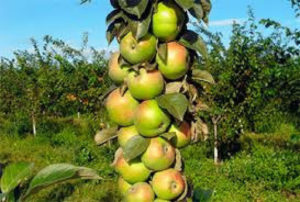 The trees are very convenient for growing in limited spaces due to their particular compactness. This is a columnar tree growing up to 1.9-2.2 meters maximum.Without additional pruning in the shade, the plant can reach up to 2.5 meters, but this is rare. It grows with a single trunk or several nearly vertical branches. The crown circumference barely reaches 20-45 centimeters, due to fruiting shoots that branch off at a very sharp angle. The tree's bark is brown, greenish-brown, or brown. Fruiting occurs on rings, fruiting twigs, and spears.
The leaves are fairly large, oval, and have a long, pointed tip, sometimes twisting into a helix. The branches are medium-thick. The leaf itself is leathery, dense, and slightly glossy, sometimes pubescent on the back, but not always. The edges are serrate and dentate, and can be wavy or serrated. The root system, unlike most similar columnar plants, is very robust, fibrous, and moderately deep, well adapted to extracting nutrients and moisture from the soil.
Productivity and pollination
Iksha can be called prolific, but she is not a leader among her peers.
Over the course of a season, under favorable climate and weather conditions, a single mature tree can yield approximately 6-8 kilograms of delicious saffron-colored fruits with a unique flavor. However, some experienced gardeners, with skillful care, have achieved much better results, yielding up to 15-18 kilograms of fruit per apple tree..
There's no official information about the tree's self-fertility, but most owners report conditional sterility. This means that some fruit develops without pollination by other varieties, but this number will be no more than 15-35%. Therefore, it's generally recommended to plant Iksha no further than 45-70 meters from apple trees that are ripe for flowering.
Winter hardiness and disease resistance
Even the Antonovka apple tree is envious of this apple tree's resilience. It easily tolerates temperatures down to -40-42°C, making it suitable for growing even in regions with fairly harsh climates. However, it's important to understand that sudden temperature fluctuations and fluctuations will be difficult for the trees, and prolonged periods of cold can lead to frostbite. Therefore, trees should be carefully prepared for winter and covered during freezing weather.
The variety is highly resistant to various diseases. It is not harmful to trees. scab, powdery mildew, cytosporosis, and many similar fungal infections. However, trees have no genetic immunity, so preventative measures should not be neglected. Insect control measures should also be carried out promptly to avoid losing your crop and your garden.
Rootstocks and subspecies
This apple tree doesn't have any subspecies, but it can be grown on various rootstocks. However, it's important to note that it won't bear fruit on every variety. Therefore, it's best to purchase Iksha apple trees only from reputable sellers, large nurseries, and farms where they can clearly explain the process and provide documentation. The most popular and widespread rootstock is the dwarf MM-106.
Features of growing Iksha
 Landing
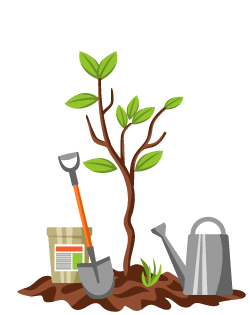 Landing
Basic conditions
- The variety responds very favorably to light, so only sunny locations should be chosen for planting. Gardeners say that Iksha will produce fruit even in the shade, but only sparingly, and the fruit may be smaller, paler, and sour.
- This variety even thrives in strong winds in summer, but in winter they can be fatal. Therefore, it's best to choose a location with good ventilation but protected from drafts.
- Almost no fruit tree can tolerate acidic soil, and Iksha is no exception. If acidic soil is too high, neutralize the soil with lime a season or two before planting.
- Proximity to groundwater is unsuitable for the tree, as its powerful and extensive root system will inevitably reach it and then begin to rot. Apple trees should not be planted near rivers and streams, ponds and lakes, in swamps, or floodplain meadows that are flooded by spring runoff.
- The holes should be prepared at least a week or two before planting. But if you have some dug from last season, that's even better.
- The distance between the holes should be 50-60 centimeters, and between the rows 1.2-1.4 meters, so that the trees will be quite comfortable at a mature age, and harvesting will be much more convenient.
- It would be a good idea to immediately dig special planks or pegs into the holes to tie up the tree trunks in the future.
- Holes are dug up to 70 centimeters deep and up to 80 centimeters in diameter. Topsoil (fertile soil) mixed with fertilizer is placed at the bottom, followed by drainage, and then filled with plenty of water.
- Place the seedling in the hole, holding it with your hand, fill it with soil, compact it, and mulch the surface.
Landing dates
The optimal time to plant Iksha is in the fall in southern regions and spring in more southern regions. This way, the trees will take root better. It's best to choose warm, dry, sunny days in March-April or September-October and plant the trees outdoors. It's important to prevent first-year seedlings from being damaged by recurrent frosts or the first frosts during the first weeks of their life.
Tree care
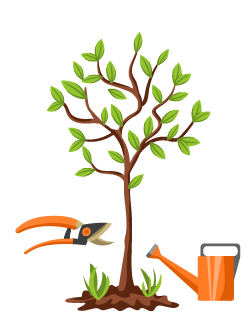 Tree care
Protection from frost and pests
In warm climates, it's generally not necessary to cover trees for the winter; they can easily withstand cold spells. However, the further north the trees are grown, the more serious the measures required. Trees are wrapped in roofing felt, tar paper, old tights, or burlap, and the root area is covered with spruce branches or even just soil. A tent-like covering method is also acceptable, as it preserves the trees best.
To repel rodents that chew young shoots and bark from young trees in winter, coat the trunks with pungent-smelling substances. Drying oil, lard, and grease are all suitable. To repel insects, whitewash the trunks with lime to a height of 80-90 centimeters in the fall and spring.
Loosening the soil, watering: proper agricultural technology
Dig around the trunk in spring and fall, but be careful. Some roots may be located right at the surface and are easily damaged. Hoeing and loosening the soil regularly, immediately after watering, should be done to prevent the soil around the rhizome from becoming compacted to a granite consistency. About 7-10 loosenings per season should be sufficient.
Trees only need to be watered during dry and hot periods; the rest of the time, they can find moisture in the soil layers themselves. If the heat lasts for at least ten days, you can apply 15-22 liters of water in two doses, early in the morning and late in the evening. Fertilizers and fertilizers are also readily absorbed with water. Mineral fertilizers are typically added in the spring and summer, and organic fertilizers in the latter half of the season.
Pruning: simple crown shaping
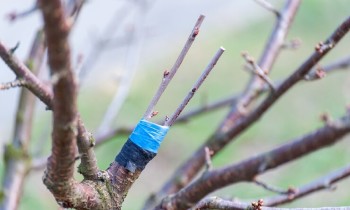
This columnar plant requires proper pruning, as it often doesn't grow as a single trunk, but produces two or three lateral branches, which become the fruiting conductors. Two shoots are usually left, the stronger and more fruitful one being retained in the fall, and the other is cut off. In the spring, the young branch is allowed to develop again, and this process is repeated annually.
Iksha can be trained into a creeping tree, making it suitable for growing in particularly harsh conditions, such as the Far East. To achieve this, the main branches are bent down to the ground and not allowed to grow upward. Sanitary pruning involves removing dead shoots; rejuvenation is not required.
Pollinator varieties
- Vazhak.
- Triumph.
- Jonathan.
- Ostankino.
- Gala.
- Korobovka.
- Chervonets.
- Borovinka.
- Gin.
Reproduction
- Rooting.
- Kidney grafting.
- Growing from seeds.
- Cuttings.
Diseases and pests
- Black crayfish.
- Powdery mildew.
- Bacterial burn.
- Scab.
- Green aphid.
- Codling moth.
- Leaf roller.
- Hawthorn.
Ripening and fruiting of Iksha
The beginning of fruiting
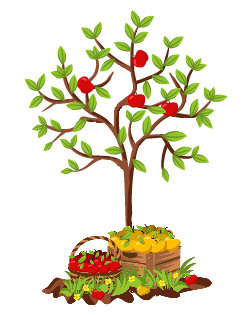 The beginning of fruiting
You can see your first flowers, and then apples, on the tree as early as the first year after planting in open ground or a nursery. It's best to pluck the first blossoms to allow the trunk to grow and develop a rhizome. Therefore, the second or third year is generally considered the official start of fruiting. The first harvests won't be abundant, as you'll only be able to collect 2-3 kilograms.
Flowering time
Like most early apple trees, Iksha blooms around late April or early May. When the weather isn't sunny and warm, the process can be significantly delayed, and when it does begin, it can take 16-18 days instead of the usual 12-14. The tree's large, cup-shaped flowers are densely clustered along the branches, fragrant and beautiful.
Fruiting and growth
The Iksha apple tree is considered fast-growing, easily reaching 45-60 centimeters in a year. It reaches its maximum height in just a couple of years, and begins producing fruit in full by the fourth to sixth year. By this time, some gardeners achieve breakthrough results, reaching twenty kilograms. Apples begin ripening as early as mid- to late August or early September. This depends on the prevailing weather conditions and the regional climate. In warm, sunny conditions, the fruit will ripen much earlier, while inclement weather can significantly delay ripening.
It's important not to miss the right moment to pick the fruit, otherwise it could fall to the ground. Then, it will have to be processed immediately. Apples don't have a long shelf life; they can be kept in a cellar or refrigerator for about 25-35 days. However, it's best to process them completely by the end of this period. Apples are difficult to transport; they are very delicate and easily damaged, after which they spoil very quickly.
Top dressing
- Compost.
- Ammonium nitrate.
- Humus.
- Superphosphate.
- Manure.
- Mineral complexes.
What to do if it doesn't bloom or bear fruit
- Check for pests or diseases.
- Transplant into the sun.
- Water.
- Fertilize.
Why do apples fall?
- Wind, hail, hurricane, rain.
- Pest damage.
- Diseases.
Please leave your feedback on the Iksha variety, as many gardeners would like to grow similar varieties in their gardens.