Belarusian Sinap apple tree: characteristics of the variety and care
| Color | Greens |
|---|---|
| Ripening season | Autumn |
| Size of apples | Average |
| Taste | Sweet and sour |
| Crown type | Tall tree |
| Shelf life | High shelf life |
| Application | Universal variety |
| Winter hardiness | High winter hardiness |
| Fruiting age | Up to 5 years |
 History of origin and regions of growth
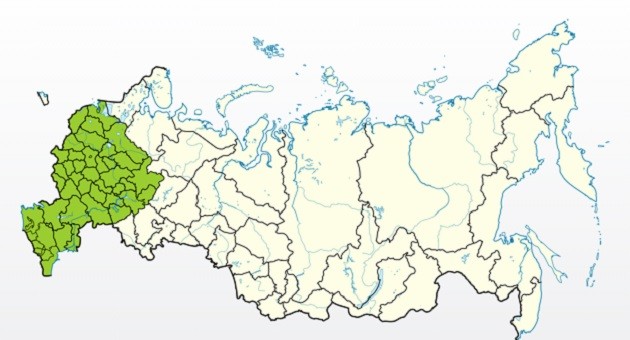
Growing regions
- Crimea.
- Yaroslavl region.
- Volga-Vyatka region.
- Middle zone.
- Tver region.
- Leningrad region.
- North Caucasus.
- Pskov region.
- Moscow region.
- Kostroma region.
Origin
The variety was developed by Soviet scientists around the early 1950s. The Belarusian Sinap was obtained at the Belarusian Research Institute of Fruit Growing by crossing the Lithuanian Pepinka with the Antonovka. The authors are considered to be A. E. Syubarov and E. P. Syubarova.
In 1958, the apple tree was first included in the state testing schedule, and a year later, an application for approval was submitted. However, the new variety was not recognized at that time, and it took another two decades for it to finally be included in the State Register of Breeding Achievements in 1988, and also zoned for the Northwestern region.
Content
Description of the Belarusian Sinap variety
 Vigorous trees bred in Belarus are sure to attract the attention of our country's gardeners. They are quite resilient to harsh weather conditions, hardy, and undemanding of soil, fertilizer, and watering. Despite their lack of genetic immunity, these apple trees are resistant to scab and other fungi, are environmentally friendly, and produce good fruit regularly.
The fruit ripens beautifully on the tree, fragrant, large, and attractive. However, many find the flavor a bit bland, and the juiciness can be subpar in some years. However, these apples can be stored for quite a long time. This variety is recommended for intensive commercial cultivation, as well as for individual home gardens.
Apples: What do they look like?
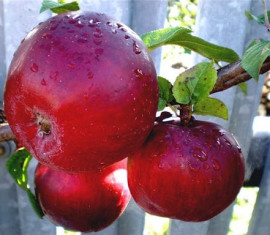
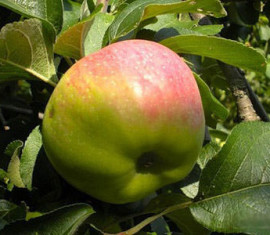
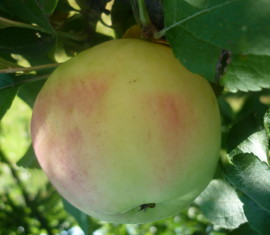
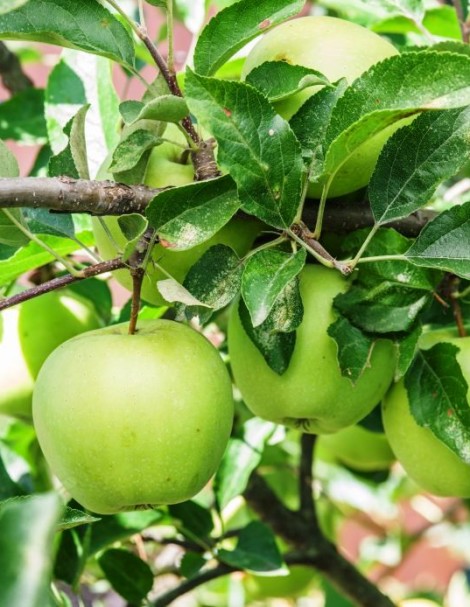
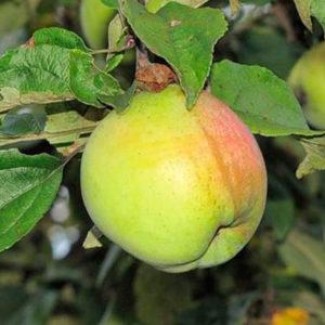
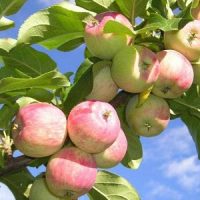 The fruits are mostly medium or larger in size, weighing up to 75-150 grams depending on the year. They are round, round-conical, or oval-elongated, cup-shaped, asymmetrical, and non-uniform. The ribbing of the apples is clearly visible at the calyx and faintly throughout the rest of the surface; the lateral seam can be clearly visible.
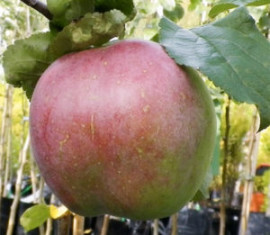
The Belarusian sinap has a dense, strong, and elastic skin that is smooth, glossy, and highly shiny. It may develop a noticeable waxy-oily coating when ripe. The skin's base color is light green, light green, or light green-yellowish. The blush consists of mottled, streaked spots of crimson-brown, pink-red, or red-brown, sometimes covering up to 55-70% of the surface, but usually no more than two-thirds of the total surface. Subcutaneous spots are pale, barely noticeable, and few in number. Experts recommend assessing the chemical composition using a specific set of indicators:
- P-active substances (catechins) – 247 milligrams.
- Ascorbic acid (vitamin C) – 15.4 milligrams.
- Total sugars (fructose) – 10.8%.
- Pectins (fiber) – 9.2%.
- Titratable acids – 0.48%.
The fruits of this Sinap have fine-grained, tender, yet prickly and crisp flesh. It has a distinct greenish or lemony hue, is medium juicy, firm, and pleasant to bite into. The flavor is considered dessert-like and satisfying, with a sweet and sour balance, leaning heavily toward the sour. According to professional tasters, it scores a maximum of 4-4.2 points.
Belarusian Sinap apple tree: characteristics
Crown and root system
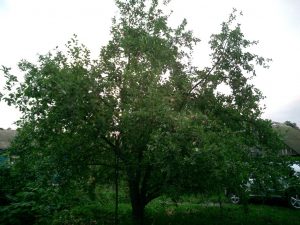 Apple trees of this variety are generally considered tall. They can easily reach 7-9 meters, and sometimes even more. Their crowns are typically rounded, broadly oval, or broadly pyramidal, with a medium density. Branches extend from the trunk at an acute angle but are firmly attached, not prone to splitting, and are covered with greenish-brown or greenish-brown bark. Fruiting is concentrated on 2-3-year-old ring shoots, which quickly lose productivity, requiring a wait for subsequent growth.
The leaves are fairly large, flattened, oval-rounded, with doubly serrated, serrated, and crenate margins. The tip is short and pointed, and may curl slightly. The leaf surface is slightly rough and wrinkled, with coarse nervation. The leaf color is green or dark green, sometimes a rich emerald. The root system is well-developed, fibrous, and branched, with numerous small branches, well adapted to the search for food and water.
Productivity and pollination
The variety is considered to be high-yielding, although its performance is rather average, given the large height of the trunks.
From one mature, fully formed Belarusian Sinap tree, good growers can harvest approximately 150-170 kilograms of apples per season. In favorable years, with careful care, this figure can increase slightly..
The Belarusian Sinap is self-pollinating, so no nearby apple trees are required for fruit production. However, experienced specialists say that the yield can be significantly increased, up to 35-50%, if the fruit is grown within 45-90 meters.
Winter hardiness and disease resistance
Trees don't mind frost if it's moderate and doesn't last too long. For example, temperatures down to -27-30°C are easily tolerated, with virtually no damage, if they last no more than a week or two at a time. Therefore, it's important to prepare your garden for winter in a timely manner, properly covering and wrapping your trees, to minimize the risk of damage.
Belarusian sinap isn't particularly susceptible to disease if the standard trees are properly cared for. It's particularly resistant to scab, and has a moderate resistance to other fungi and infections. If you spray and treat your garden with insecticides and fungicides regularly, you won't have to worry about losing it.
Rootstocks and subspecies
The variety doesn't have its own subspecies, and it's unlikely it ever will. However, it can be grown on various rootstocks, the most preferred and popular of which is the semi-dwarf 62-396. This produces more compact trees, while also increasing their early fruiting, allowing the first harvest to be harvested as early as the second or third year.
Features of growing Belarusian sinap
 Landing
 Landing
Basic conditions
- Apple trees thrive in full sun, so planting sites should be in full sun for most of the day. In the shade, trees don't thrive, become diseased, and eventually die.
- Crown ventilation is key. It should be adequate, but completely free of drafts. Be careful not to let strong northerly winds damage young trunks, when they are most vulnerable.
- Leave a distance of 4-5 meters between trees, and 5-6 meters between rows is best. This will make harvesting and maintaining the trees much easier.
- When planting, consider the water table. It should be average, neither too deep nor too high. If the water is too deep, you'll have to spend a lot of time watering, and if it's too close, the rhizomes may rot.
- It's customary to prepare the holes a season before the apple trees are scheduled to be planted. However, if time is running out, this can be done 4-5 weeks before planting.
- Dig holes approximately 60-70 centimeters deep and up to 1 meter in diameter. Place the topsoil, thoroughly mixed with fertilizer (organic and mineral), at the bottom. Then add a drainage layer on top, such as stones, broken brick, screenings, vermiculite, or nut shells. Water the entire surface with 45-60 liters of water and leave it uncovered.
- It is customary to immediately drive stakes, trellises or planks into the holes to tie up the trees.
- The grafting site (root collar) should always remain above the soil surface; for Belarusian sinap, 5-8 centimeters is sufficient.
- Before planting, apple trees are inspected, all dry shoots or branches are cut off, and they are soaked in water for 4-7 hours.
- The seedling is placed on drainage, the rhizome is straightened, covered with soil, compacted, watered with 45-50 liters of water, and the surface is mulched.
Landing dates
The optimal planting time for this variety is spring, around late March or early April, before the sap begins to flow in the trunk. This way, the trees won't be particularly vulnerable to late frosts. However, in calmer, less severe regions, apple trees can also be planted in the fall, around late September or October, when the last yellow leaves have fallen, that is, when the sap has completely stopped flowing.
Tree care
 Tree care
Protection from frost and pests
Young tree trunks are very easy to cover using the tent method, which involves wrapping the entire tree from rootstock to crown. However, for large, mature apple trees, this is hardly feasible, nor is it necessary. Simply wrap the trunks with burlap, roofing felt, roofing felt, or old tights, and cover the root area with straw, hay, or spruce branches. In the coldest regions, you can even pile up soil, which needs to be removed in early spring.
Whitewashing the bark at the base of the trunk with lime helps repel insects. This will keep the apple trees looking neat, and cracks and chips will prevent pests from nesting. Rodents can be repelled by smearing the trunks with lard, tallow, grease, fuel oil, and other unpleasant-smelling substances.
Loosening the soil, watering: proper agricultural technology
The tree trunk area is typically dug once or twice a year, either in early spring during pruning or again in late fall. It's best not to dig too deep to avoid damaging root shoots that are close to the surface. During the growing season, it's also a good idea to lightly loosen the soil with a hoe, removing weeds, root suckers, and any debris.
Water the trees as needed, ensuring the soil around the root system never dries out completely. If the groundwater is deep and there is no precipitation, and the weather is hot, it's a good idea to water at least once every ten days. glaze The next day, be sure to loosen the soil to prevent it from compacting into a solid lump. It's a good idea to add fertilizer with water; this will ensure it's absorbed by the tree better and faster.
Pruning: simple crown shaping
Apple trees are trained from the first year after planting in the garden, unless pruning was done at a nursery. The optimal shape for the tree is pyramidal or high oval, as this allows for easy exposure of the branches not only to sunlight but also to air, preventing stagnation in the crown. A sparse or sparsely layered form is also suitable.
Sanitary pruning involves more than just removing broken, diseased, or dead branches. It's also advisable to remove any branches that protrude into the crown, causing it to become denser, or that grow vertically or parallel to other branches. Don't forget to apply oil to the cut areas, known as wounds. garden pitch or paint.
Pollinator varieties
- Titovka.
- Gala.
- Saffron pepin.
- Teremok.
- Glory to the victors.
- Antonovka.
- Borovinka.
Diseases and pests
- Cytosporosis.
- Fruit rot.
- Cancer.
- Powdery mildew.
- Scale insect.
- Fruit hyacinth.
- Moth.
- Green aphid.
- Leafhopper.
Ripening and fruiting of the Belarusian sinap
The beginning of fruiting
 The beginning of fruiting
This variety is considered early-bearing, as it can produce a harvest within 4-5 years after planting in open soil. In some cases, in the harshest regions, the first fruiting may be delayed until 5-6 years, but this is rare. The first harvests leave much to be desired, so you'll have to wait quite a while before a full harvest.
Flowering time
Most apple trees open their buds before mid-May, and the Belarusian Sinap is no exception. However, after prolonged frosts or a cold, damp spring, in harsh climates, the trees may not bloom until the end of the month, or sometimes even as late as early June. Their flowers are large, with delicate oval petals in shades of white, pink, or pure white. They are fragrant and densely covered with blossoms.
Fruiting and growth
This variety grows fairly quickly, but not at an extraordinary pace. It can easily reach 35-40 centimeters in a year, and sometimes even a little more. After fruiting begins, the apple trees slow down slightly, so it takes approximately 7-9 years for them to reach their full potential. It will take the same amount of time for the harvest to reach its full potential.
Apples ripen on the vine as early as late September, sometimes as early October, depending on the general climate and weather conditions of the particular year. They are not prone to shedding, and severe overripening will not harm them, but after even a slight frost, the entire harvest will have to be harvested at once. recycle or dispose of. They are transported very well, and are stored in a special refrigerator until spring, and sometimes until the new harvest.
Top dressing
- Superphosphate.
- Nitrogen complexes.
- Humus.
- Peat.
- Calcium.
- Manure.
- Compost.
What to do if it doesn't bloom or bear fruit
- Limit or activate watering.
- Remove insects.
- Cure diseases.
- Fertilize.
- Transplant to a sunny place.
Why do apples fall?
- Wind, frost, rain, hail.
- Overripe.
- Pests or diseases.
Leave a review of the Belarusian Sinap apple tree variety so that even a novice gardener can receive useful information firsthand.