Apple tree Moskovskoe pozdennye: characteristics of the variety and care
| Color | Greens |
|---|---|
| Ripening season | Autumn |
| Size of apples | Large |
| Taste | Sweet and sour |
| Crown type | Tall tree |
| Shelf life | High shelf life |
| Application | Universal variety |
| Winter hardiness | High winter hardiness |
| Fruiting age | From 5 years old |


 History of origin and regions of growth
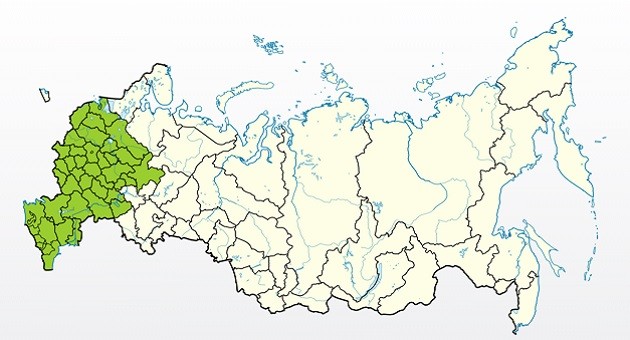
Growing regions
- Middle zone.
- Leningrad region.
- Middle Volga region.
- North Caucasus.
- Crimea.
- Some northern regions.
- Moscow region.
Origin
The variety was developed at the experimental station of the Lomonosov Moscow State University in the early 1960s. The first seedling was obtained in 1961 by crossing the Northern Sinap and the New Cinnamon (Welsi, Kitayka Kandil, and Striped Cinnamon). The author of this variety is the renowned Soviet breeder Sergei Ivanovich Isaev.
The trials lasted a very long time. The Moskovskoe apple tree was only added to the State Register of Breeding Achievements in 2001. The variety was officially zoned for the Volga-Vyatka and Central regions. In practice, it grows well throughout almost the entire Central Belt, slightly south and north of it, and is suitable for the Moscow and Leningrad regions.
Content
Description of the Moscow late variety
 The tree is vigorous and late-ripening. It is hardy, environmentally sustainable, and suitable for growing in poor soils and in polluted and polluted environments. The apple tree requires little care, is frost-resistant and resistant to high humidity, tolerates dry periods well, and is resistant to pests and diseases.
The fruits have high consumer qualities. They are large, attractive, aromatic, juicy, and delicious. These apples are easy to transport and store well in a standard cellar until the next harvest, or even longer. This variety is suitable for planting in intensive commercial orchards, as well as for individual cultivation in private gardens.
Apples: What do they look like?
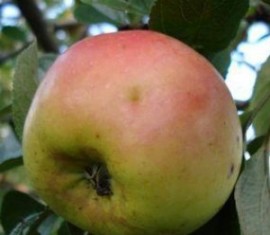
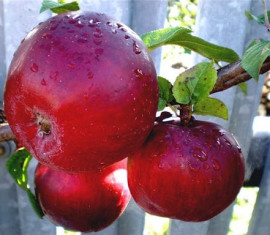
 The fruits are typically larger than average or large, weighing 200-250 grams. They are generally round or spherical, but can also be conical or turnip-shaped. The surface is smooth and lacks ribbing.
The skin is dense or very dense, even hard, elastic, and thick. It is green or greenish-yellow in color, smooth, glossy, shiny, and pubescent. The blush is faintly visible, pale pink, translucent, sometimes slightly orange or crimson, covering no more than 35-50% of the surface, barely noticeable, and visible on the sunny side. Subcutaneous dots are very pale, small, and barely noticeable. Professionals evaluate the fruit based on the following chemical composition factors:
- P-active substances (catechins) – 248 milligrams.
- Ascorbic acid (vitamin C) – 9.7 milligrams.
- Fructose (total sugars) – 11.2%.
- Pectins – 11.2%.
- Titratable acids – 0.96%.
The fruit has a pleasant texture, with dense, fine-grained flesh. It's crisp, easily broken, and prickly, usually snow-white in color, but can be slightly creamy. It's very tasty, very juicy, and sweet with a slight apple tartness and pronounced spice. Experts give the fruit a 4.3 out of 5 on a professional tasting scale.
Apple tree Moskovskoe Late: characteristics
Crown and root system

It is believed that the Moskovskoe tree is a late-growing tree. However, without proper and timely pruning, it can only reach 5-6 meters maximumInitially, the shape is strictly pyramidal, but over the years it becomes broadly oval, and in old age, even weeping, drooping, and spreading. The branches are arranged obliquely vertically, at an acute angle; they are long, straight, directed upward, pubescent, and covered with brown or fulvous-brown bark.
The leaves are dense, medium-sized, green or rich green, sometimes emerald, dark, and deeply colored. They are ovate or elliptical in shape, with short, pointed edges and serrate-crenate, doubly serrated edges. They are smooth, leathery, dense, and glossy, with a lightly felted pubescence on the back. The root system is extensive, robust, and fibrous, penetrating deep into the soil and well adapted for water-seeking.
Productivity and pollination
Moskovskoe Pozdennye begins bearing fruit early. Slight fluctuations in fruit production may be observed from year to year, but they are not significant; there is virtually no periodicity in fruiting.
From one fully formed, adult tree trunk, a good owner can get approximately 150-180 kilograms of beautiful, long-lasting and tasty apples per season..
The variety doesn't necessarily require additional pollinators to produce fruit and ovaries. However, to maximize yields, it's a good idea to plant trees with suitable flowering times within 150-250 meters. Mobile apiaries can also be used, as can spraying the trees with sugar or honey syrup to attract bees.
Winter hardiness and disease resistance
Trees' resistance to low temperatures is quite good, above average. They can easily tolerate temperatures down to -25-27°C. They are also resistant to high humidity and sudden changes from frost to thaw, but prolonged frosts lasting 4-6 weeks can seriously damage the buds. In this case, the apple trees will require several years of recovery.
Moskovskoe has moderate resistance to scab; it is rarely and mildly affected. The foliage is primarily affected, while the fruit remains suitable for processing or consumption. Other diseases also occur occasionally, and parasites are reluctant to damage the trees. With timely preventative treatments and spraying, all risks can be minimized.
Rootstocks and subspecies
The Moskovskoe Late variety has no subvarieties, and it's unlikely that any will ever be developed. However, trees can be grown on various rootstocks, imparting unique qualities to the standard trees. On semi-dwarf and dwarf varieties, they begin bearing fruit much earlier, in the second to fourth year, and grow no more than 2.3-2.5 meters in height. While these varieties are somewhat less resistant to winter frosts, they produce larger fruits. The rootstock has virtually no effect on the taste or quality of the apples.
Features of growing Moscow Late
 Landing
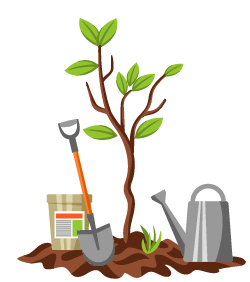 Landing
Basic conditions
- It is customary to shorten a seedling purchased from a nursery before planting to 80-90 centimeters if it is taller, but not more than one-third of the height.
- You can choose any soil for trees, as long as it's not overly acidic or saline. Excessively acidic soil can be mitigated with saltpeter, dolomite flour, or lime.
- Poor soils can be pre-fertilized by digging holes 5-8 months before planting. The holes are 80-85 centimeters deep and the same diameter. Organic fertilizer mixed with minerals is placed at the bottom, then covered with drainage material and filled with 20-30 liters of water. Leave the holes uncovered until planting time.
- Leave at least 4.5-6 meters between trees on vegetative rootstocks to prevent crown-root conflict. 3-4 meters is sufficient for dwarf rootstocks. The same distance is recommended between rows.
- The groundwater level in the area where trees are grown should not be higher than 3 meters, due to the depth of the rhizomes.
- Stakes or planks are immediately driven into the holes for staking. If placed on the north side, they will provide additional protection for young trees from frost during the winter. The stakes should not be removed until at least 4-5 years after planting in open ground.
- The tree's root collar, the grafted point to the rootstock, should always remain above the soil surface (5-7 centimeters). If the roots emerge above this level, the rootstock's properties will not be preserved.
- Place the seedling on a drainage mound gathered in the center of the hole. Gently spread the roots to prevent them from bending. The hole can be widened as needed. Cover the tree with soil, compact it gently by hand, and water with 30-40 liters of water. To retain moisture in the soil, the surface can be generously mulched.
When choosing seedlings at a specialty store, market, or nursery, pay close attention to the size and shape of the trunk. It should be straight, not too large, and of medium thickness. Deformed or bent trunks, an obscured root collar, knots, and thickenings can lead to rapid plant death.
Landing dates
The trees are very hardy, so they tolerate both spring and fall weather well. In spring, seedlings can be planted in the soil immediately after it has thawed. They are not affected by subsequent frosts.
Autumn planting is usually done after the leaves have fallen, in October. However, trees can be planted even after the first frost. It's better to plant later. If the weather is warm enough, the tree may begin to leaf out and grow, which will ultimately lead to its death in the winter.
Tree care
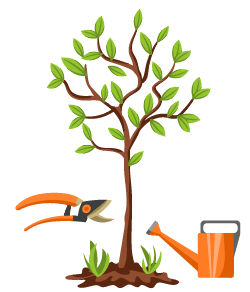 Tree care
Protection from frost and pests
Standard cold weather protection measures for Moskovsky are sufficient. It's advisable to wrap the trunks with burlap, agrofibre, spongebond, old tights, roofing felt, or roofing felt. Straw mats are thrown over the roots, soil is raked, and spruce branches are laid down. This effectively protects the trees from frost. Young seedlings can be covered using a tent-like method.
To eliminate insects that nest in bark crevices, they should be regularly treated with commercially available products. Whitewashing the trunks with lime in spring and fall is effective. To prevent rodents from eating the bark of young trees and lower shoots, you can coat them with melted animal fat, fuel oil, or grease.
Loosening the soil, watering: proper agricultural technology
Apple trees are usually hoeed once or twice a year. Weeds, plant sprouts, and debris should be removed at this time. In the summer, the soil can be hoeed several times, for example, the day after applying water. Apple trees prefer loose, airy soil, but over the years, the root zone can be seeded with herbs or grasses.
Under normal conditions, only young seedlings need watering. A good rule of thumb is to water them once every 7-10 days. For mature trees, 5-7 waterings per season are sufficient, and even then, only in dry and very hot years. Fertilizer and other fertilizers are usually added along with water. The last watering of the season should be done no later than mid- to late August.
Pruning: simple crown shaping
The first formative pruning should be done no earlier than 2-3 years after planting in the garden. To do this, remove all unwanted branching, leaving only 3-4 skeletal shoots and a central conductor. Branches should be spaced widely apart and at different heights. The desired shape is sparse or sparsely layered.
Every fall and spring, inspect the crown. Remove all broken and dead branches. It's also a good idea to prune any shoots that grow inward or vertically. These are of no use, as fruit usually doesn't ripen there.
Diseases and pests
- Cytosporosis.
- Scab.
- Moniliosis.
- Powdery mildew.
- Hawthorn.
- Green aphid.
- Leaf roller.
- Scale insect.
Ripening and fruiting of Moscow late
The beginning of fruiting
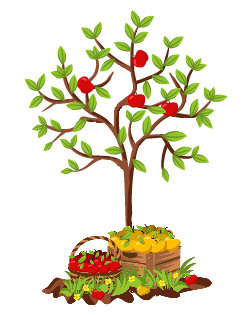 The beginning of fruiting
Despite the tree's rapid growth, the first flowers appear only in the fifth to seventh year. It is recommended to completely pluck them, as this will result in a much better subsequent harvest and larger fruit. Fruiting can be regulated in subsequent years. To achieve this, apple ovaries are plucked by 35-50% and thinned. The harvest is usually not reaped until the sixth year.
Flowering time
The buds on the Moskovsky lily bloom only in mid-May or towards the end of May. After a long, very cold winter, flowering can begin as late as June. It lasts approximately 12-16 days. The buds may have a pinkish tint, but the flowers themselves are snow-white, sometimes with the slightest, barely noticeable pink tint. They are large, beautiful, and fragrant, densely covering the branches and gathered in clusters.
Fruiting and growth
Trees can grow 45-60 centimeters per year in good conditions. They quickly reach their full height and produce a nearly full harvest by the 9th to 12th year. Apple trees have an active lifespan of over 50-70 years, so you can expect a great return on your orchard.
The harvest ripens later, with the fruit usually ready for picking in late September or early October. Technical (picking) maturity can be judged by the presence of a light, bluish-gray waxy coating. Apples are easily transported in standard wooden or plastic crates. Stored in a good cellar or refrigerator, the fruit can be harvested until the next harvest without any loss of marketability.
Top dressing
- Dolomite flour.
- Eggshells (calcium-containing complexes).
- Humus.
- Manure.
- Compost.
- Superphosphate.
- Mineral and nitrogenous complexes.
- Chicken or pigeon droppings.
- Ammonium nitrate.
What to do if it doesn't bloom or bear fruit
- Wrap up.
- Limit or increase watering.
- Remove insects.
- Cure diseases.
Why do apples fall?
- Weather troubles.
- Early frosts.
- Pests or diseases.
- Overripening.
Please leave a review of the Moskovskoe apple tree variety later to help novice gardeners avoid any questions about tree cultivation.