Bogatyr apple tree: characteristics of the variety and care
| Color | Greens |
|---|---|
| Ripening season | Winter |
| Size of apples | Large |
| Taste | Sweet and sour |
| Crown type | Tall tree |
| Shelf life | High shelf life |
| Application | Universal variety |
| Winter hardiness | High winter hardiness |
| Fruiting age | Up to 5 years |
 History of origin and regions of growth
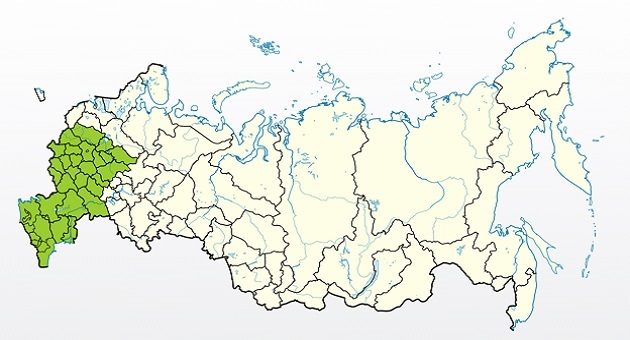
Growing regions
- Some northern regions.
- Middle zone.
- North Caucasus.
- Crimea.
Origin
The variety was first developed in 1924-1925 at the I.V. Michurin All-Russian Research Institute of Genetics and Fruit Plant Breeding by the eminent Russian scientist, plant breeder, and biologist Semyon Fedorovich Chernenko. He used the beloved Antonovka and the winter-hardy German Renette Landsbergensis as parent varieties. Testing was conducted at the experimental station in Michurinsk, Tambov Oblast.
The variety was only accepted for official testing more than twenty years later, in 1948, after the end of World War II. These trials lasted quite a while, after which, in 1971, Bogatyr was added to the State Register of Breeding Achievements and zoned for the Volga-Vyatka, Northwestern, Central, and Central Black Earth regions.
Content
Description of the Bogatyr apple variety
 The unique feature of this winter variety is its easy adaptation to virtually any climate and weather conditions. The trees are undemanding regarding moisture, soil, average growing season temperature, fertilizers, and care. They grow equally well on the rocky slopes of the North Caucasus or the sandy Crimean soils, as well as in the chernozem soils of the central zone.
The apples are tasty, aromatic, and easy to store and transport, even over long distances. Bogatyr is recommended for growing near the home, as well as in small and large intensive commercial and industrial orchards.
Apples: What they look like
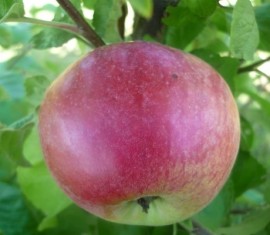
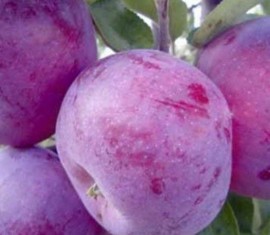
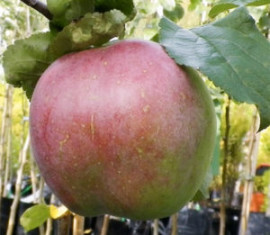
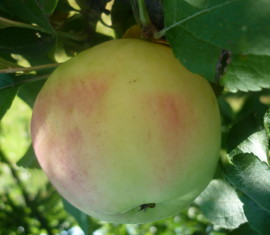
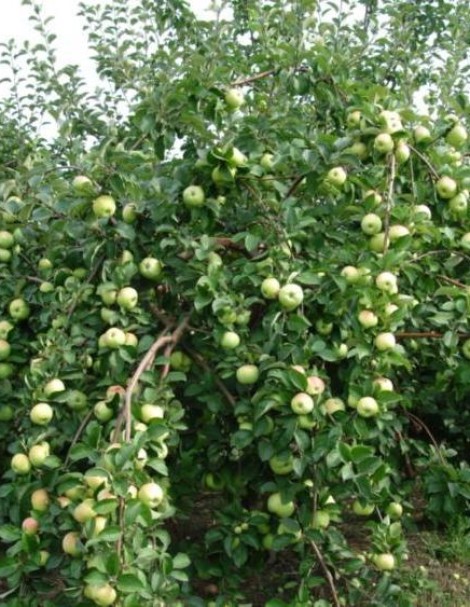
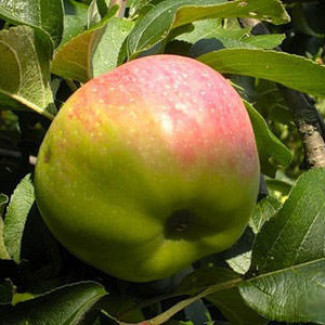
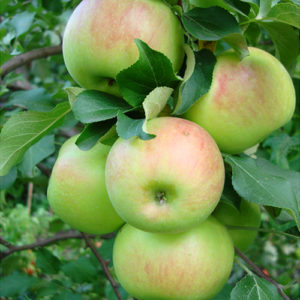 The fruits of this tree are predominantly large or very large, but medium-sized ones can also be found. They can easily weigh 280-300 grams, but typically range from 180-250 grams. They are symmetrical, non-uniform, round or round-conical, sometimes slightly flattened along the central axis, and may have distinct ribbing.
The skin is smooth, glossy, and shiny, and may have a slight oily or waxy coating when ripe. It is initially green or even dark green, becoming increasingly light green or yellowish as it ripens, becoming increasingly lemon-colored during storage. When exposed to sunlight, apples may have a diffuse, translucent, pale red blush covering no more than 35-60% of the surface. Subcutaneous spots are light, large, numerous, and clearly visible. The chemical composition is best indicated by the following indicators:
- P-active substances (catechins) – 134.4 milligrams.
- Ascorbic acid (vitamin C) – 13.2 milligrams.
- Total sugars (fructose) – 9.9%.
- Pectins (fiber) – 10.2%.
- Titratable acids – 0.57%.
The flesh is very dense, fine-grained, firm, and prickly when picked. It becomes more palatable, harmonious, and balanced with storage. It can be white or slightly greenish, more tart, but with a sweet, refreshing aftertaste. A professional tasting score for Bogatyr, based on taste and appearance, is 4.2-4.4 points on a 5-point scale.
Apple tree Bogatyr: characteristics
Crown and root system
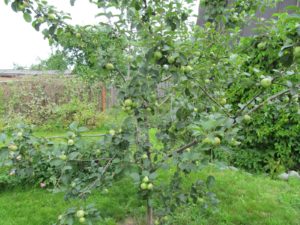 The tree is considered vigorous, although it would be more logical to classify it as medium-sized. Without additional pruning, it can reach a height of approximately 5-5.5 meters., no more. The crown is quite vigorous, but not prone to dense growth. It is oval or rounded, and over the years it inevitably acquires a broadly oval or even weeping, spreading form. The shoots usually grow at a right angle, are long and straight, but can also be slightly geniculate, covered with reddish-brown or reddish-brown bark with slight pubescence. Fruiting is usually concentrated on the shoots.
The leaves are medium-sized, dark green or rich green, slightly elongated, long-pointed, and have a curled tip. They are leathery, dense, and thick, with a rough, matte surface and light pubescence on the back, and can be folded into a boat-shaped form. The root system is robust, branched, and deeply rooted.
Productivity and pollination
The tree is considered a high-yielding variety, although with such leaders as Antonovka it can't be compared.
One mature Bogatyr tree can yield approximately 75-95 kilograms of shelf-stable fruit per season. However, under favorable weather and climate conditions, as well as with good care, experienced gardeners can achieve up to 90-120 kilograms of fruit..
The variety is considered conditionally sterile. This means it will bloom and produce a few apples even when there are no other apple trees nearby. However, you'll only be able to count them on your fingers, so this isn't a good option. Trees with suitable bloom times should be planted near the Bogatyr to ensure cross-pollination. Many gardeners spray the trees with syrup during bud break to attract more insects.
Winter hardiness and disease resistance
Apple trees are called winter-hardy, and this characteristic goes far beyond simply resistance to low temperatures. Not only do the trees tolerate temperatures below -35-37°C without even causing any noticeable damage, but they also tolerate sudden temperature fluctuations, and humidity plays no significant role. However, it's also a good idea to avoid covering the trees in harsh regions, as predicting the weather is very difficult.
Bogatyr is immune to fungal apple diseases, particularly powdery mildew and scab. Therefore, treatment against them is completely unnecessary. However, in some cases, they can be seriously damaged, for example by insect pests, so it's important not to neglect insecticides.
Rootstocks and subspecies
There are currently no subspecies of Bogatyr, but it can be grown on a wide variety of rootstocks, except seedlings. This directly affects the tree's characteristics and yield. For example, semi-dwarf trees don't grow taller than 3.5-4 meters, while dwarf trees don't grow taller than 2.5-3 meters. The root system of these varieties is shallower, significantly reducing their winter hardiness. Due to the compact crown, yields are also slightly lower, although not significantly.
Features of growing Bogatyr
 Landing
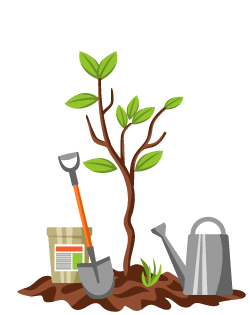 Landing
Basic conditions
- Sunny, open areas are good for any apple tree variety. Bogatyr apple trees will also thrive in such locations. The main thing is to avoid drafts, which can damage the trees during the spring, winter, and fall.
- Loamy or sandy loam soils are best for the tree, but a good harvest can also be grown in black soil, if enriched with river sand. The main requirement is that the soil be loose and slightly acidic.
- Groundwater levels above 2.5-3 meters can be fatal for the apple tree. It's best to choose locations where the Bogatyr's roots can't reach the water.
- The holes need to be prepared in advance, ideally the season before, but can be done as early as 3-4 weeks beforehand. To do this, dig holes 65-80 centimeters deep, add soil and fertilizer to the bottom, add drainage on top, and then fill with water (35-50 liters).
- Stakes or supports are dug into the holes to support the seedlings. These can be made from any available material, but it's best to place them on the north side of the tree.
- Place the seedling upright, leaving the root collar 8-10 centimeters above the surface. Cover with soil, gently shaking to prevent air pockets. Compact the surface, water with 40-45 liters of water, and mulch with sawdust or compost.
Landing patterns
This variety can be planted either in early spring, around late March or early April, or in autumn, but only after the leaves have completely fallen. Trees thrive equally well in both situations. Closed rhizomes are generally unproblematic; they can be transplanted to their permanent location at any time during the growing season.
Protection from frost and rodents
The Bogatyr won't require any special care, but it certainly won't hurt to give it a little extra attention. You don't need to cover the trees with grass mats or straw bales, but wrapping the trunks with burlap is a good idea. Young saplings in harsh climates can be covered with a tent-like covering.
To protect against insects, tree trunks are whitewashed with lime to a depth of 1-1.4 meters. This will prevent pests from settling in cracks and broken bark, as well as near the roots. Hungry rodents, even in winter, are effectively repelled by smearing the trunk with grease, melted garden oil, or other substances with an unpleasant, pungent, or unnatural odor.
Tree care
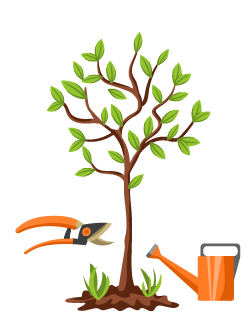 Tree care
Loosening the soil, watering: proper agricultural technology
Digging around the tree trunk is acceptable only once a year; this is sufficient, especially if it's a dwarf rootstock. However, if desired, you can do it twice; it won't cause any harm. The key is to avoid digging too deeply to avoid damaging the roots. Throughout the summer, you can hoe the soil every 10-20 days to allow oxygen to reach the rhizome. At the same time, remove any weeds, root suckers, shrubs, and other growth.
Trees should only be watered in dry and hot weather. Under normal conditions, excess watering is not necessary. It's best to follow the 10-day rule, applying no more than 10 liters of water if there's been no natural precipitation for ten days. You can also fertilize and feed the apple tree with the water, as this will help it absorb minerals and other nutrients better.
Pruning: simple crown shaping
The Bogatyr's crown isn't prone to becoming dense, so pruning performed at the nursery will essentially be the only formative pruning. Subsequently, only slightly shortening the shoots will be necessary to maintain the desired shape. Also trimmed are suckers (upward-protruding branches) and those growing inward.
Sanitary pruning involves removing old, diseased, and dead branches, which will make the tree look much cleaner. It should be done in late autumn or early spring, before the sap begins to flow. Rejuvenation can begin between the ages of 15 and 18, keeping in mind that fruiting occurs on wood that's 3-5 years old.
Pollinator varieties
- Cinnamon Striped.
- Melba.
- Robin.
- Sinap northern.
- Zhigulevskoye
- Borovinka.
- Streifling.
Reproduction
- Rooting cuttings.
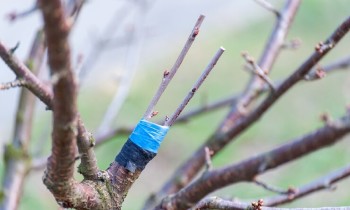
- Grafting by buds or cuttings.
- Growing from seeds.
- Clones (layering).
Diseases and pests
- Black crayfish.
- Cytosporosis.
- Green aphid.
- Hawthorn.
- Codling moth.
Ripening and fruiting of Bogatyr
The beginning of fruiting
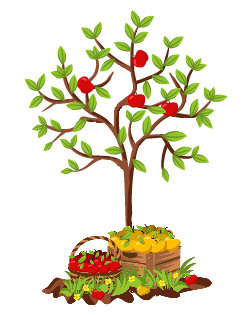 The beginning of fruiting
Bogatyr may not bear fruit for the first time for a long time, only 6-8 years after planting in open ground. This will be just a few fruits, just a taste. A full harvest will come much later.
Flowering time
Like all other apple trees, the Bogatyr begins to open its buds only by mid-May. However, the climate and growing zone play a significant role. Blooming times can vary significantly due to external factors. In northern regions, where springs are cold and rainy, they can shift to the end of the month. The flowers themselves are large, beautiful, pure white or slightly pinkish, and fragrant. They are gathered in inflorescences of 6-8 and bloom closely, giving the tree a very decorative appearance.
Fruiting and growth
A major advantage of this variety is its regular fruiting, which increases exponentially. Each year, the trees produce more and more fruit. By the 12th to 16th year, they are fully mature, and you can harvest the coveted hundred kilograms of delicious, long-lasting fruit. A young tree grows much faster than a mature one, gaining 45-65 centimeters in height per year.
Harvesting maturity occurs around mid-September, but experienced gardeners recommend not rushing to pick the apples from the branches. They are firmly attached and won't fall to the ground. Therefore, it's usually customary to harvest them towards the end of October, the main thing is to watch for frost. The fruits are not suitable for immediate consumption; they are very hard and sour. Consumer maturity occurs around December-January, after 1-3 months of storage. Bogatyr apples have a very good shelf life, keeping well until the next harvest.
Top dressing
- Mineral complexes.
- Wood ash.
- Ammonium nitrate.
- Compost.
- Chicken manure.
- Manure.
What to do if it doesn't bloom or bear fruit
- Check for pests and diseases.
- Transplant to a sunnier location.
- Fertilize.
Why do apples fall?
- Pests.
- Diseases.
Please leave your feedback on the Bogatyr variety so that other gardeners can learn about your experiences growing these trees.