Black Prince Apple Tree: Variety and Care Features
| Color | Reds |
|---|---|
| Ripening season | Autumn |
| Size of apples | Large |
| Taste | Sweet and sour |
| Crown type | Average tree height |
| Shelf life | High shelf life |
| Application | Universal variety |
| Winter hardiness | Average winter hardiness |
| Fruiting age | Up to 5 years |
 History of origin and regions of growth
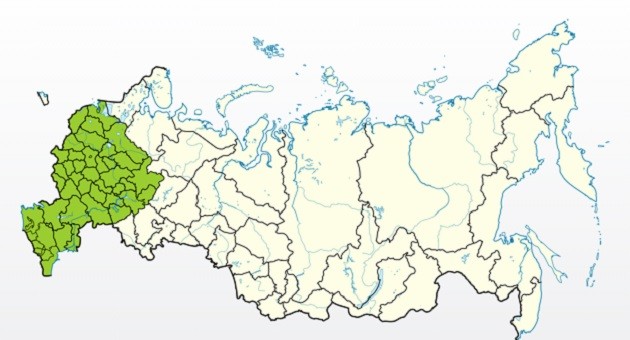
Growing regions
- European part of Russia.
- Moscow and Moscow region.
- North Caucasus.
- Leningrad region.
- Crimea.
- Southern regions.
Origin
The variety arrived in our country relatively recently, but has already gained widespread popularity and genuine interest from both professionals and amateur gardeners thanks to its unique qualities and properties. Although the history of the Black Prince is not particularly long, it is eventful. It began in the mid-20th century in the United States with the development of the Jonagold variety, which became the parent of the new apple tree.
In 1994, the first seedling of one of hundreds of hybrids, named Wilton's Red Jonaprince, was obtained in Holland. It is known as the Black Prince in our country. It is grown throughout almost all of Europe and North America, and in Canada (in Ontario County), it has even become a commercial specialty. In 2015, it was accepted for variety testing in Russia; it has not yet been included in the State Register of Breeding Achievements and has not yet received official zoning.
Content
Description of the Black Prince variety
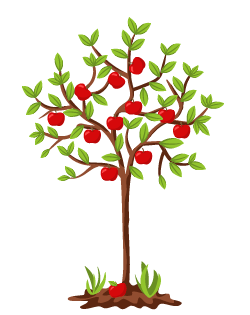 This fast-growing apple tree, ripening in the fall and late fall, can be found in many farms across our country. It's beloved by gardeners for its exceptional undemanding nature, undemanding soil, watering, fertilizing, and care, although it never hurts. The Black Prince is highly resistant to fungal and bacterial infections and bears fruit annually, without rest, for many years in a row.
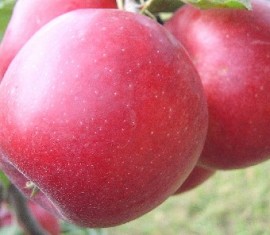
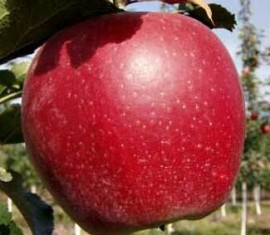
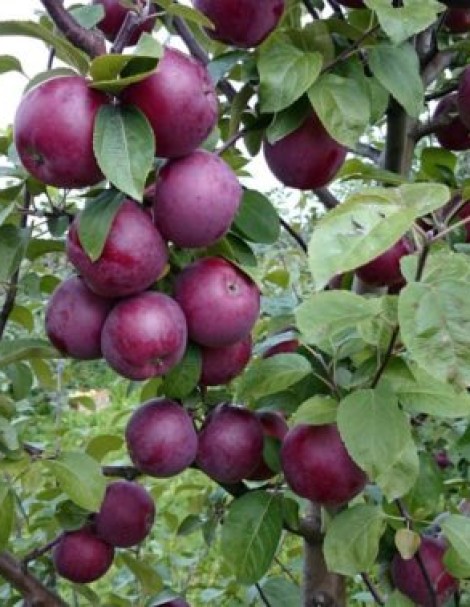
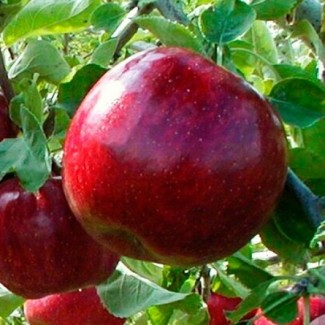
The apples of this variety are very beautiful, dark red, almost black, and easily recognizable. They are large and attractive, with a unique flavor and a powerful aroma that can be felt for many meters. This variety is recommended for intensive industrial orchards and small gardens in private gardens.
Apples: What do they look like?
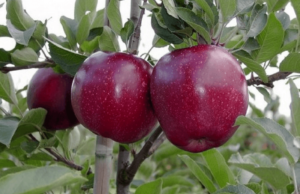 The fruits are uniform, large or even larger than large, but this directly depends on climate, weather, and care. They grow to 190-220 grams in weight, but can also reach 250-280 grams or even more. They are round or round-elongated, smooth, symmetrical, and slightly cylindrical. The ribbing is well-defined at the tip, but smoothed over the rest of the surface.
The skin is firm, fairly thick but not hard, elastic, and protects the apples well from mechanical damage. It is greenish-yellow or green, difficult to notice because it is over 95% covered with a dense, continuous blush. This blush is red or dark red, turning dark burgundy or reddish-black during ripening. Subcutaneous punctures are numerous, small, grayish-green, and clearly visible on the surface. Professionals typically evaluate the chemical composition based on the following parameters:
- Sugar (fructose) – 16.9%.
- Ascorbic acid (vitamin C) – 17.8 grams.
- Pectins (fiber) – 12.5%.
- P-active substances – 341 milligrams.
- Titratable acids – 0.78%.
The flesh is dense, crisp, splittable, prickly, fine-grained, and of a pleasant texture. It has a distinct yellowish-cream, sometimes lemon-like, hue. The flavor is considered harmonious, dessert-like, and balanced; it is sweeter, with a noticeable acidity in the aftertaste. Professionals give the Black Prince a tasting score of 4.8 out of 5.
Black Prince apple tree: characteristics
Crown and root system
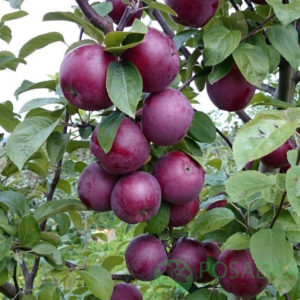 The tree is considered tall, although in reality, it usually doesn't grow taller than 4.5-5 meters. If grown on a dwarf rootstock, as experts recommend, it may only barely reach 3.5-4 meters.Its crown is compact, moderately dense or sparsely dense, with branches extending from the central core at a nearly 90-degree angle. They are straight, long, and pointed upward, covered with smooth gray-brown or gray-brown bark, slightly pubescent in some areas.
The leaves are large, beautiful, dense, and leathery, with coarse ribbing. They are shiny, glossy, and short-pointed, with a serrated and crenate margin, and have a felt-like pubescence on the underside. The root system is medium-deep, branched, and can be either taproot or fibrous, depending on the rootstock used. It is well-adapted to the search for nutrients and moisture.
Productivity and pollination
This is a triploid variety, characterized by high yield and, most importantly, stable fruiting.
A single mature tree can easily yield 200-250 kilograms of fruit per season. With proper care, timely feeding, and fertilization, this figure can be increased to 300 kilograms in favorable years, and sometimes even more..
The triple chromosome set makes it somewhat difficult to find pollinators, without which high yields are unlikely. Initially, trees should be planted interspersed with those that bloom at the appropriate time, no further than 40-50 meters from the Black Prince.
Winter hardiness and disease resistance
The Black Prince tolerates cold weather and fairly harsh winters quite well. It can withstand sudden temperature fluctuations, constant alternations between thaws and bitter frosts, and temperatures as low as -22-25°C are completely unaffected. However, in the first few years of its life, while the tree is young and fragile, it will require adequate insulation and proper preparation for the cold.
Triploid apple trees have a unique feature – high resistance to scab and other fungal diseases. However, during years of severe epiphytotics, they can still be affected. Although the disease typically affects only the leaves, and the fruit remains edible, it's best to take preventative measures early and also treat the trees with insecticides. Apple mites are particularly dangerous for this variety, so pay attention to this.
Rootstocks and subspecies
There are no subspecies of the Black Prince, nor is there a columnar form. If you're offered something similar, it's best to refuse; it's a scam. It's best grown on dwarf and semi-dwarf rootstocks; these will result in more compact trees and the largest fruit, although winter hardiness will be slightly reduced.
Features of growing Black Prince
 Landing
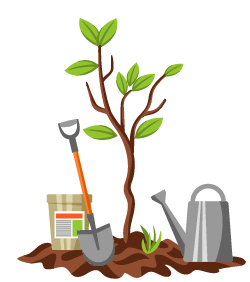 Landing
Basic conditions
- To plant an apple tree, choose a sunny location with adequate ventilation. A well-ventilated, draft-free crown, along with good light, is key to achieving a large harvest.
- The Prince's soil is best suited to light, loamy but fertile soil. However, strong and healthy trees can be grown in sandy loam and black soil, provided they are properly supplemented with fertilizer, sand, clay, and other necessary nutrients.
- Trees should not be planted in holes where the groundwater level is too close to the surface. A floodplain meadow, which is flooded by spring runoff in the spring, is unsuitable; a site near a swamp, shallow well, river, or pond will only be suitable after additional drainage.
- The holes are prepared 6-7 months before planting. They are dug 80 centimeters deep and up to 1 meter in diameter. The bottom is filled with wood ash, horse humus, chicken manure, compost, or other organic matter, and minerals can be added. This is then topped with soil or a drainage layer as needed, filled with 25-30 liters of water, and left uncovered.
- At least 5 meters of free space should be left between standard trees, and 3.5-4 meters will be enough for dwarf and semi-dwarf trees.
- Immediately dig a stake, approximately 1.4-1.5 meters high, into the hole for tying. If placed on the north side of the trunk, it will not only serve as support but also provide additional protection from freezing winds in winter.
- The root collar of the tree should always be left above the surface, approximately 7-10 centimeters, so that it does not take root higher.
- The roots are inspected, dry or broken ones are cut off, they are dipped in a mixture of water and clay, and placed on a drainage surface so that all shoots lie freely and do not curl. They are covered with soil, compacted by hand in layers, and watered with 35-40 liters of water. mulch for additional moisture retention.
Landing dates
Black Prince can be planted in both spring and fall. However, in warmer regions, it's best to avoid this, while in colder climates, it's best to choose an earlier planting date. Ideally, choose a warm day in April or May, before the sap starts to flow. Containerized root systems (in bags, pots, or containers with a root ball) can be planted at any point during the growing season.
Tree care
 Tree care
Protection from frost and pests
To protect young trees, it's best to cover them with a tent-like covering, from rootstock to crown. If this isn't possible, the area around the trunk is raked with soil, covered with spruce branches, hay bales, or straw. The trunks are wrapped with burlap, agrofibre, roofing felt, or even old tights.
Whitewashing the trunks with lime and regularly and timely spraying with commercially produced insecticides are effective against insects. To repel rodent pests, such as mice or hares, that chew the delicate bark, trees are coated with fuel oil, grease, or rendered animal lard.
Loosening the soil, watering: proper agricultural technology
Apple trees are dug up twice a year, being careful not to disturb the shallow roots. Hoeing the roots can be done more frequently, but be careful. Weeds, plant shoots, and root suckers are removed at the same time. To simplify care, many simply create a circle of mulch or sow mint, lemon balm, dill, cilantro, or parsley in it.
Watering Trees need to be watered carefully and timely, depending on their needs. The soil should be constantly slightly moist, airy, and not compacted to the consistency of granite. Young trees can be watered with 10-20 liters once a week, while for mature trees, two waterings per month of 15-35 liters is sufficient. Drip irrigation is a good option. watering or sprinkling.
Pruning: simple crown shaping
The first formative pruning is carried out in the second year after planting. It is advisable to create a sparse, tiered crown, placing the skeletal branches at different heights and widely spaced. Regular branching will need to be monitored annually thereafter. At the same time, it is necessary to prune spinning tops (branches sticking up) and those that grow inside the crown.
Sanitary pruning is carried out in spring and fall. All damaged, diseased, or dead shoots should be removed to prevent them from wasting sap and nutrients. After 15-17 years, rejuvenation can begin, removing 2-3 older branches.
Pollinator varieties
Reproduction
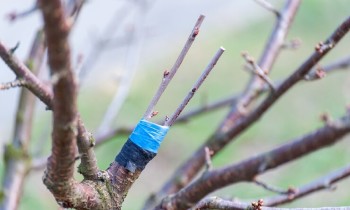
- Grafting.
- Rooting.
- Layers.
- Growing from seeds.
Diseases and pests
- Green aphid.
- Bacterial burn.
- Scale insect.
- Codling moth.
- Leaf roller.
- Hawthorn.
Ripening and fruiting of the Black Prince
The beginning of fruiting
 The beginning of fruiting
This tree is quite early-bearing, blooming for the first time as early as 2-3 years after planting in open ground. However, it's recommended to allow the flowers to develop into ovaries only in the 4-5 year, when you can eventually harvest approximately 5-15 kilograms of fragrant, beautiful, and long-lasting fruit.
Flowering time
The apple tree blooms about a week to half a week earlier than its parent variety, but also primarily in May. By mid- to late April, it is covered in buds, which quickly open into large, beautiful pink flowers with delicate petals and a simply stunning fragrance. These large, delicately petaled flowers are gathered in clusters of 6-8. To increase the size of the fruit, experienced gardeners recommend regulating the blooming process by thinning the buds, removing 30-35% of the total number evenly across the tree.
Fruiting and growth
The tree grows very quickly, producing up to half a metre of fruit per season, and even faster when young. Therefore, it can increase its yield in the shortest possible time. By the 10th to 12th year, it reaches its full potential, and the number of fruits can please even the most demanding growers.
Black Prince apples ripen by the end of September, about a week earlier than Delicious Golden. They can be picked immediately and sent for processing or storage, but they can also be left hanging on the branches for longer shelf life. In a special refrigerator or a cellar with suitable conditions, they can be stored until the following summer, but indoors in a crate they will only last until January. They can be transported easily over any distance.
Top dressing
- Mineral complexes.
- Peat.
- Superphosphate.
- Compost.
- Manure.
- Chicken manure.
- Humus.
- Ammonium nitrate.
- Humus.
What to do if it doesn't bloom or bear fruit
- Inspect for diseases or pests.
- Arrange regular watering.
- Fertilize.
- Transplant to a more suitable location.
Why do apples fall?
- Natural weather conditions (wind, rain, hurricane, hail).
- Pest damage.
- Various diseases.
Share your own experience with the Black Prince apple variety so everyone can get to know it and get maximum yields with minimal effort.