Dialogue apple tree: characteristics of the variety and care
| Color | Greens , Whites |
|---|---|
| Ripening season | Summer |
| Size of apples | Average |
| Taste | Sweet |
| Crown type | Columnar tree |
| Shelf life | Low shelf life |
| Application | For recycling , Fresh |
| Winter hardiness | High winter hardiness |
| Fruiting age | Up to 5 years |
 History of origin and regions of growth
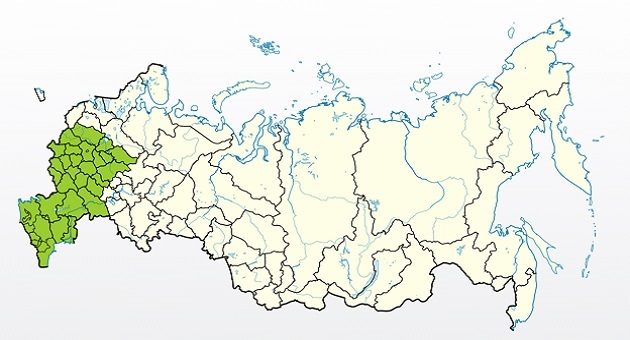
Growing regions
- Some northern regions.
- North Caucasus.
- Crimea.
- European part of Russia.
Origin
The development of columnar apple trees in our country owes much to the renowned scientist and plant breeder Viktor Valer'yanovich Kichina and his loyal colleagues at the All-Russian Institute of Selection and Technology of Horticulture and Nursery. He developed this variety with Mikhail Vitalyevich Kachalkin, beginning in 1985. The starting material was the already well-known winter-hardy Brusnichnoe variety and the columnarity donor KV-102. After seven years of intensive work, the first seedling, designated 330/43, was selected. In 1999, the variety was given its own name, Dialog, classified as an elite variety, and sent for official field trials.
In January 2001, an application was submitted to add the variety to the list of breeding achievements. Dialog was added to the State Register only in 2004. Officially, the apple tree is zoned for eight regions (Central Region: Smolensk, Ryazan, Vladimir, Kaluga, Moscow and the Moscow Region, Tula, Ivanovo, and Bryansk). However, in fact, fruitful columns are grown throughout the European part of the country, in the Caucasus, the Leningrad Region, and Crimea.
Content
Description of the Dialogue apple tree variety
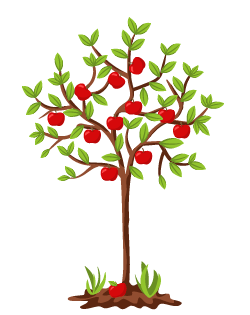 This low-growing apple variety with a compact, columnar crown always attracts the attention of experienced gardeners. Add to this its enviable winter hardiness, something not every apple tree can boast, its vigorous and abundant annual fruiting, and its ease of care and cultivation.
Considering the commercial and consumer qualities of these unusual sweet fruits, Dialog can confidently be considered one of the most popular and sought-after apple trees on the market. Professionals recommend using these apple trees for large, intensive commercial orchards, as well as for small homesteads.
Apples: What they look like
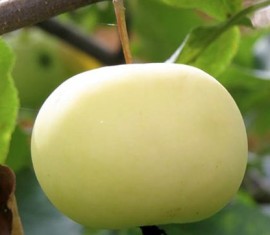
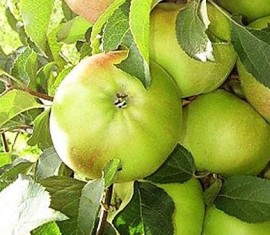
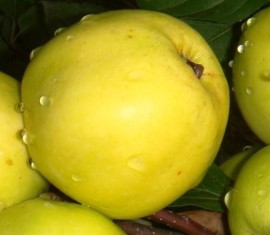
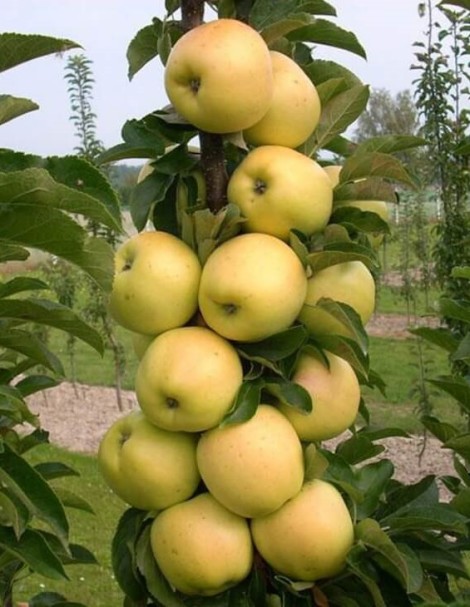
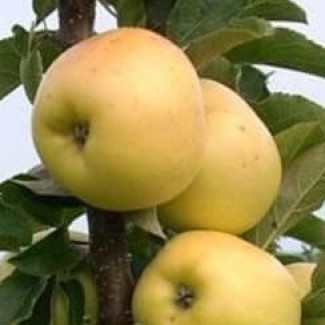
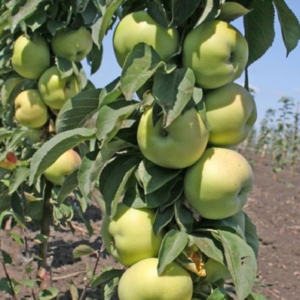 The fruits are usually round or flattened-round. They are symmetrical, smooth, and mostly uniform in size. They can weigh approximately 80-115 grams, but sometimes somewhat larger ones, up to 110-130 grams, are found, making them considered medium-sized. Ribbing is very subtle, with only the sepals exhibiting very smooth, almost imperceptible, protrusions.
The skin of the fruit is strong, elastic, and firm, yet thin, helping preserve it during transportation. It has a beautiful light green hue, which turns yellow or golden as it ripens. Sometimes, when overripe, the fruit appears plump, almost translucent. The blush is usually absent, but can appear as translucent raspberry-pink spots on the sunny side. Subcutaneous spots are grayish, small, and barely noticeable, although numerous. Professionals evaluate the chemical composition based on the following parameters:
- P-active substances – 292-312 milligrams.
- Ascorbic acid (vitamin C) – 13.7-14 grams.
- Sugar (fructose) – 12.5-13.8%.
- Titratable acids – 0.39%.
- Pectins (fiber) – 11.6%.
The pulp is pleasantly textured, tender yet slightly prickly and crisp, juicy, and has a strong, pleasant, characteristic aroma. It is snow-white in color, but can sometimes acquire a slight yellowish tint. Considered a dessert fruit, it has a sweet flavor with a pleasant, slightly tart aftertaste, with hints of honey and herbs. Professional tasters give Dialog 4.7-4.8 points on a 5-point scale.
Apple tree Dialogue: characteristics
Crown and root system
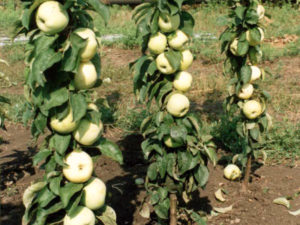 These apple trees are truly compact, fast-growing, and compact. Growing in a columnar formation, they occupy no more than half a square meter, allowing for very dense plantings for a bountiful harvest. The maximum height of the tree is approximately 2.2-2.5 meters, and this is without proper formative pruning. The trunk is covered with smooth, pubescent bark, cherry-brown or brown in color, which is prone to cracking over time. Fruiting occurs on fruiting twigs growing directly from the trunk.
The tree's leaves are quite dense, arranged close together. They are dense, leathery, green, and glossy, often with a downy underside. The leaf blade is elongated, short-pointed, and the margins are serrate-crenate and wavy. The root system is superficial, fibrous, and branched, but does not anchor the tree firmly in the soil and is not adapted to seeking water.
Productivity and pollination
With normal care, the tree is considered highly productive and early-bearing. Remarkably, during testing, the variety's yield was nearly twenty times higher than that of the officially recognized leaders—English apple trees.
In one season, a mature Dialog tree can yield at least 5-6 kilograms of beautiful, delicious apples, equivalent to approximately 85-98 tons per hectare. However, with proper feeding, fertilizer, moderate and reasonable watering, and favorable weather conditions, these figures can increase by 1.5 times..
The variety is completely self-sterile, so don't expect apples to bloom unless there are other trees nearby. Therefore, it's essential to plant them interspersed with plants that bloom at the same time.
Winter hardiness and disease resistance
Compared to other columnar varieties, this one truly stands out: not every variety can withstand temperatures down to -37-40°C. Its performance in this regard is comparable to that of the Antonovka varietal, but the variety can only tolerate such extreme conditions for a short time. If the frost lasts more than 1-2 weeks, the trees will likely die.
Scab Dialog is almost immune to both cytosporosis and powdery mildew. If not properly cared for, during years of severe epidemics, the foliage may be affected, but the fruit remains suitable for consumption. Insects can be a problem for gardeners, so prevention is essential.
Rootstocks and subspecies
This variety has no subspecies, but it is grown on various rootstocks. The most common are considered to be the dwarf and semi-dwarf varieties Mark, 62-396, MM-106, and M-9. It's important to understand that this apple tree will not bear fruit on every rootstock, so it's recommended to purchase planting material only from trusted sellers, large nurseries, and fruit and vegetable farms.
Features of growing Dialogue
 Landing
 Landing
Basic conditions
- This variety prefers open, sunny, and wind-blown spaces. However, it will grow and produce fruit well even in the shade. Note that good ventilation does not necessarily mean a draft.
- The soil for columns should be airy, oxygenated, and fertile, but moderately acidic. Acidic soils usually result in the death of seedlings within the first year. Loam, black soil, sandy loam, and rocky slopes are all suitable, but be sure to fertilize regularly.
- Proximity to groundwater doesn't play a big role, as the roots don't penetrate deeply. If the water doesn't reach more than 1.5 meters, then everything is fine and there won't be any problems. However, planting Dialog in a swamp or lowland near a stream is not recommended.
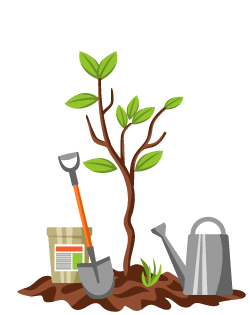
- There's no need to prepare the holes in advance; just dig 60-80 cm holes 1-3 weeks before planting. The bottom is usually filled with fertile soil, additionally mixed with fertilizer, filled with drainage if necessary, and filled with water. Afterwards, be sure to let the holes settle for a while.
- The distance between trees should be no more than a meter, but between rows, a distance of about 90-95 centimeters is preferable to facilitate harvesting, weeding, and other maintenance. Slats or other supports are dug into the holes to support the trees.
- Root collar The seedling's rootstock should always protrude above the surface, otherwise the tree will root higher. In this case, the rootstock's qualities will be completely lost.
- Hold the seedling upright, cover it with layers of soil, and compact it by hand, being careful not to pack the soil too tightly around the root ball. After leveling the soil, water the tree with 15-25 liters of water, and mulch the surface with any suitable material.
Disembarkation time
Trees can be planted in spring and late fall, as long as there's no risk of frost. However, experienced gardeners recommend choosing a sunny day in March or April and reserving fall planting for other varieties.
Tree care
 Tree care
Protection from frost and pests
If the region's climate is not particularly mild, and frosts are likely to damage your orchard, it's best to properly cover it for the winter, especially for delicate apple trees like columnar apple trees. Despite Dialog's resistance to low temperatures, it needs to be wrapped for the winter, with the trunks wrapped in old tights or burlap, and the root zone covered with spruce branches, straw, or hay, or covered with a tent.
Timely and regular treatment with insecticides helps against insects, as well as whitewash Lime in spring and fall. To prevent fungal diseases, trees are sprayed with fungicides.
Loosening the soil, watering: proper agricultural technology
The tree's trunk area should be dug up twice a year, but this must be done very carefully and gently. The roots are shallow beneath the soil surface and are easily damaged, which can cause severe stress to the tree. The rest of the year, the soil should be hoeed the day after watering or rain to prevent it from drying out into a solid crust. Weeds, fallen leaves, and shoots from other plants should also be removed.
Dialog requires regular watering; this is the foundation of its care, as it can't "get" its own water. A mature tree requires at least 15-20 liters of water, ideally in two doses, morning and evening. Regarding the watering schedule, everything is clear here: once or twice a week, in the absence of natural rainfall. Fertilizer and top dressing.
Pruning: simple crown shaping
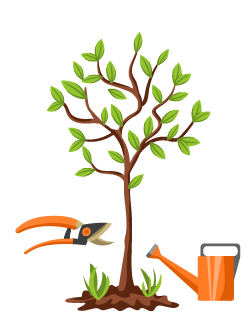
Forming a natural column is not difficult. It's enough to remove a third of the trunk in the first year, and then simply ensure the tree doesn't produce skeletal side shoots and remove dead fruiting branches. If the top bud freezes in the winter, it should be cut off and a new top will develop. The lifespan of an apple tree is short, only 15-18 years, so rejuvenation is out of the question.
Reproduction
- Rooting.
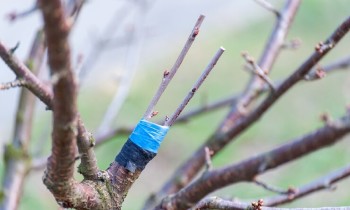
- Kidney grafting.
- Growing from seeds.
- Cuttings.
Diseases and pests
- Black crayfish.
- Bacterial burn.
- Scab.
- Cytosporosis.
- Powdery mildew.
- Green aphid.
- Codling moth.
- Hawthorn.
The Ripening and Fruiting of Dialogue
The beginning of fruiting
 The beginning of fruiting
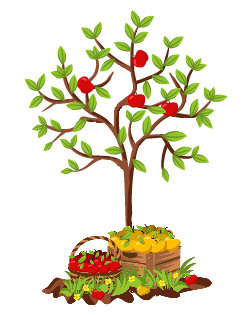
It first blooms approximately 2-3 years after planting in open ground, but the first fruiting should be timed for 4-5 years. Before this, all flowers are mercilessly removed so the tree can develop its root system and green mass. At this point, the harvest will be only a few fruits, but it will certainly be enough to sample what kind of fruit it is.
Flowering time
Dialog is considered an early weed, so its buds begin to open quite early. By late April or early May, they can already delight with their snow-white, fleshy, and very delicate petals. Flowering continues for quite a long time, at least 14-18 days, so bees usually have time to cross-pollinate. To further attract insects, experienced gardeners use mobile apiaries and also spray the trees with honey or sugar diluted with water.
Fruiting and growth
This variety grows foliage very quickly, reaching at least 35-50 centimeters per season. Therefore, the tree can reach its full height in just a few years. Fruiting also increases quickly. Before you've even had a chance to taste the first fruits, you'll be able to harvest a full crop of 6-11 kilograms in the seventh or eighth year, under favorable conditions.
Outstanding results can be achieved even by growing trees without planting them in open ground at all, placing them in pots outdoors or in a greenhouse. For this reason, these plants are popular among winter garden owners in the Far East and the Far North.
The fruits begin to ripen as early as early August, practically the first among the late summer varieties. While they won't surpass Bely Naliv or Papirovka, they will certainly ripen by early autumn, delighting with a sweet taste and a light, pleasant aroma. Unfortunately, their shelf life is anything but exceptional. Apples can be stored in the cellar for only 30-40 days, after which they become loose, begin to rot, and taste bitter. By then, it's best to process the entire harvest into juices, jams, preserves, or compotes.
Top dressing
- Compost.
- Ammonium nitrate.
- Humus.
- Superphosphate.
- Manure.
- Mineral complexes.
What to do if it doesn't bloom or bear fruit
- Check for pests or diseases.
- Transplant into the sun.
- Water.
- Fertilize.
Why do apples fall?
- Wind, hail, hurricane, rain.
- Pest damage.
- Diseases.
Please leave your feedback on the Dialogue variety, as many gardeners would like to grow similar varieties in their gardens.