
White Naliv apple tree: characteristics of the variety and care
| Color | Whites , Greens |
|---|---|
| Ripening season | Summer , Early |
| Taste | Sweet and sour , Sweet |
| Crown type | Average tree height |
| Shelf life | Low shelf life |
| Application | Fresh , For recycling |
| Winter hardiness | Low winter hardiness |
History of origin and regions of growth
Growing regions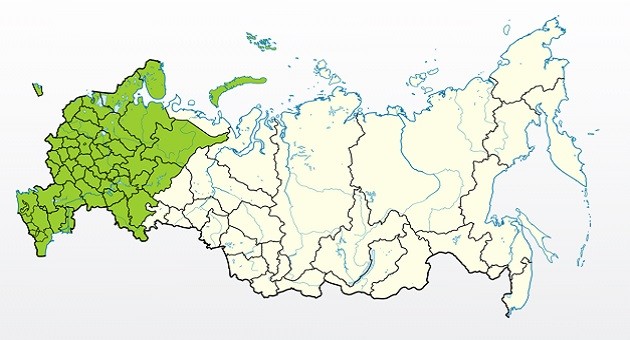
The variety is zoned in the State Register of almost all regions of our country, except for the Ural, Far Eastern and East Siberian regions.
Origin
Many people ask where the White Naliv apple variety originated. There's no definitive data on this. Some researchers claim it's an ancient Russian variety, others insist it came to us from the Baltic coast, and still others say it's possible the ancient Greeks ate these fruits.
White filling has many different popular names: Pudovshchina, Beloplodka, Nalivnoe beloe, Dolgostsebelka and others.
Content
Description of the White Naliv apple variety
This apple variety is considered one of the oldest, which has not lost its popularity to this day.
Apples: size, color, weight
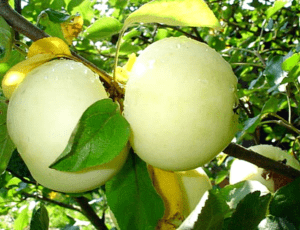
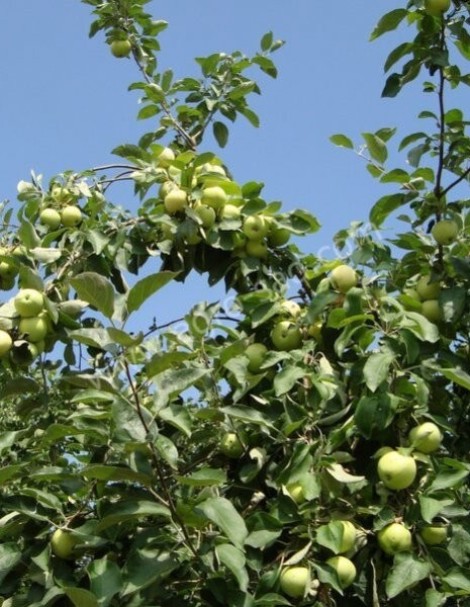
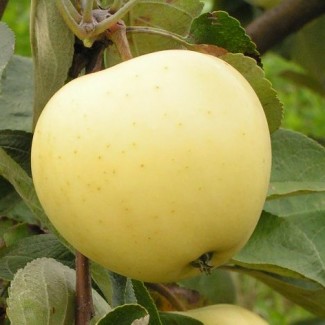
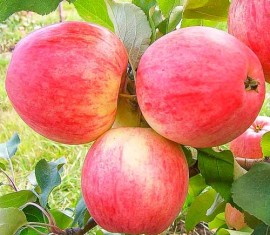
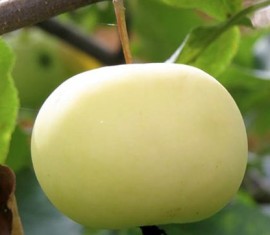
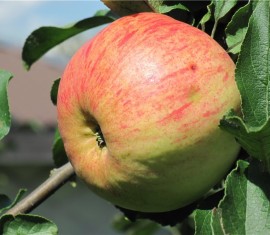
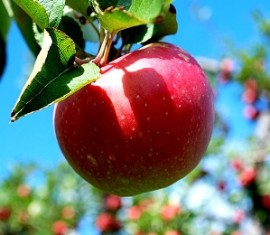
The fruits appear quite early, with light green or yellowish skin that turns white or yellow as they ripen. Occasionally, the side may take on a slightly pinkish tint. On one side of the apple, there is usually a seam running from the sepal to the stalk.
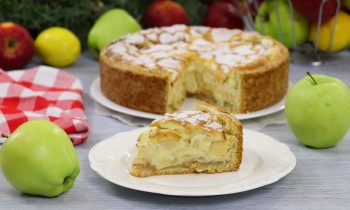
These apples have a tender, slightly sweet, delicious, and juicy flesh. While these apples don't keep well for long periods of time, they're a real find as a seasonal treat for compotes, pies, and jams. They're generally round, but can taper slightly toward the sepals. The average weight of one fruit is 80-120 grams.
White filling apple tree: characteristics
Crown and root system
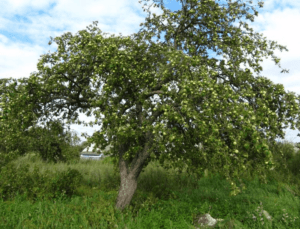
This apple tree is classic. It can reach 5 meters in height., but with proper garden pruning, owners typically limit the tree to 2-3 meters for ease of harvesting. The bark, smooth when young, hardens over time, becoming slightly rough. It has a characteristic light gray color with patches of a darker shade.
Initially, while the tree is still young, the crown is predominantly pyramidal, but with time it acquires a more rounded shape. The fairly spreading branches can cover a fairly large area, approximately 2-3 meters in diameter. The root system is determined by the rootstock onto which the White Naliv is grafted. It may have a central taproot or not, and may be highly branched or quite compact.
Productivity and pollination
This variety is very productive, and in good years even a young tree is literally covered with apples, but for this to happen it must be provided with optimal care.
A mature tree can produce 60-80 kilograms of fruit per year, but can reach 150-200 kilograms. Typically, two-year-old seedlings are planted, and harvesting begins two to five years after planting.
The White Naliv is not self-fertile, so it will not bear fruit without a pollinator. Other apple trees are used for pollination. Preference should be given to those that bloom during the same period as the White Naliv.
Winter hardiness and disease resistance
White filling grapes became widespread in our country due to their exceptional frost resistance. They easily survive even harsh winters, preserving almost all their fruit. However, in northern regions, where temperatures drop below -30-35°C, growing them is impractical. They will likely die there.
White filling grapes aren't particularly resistant to various diseases. Pests also attack them quite readily. Therefore, they require regular treatment if you want to reliably obtain high yields. The most serious problem is scab, which is especially active in high humidity on unpruned trees.
Subspecies and rootstocks
There are many subspecies of this variety, which are not easy to distinguish from each other.
| Subspecies | Description |
| Steppe | It has the smallest fruits (up to 45 grams). It is fairly frost-resistant, and ripe fruits have a yellow tint. It is common in the Far East. |
| Honey | Produces slightly larger fruits (70-90 grams). They are usually yellow, and the trees rarely get sick. scabFrost-resistant, recommended for warm regions. |
| Ural | It produces larger apples (up to 100 grams). They are golden-green, sometimes with a pink blush. It tolerates frost well and begins to bear fruit 2-3 years after planting. As the name suggests, it is widespread in Urals. |
| Isetsky | It bears medium-sized apples (100-130 grams). It ripens very early, produces yellowish-white apples, and tolerates even severe frosts well. |
| Gold | Produces large, golden-green apples (up to 140-150 grams). This variety is not listed in many catalogs. It is resistant to scab or black crayfish. |
| Pink | It bears the largest fruits (up to 200 grams). Its apples are turnip-shaped, greenish with a pink tint. The Nizhny Novgorod region is considered the main growing region. |
It's often confused with Papirovka, which was indeed brought from the Baltics. Moreover, many reputable breeders believe they are varieties of the same cultivar. Upon closer inspection, many differences can be found, so we'll tentatively consider them to be different.
Rootstocks: features
Any of the subspecies of the variety can be grown on different rootstocks.
| Rootstocks | Peculiarities |
| Creeping | This is the most dwarf, low-growing variety. They are the most cold-resistant. |
| Semi-dwarf | It reaches a height of 3-4 meters and can withstand quite severe frosts. |
| Dwarf | This rootstock will yield the largest possible harvest, provided it receives proper care (watering and fertilizing regularly). It grows to a height of approximately 3 meters and tolerates temperatures down to -30°C. |
The creeping White filling is grown even in SiberiaIt produces fairly good yields, is distinguished by its early maturity, and is particularly easy to grow. Dwarf and semi-dwarf varieties are more demanding, requiring watering, fertilizer, and proper pruning.
Features of growing White filling
Growing seedlings requires special attention to their specific characteristics. Many factors must be taken into account: the weather conditions in your region, its climate, and the variety's care and growing requirements.
Landing
Basic conditions
- White filling will not thrive in waterlogged soils. Loam is ideal. You can dilute the soil with river sand if it is too clayey. This will also improve root drainage.
- The variety does not like lowlands and proximity to groundwater, so it is better to plant it on hills and elevations.
- Ideally, trees should be protected on the north side. This could be a fence, a hedge, or other plants. The distance from them to the White Filling should be 2.5-3 meters.
- The soil should be neutral or slightly acidic (no more than 66.5 pH).
- It's best to keep the roots of other fruit trees away from the soil within 2-3 meters. They can draw moisture and nutrients, reducing fruit production. The optimal planting pattern is a 4-by-5-meter grid.
Landing dates
The timing depends directly on the growing region. In harsher climates, spring is the best time to plant, as this gives the plant a better chance of rooting. They should be planted in mid- to late April, but no later than early May. The key requirement is well-warmed, sunny, and reasonably dry soil.
For larger seedlings (over 2 years old), late fall planting is recommended. This is best done in late October, before the first frosts. The ground should freeze for at least a month.
Protection from frost and rodents
Young first-year trees should be carefully protected from frost. First and foremost, ensure that the trees' bark is undamaged, otherwise they will likely die. Spruce branches are often used for protection, meaning the tree is surrounded by a circle of branches. All trees under five years old should be additionally mulched annually with manure. In particularly harsh conditions, piling soil up to 15-25 centimeters onto the trunk is acceptable to protect the roots.
The thin, succulent bark of young trees, along with similar winter protection, creates favorable conditions for colonies of rodents, which can damage the apple trees. For protection, you can use roofing felt or tar paper wrapped around the trunk. Fine mesh or even burlap are also suitable. However, it's best to treat the trunk with a repellent; for example, rendered lard is considered the safest.
Tree care
It's important to understand that the more effort you put in, the better the results. Therefore, it's worth investing time and effort to provide your apple tree with the care it deserves, especially since it's not difficult.
Loosening the soil, watering: proper agricultural technology
Experienced gardeners recommend watering White Naliv every week for the first five years of growing the variety. The exception is during harvest and the period immediately following the first frost. If watering continues, the seedlings may freeze and die. The watering schedule and rules are quite simple.
- Irrigation can be by drip, groundwater, surface irrigation, or even sprinkler irrigation. It's best to do all irrigation in the evening, when the sun has already begun to set.
- For the first time, watering begins in the spring, even before the buds open.
- The second time for an adult plant to be watered is optimal when the ovaries are forming.
- The third watering is carried out 2-3 weeks before harvesting.
- The last time to water the apple tree is best no later than the beginning of October, before the first frost.
For a one-year-old seedling, the recommended watering rate is 16-20 liters. This amount can be doubled annually. Apple trees older than five years require 50 to 100 liters of water per square meter of irrigated area.
After each watering, be sure to loosen the soil to prevent it from compacting into a tight ball. Don't forget to weed, as weeds will rob the apple tree of nutrients and water. This is especially true for weed seedlings, such as maple trees.
Pruning: simple crown shaping
There are four basic types of pruning that all fruit trees, including apple trees, require.
- FormativeTo achieve this, the branches are formed into 2-3 tiers to facilitate fruit picking. This type requires only 5-6 branches, diverging at an angle of 65-70 degrees. This type of pruning should be done in the first 2-4 years of growth. If the branches are at a different angle, they can be bent back and secured with twine or weights.
- SupportiveThis pruning is performed only on young trees to allow the "wounds" to heal more easily. It involves leaving only one of the double shoots, the thicker, stronger one, and simultaneously shortening it. Moreover, the faster the shoot grows, the shorter the shoot should be.
- SanitaryThis type of pruning involves cutting off all diseased, old, or damaged branches.
- RejuvenatingApple trees typically reach a plateau around 30 years old. At this point, rejuvenation is performed, which gardeners call "pinching." The shoots are pruned back to two- or three-year-old wood.
It's customary to graft "seed to seed," meaning plants of the same variety that are at the same fruiting time. White Naliv is not a suitable rootstock for winter apple varieties.
Pollinator varieties
- Antonovka.
- Grushovka Moscow.
- Mantet.
- Cypress apple tree.
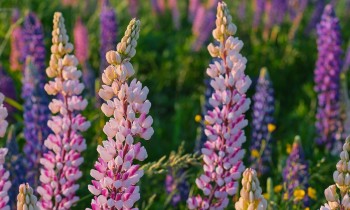
- Lungwort.
- Early pear.
- Ottawa.
- Chinese golden.
- Candy tree.
Reproduction
- Layers.
- Growing from seeds.
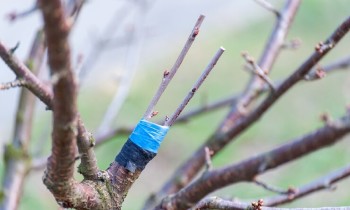
- Grafting (rootstock) using buds or cuttings. This can be done on apple, rowan, pear, wild stock, or clonal shoots.
Diseases and pests
- Powdery mildew.
- Scab.
- Black crayfish.
- Codling moth.
- Flower beetle.
- Green aphid (apple aphid).
To prevent tree death, it's important to promptly collect fallen fruit, weed, regularly thin branches, and perform sanitary pruning. It's also a good idea to whitewash the trunks and skeletal branches, install rodent traps, and spray the apple trees with appropriate solutions as needed.
Ripening and fruiting of White filling apple trees
These factors are directly dependent on climate and weather each year and can fluctuate significantly. However, the characteristics of the cultivar also play a significant role.
The beginning of fruiting
It all depends on the subspecies of white filling chosen. Some begin to bear apples as early as the second or third year, while others may take five or six years. This is easiest to determine when purchasing seedlings. This largely depends on the rootstock. Trees on dwarf varieties begin bearing fruit sooner than others.
Flowering time
This variety is distinguished by its rather large, snow-white flowers, which literally cover the entire tree. In the temperate zone, flowering begins approximately between the 1st and 10th of May. In the south, White Naliv may bloom even earlier, in mid- to late April, and in the north, in mid-June.
Fruiting and growth
White Naliv often ripens earlier than other varieties, making it considered an early-ripening variety. By mid-August, the fragrant fruits are usually ready to be fully harvested. Weather plays a major role: the cooler the summer, the later the apples ripen. They are harvested twice, with a one- to two-week break between harvests.
Typically, each tree determines its own fruiting cycle. This is influenced not only by the subspecies, but also by climate, weather, soil, proximity to groundwater, and its quality.
On average, the White Naliv produces 4-7 large, strong shoots annually. These shoots begin to ripen fruit the following year. However, this factor also depends on the weather, care, watering, and fertilizing.
The White filling apple tree requires moderate fertilization.
Top dressing
- Organic.
- Potassium.
- Phosphorus.
- Enriched with microelements.
What to do if it doesn't bloom or bear fruit
- Perform pruning.
- Transplant.
- Fertilize the soil.
- Check for pests or diseases.
Why do apples fall?
- Pests.
- Diseases.
- Insufficient watering.
- Natural phenomena (strong wind, hail, etc.).
You need to be extremely careful with nitrogen fertilizers, they can easily “kill” the tree.
Leave your own reviews of White Filling in the comments and share your experiences!

Comments
I live in the Volga region, in central Russia. Last summer, the White Naliv apples were ripe by early August. I wanted to let them ripen, but the fruit started falling off. From the ground, these apples are only good for drying, compote, jam, preserves, or marmalade. Incidentally, jam made from White Naliv apples is delicious.
I also pickle these apples in cabbage. Or, as we say, "pickle" them. But they don't last long in the cellar before they start to spoil. In a cool, rainy summer, you can store them until December, but in that summer, when the fruit was already picked in early August, I couldn't.
Question: White Naliv is a pollinator for the strife. And vice versa? Will the strife also pollinate the white Naliv? Thank you.