Cheburashka apple tree: characteristics of the variety and care
| Color | Greens |
|---|---|
| Ripening season | Summer |
| Size of apples | Average |
| Taste | Sweet and sour |
| Crown type | Columnar tree |
| Shelf life | Low shelf life |
| Application | For recycling , Fresh |
| Winter hardiness | High winter hardiness |
| Fruiting age | Up to 5 years |
 History of origin and regions of growth
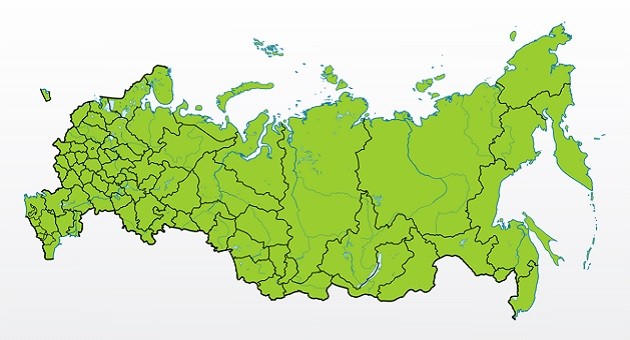
Growing regions
- Far East.
- European part of Russia.
- Ural.
- Moscow and Moscow region.
- North Caucasus.
- Northern regions.
- Leningrad region.
- Crimea.
- Siberia.
- Southern regions.
Origin
This variety is a new cultivar developed by the Sverdlovsk Horticultural Breeding Station of the Russian Academy of Agricultural Sciences in the Middle Urals. It was developed as a summer variety with excellent winter hardiness, and seedlings are successfully passing trials. While this apple tree is not yet listed in the state register, nor is it officially zoned, it has rapidly gained popularity among gardeners. It is considered one of the most resistant to low temperatures, making it suitable for cultivation even in Siberia and the Far East.
Content
Description of the Cheburashka variety
 This amazing little apple tree is sure to catch the eye of any gardener. It can withstand harsh Siberian winters, tolerates the treacherous weather of Primorye, and easily copes with frequent temperature fluctuations and changes. conditions of the Moscow region and the Leningrad Region. Cheburashka grows in virtually any soil, requires little watering or fertilizing, will grace any plot, and even produces a decent harvest.
The fruit is quite large, typical of northern apple trees. It's beautiful, juicy, and delicious, with a pleasant, distinctive aroma. While the fruit can be transported long distances, it doesn't store well. Despite this, this variety is recommended not only for small home gardens but also for intensive commercial orchards.
Apples: What do they look like?
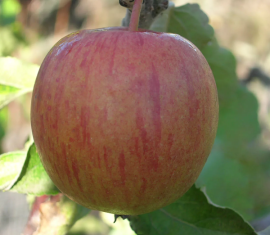
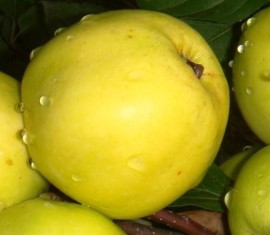
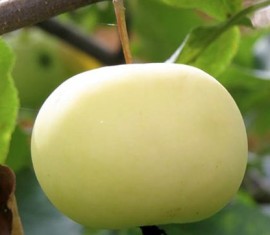
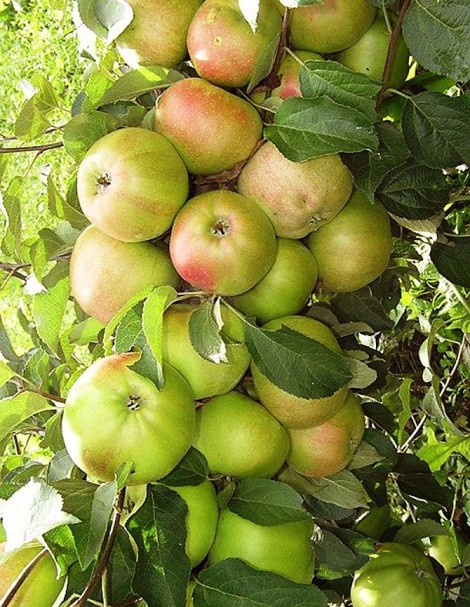
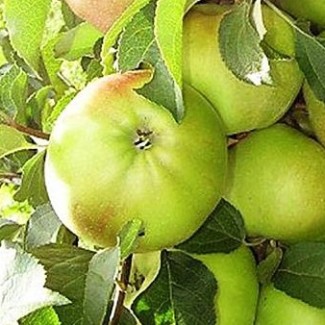
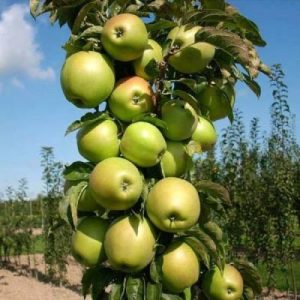 The fruit grows to a medium size on the tree, but can be smaller or larger depending on environmental conditions. In favorable years, they can reach 130-180 grams, but when the weather is unfavorable or the care is inadequate, they shrink to 80-110 grams. However, even these figures are quite good compared to coastal or Siberian apple trees. The apples are round or round-conical in shape, sometimes somewhat elongated and tapering toward the tip. The ribbing near the calyx is clearly visible, but the lateral seam is not visible.
The fruit's skin is medium-thick, fairly dense, elastic, and firm, but easily splits when bitten. It is green or even bright green, and can turn whitish-green or beige-green as it ripens. The blush is either completely absent or appears on the sunny side as carmine-red or slightly pink, translucent, blurred streaks and spots. Subcutaneous spots are medium-sized and quite numerous, but they have a greenish tint, blending with the base color. The chemical composition is usually assessed based on the following data:
- Sugar (fructose) – 10.2%.
- Pectins (fiber) – 14.8%.
- P-active substances – 234 milligrams.
- Titratable acids – 0.87%.
- Ascorbic acid (vitamin C) – 11.4 grams.
The fruit's flesh is medium-dense, fine-grained, and has a very pleasant, crisp, and slightly prickly texture. It has a bright, pleasant sweet-and-sour flavor, leaning more toward the sour side but with a sweet aftertaste. It also has a very strong aroma, spicy, slightly lemony, and honey-like. While the fruit hasn't been professionally evaluated, experts unofficially give it a 4.5 on a 5-point scale.
Cheburashka apple tree: characteristics
Crown and root system
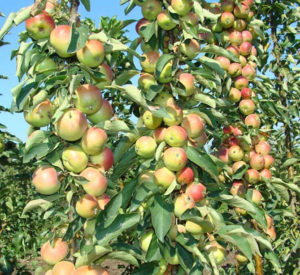 The variety is columnar, meaning the tree grows as a single trunk, making it much easier to care for. These columns are medium-sized, They easily grow up to 2.3-2.5 meters without pruning., and can sometimes reach three. The trunk is quite strong but not thick, covered with gray-brown or brownish-brown bark, smooth, with slight pubescence in some areas. Fruiting occurs in a mixed manner, that is, on spurs, fruiting shoots, and rings located directly on the trunk.
Cheburashka's leaves are lanceolate, elongated, flattened, leathery, and glossy. They are a rich green or even sometimes a deep emerald hue, large, very beautiful, and dense, making them popular in landscape design. The root system is shallow, mostly superficial, fibrous, and highly branched. It is moderately adapted for foraging for food and water.
Productivity and pollination
The yield of this tree is considered high, as is its growth rate.
A good apple grower can produce approximately 13-16 kilograms of aromatic and delicious apples per season from a single tree trunk, even in a favorable year. However, under unfavorable environmental conditions, yields can drop significantly, to around 8-12 kilograms, which is still quite good.
The apple tree is considered self-fertile, but only conditionally. This means the tree can pollinate on its own, with the help of bees and wind alone, and doesn't require nearby apple trees. However, it's important to note that harvests are significantly higher if other varieties are grown within 10-150 meters, so it's recommended to plant Cheburashka interspersed with other varieties. Experienced gardeners recommend establishing an apiary near the garden and spraying the trees with honey or sugar syrup during flowering.
Winter hardiness and disease resistance
This variety can easily withstand even the harshest conditions, such as Siberian or coastal winters, which few plants can survive. Cheburashka even withstands temperatures down to -39-42°C with flying colors, and if it does sustain damage, it's minor and recovers quickly. However, proper shelter should be used in the harshest regions to avoid losing your trees.
This variety has very good resistance to scab, powdery mildew, fire blight, and a number of other apple tree diseases. During testing, the percentage of damage was no more than 5.6, which is very low. However, regular preventative maintenance is still necessary, including treating the trees with insecticides.
Rootstocks and subspecies
The variety has no subspecies, although it is grown on different rootstocks. However, the differences are minor. For example, on a vegetative rootstock, the tree is more resistant to low temperatures and sudden temperature fluctuations, while on semi-dwarf and dwarf rootstocks, it grows shorter. Rootstock has virtually no effect on the quality or size of the fruit, although the data on this is somewhat contradictory.
Peculiarities of Growing Cheburashka
 Landing
 Landing
Basic conditions
- These apple trees are very sun-loving, so they should only be planted where their crowns will be exposed to sunlight for most of the day. In the shade, the trees become spindly and weak, and can become diseased and die without any apparent cause.
- The main requirement for soil is that it shouldn't be too acidic or salty. Everything else is unimportant. Trees grow well in loam, sand, or black soil, even on rocky slopes, bearing fruit regularly and producing good harvests.
- The groundwater level for Cheburashka should be more than 1.3-1.5 meters, meaning it can be planted almost anywhere; there's a suitable spot everywhere.
- Dig holes for the columns in advance, approximately 6-8 months before planting. If you don't have time to do this in time, you'll need to wait at least 3-4 weeks after properly digging the holes. To do this, dig them 60-70 centimeters deep and the same in diameter, adding a small amount of fertilizer mixed with the topsoil to the bottom. Then, line the entire hole with drainage and water it with 15-30 liters of water, leaving it uncovered to rest.
- Stakelines, stakes, or metal rods should be driven into the holes immediately, to which the apple trees can be tied. These will not only provide additional support for the fragile tree but also protect it from frost if placed on the north side.
- It is customary to leave the root collar of the apple tree above the soil surface horizon so that the seedling acquires the original properties of the rootstock.
- Place the tree vertically, sprinkle it with soil, compact it by hand and water it with 25-35 liters of water; the surface can be mulched to retain moisture.
Landing dates
Cheburashka can be planted in both spring and fall, as long as there's no sap movement in the trunks. In spring, it's best to wait until the soil has warmed completely, but be careful not to let the buds begin to open. In fall, wait until the leaves have fallen, when there are at least 21-35 days left before frost.
Tree care
 Tree care
Protection from frost and pests
Covering trees for the winter is not at all difficult, as their compact size allows for the trunk to be covered from rootstock to tip using a tent-like method. However, this isn't always necessary; in warmer regions, it's sufficient to wrap the trunk with burlap or roofing felt and scatter spruce branches over the root zone.
Regularly whitewashing tree trunks up to a height of 70-80 centimeters with lime diluted with water helps repel insects. However, this won't protect against hungry mice and hares during the winter. Therefore, more advanced gardeners recommend coating the trunks with a thick layer of melted lard, fuel oil, grease, or other pungent and unpleasant-smelling substances.
Loosening the soil, watering: proper agricultural technology
Apple trees prefer loose, friable soil filled with oxygen and moisture. Digging around the trunk should be done no more than twice a year, and even then, very carefully. This is due to the roots, which are located near the surface and are easily damaged. The rest of the time, you can carefully hoe the soil, pulling out weeds and other plant shoots.
Watering Young trees need regular watering, at least once every 7-10 days, depending on natural precipitation. As they mature, watering can be reduced to once every two weeks, unless temperatures rise excessively or there is intense heat. Fertilizers and fertilizers are added with the water so the roots absorb them better.
Pruning: simple crown shaping
Everything is standard here – columnar trees require virtually no pruning, except when they sprout a stray lateral shoot. In such cases, it should be cut off before it becomes woody, and the cut should be sealed with garden pitch. If frost damage occurs, the terminal bud is also cut back to living wood, after which a new top is grown. Dried fruiting shoots are also regularly removed, and that's all there is to it.
Pollinator varieties
- Currency.
- Juicy greenery.
- Conference.
- Garland.
- Ostankino.
- Brotherchud.
- Dialogue.
- Korobovka.
- Chervonets.
- Sakhalin pendula.
Reproduction
- Grafting.
- Rooting.
- Growing from seeds.
Diseases and pests
- Powdery mildew.
- Scab.
- Green aphid.
- Fruit rot.
- Bacterial burn.
- Scale insect.
- Codling moth.
- Leaf roller.
- Hawthorn.
Ripening and fruiting of Cheburashka
The beginning of fruiting
 The beginning of fruiting
Flowers on the Cheburashka tree usually begin to bloom in the first year, and they're not barren; they can easily develop into apples. However, there will only be a few, so don't expect a large crop. Professionals advise plucking the first blossoms so the apple tree doesn't waste energy on them and instead develops its rhizome and green mass. Fruiting formally begins in the second or third year. At that point, you can harvest approximately 4-5 kilograms in a good year.
Flowering time
This variety is considered a summer plant, meaning it's designed to bear fruit fairly early, meaning it shouldn't be harvested until late. Buds appear as early as late April or early May, quickly blossoming into large, beautiful, and fragrant snow-white flowers, gathered in clusters of 5-7. They bloom for approximately 10-12 days. It's important to ensure there are enough insects for pollination.
Fruiting and growth
Cheburashka is considered a fast-growing variety because it can easily reach half a meter in height in just one season. The tree quickly reaches its maximum height, simultaneously increasing its productivity. By the age of 5-7 years, the yield exceeds 13-15 kilograms, which is already quite sufficient. By the age of 8-9 years, under any conditions, the tree enters its most active phase, which it maintains practically throughout its life.
The fruits ripen in late July or early August. In some exceptional cases, they may be delayed until mid-month. Consumer ripeness can be determined by a fresh, waxy, oily coating and a pleasant, sweet taste. Unfortunately, even in a special refrigerator, apples won't keep for long—only a few weeks, so it's best to process them immediately or eat them fresh.
Top dressing
- Mineral complexes.
- Peat.
- Superphosphate.
- Compost.
- Manure.
- Chicken manure.
- Humus.
- Ammonium nitrate.
- Humus.
What to do if it doesn't bloom or bear fruit
- Inspect for diseases or pests.
- Organize timely regular watering.
- Fertilize.
- Transplant to a more suitable location.
Why do apples fall?
- Overripe.
- Natural weather disturbances.
- Pest damage.
- Various diseases.
Please share your own experience with the Cheburashka apple variety so everyone can learn about it and avoid potential mistakes when growing their own.