Apple tree Elena: characteristics of the variety and care
| Color | Reds |
|---|---|
| Ripening season | Early |
| Size of apples | Average |
| Taste | Sweet |
| Crown type | Average tree height |
| Shelf life | Low shelf life |
| Application | Fresh , For recycling |
| Winter hardiness | Average winter hardiness |
| Fruiting age | Up to 5 years |
 History of origin and regions of growth
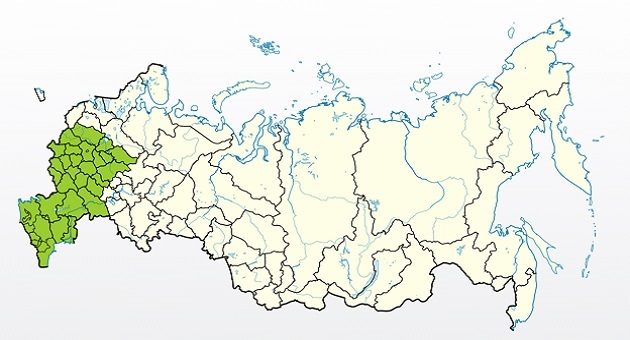
Growing regions
- Middle zone.
- Some northern regions.
- North Caucasus.
Origin
This is a typical Belarusian apple, bred at the Belarusian Research Institute of Fruit Growing using the methods of 20th-century Russian specialists, that is, through hybridization and crossbreeding. The apple tree was created under the guidance of Professor Zoya Kozlovskaya, with G. M. Maduro and E. V. Semashko also participating in the project.
The Ranneye Sladkoe variety served as the basis, crossed with the Discovery variety through pollination. Experiments were conducted from 1990 to 2000, when a completely new hybrid was finally isolated, named Elena, after one of the breeders. Currently, the apple tree has not yet been entered into the Russian State Register and is not officially zoned, but it is widely grown in Belarus.
Content
Description of the apple tree variety Elena
 Few people want to add this apple tree to their garden, and that's a shame. This tree boasts a long, consistent annual harvest, a pleasantly sweet flavor, and beautiful fruit, and, most importantly, good winter hardiness, making it suitable for growing not only in the harsh climate of the central part of Russia but also further north, such as in the Leningrad, Pskov, or Novgorod regions. It's recommended for both home gardens and intensive commercial plantings.
Apples: What they look like
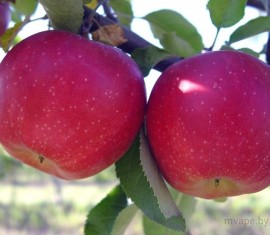
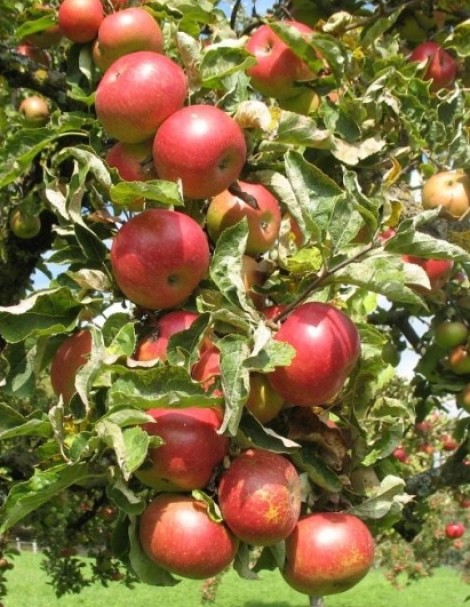
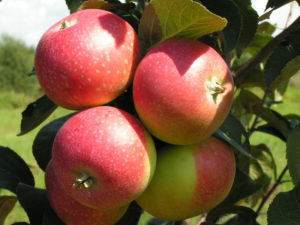 The fruits are generally medium-sized or slightly above average, weighing between 110 and 150 grams. They are round, mostly uniform in size, and can be slightly flattened or elongated, though not particularly noticeable. The surface is smooth, without protrusions, and the ribbing is subtle and virtually invisible.
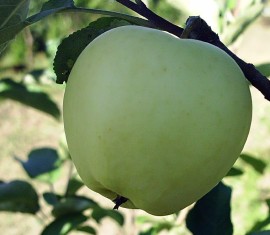
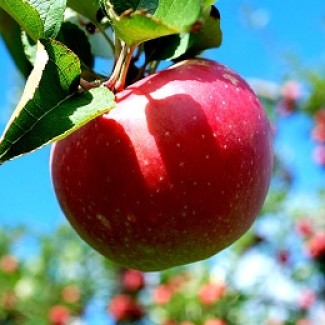
The fruit skin is thin, delicate, yet quite strong, green initially, gradually turning light green or even yellow as it ripens. The blush covers 60-85% of the surface; it is red or crimson, diffuse, and lacks distinct stripes. Subcutaneous punctures are light green, numerous, large, and clearly visible. The chemical composition can be characterized by the following indicators:
- P-active substances (catechins) – 248 milligrams.
- Ascorbic acid (vitamin C) – 6.8 milligrams.
- Total sugars (fructose) – 10.86%.
- Pectins (fiber) – 13.2%.
- Titratable acids – 0.36%.
The flesh of Elena apples is moderately firm, fine-grained, prickly, tender, and very juicy. It is white or greenish-white, and may have a layer of reddish or pink veins under the skin. The flavor is predominantly sweet, with a characteristic tartness in the aftertaste, which is why it is often considered bland. The tasting score at technical and consumer maturity, which are completely identical for this variety, is 4.8 points out of 5.
If apples are overripe and not picked at the right time, their original flavor will be completely lost. Even if they don't fall to the ground, they can only be processed into jam or preserves.
Apple tree Elena: characteristics
Crown and root system
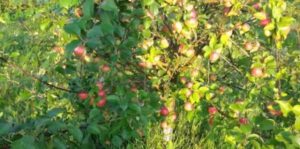 The trees are considered particularly compact, medium-sized, and even low-growing, as without pruning they can reach a maximum height of 3.5-4 meters. At a young age crown The tree is primarily pyramidal, but with age it can become broadly pyramidal or rounded, and even spreading. The branches are usually directed upward rather than downward, and are not very dense. The bark can be gray or greenish-gray, turning brown with age, cracking, and beginning to crumble.
The leaves are rich green, medium-sized, rounded-oval, and slightly elongated. They are leathery, dense, and glossy, with a serrated edge and a pointed tip. They are very dense toward the tips of the branches and thinner toward the center of the crown. The undersides are grayish and may be slightly pubescent. The root system is branched, and depending on the rootstock, may or may not have a central taproot.
Productivity and pollination
The variety is considered highly productive, though it's far from comparable to the Antonovka apple. On average, one mature tree can produce approximately 90-140 kilograms of delicious and distinctive apples per season. In intensive orchards, it's grown primarily for its yield per hectare, which can easily exceed 20-25 tons.
Elena is self-fertile, so to produce apples annually, she doesn't need other varieties with suitable flowering times. However, experienced gardeners believe that cross-pollination always increases the number of ovaries, and therefore the overall yield. They also recommend planting orchards close to apiaries or using mobile apiaries during flowering to achieve maximum yield.
Winter hardiness and disease resistance
Despite the fact that the apple tree was bred in relatively mild climates, it underwent extensive testing for winter hardiness and a kind of "hardening off" at low temperatures. In a moderate climate, Elena won't even require any insulation, but in harsher conditions, for example, in Moscow region or the Leningrad region, it's worth tinkering with this to prevent the trees from freezing.
The variety's resistance to various types of fungal infections is average. Therefore, to prevent damage scab, powdery mildew or milky shine, it's better to take all preventative measures promptly. The same applies to insects: it's better to treat the tree with insecticides promptly than to spend a long time fighting pests later.
Rootstocks and subspecies
There are no subspecies of this apple tree yet, as it is still young and not all of its properties have been fully explored. For example, no one yet knows the final period of its active life or fruiting. However, it can be grown on various rootstocks, the most popular of which are 5-25-3 and 62-396. Elena can be grafted onto dwarf and semi-dwarf varieties, but it is not yet compatible with columnar varieties.
Peculiarities of growing Elena
 Landing
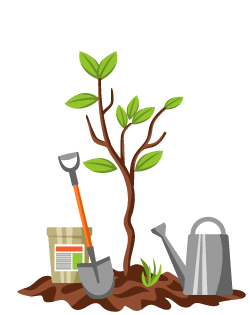 Landing
Basic conditions
- The tree doesn't have any special soil requirements, but if you choose loamy black soil with slight acidity, you'll definitely hit the spot.
- Apple trees don't like areas where many older apple trees (replants) have already been planted. This will lead to root entanglement and crown conflict in the future.
- Swampy areas, areas with persistent moisture, near open water bodies, or areas with high groundwater levels are not the best places to plant trees. Elevated sites are best, and if slopes are present, south-facing ones are best.
- This variety prefers well-lit, air-conditioned locations, but never in drafty locations. This can cause the trees to become diseased, produce poor fruit, and produce small fruit, just as when grown in the shade.
- The holes are prepared in advance using the standard method, ideally in the fall, but can be done 3-4 weeks before planting. To do this, dig holes 80 centimeters deep and the same diameter, mix the topsoil with organic and mineral fertilizers, fill them back in, add 30 liters of water, and leave them outdoors.
- The distance between holes can be made about 3-4 meters; this should be enough for a compact crown and a small root system.
- Before planting, place drainage (broken brick, vermiculite, nut shells, gravel) at the bottom of the hole in a 10-15 centimeter layer.
- Place a seedling on top so that root collar The rootstock should be 10-15 centimeters above the soil level. Otherwise, the tree may root above the rootstock and negate all its properties.
- The holes are carefully covered with soil, lightly shaking the tree trunks to prevent the formation of air pockets, watered with 30-40 liters of water, and the surface is mulched with humus, chopped grass, or compost.
Landing dates
You can plant Elena in early spring, before the buds begin to open, around April. However, this won't give it time to adapt, as it will need to immediately begin growing foliage. Therefore, it's preferable to plant it in the fall, in late September or October, after the leaves have completely fallen.
Protection from frost and rodents
In temperate climates, protecting trees from the cold isn't necessary, as they tolerate even temperatures as low as -22-25°C very well, especially in low humidity. However, in harsher winters, humid growing conditions, or regular temperature fluctuations from frost to thaw, it's better to be on the safe side. It's recommended to cover the root zone with hay or straw mats, wrap the trunks with roofing felt, tar paper, or cover them with spruce branches.
To deter rodents from feasting on the juicy bark of apple trees during cold weather, they are coated with grease or lard. To repel insects that often settle in the roots during the winter, the trunks are whitewashed to a height of 1-1.5 meters.
Tree care
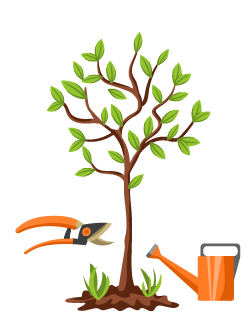 Tree care
Loosening the soil, watering: proper agricultural technology
All trees appreciate loosening the soil, as it oxygenates it. Therefore, it's recommended to thoroughly dig the area around the tree trunk twice a year, but proceed carefully to avoid damaging the roots. During the growing season, you can simply hoe the soil, removing weeds, grass, root suckers, and anything else that could rob the tree of its nutrients.
The tree doesn't require watering, but if the summer is particularly hot and dry, it won't hurt. No more than 5-6 times per season is sufficient, as excess moisture can cause tree diseases. You can time watering to coincide with bud and fruit formation, flowering, and fruit ripening. 20-30 liters per year is sufficient, along with additional fertilizer.
All watering should be stopped completely no later than mid-September. This is necessary to allow the tree time to prepare for winter by ensuring that sap flow ceases.
Pruning: simple crown shaping
The tree isn't particularly prone to developing a dense crown, so there won't be much work involved. Nursery seedlings usually come with pre-established skeletal branches, which can be simply shortened by a third the following year.
Sanitary pruning involves removing all damaged, diseased, or dead branches. Inward-growing branches and suckers (those growing vertically upward) should also be removed. At 10-15 years, rejuvenation can be performed by removing 2-3 mature branches, allowing the young ones to develop.
Pollinator varieties
- Arkad.
- Mantet.
- Melba.
- Quinti.
- Grushovka.
- Chinese golden.
- Folder.
Reproduction
- Grafting by cuttings or buds.
- Layers (clones).
- Rooting cuttings.
- Growing from seeds.
Diseases and pests
- Scab.
- Powdery mildew.
- Milky shine.
- Moniliosis.
- Green aphid.
- Codling moth.
- Hawthorn.
Ripening and fruiting of the Elena apple tree
The beginning of fruiting
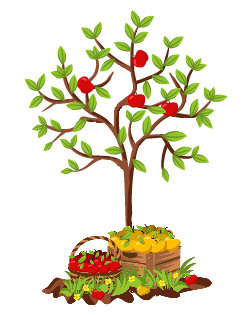 The beginning of fruiting
This apple tree is called "very early fruiting" for good reason: it produces its first harvests just two or three years after planting in open ground. While they may not be considered full-bodied, they can yield up to 5 kilograms of fragrant fruit.
Flowering time
Like all early apple trees, Elena blooms in early May or even late April. However, in harsher climates, with late frosts and heavy, cold spring rains, it may linger until mid-month. The variety's flowers are quite large, gathered in clusters, mostly white or slightly pinkish. They are extremely fragrant, attracting numerous bees to the garden.
Fruiting and growth
The variety quickly gains height and density, growing 20 to 60 centimeters per season, so within a few years it becomes a full-fledged tree. By this time, approximately 5-7 years after planting, the maximum number of apples can be harvested. Fruiting occurs annually, reliably, without rest periods.
Apples ripen in the second half of July, about a week or earlier than White fillingThis is precisely when they can and should be harvested. By mid-August, the apples will first lose their original flavor and then completely fall to the ground. Therefore, by the beginning of the month, the entire harvest should be collected. The main drawback of this variety is that, even in the most favorable conditions, it can only be stored for 2-4 weeks, and even then, with great difficulty. Therefore, they must be eaten fresh or processed very quickly.
Top dressing
- Manure.
- Bird droppings.
- Humus.
- Compost.
- Peat.
- Nitrogen fertilizers.
- Ammonium sulfate.
- Urea.
- Mineral complexes.
- Superphosphate.
What to do if it doesn't bloom or bear fruit
- Transplant to a more illuminated and windless area.
- Check for pests or diseases.
- Stop watering.
- Feed.
- Trim.
Why do apples fall?
- Overripe.
- Natural phenomena.
- Diseases.
- Pests.
Please leave your feedback on the Elena variety in the comments below so everyone can learn from your experience and make their own growing experience easier.