
Melba apple tree: characteristics of the variety and care
| Color | Reds |
|---|
 History of origin and regions of growth
Growing regions
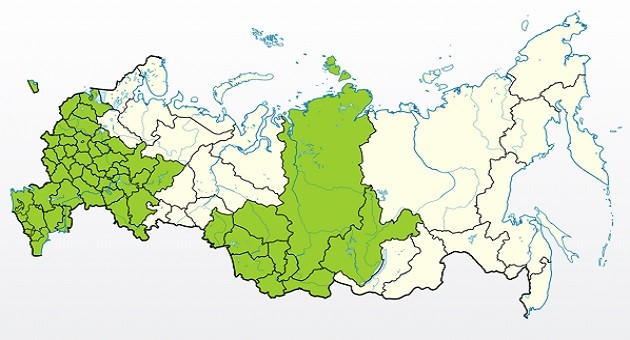
It is zoned in almost all regions of Russia, with a few exceptions:
- Far Eastern.
- Northern.
- Ural.
Origin
The Melba apple variety originates from Canada, specifically Ottawa. At the Central Experimental Station in 1898, after open pollination of the McIntosh variety, a completely unusual apple variety was created.
The new Canadian apple variety was named after the famous Australian opera singer Nellie Melba. Her fame was celebrated worldwide at the time and is now immortalized for centuries.
After the first bountiful harvests, the variety quickly spread throughout North America. In the early twentieth century, it was brought to Europe, from where it made its way to Russia, where it is listed in the state register as Melba. However, most gardeners prefer to pronounce and spell this word with a soft sign.
Content
Description of the Melba apple variety
 The Melba apple variety is an artificially bred variety. It is popular worldwide due to its high yield and pleasant flavor. These trees are suitable for cultivation throughout Russia, but they are not winter-hardy, so they are not suitable for the Far East or Siberia It's better to choose something else.
Apples: color, size, weight
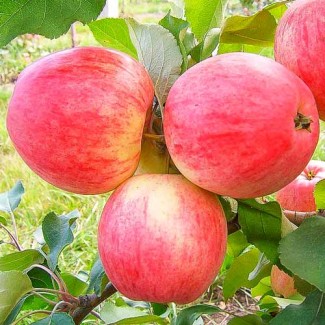
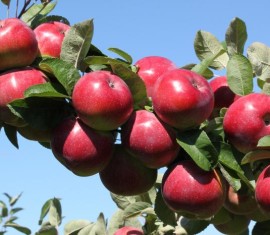
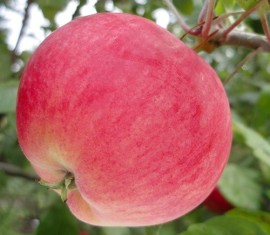
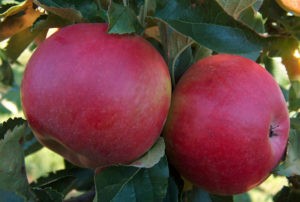 This variety is considered a late-summer variety, meaning the apples ripen from mid- to late August. They are typically medium to large in size, weighing up to 150-200 grams, round or slightly flattened, and slightly elongated toward the sepals. Young fruits are yellowish-green in color, and as they ripen, they develop a large red blush in stripes. The chemical composition can be characterized by the following indicators per 100 grams of product:
- P-active substances – 295-297 milligrams.
- Ascorbic acid (vitamin C) – 13.3-13.5 grams.
- Sugar (fructose) – 10-10.5%.
- Titratable acids – 0.78%.
- Pectins (fiber) – 10-10.2%.
Melba apples have thin, waxy skin and snow-white, sweet flesh with a slight tartness. It's soft, moderately firm, very juicy, and has a distinct vanilla-candy aroma. Tasters rate them 4.8-5 out of 5. Their flavor is considered rich, vibrant, and harmonious. The fruit is firm, transports well, and stores in a cool place for at least 4-6 months, which is why they are often grown commercially.
Melba apple tree: characteristics
Crown and root system
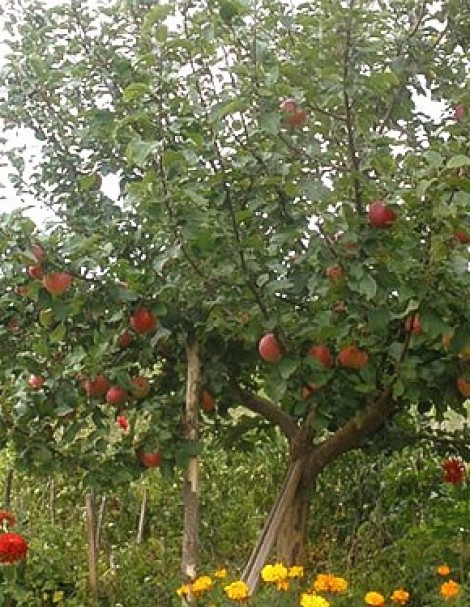
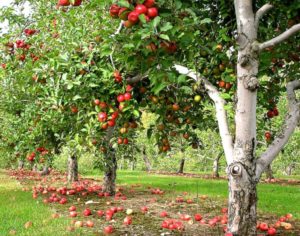 The variety is considered medium-sized, so it rarely reaches more than 3 meters in height.It is recommended to limit the tree's height by pruning it regularly; this will significantly simplify harvesting. For young trees crown The tree may be slightly pyramidal, but later becomes rounded and moderately spreading. The tree's structure is usually columnar, but the central trunk may arch. The bark of the branches is dark brown, sometimes with an orange tint, and with age may become gray or brown, becoming fissured.
Young shoots have a reddish tint and may be slightly drooping, unlike older shoots that are raised high. In most cases, the fruit stalks are attached to the ring-shaped branches. The tree's branches can cover a fairly large area, up to 5-7 meters. The foliage is soft green, oblong with a jagged edge, and can be slightly yellowish. The root system is branched and, depending on the rootstock, may or may not have a central taproot.
Productivity and pollination
Melba is considered a high-yielding variety if properly cared for.
An adult tree can produce 80-120 kilograms of fruit.
Usually one- or two-year-old seedlings are planted, reaching their maximum yield at 10-13 years of age.
The variety is self-fertile, meaning it doesn't require additional pollination to produce fruit. However, high yields are unlikely under these conditions, so it's best to plant Melba with pollinators that bloom roughly at the same time.
Winter hardiness and disease resistance
The variety isn't particularly cold-resistant. It can tolerate temperatures down to -22-25°C without losing fruit. Therefore, it's primarily grown in southern regions, the Caucasus, and temperate climates. If you provide reliable wind protection for apple trees on frost-resistant rootstocks, they can even be grown in Siberia, but there's a high risk of sunburn.
The variety has an enviable resistance to various apple diseases, except scabiesApple trees are frequently and extensively affected by this disease. Therefore, it is recommended to regularly prune the trees for sanitary purposes, as well as promptly remove fallen leaves and fruit from under them.
Subspecies and rootstocks
There are several hybrid, but very similar subspecies of this variety.
| Subspecies | Description |
| Melba red or Melba red | This subspecies is characterized by a bright red blush (sometimes up to 80-90% of the fruit) over greenish-white skin. Whitish spots are clearly visible in the flesh. The apples grow very large, weighing 160-200 grams, but are not as sweet as the main variety. The average tree yield reaches 80-90 kilograms. |
| Melba's daughter | The hybrid has increased frost resistance, able to withstand temperatures as low as -23-28°C without losing its fruit. The fruits are medium-sized, weighing up to 120-130 grams, and are sweet. However, this subvariety is not known for its high yield, with a maximum yield of only 30-35 kilograms per mature tree per year. |
There are often reports online that there is another subspecies—the columnar Melba—but nothing of the sort is listed in the state register of cultivars. The confusion may arise because young trees up to 3-5 years old have a similar crown shape.
Rootstocks: features
Any Melba hybrid can be grown on different rootstocks.
| Rootstocks | Peculiarities |
| Dwarf | Trees on such rootstocks begin to bear fruit as early as 3-4 years. They are more frost-resistant, but produce less fruit. |
| Vigorous | With this option, fruiting begins later, only in the 4th-5th year. |
The latter usually have a higher yield, which is why many experienced gardeners prefer them.
Features of Melba cultivation
Getting a good harvest of this apple variety doesn't require much effort, but it still requires some work. Climate, weather conditions, soil characteristics, and many other factors must be taken into account.
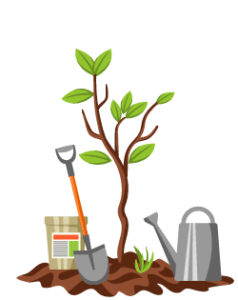
Landing
Basic conditions
- The variety doesn't like close groundwater or high humidity. Therefore, if planting is only possible in a low-lying area, it's best to ensure drainage by pouring a bucket of nut shells into the bottom of the hole. You can also create a special mound for planting to raise the tree.
- This variety is very light-loving, so choose a sunny spot 4-6 meters away from other trees. It doesn't like drafts, so it's best to choose a site protected by hedges, building walls, fences, or taller vegetation.
- For Melba, holes are dug 60-80 centimeters deep with smooth edges and a diameter of at least 1 meter.
- Before planting, remove leaves from the branches and tie them together to prevent moisture loss. If the seedlings are weak and thin, it's best to soak them in a bucket of water for 24 hours before planting to allow them to absorb moisture for better rooting.
- Trees can be planted directly into the soil, but only if it's loamy. If not, you'll need to prepare the soil. To do this, mix equal parts peat, sand, and compost or manure (preferably horse manure). Place all of this in a pre-dug planting hole.
- The seedling is positioned so that the root collar is exposed to the surface. If necessary, stakes are driven in immediately for staking. The soil around the tree is not compacted, but only lightly pressed down—Melba likes its roots to have plenty of room to move.
- Watering is required immediately upon planting, but not too much. 8-10 liters per tree is sufficient.
Landing dates
Melba is usually planted in the fall rather than in the spring. The best time is late September or early October. This depends entirely on the growing region. The tree will need approximately three to four weeks to root properly. This should be done before the first hard frost, otherwise it will die.
Protection from frost and rodents
This variety is quite heat-loving, so it will need careful protection from freezing. First-year trees should be protected from the cold with particular care. It's a good idea to line the trunk with spruce branches, wrap it in straw, burlap, or roofing felt; scraps of roofing felt can also be used. If freezing temperatures threaten, rake a 15-25 centimeter layer of soil over the rhizome. An annual mulch with manure is also a good idea. The trunks can be coated with grease or rendered lard.
Young shoots, especially covering apple trees with straw or burlap, will inevitably attract rodents and insects. Therefore, the trunks must be treated with special compounds and whitewashed. Fine metal or nylon mesh, or thin raspberry or cherry branches soaked in lime, can be used for tying.
 Tree care
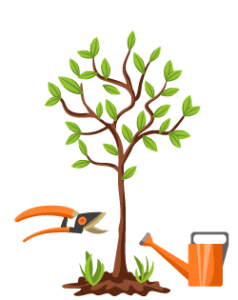 Tree care
To obtain a bountiful harvest from a tree, you need to devote sufficient time to it. It will require special conditions and care, but these are not difficult to achieve.
Loosening the soil, watering: proper agricultural technology
Melba prefers loose, aerated soil, so the trees need to be dug around annually. It's also a good idea to loosen the soil every time you water. However, remember that this variety doesn't like excessive moisture, so watering should be done with extreme caution.
- In the spring soil It's already saturated with meltwater after the snow melts. Therefore, trees don't need watering until about mid- to late May, depending on the weather and region.
- During the summer months, Melba needs to be watered in small portions (10-18 liters) once a week.
- If it rains, watering may not be necessary until dry weather sets in.
In late August or early September, watering should be stopped completely if the autumn is rainy. In extremely dry weather, the trunk area can be lightly moistened (2-3 liters). Watering should be stopped until mid- to late October to allow the tree time to prepare for winter.
Pruning: simple crown shaping
To ensure high yields and easy harvesting, regular pruning is required. This is best done in early spring, before the sap begins to flow.
- FormativeThe central trunk is pruned by approximately a third during the first year. This will allow the lateral fruiting branches to develop more quickly, forming a proper crown.
- SupportiveMelba is a fairly branchy tree, so you'll need to systematically remove weaker branches while simultaneously shortening remaining ones by half or one-third. However, this type of pruning is only performed on young trees aged 3-6 years.
- SanitaryRegularly remove old, diseased, damaged or dry branches.
- RejuvenatingIt is perfectly acceptable to prune 2-3 older branches per year to rejuvenate the tree.
Apple trees of this variety require special care when pruning. All cut areas should be immediately treated with garden varnish or water-based paint.
Reproduction
- Layers.
- Growing from seeds (rarely).
- Grafting (rootstock) by buds or cuttings.
It is permissible to graft only onto apple trees of suitable varieties, wild trees, or pears (with loss of frost resistance).
Diseases and pests
This variety has a unique feature: it is extremely resistant to almost all apple diseases except scab. Melba is often and extensively affected by scab, and it's difficult to treat. Therefore, it's important to devote time to preventative pruning, systematically removing leaves and rotting fruit from under the tree. Regularly spraying the trees with Bordeaux mixture (2%) and the trunk area with ammonium nitrate (10%) is recommended. However, it's not diseases, but pests, that pose the greatest danger:
- Scale insect.
- Bark beetles.
- Flower-eating beetles.
- Green aphid.
- Caterpillars.
- Codling moth.
To protect apple trees from insects, treat them with special solutions, such as copper oxychloride, in mid-spring, but before flowering. This will kill pests that hid in the root zone during the winter.
Ripening and fruiting of Melba apple trees
The beginning of fruiting
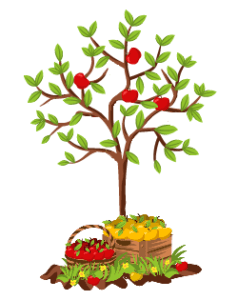 The beginning of fruiting
Young seedlings grown from seeds begin to bear fruit as early as 2-4 years after planting in open ground. However, a full harvest is unlikely before 8-10 years.
Flowering time
Melba apple blossoms begin to bloom early, in late April or early May. The apple blossoms are large, often a rich pink hue, sometimes with a purple tint.
Fruiting and growth
A small amount of apples can be harvested as early as the fourth year, with yields gradually increasing. A single mature tree can yield a maximum of 120 kilograms of apples.
You can begin harvesting fruit from a mature tree as early as the second half of August. They don't all ripen at once, so it's recommended to pick them by hand as needed. Overripe fruit will fall off the tree on its own, but won't keep for more than 2-3 weeks.
Top dressing
- Humus.
- Ash.
- Peat.
- Rotted manure.
- Urea.
- Chicken manure.
- Potassium chloride.
- Superphosphate.
- Compost.
What to do if it doesn't bloom or bear fruit
- Transplant.
- Make a cut.
- Apply fertilizer.
- Check for pests or diseases.
Why do apples fall?
- Overripe.
- Strong wind, hail, rain.
- Pests.
- Diseases.
- Over- or under-watering.
Please leave your feedback on Melba in the comments below to share your experiences with fellow novice gardeners.






Comments
Very good stuff