Apple tree "Fonarik": characteristics of the variety and care
| Color | Reds |
|---|---|
| Ripening season | Autumn |
| Size of apples | Small ones |
| Taste | Sweet and sour |
| Crown type | Average tree height |
| Shelf life | Average shelf life |
| Application | Fresh , For recycling |
| Winter hardiness | High winter hardiness |
| Fruiting age | Up to 5 years |


 History of origin and regions of growth
Growing regions
- Chita region.
- Irkutsk region.
- Buryatia.
- Khakassia.
- Tuva.
- Tomsk, Omsk and Tyumen regions.
- Novosibirsk and Kemerovo regions.
- Krasnoyarsk Krai.
Origin
Since the mid-1950s, the M.A. Lisavenko Siberian Horticultural Research Institute at the Krasnoyarsk Fruit Growing Station has been developing apple trees suitable for growing in the harsh Siberian conditions. One of these developments involved crossing an Omsky seedling (Ranetka No. 6774) with a saffron Pepin. The authors are considered to be Nikolai Nikolaevich Tikhonov and Alexandra Semyonovna Tolmacheva, who submitted the Fonarik variety for official certification and variety testing in the early 1960s.
In 1963, the first application for registration was submitted, and the variety was considered elite. However, another 11 years passed before it was entered into the State Register of Breeding Achievements and officially zoned. Fonarik is zoned for the East Siberian and West Siberian regions.
Content
Description of the variety 'Fonarik'
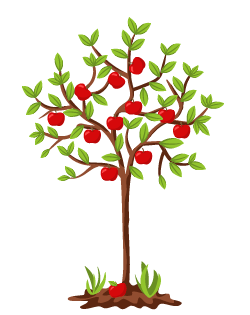 These apple trees, with their unusual narrow and tall crowns, attract gardeners for many reasons. They are easy to care for, tolerant of a variety of soils, and, most importantly, highly resistant to frost and apple diseases. The lantern apple tree doesn't require frequent fertilizing or constant digging around the trunk; it will bear fruit without it. However, without regular watering, it can suffer greatly.
Despite the small size of the fruits, their attractive appearance and pleasant, slightly spicy flavor are worth noting. They transport well without mechanical damage and make excellent juice, jam, and compotes. This variety is recommended for both individual and commercial gardens.
Apples: What do they look like?
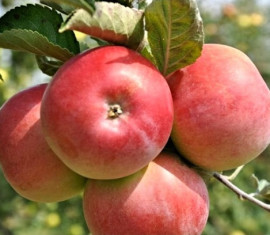
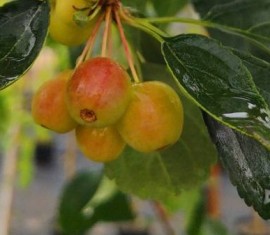
 The fruits are indeed small, sometimes very small. They can reach a maximum weight of 35-45 grams. Their uniformity is average; sometimes larger apples and smaller ones can be found on the same tree. The shape of the fruit is oval, slightly elongated, round, and smooth, with almost imperceptible ribbing and no lateral seam.
The skin is dense, sometimes firm, thick, durable, glossy, smooth, and shiny. The underlying shade is greenish-yellow, but it's virtually invisible, as it's almost completely covered with a deep, burgundy, purple, dark crimson, or deep beetroot-colored, diffusely streaked, dense blush. Subcutaneous punctures are numerous, light-colored, and easily visible. It's best to assess the chemical composition with a specific set of data:
- P-active substances (catechins) – 133 milligrams.
- Ascorbic acid (vitamin C) – 24.5 milligrams.
- Fructose (total sugars) – 14.3%.
- Pectins – 20.8%.
- Titratable acids – 2.3%.
The fruit's flesh is very dense, even hard when unripe, making it difficult to bite into. It is fine-grained, with a pleasant, juicy, refreshing, piercing, and crunchy texture. It has a beautiful yellowish-green hue, sometimes creamy, appearing bright pink near the skin due to red veins. The flavor is considered a dessert fruit; it is sweeter but has a distinctive tartness. The aroma is medium-intensity, spicy, and distinctive. Tasting scores range from 4.1 to 4.3 for both flavor and appearance.
Apple tree "Fontarik": characteristics
Crown and root system
 The tree is of medium height, it can hardly grow up to 4-5 meters., but most gardeners limit it to 3-3.5 meters through pruning. The crown is clearly narrowly pyramidal when young, but can become highly oval or simply oval with age. The density and foliage are moderate. The branches are arranged at right angles to the trunk and are covered with olive-brown bark. Fruiting occurs on one- and two-year-old growth and ring shoots.
The leaves are small to medium-sized, elongated, oval, short-pointed, glossy, and highly lustrous. They are predominantly dark green or deep emerald in color, with coarse ribbing, a slightly glaucous tint due to pubescence, and serrated, crenate-serrate edges. The root system is extensive, fibrous in most cases, well-developed, and moderately adaptable to moisture acquisition.
Productivity and pollination
This variety cannot compete with Antonovka or even Lada, but despite its compact height, it produces quite good yields, considered average.
A single Fonarik tree can yield a maximum of 35-45 kilograms of small fruits per season. But this is only in good years, with regular watering. On average, yields barely reach 30-35 kilograms..
The trees are completely self-sterile, meaning they cannot pollinate themselves. Therefore, they need to be interspersed with other trees that bloom at the appropriate time. Spraying with sugar or honey syrup during flowering is also common, as is bringing mobile apiaries to the planting sites.
Winter hardiness and disease resistance
The variety is extremely tolerant of low temperatures. It can easily withstand temperatures as low as -32°C to -37°C, even more so than the summer heat and drought. During prolonged cold spells or when temperatures fluctuate widely, the trees suffer little, but they can die during droughts.
Apple trees have moderate disease resistance, but respond quite well to various preventative measures. If you take these steps regularly and in a timely manner, you won't have to worry about any problems. scabies, no cytosporosis, no powdery mildew. And regular insecticide spraying is necessary.
Rootstocks and subspecies
The Lantern doesn't have any distinct subspecies, and there are no columnar or creeping varieties. However, it can be grown on different rootstocks, imparting different qualities to the variety. For example, on dwarf rootstocks, the trees grow even more compactly and produce slightly larger fruit, but they won't be able to withstand severe, prolonged frosts.
Features of growing Lantern
 Landing
 Landing
Basic conditions
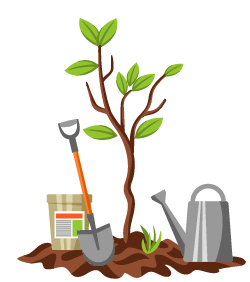
- Sunny, open, and well-ventilated locations are ideal for this variety. Care should be taken to avoid shade or drafts, as this will damage the Lantern, potentially delaying fruiting for several years.
- The planting soil should not be salty or acidic—those are the main requirements. Otherwise, it can be black soil, clay, sand, rocky, or podzolic soil.
- The holes should be prepared in advance, at least 2-4 weeks in advance. However, those dug earlier in the season are also ideal. Dig holes 50-60 centimeters deep and approximately 70-85 centimeters in diameter. Fertilizer should be placed at the bottom, followed by drainage if needed, and then filled with water (35-50 liters). Leave the holes uncovered so they can mature in the open air.
- It's customary to immediately dig or drive a stake or staking rod into the hole. It can be metal, plastic, or, more traditionally, wooden. Placing it on the north side of the tree will provide additional frost protection. It shouldn't be removed until two to three years after fruiting begins.
- Don't leave too much space between trees, as their crowns are not very large in diameter. Two to three meters is sufficient, along with the same amount between rows. This will make it easier to tend and harvest the fruit.
- The root collar of a seedling should always remain at least 3-5 centimeters above the soil surface, but allow for subsidence. After one or two months, the soil beneath the tree will inevitably collapse and need to be replenished. Therefore, a good starting point is to maintain a distance of 8-12 centimeters from the surface to the root collar.
- Before planting, you can soak the rhizome for 5-8 hours in warm water or a mixture of water and clay.
- Place the tree in the hole, spreading out its roots, cover with soil, and compact it lightly with your hands. The surface above mulch To retain moisture, the trunk itself is tied to a stake with rope in the shape of a figure eight or infinity sign. This will prevent the bark from being damaged by wind.
Landing dates
It's best to plant Lantern in the fall in areas with a moderate climate, where severe frosts don't linger for long or arrive early. In harsher conditions, spring planting is preferable. Choose a warm, dry day in mid-March or early April, when the soil has already warmed up completely.
Tree care
 Tree care
Protection from frost and pests
Before the cold weather sets in, you need to stop watering properly, otherwise the tree won't have time to prepare for winter. Already in the middle August Or by the end of the month, any moisture should be avoided. The trunks can be wrapped in old rags, roofing felt, tar paper, or burlap. While the apple trees are still small, you can create makeshift shelters for them using agrofibre or tarpaulin.
To protect your lantern from insects, you can whitewash the trees twice a year—in spring and fall, regularly clean the bark on the trunk and skeletal shoots with a stiff brush, and treat the trees with specialty products available at tree stores. Fuel oil, lard, and grease applied thickly to the trunk also help repel rodents.
Loosening the soil, watering: proper agricultural technology
Dig around the trunk no more than twice a year; this is enough to provide aeration without damaging the roots. Hoeing can be done in between, 5-8 times per season as needed, breaking up the dense soil, removing weeds and other plants, and regularly clearing debris from the tree.
Watering Apple trees require regular watering, especially when young. Young seedlings require weekly watering, preferably via sprinkler or drip irrigation. If possible, be sure to use this option. Fertilizers and fertilizers can be applied directly by diluting them with water, which will ensure their absorption.
Pruning: simple crown shaping
The sparse, tiered form suits most apple trees, and this one is no exception. However, almost any shape can be shaped, as the variety is so adaptable and flexible. A broom-shaped form, a cordon, or even a hedge can be created with the Lantern without much difficulty. The main thing is to regularly thin the crown, preventing it from becoming overgrown.
Sanitary pruning involves removing dry, broken, and diseased shoots that protrude into the crown or vertically upward. After 12-15 years, you can consider rejuvenating the tree by cutting off 3-4 mature branches to allow new ones to replace them.
Pollinator varieties
- Krasnoyarsk sweet.
- Alyonushka
- Light.
- Nastenka.
- Lada.
- Zhivinka.
- Bellefleur the Chinese.
Reproduction
- Layers.
- Grafting cuttings.
- Clones.
- Growing from seeds.
Diseases and pests
- Cytosporosis.
- Scab.
- Rust.
- Powdery mildew.
- Pit bitterness.
- Spider mite.
- Green aphid.
- Weevil.
- Flower beetle.
- Fleas.
- Codling moth.
Ripening and fruiting of the Lantern
The beginning of fruiting
 The beginning of fruiting
Depending on the rootstock, trees begin bearing fruit at different times. Dwarf trees may produce buds and even produce a few apples in the first year, but this is not recommended. It's best to pluck the flowers immediately, before they open, to prevent them from draining the tree's sap.
An apple tree first needs to develop green mass and rhizomes. Trees grown on standard vegetative material don't begin to bear fruit until the fourth or fifth year, but they will immediately produce 4-5 kilograms of small but delicious sweet apples.
Flowering time
Lanternflower begins blooming in May, and this can occur early, mid, or late in the month. Everything depends on the preceding winter, the prevailing weather, climate, growing conditions, and even the quality of care. Therefore, even experienced growers don't give exact dates, as they can vary so much. The flowers themselves are medium-sized, snow-white with a slight pinkish tint in the center, fragrant, and gathered in clusters of 4-6.
Fruiting and growth
The tree grows at a moderate pace after fruiting begins, but initially, it reaches record heights, reaching 65-70 centimeters per season. After 4-5 years, the growth rate slows to 35-45 centimeters, but the apple tree still quickly reaches its maximum height. It also increases its fruit production quite rapidly. While it yields only a few kilograms in the first few years, after 4-6 years, the yield doubles, and by 7-9 years, it becomes a full-fledged fruit tree.
The harvest is usually started in early September, by which time the apples are fully ripe. They ripen uniformly, all at once, and cling quite firmly to the branches, although they can fall off if they become overripe. They don't last very long in the cellar, only 3-4 months, but they make delicious juices and compotes.
Top dressing
- Compost.
- Peat.
- Manure.
- Humus.
- Superphosphate.
- Chicken manure.
- Wood ash.
- Ammonium nitrate.
What to do if it doesn't bloom or bear fruit
- Inspect for diseases or pests.
- Limit or increase watering.
- Feed or apply fertilizer.
- Transplant to a sunny place.
Why do apples fall?
- Natural weather conditions (wind, rain, hurricane, hail).
- Pest damage.
- Diseases.
- Overripe.
Share your own experience with the Fonarik apple variety so that any gardener can learn about it before planting and achieve maximum results.