Lada apple tree: characteristics of the variety and care
| Color | Reds |
|---|---|
| Ripening season | Autumn |
| Size of apples | Small ones , Average |
| Taste | Sweet and sour |
| Crown type | Tall tree |
| Shelf life | Average shelf life |
| Application | Fresh , For recycling |
| Winter hardiness | High winter hardiness |
| Fruiting age | Up to 5 years |
 History of origin and regions of growth
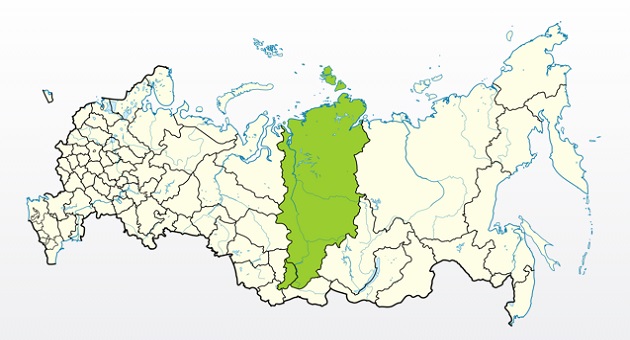
Growing regions
- Khakassia.
- Krasnoyarsk Krai.
Origin
This apple tree was first developed in the mid-1970s at the M.A. Lisavenko Siberian Research Institute of Horticulture, specifically at the Krasnoyarsk Fruit Growing Station (now the Krasnoyarsk Scientific Center of the Siberian Branch of the Russian Academy of Sciences). The cultivar's creators are considered to be the eminent Russian biologists and breeders Nikolai Nikolaevich Tikhonov and Alexandra Semyonovna Tolmacheva, who crossed the Papirovka apple with the Laletino apple variety.
In 1973, they obtained their first seedling of a new apple tree, which was soon selected as an elite variety and given the beautiful, poetic name "Lada." Then, the first application was submitted for the variety's approval for official variety testing and subsequent zoning. The apple tree was only added to the State Register in 1989. It was officially zoned for the East Siberian region, but it can be grown in much larger areas.
Description of the Lada variety
 Despite its compact size, the apple tree produces substantial yields, which immediately attracted many gardeners. It is resistant to various diseases, including parasitic ones, tolerates frosty and variable winters well, and is undemanding in terms of soil and care.
The fruits, although small in size, are beautiful and possess high consumer and commercial qualities. They ripen in mid-season, are suitable for long-distance transportation, and retain all their qualities until spring, and sometimes, under suitable conditions, until the next harvest. Lada is recommended for both individual cultivation and large, intensive commercial orchards.
Apples: What do they look like?
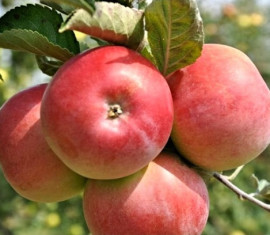
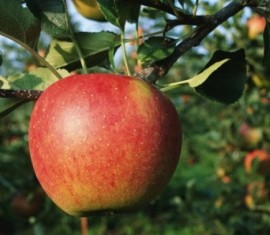
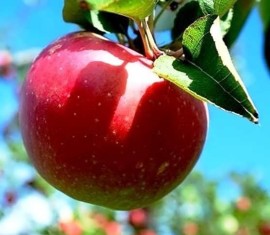
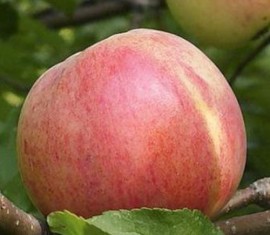
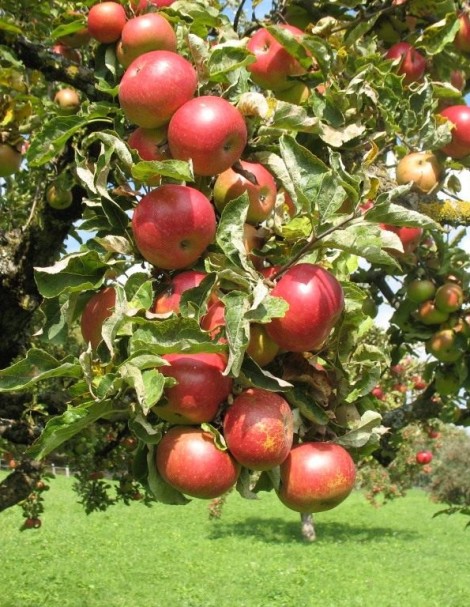
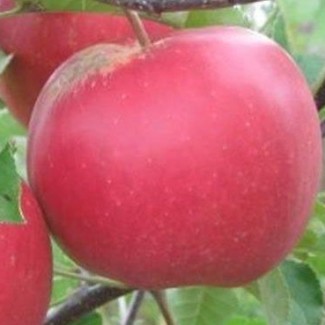
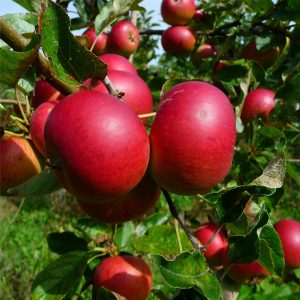 The fruits grow small or slightly larger than small on the tree. They can reach a maximum weight of 50-95 grams, rarely reaching 90-110 grams. They are round, mostly uniform, spherical, and can be flattened. The ribbing is visible at the calyx and smoothed out over the rest of the fruit; the lateral suture is rarely visible.
The skin is dense, medium-thick, smooth, glossy, and highly shiny. At full maturity, it may have a light waxy or waxy-oily coating of a bluish-silver hue. The greenish-green base color becomes almost white or lemon-white over time. The blush is vaguely striped, translucent, and carmine-red or raspberry-colored, and may turn brown when overripe. Subcutaneous punctures are numerous; they are quite large, green-gray, and clearly visible. The chemical composition is easiest to assess with a few basic data:
- P-active substances (catechins) – 340 milligrams.
- Ascorbic acid (vitamin C) – 17.9 milligrams.
- Fructose (total sugars) – 12.2%.
- Pectins – 11.1%.
- Titratable acids – 1.14%.
The flesh is dense, crisp, fine-grained, and easily peeled. It is snow-white or slightly yellowish in color, very juicy, and aromatic. The flavor is considered sweet and sour, dessert-like, pleasant, refreshing, and spicy. Professionals give the fruit a tasting score of 4.5-4.6 for both flavor and appearance.
Lada apple tree: characteristics
Crown and root system
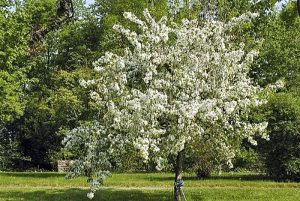 The tree is considered to be of medium height and fast growing. It can stretch without formative pruning no more than 4-5 meters.However, most gardeners prefer to limit the apple tree to 3-4 meters to facilitate care and fruit picking. The crown is rounded, sometimes even spherical, of moderate density, becoming drooping, spreading, and weeping over the years. The shoots are long, medium-thick, round in cross-section, slightly curved, and covered with bark ranging from greenish-brown to brown. Fruiting occurs on spurs, simple and compound rings.
The leaves are quite large, oval-elongated, short-pointed, and elongated. They are leathery, dense, glossy, concave, and green or dark green. They have a wavy, serrate-crenate, and serrated margin. The root system is branched and fibrous, but in some cases, depending on the rootstock, it can be taproot. Some roots are deeply buried, while others are surface roots; they are well adapted to seeking water.
Productivity and pollination
For a Siberian semi-cultivated crop, the trees are extremely prolific. With careful growers, they can produce truly substantial harvests.
In a single season, a 9-12-year-old apple tree can produce over 100 kilograms of delicious and beautiful fruit. Full fruiting begins when the tree produces at least 150-180 kilograms of apples, and in favorable years, even 180-210.
The variety is completely self-sterile, so without outside pollinators, no fruit will be produced. It's common to plant other apple trees within 50-100 meters to ensure cross-pollination. It's important that the plants bloom at the same time. Bees should be given direct access to the trees using mobile apiaries, and the trunks are sprayed with sugar syrup to attract insects.
Winter hardiness and disease resistance
Lada's frost resistance can be considered average, judging by Siberian apple trees. However, objectively, it is quite high, as it can withstand temperatures down to -32-37°C with virtually no damage. The apple tree dislikes sudden changes in temperature and high humidity, but even with minor damage, it recovers very quickly, with minimal impact on yield.
To powdery mildew, scab, black crayfish The variety has good resistance to and other apple diseases, but it is not immune. Therefore, it's a good idea to regularly and timely spray the apple tree with fungicides and insecticides. This will minimize the risk of infection or pests.
Rootstocks and subspecies
There are no subspecies of the Lada variety, but it can be grown on a wide variety of rootstocks. This allows the variety to develop slightly different vegetative properties from its original. On dwarf and semi-dwarf rootstocks, trees grow no more than 2-3 meters tall, making harvesting and care much easier. However, frost resistance is somewhat reduced, and fruit size increases.
Features of growing Lada
 Landing
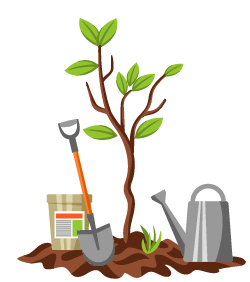 Landing
Basic conditions
- A sunny location and open space are ideal for apple trees to thrive. While they can thrive in the shade, they are often weak, unviable, and may fail to bloom or produce fruit.
- Avoid air stagnation in the crowns, so choose a location with good ventilation. However, keep in mind that drafts will likely kill the plants within a year or two, so avoid strong winds.
- Groundwater should be deep in areas where apple trees are planted, no higher than 2.4-2.2 meters, as the trees actively reach for moisture with their roots and then begin to rot.
- Lada thrives in any soil—podzolic, black soil, sand, or clay—and even rocky slopes. It's easy to maintain and grows well in any soil type, but dislikes excessive salinity or acidity.
- Planting holes for apple trees are prepared the previous season, but for this variety, 4-5 weeks is sufficient. Dig holes 60 centimeters deep, then add a small amount of topsoil mixed with fertilizer (minerals and organic matter) to the bottom. Top with a small amount of soil or a thin layer of drainage material, and add 20-35 liters of water.
- Stakes or rods are driven directly into the holes to support the young seedlings. This will prevent them from being damaged by wind during adverse weather conditions. Placing them north of the tree's trunk will provide additional protection during cold weather.
- Between tall vegetative trunks you need to leave at least 5-5.5 meters of distance, and for dwarfs 2-3 is enough.
- Place the tree on a mound of soil or drainage material, spreading the roots out with your hands. They should lie freely, not bend or become crushed. Fill the hole with soil, compact it with your hands, and water with 45-50 liters of water. If additional moisture retention is needed, the surface mulch.
Landing dates
Official information on apple trees states that they can be planted in both spring and fall. In the former case, you need to wait until the soil has warmed up completely, and in the latter, until the leaves have finished falling. It's important to ensure that young seedlings aren't damaged by recurrent frosts or exposed to the first early frosts, which should be at least 3-5 weeks away. Plants with a closed root system can be planted at any time, even in midsummer; they take root very well in their root ball.
Tree care
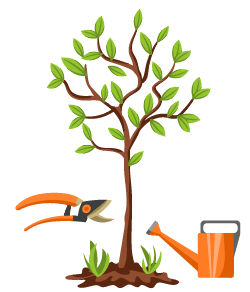 Tree care
Protection from frost and pests
Semi-cultivated varieties generally don't require special winter protection, but it's a good idea to make an exception for Lada. The root zone should be covered with a mat of hay or straw; spruce branches or just soil can be used. This will prevent the risk of freezing of some of the roots near the surface. The trunks can be wrapped in burlap and roofing felt, agrofibre, foam rubber, or roofing felt. Covering the variety with a tent is not common, except for very dwarf varieties.
To control insects that settle in the cracks of the bark, it is recommended to spray with industrial products, regularly clean the trunk and skeletal branches with a stiff brush, whiten Trees with lime. To protect the delicate bark from being eaten by mice, hamsters, and hares, the table can be greased with lard, fuel oil, or grease.
Loosening the soil, watering: proper agricultural technology
In the first few years, it's a good idea to dig around the root zone twice, but don't dig too deep (more than 7-10 centimeters). In between, you can carefully hoe the soil, removing weeds, root suckers, and other plant shoots. Regularly clear the area around the tree trunk of fallen leaves and fallen fruit, as this can lead to disease.
Trees require watering only when young and during the driest periods. If there has been no rain for more than 3-4 weeks, it's essential to apply 35-45 liters of water per tree, distributing it around the perimeter of the tree's trunk and into the crown. During the first two years, the tree doesn't need fertilization; the nutrients added to the hole before planting are sufficient.
Pruning: simple crown shaping
Timely and proper crown pruning will result in a more abundant harvest, larger fruit, and a longer, more productive life for the apple tree. A sparse, tiered form is ideal, which is especially suitable for the Lada. Branches are spaced widely apart at different heights to avoid interference. Trees are trained in the first year, while still in the nursery, and then simply support and thin the shoots, maintaining proper branching.
In the fall, and sometimes in the spring, sanitary pruning is done. At this time, all dry, damaged, or broken branches are removed. Diseased shoots that are sticking up vertically should also be removed.spinning tops) or growing inward into the crown, thereby thickening it. From the 14th to 16th year, rejuvenation can begin, removing 2-4 older branches over several years, allowing the young ones to grow and develop.
Pollinator varieties
- Alyonushka
- Nasenka.
- Antonovka.
- Pepinchik Krasnoyarsk.
- Zhivinka.
- Korobovka.
- Flashlight.
- Bellefleur the Chinese.
Reproduction
- Layers.
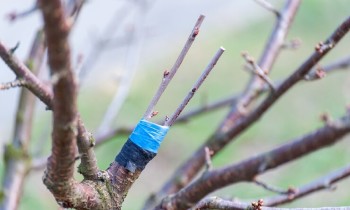
- Grafting cuttings.
- Clones.
- Growing from seeds.
Diseases and pests
- Cytosporosis.
- Scab.
- Rust.
- Powdery mildew.
- Pit bitterness.
- Spider mite.
- Green aphid.
- Weevil.
- Flower beetle.
- Fleas.
- Codling moth.
Ripening and fruiting of Lada
The beginning of fruiting
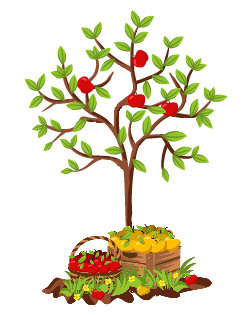 The beginning of fruiting
The variety begins bearing fruit quite early; by the third or fourth year, a tree can bear up to 3-5 kilograms of fragrant and beautiful apples. Dwarf and semi-dwarf varieties begin to bloom as early as the second or third year, and sometimes even in the first. In the first or second year, it's recommended to immediately remove the buds to prevent them from drawing sap from the tree while it develops its rhizome and crown. While the harvest may initially be considered full-bodied, things change very quickly.
Flowering time
The tree begins blooming around May 10th to 15th, and by the end of the month, the process is fully completed. Its large, pink buds open into deep, cup-shaped flowers, pure white with a slight pinkish tint at the center. These flowers are fleshy, large, and fragrant, densely covering the branches and gathered in clusters of 4-6.
Fruiting and growth
Trees grow quite quickly. In the first few years, they can reach a height of 55-60 centimeters or more. As fruiting begins, the growth rate slows slightly, but not dramatically. The plants still reach their full height very quickly. The tree also increases its fruiting rate very quickly; by the fifth or sixth year, you can harvest 8-10 kilograms of apples, and by the 10th or 12th year, you'll have a full harvest.
Apples ripen uniformly at the very beginning of autumn. Harvesting is best scheduled from early September until the tenth. The fruit may fall to the ground, but if they're left standing or overripe, this won't happen immediately. Therefore, there's no need to rush. They are easy to transport, even over long distances, and will keep in a cellar for at least 130-150 days. In special refrigerators or cellars with suitable conditions, they can be stored until the following summer.
Top dressing
- Compost.
- Peat.
- Manure.
- Humus.
- Superphosphate.
- Chicken manure.
- Wood ash.
- Ammonium nitrate.
What to do if it doesn't bloom or bear fruit
- Inspect for diseases or pests.
- Limit or increase watering.
- Feed or apply fertilizer.
- Transplant to a sunny place.
Why do apples fall?
- Natural weather conditions (wind, rain, hurricane, hail).
- Pest damage.
- Diseases.
- Overripe.
Share your own experience with the Lada apple variety so that any gardener can learn about it before planting and achieve maximum results.