Zavethnoye apple tree: characteristics of the variety and care
| Color | Reds |
|---|---|
| Ripening season | Autumn |
| Size of apples | Small ones |
| Taste | Sweet and sour |
| Crown type | Average tree height |
| Shelf life | High shelf life |
| Application | Universal variety |
| Winter hardiness | High winter hardiness |
| Fruiting age | Up to 5 years |


 History of origin and regions of growth
Growing regions
- Ural.
- Western Siberia.
Origin
In the post-war period, the M. A. Lisavenko Siberian Research Institute of Horticulture began active work on developing new apple trees suitable for cultivation in the region's rather harsh conditions. The variety's creator is considered to be M. A. Lisavenko himself, along with his fellow scientists I. P. Kalinina, T. F. Kornienko, L. Yu. Zhebrovskaya, and Z. A. Grankina. In 1958, they obtained a new hybrid seedling by crossing Melba and Radost Osennyaya.
Almost immediately, the new variety was considered elite and became widespread throughout the region. Gardeners appreciated the apple tree's many virtues, but it received no official support for a long time. Only in 1995 was it finally decided to include it in the State Register and zone it for the aforementioned region.
Content
Description of the Zavethnoye apple tree variety
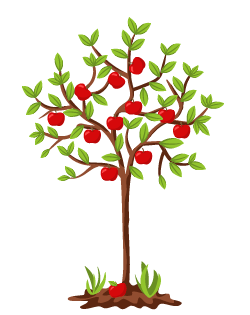 Low temperature-resistant wood is always in demand among gardeners. Siberia and more northern regions. Add to this the early maturity, high yields, excellent taste, and ease of transportation, and you'll definitely get the Zavetnoye apple variety, which has long been popular.
The trees require little care, rarely get sick, and produce fruit regularly without resting, producing delicious and beautiful fruit. This variety is recommended for small private gardens or intensive commercial orchards.
Apples: What they look like
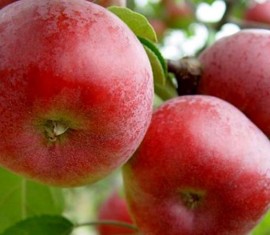
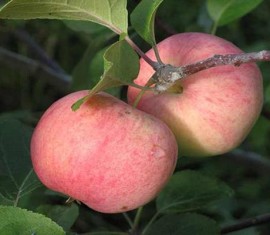
 Like most Siberian apple trees, the fruit on Zavetny grows quite small, weighing no more than 45-80 grams. They are slightly larger in the first few years, then become smaller. This is normal and should not be alarming. The apples are uniform, round, and may be slightly flattened, with subtle ribbing that is completely invisible to the naked eye.
The skin is dense, smooth, and glossy, and can become covered with a fairly thick waxy coating at maturity. Its base color is greenish-green, becoming increasingly white with a slight yellowish tint over time. The blush is dense, mottled, bright red or carmine, occupying approximately 65-75% of the surface. Subcutaneous dots are small, light gray or slightly greenish, and clearly visible. The chemical composition is characterized by the following indicators per 100 grams:
- P-active substances (catechins) – 179 milligrams.
- Ascorbic acid (vitamin C) – 15.3 milligrams.
- Total sugars (fructose) – 12.6%.
- Pectins (fiber) – 7.1%.
- Titratable acids – 0.45%.
The fruit's flesh is dense, crisp, fine-grained, slightly prickly, yet tender, and white or slightly creamy in color. It's sweet and sour, with a distinct strawberry flavor, considered a dessert fruit, harmonious, and balanced, with a medium-strength aroma. Professional tasters give the fruit a 4.6 out of 5 stars for both taste and appearance.
Zavethnoye apple tree: characteristics
Crown and root system
 It is considered that the variety is medium-sized, but in fact it can easily be called a natural dwarfEven without pruning, the trees grow no more than 2-2.5 meters, rarely up to 3 meters in milder climates.The crown is spherical, broadly oval, and very low density, so pruning is easy. Branches extend from the trunk at a 90-degree angle, preventing them from breaking off even during the heaviest harvests. The shoots are long, covered with reddish-brown bark, and fruiting occurs primarily on the rings and spurs.
The leaves are small, well-elongated, long-pointed, dark green or just green. They are leathery, dense, matte, covered with wrinkles, with a finely serrated, wavy edge. The root system is medium-deep, branched, and adapted to the search for water.
Productivity and pollination
For such a low-growing and compact tree, the yield is really high.
In a single season, a mature Zavetnoye apple tree can yield approximately 50-80 kilograms of small but delicious fruits. The maximum yield is usually achieved when the tree receives high-quality and timely care, and the weather is favorable..
This variety is considered conditionally self-sterile, meaning that some harvest will be possible even if there are no other apple trees nearby with suitable flowering times. However, these will be extremely few, so it's best to interplant this variety with others. Spraying flowering trees with sugar syrup to attract bees is also helpful, as is using portable apiaries.
Winter hardiness and disease resistance
Trees are very resilient even to severe frosts and can easily survive winters when temperatures drop to -35-40°C. However, neglecting to prepare for the cold is still not recommended. If frost persists for a long time, with sudden temperature fluctuations, trees may freeze and even die.
The variety has good resistance to infectious diseases, although it does not have genetic immunity. Therefore, under suitable conditions, it is susceptible to powdery mildew and all types of scabiesHowever, if preventative measures are taken in a timely manner, such as treating trees with fungicides and insecticides, the risks are significantly reduced.
Rootstocks and subspecies
Zavetny has no subspecies, although it can be grown on a wide variety of rootstocks: vegetative seedlings, standard rootstocks, dwarf rootstocks, and semi-dwarf rootstocks. This won't significantly affect the size, flavor, or fruit production. The latter two varieties may slightly reduce frost resistance, but their compact size allows for better frost protection.
Features of growing Zavethnoe
 Landing
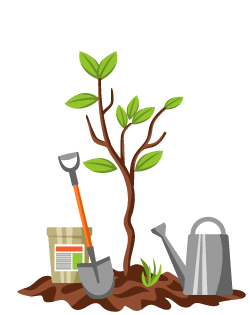 Landing
Basic conditions
- Planting sites are selected according to standard criteria. They should be well-lit, have a low water table, and be well-ventilated, but not subject to drafts.
- The soil should be slightly acidic, and if necessary, amend it with lime. Sandy loam, loam, or black soil are suitable, but apple trees also grow well in rocky areas with proper care.
- You can use the same holes prepared last season, or you can dig new ones approximately 3-4 weeks before planting. They should be 1 meter in diameter and 70-80 centimeters deep. Add a small amount of fertilizer and drainage to the bottom, then pour 45-50 liters of water over the top. It's not customary to cover the prepared holes; they should be left outdoors.
- Between trees in a row, approximately 2.5-3 meters will be enough, but between rows, you can leave even less than 2-2.5 meters.
- The root collar is left 6-9 centimeters above the surface to prevent the tree from rooting higher. Otherwise, the rootstock's properties, which the gardener relies on, will be lost.
- Inspect the rhizome, and trim away any dry, broken, or diseased shoots using pruning shears if necessary. Place the plant in warm water for 4-5 hours or in a mixture of soil and water for 6-9 hours.
- Holding the tree trunk, place the seedling vertically on a mound of drainage material in the hole, cover with soil, and compact it by hand. Water the surface (35-45 liters) and then mulch with chopped grass, sawdust, and compost.
Landing dates
Experts advise planting the Zavetnoye variety in the spring, when soil The soil has already completely thawed and warmed up, and the risk of recurrent frosts has passed. If you purchased it in the fall, don't worry, as you can bury it at a 45-degree angle, with the crown facing south. In the spring, simply move the seedling to its permanent location. This is best done in April, but be sure to watch before the buds begin to open.
Protection from frost and rodents
Standard winter protection procedures are sufficient for this variety. The trunks are usually wrapped in whatever materials are available, from industrially produced agrofibre to burlap and old nylon tights, roofing felt, and tar paper. Straw or grass mats can be laid around the trunk area, and in severe frosts, even a 15-20 centimeter layer of soil can be piled up.
To repel hungry rodents, who love tender bark and young shoots, coat the trunks with melted pork fat or any other animal fat. You can also use grease or special products from a gardening store. To protect against insects, whitewash the trunks to any height, but no less than 1-1.2 meters.
Tree care
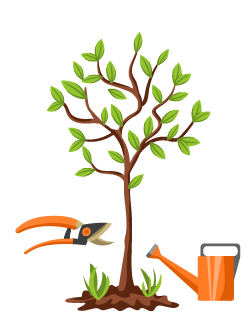 Tree care
Loosening the soil, watering: proper agricultural technology
Apple trees don't require any special soil care. It's enough to dig around the tree trunk once a year during the first few years. Later, you can simply cover the trunk with sod and forget about weeding, root suckers, or other plant shoots.
Watering Zavetnoye frequently is not recommended, as it can cause fungal infections. Ideally, water only 2-3 times per season, timing this around flowering, fruit formation, and ripening. If the weather is very dry and hot, you can increase the frequency of watering, but limit it to 5-6 times.
Pruning: simple crown shaping
The most important step in caring for this variety is root pruning, as only by properly shaping it can you achieve abundant harvests. Therefore, it should be started from the very first year. Keep in mind that the main branches should be spaced widely apart, in tiers, creating a spreading, well-ventilated, and sunlit crown from the start.
Sanitary pruning, which involves removing all dead or damaged shoots, is also important. Leaving diseased branches is not recommended, as they can trigger a new outbreak. Rejuvenation begins in the 10th to 15th year, removing several older shoots to make way for younger ones.
Pollinator varieties
- Altai crimson.
- In Memory of Ulyanishchev.
- Uralsk resident.
- Firebird.
- Bellefleur the Chinese.
- Gorno-Altaisk.
Reproduction
- Rooting cuttings.
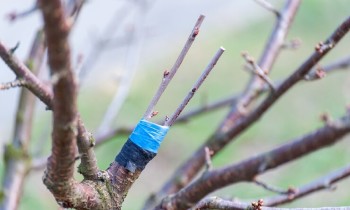
- Grafting by buds and cuttings.
- Clones (layering).
Ripening and fruiting of the Covenant
The beginning of fruiting
 The beginning of fruiting
No one doubts the variety's early fruiting, as flowers begin to bloom as early as 2-3 years after planting. However, it's recommended to pluck them to allow the tree to develop roots and branches. The first substantial harvests can be obtained in the 4-5 year, when you can harvest at least 5-8 kilograms of small but delicious fruits.
Flowering time
The buds open around mid-May, but if the weather is rainy and cold, they may linger until the end of the month. The process lasts approximately 14-16 days, so the bees usually have time to do their work. The flowers themselves are quite large, pure white or with a slight pinkish-raspberry hue, and have a moderate fragrance.
Fruiting and growth
The "Zvestnoye" (Chestnut) grows quickly and reaches its full height by the seventh or eighth year. It can grow 25-60 centimeters per year, depending on external factors (climate, weather) and the onset of fruiting. Initially, the tree grows very rapidly, then slows down. The variety gradually increases its yield, increasing by 5-10 kilograms each year until it reaches its peak.
The fruit is usually harvested around early or mid-September, when it reaches technical maturity. They ripen almost all at once and cling firmly to the branches. Therefore, it's difficult to miss the harvest, unless frost strikes, in which case all the fruit will be unsuitable for storage. Apples store quite well, for at least 4.5-5 months. If provided with good conditions, they can retain virtually all their qualities until the next harvest.
Top dressing
- Superphosphate.
- Compost.
- Nitrogen fertilizers.
- Humus.
- Potassium complexes.
- Ammonium nitrate.
- Manure.
What to do if it doesn't bloom or bear fruit
- Check for pests and diseases.
- Transplant.
- Limit or increase watering.
Why do apples fall?
- Natural factors.
- Pests.
- Diseases.
Leave your feedback on the winter-hardy Zavethnoye variety to share your experience with others.