Carmelita apple tree: characteristics of the variety and care
| Color | Reds |
|---|---|
| Ripening season | Autumn |
| Size of apples | Small ones |
| Taste | Sour |
| Crown type | Columnar tree |
| Shelf life | Low shelf life |
| Application | For recycling , Fresh |
| Winter hardiness | High winter hardiness |
| Fruiting age | Up to 5 years |
 History of origin and regions of growth
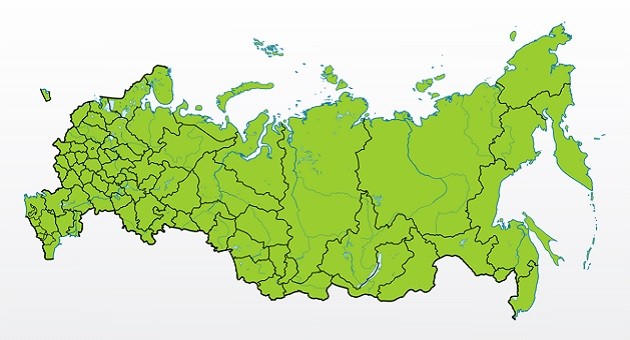
Growing regions
- North Caucasus.
- Far East.
- European part of Russia.
- Siberia.
- Moscow and Moscow region.
- Northern regions.
- Leningrad region.
- Crimea.
- Southern regions.
- Ural.
Origin
This is a relatively new apple variety that truly differs from previously known ones, not only in appearance but also in its key qualities and properties. It was invented by the distinguished Russian scientist and breeder, Mikhail Vitalyevich Kachalkin, PhD in agricultural sciences, and founder and director of the Experimental and Selection Nursery LLC.
At the beginning of the new century, the first hybrid seedlings were obtained, and by 2013, an application for official registration was submitted. In 2014, the Carmelita apple tree was included in the State Register of Breeding Achievements and, most importantly, was zoned for cultivation in virtually every region of our vast country.
Content
Description of the Carmelita variety
 A low tree with a compact crown, which in spring bloom resembles a living column of flowers, immediately attracted the attention of all garden decor enthusiasts. But its picturesque appearance is far from the only advantage of the Carmelita apple tree. It is undemanding in terms of growing conditions, quite fruitful, withstands winter cold and summer heat, and requires little maintenance.
Its fruits, although small, have a refreshing taste, a pleasant aroma, are easy to transport, and can even be stored for quite a long time. This variety is recommended for growing in small plots; it has no potential for commercial cultivation.
Apples: What do they look like?
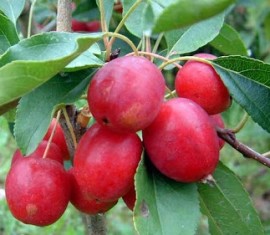
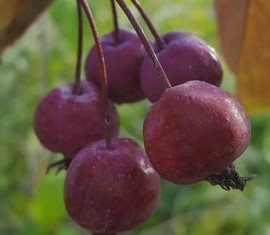
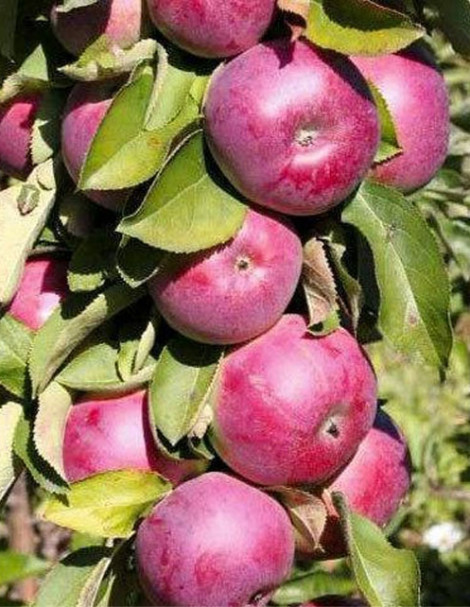
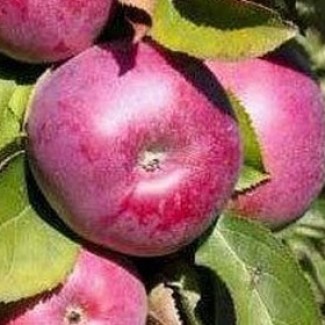
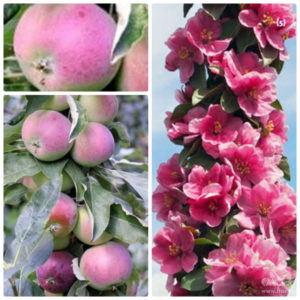 The fruit grows smaller than average or small on the tree. They rarely reach 25-35 grams, and in the most fruitful years, up to 45-50 grams. The apples are round, flattened, and smooth, and can be slightly uneven and asymmetrical, slightly slanted to one side. The ribbing is almost imperceptible, but slightly visible near the calyx; there is no lateral seam.
The skin is smooth, shiny, thick, dense, strong, and elastic, providing excellent protection against mechanical damage. It is green, but can turn lemon or yellow-green as it ripens. The blush is diffusely spotted, speckled, and dense, ranging in shades of beetroot red, violet, reddish-brown, and sometimes dark lilac, covering at least 65-85% of the apple's surface. Subcutaneous punctures are small but numerous, grayish, and not very visible. Experts recommend assessing the chemical composition based on the following criteria:
- Sugar (fructose) – 8.7%.
- Pectins (fiber) – 13.5%.
- P-active substances – 189 milligrams.
- Titratable acids – 1.67%.
- Ascorbic acid (vitamin C) – 12.3 grams.
The fruit's flesh is dense, even more than dense, fine-grained, medium-juicy, crisp, and easily broken apart. It has a pleasant, slightly strange and unusual aroma of nutmeg, honey, and a slightly spicy flavor. The flavor is considered table grape-like; it is more sour, astringent, and refreshing, but with a light and pleasant sweetness in the aftertaste. The fruit has not received an official tasting evaluation.
Carmelita apple tree: characteristics
Crown and root system
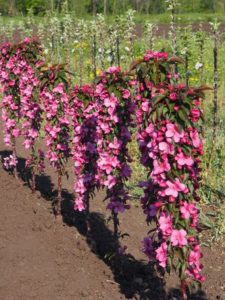 This tree is not just a column, it is a columnar dwarf. Its maximum height without formative pruning can be 1.3-1.6 meters, no more. However, most gardeners don't let their apple trees exceed one and a half meters, as they are used primarily for landscaping. It grows exclusively from a single trunk, rarely producing side shoots. The foliage is dense, without so-called bare spots, and the trunk is covered with gray-green, brownish, or russet bark. Fruiting occurs on fruiting canes that grow directly from the central core.
The leaves are medium-sized, elongated, oval, or ovate, with long-pointed tips. The leaflet margins are serrated, finely serrated, crenate, and can be slightly wavy. The blade is dense, leathery, glossy, and emerald green, often with a distinct reddish-brown tint. The ribbing is coarse. The root system is fibrous, lacking a central taproot, branched but shallow, and moderately adapted to the search for water and nutrients.
Productivity and pollination
The tree produces a high yield, although it's unlikely anyone would consider growing Carmelita for its harvest. The problem is that even with a large number of fruits, they are so small that they are unlikely to outperform even those varieties considered less productive, but used for fruit rather than ornamental purposes.
One mature Carmelita tree can produce approximately 6-9 kilograms of fragrant, small fruits per year. However, this is only with good care and favorable weather. In most cases, the yield is significantly lower, around 4-5 kilograms.
This variety requires no pollinators at all, which is one of its main advantages. Even if there isn't a single apple tree within a few hundred meters of the appropriate flowering period, the fruit will still set and ripen to its normal size. Carmelita itself can serve as a good pollinator for many different varieties, including Far Eastern and Siberian apple trees, where the choice is limited.
Winter hardiness and disease resistance
The tree's cultivation throughout our country is possible precisely because of its exceptional tolerance to low temperatures and sudden fluctuations. During field trials and storage in special boxes, the apple tree demonstrated minimal damage at temperatures of -38-40°C. It recovers very quickly, and the stress it experiences has virtually no impact on next year's blooms. However, thrifty growers know that overwintering is essential to avoid many problems later.
Carmelita has a high level of resistance to scab, fire blight, powdery mildew, and other apple tree diseases. However, it has no genetic immunity, so damage can still occur during years of severe epiphytotics. Insects can also damage the plants, so preventative measures should be taken promptly.
Rootstocks and subspecies
The variety is very young, so it's too early to talk about its subspecies. However, it is already being grown on various rootstocks. On dwarf and semi-dwarf rootstocks, the tree grows most compactly and produces the largest fruits, while on vegetative rootstocks, it is least susceptible to frost. It is suitable for growing in pots both outdoors and indoors.
Features of growing Carmelita
 Landing
 Landing
Basic conditions
- Trees are most often used to decorate garden plots or parks, so their locations are chosen accordingly. The key requirement is good daylight. In the shade, trees grow, bloom, and bear fruit, but not nearly as abundantly as in the sun.
- Groundwater depth doesn't matter much, unless it's in a swamp. If it's no deeper than 1-1.3 meters, the apple tree's roots likely won't be able to reach it. Therefore, it's acceptable to plant apple trees directly near ponds, streams, rivers, and lakes.
- Carmelite thrives in almost any soil; it's completely undemanding. Fertile black soil, whether gravelly or deciduous, sandy loam, loamy clay, or rocky soil—all of these will become a true "home" for the tree. The main thing is that the soil isn't overly acidic, as this can kill almost any fruit plant.
- The holes can be dug either before the planting season or just a week or two before planting the apple trees. To do this, dig small round holes 50-60 centimeters deep and the same in diameter. Add a small amount of fertilizer to the bottom, add drainage, water with 25-30 liters of water, and leave them outdoors.
- It's a good idea to immediately drive stakes into the holes, especially if your region is known for its wind-blown vera. Weak young roots won't be able to hold the tree in place, so you need to help it establish.
- The root collar of apple trees is always left 5-7 centimeters above the soil surface to prevent the tree from sending out roots higher.
- Place the seedling vertically, supporting it with your hand, cover it with soil, and compact it. Water the tree from above with 15-20 liters of water, and then water the soil surface. mulch for additional moisture retention.
Landing dates
Carmelita is so tolerant of any growing conditions that it makes no difference whether it's moved outdoors in spring or fall. Trees can be planted before bud break or after leaf fall if they're bare-root. Trees in bags, containers, or pots (with a closed root system and a root ball) can be planted in soil at any time during the growing season.
Tree care
 Tree care
Protection from frost and pests
Trees are very compact, so they're best covered using a tent-like method without worrying about freezing. Soil is raked onto the root zone and covered with spruce branches, straw bales, and hay mats. In warmer climates, standard trees don't require any covering, although wrapping the trunk in burlap is always a good idea.
To prevent rodents from chewing the bark off your trees during the harsh winter cold, you can coat the trunks with fuel oil, grease, or lard. This will repel hares, mice, and hamsters. Whitewashing the trees twice a year also helps repel insects, giving them an even more attractive, decorative appearance.
Loosening the soil, watering: proper agricultural technology
Carmelita grows well if you keep it hilled up all summer and dig the area around the trunk twice a year, being careful not to damage the surface roots. Even without this, the tree doesn't suffer much. Many people cover this area with sod or sow lawn or herbs, whichever best suits the landscape. However, weeds should be kept away from the tree, as they will spoil its appearance and rob it of nutrients.
Watering Trees should be watered well once or twice a week in the year of planting, gradually tapering off all watering by early September or even late August in colder areas. It's a good idea to add various fertilizers and fertilizers along with the water. After watering, especially in extreme heat, it's still a good idea to lightly loosen the soil around the trunk to prevent it from compacting into a solid lump.
Pruning: simple crown shaping
Carmelita grows as a single trunk, so it requires no shaping and can be grown by even a novice gardener with no prior gardening experience. If side shoots suddenly appear, they can be immediately cut back to the trunk, before they harden, and the wound can be sealed with garden pitch. If the top bud freezes, the bud is trimmed back to a live bud, allowing a new tip to develop. Dead fruit shoots, which are no longer producing fruit, are also usually removed.
Pollinator varieties
- Sakhalin pendula.
- Welsey.
- Juicy greenery.
- Far East.
- Garland.
- Brotherchud.
- Mantet.
- Korobovka.
- Chervonets.
- Ostankino.
Reproduction
- Grafting.
- Rooting.
- Growing from seeds.
Diseases and pests
- Powdery mildew.
- Scab.
- Green aphid.
- Scale insect.
- Codling moth.
- Hawthorn.
Ripening and fruiting of Carmelita
The beginning of fruiting
 The beginning of fruiting
Like almost all existing columnar varieties, this one begins bearing fruit quite early. Buds and flowers can already be seen on the seedlings from the nursery. You can allow a few apples to ripen, or you can pluck the flowers to allow the tree to develop foliage. The first harvests can be reaped around the second or third year, yielding no more than 3-4 kilograms of apples at best.
Flowering time
This variety begins blooming as early as May, usually quite early, at the very beginning of the month. However, the exact dates can vary greatly depending on the weather, regional climate, and other external factors. The main attraction of this apple tree is its flowers. They are large, with numerous, ruffled petals, dark, pink-purple, or crimson-red in color, extremely fragrant and attractive. They cover the branches very densely, covering the entire trunk from a height of 25-30 centimeters to the very top.
Fruiting and growth
The apple tree has a medium growth rate, slowing slightly from the second to third year. It can consistently grow 20-35 centimeters per year, so it reaches its maximum height very quickly. The tree's fertility also increases, along with its trunk. By the fifth to seventh year, it produces a full harvest of apples, which can not only be eaten fresh but also added to various dishes, making them suitable for jams, compotes, and preserves.
The fruits begin to ripen as early as late August, but it's too early to pick them. It's best to wait until early, or even better, mid-September, when they're at their most delicious and enjoyable. They cling firmly to the tree and don't fall to the ground. The shelf life of Carmelita apples leaves much to be desired. It lasts no more than 45-60 days, after which they should be completely processed. With further storage, they become sour, crumbly, and cottony, losing their unique honey-cinnamon aroma.
Top dressing
- Ammonium nitrate.
- Mineral complexes.
- Chicken manure.
- Peat.
- Superphosphate.
- Compost.
- Manure.
- Humus.
- Humus.
What to do if it doesn't bloom or bear fruit
- Inspect for diseases or pests.
- Organize timely regular watering.
- Fertilize.
- Transplant to a more suitable location.
Why do apples fall?
- Natural weather disturbances.
- Pest damage.
- Various diseases.
Please share your own experience with the Carmelita apple variety so that everyone can learn about it and avoid potential mistakes when growing their own orchard.