Garland apple tree: characteristics of the variety and care
| Color | Greens |
|---|---|
| Ripening season | Autumn |
| Size of apples | Large |
| Taste | Sweet and sour |
| Crown type | Columnar tree |
| Shelf life | Average shelf life |
| Application | For recycling , Fresh |
| Winter hardiness | High winter hardiness |
| Fruiting age | Up to 5 years |
 History of origin and regions of growth
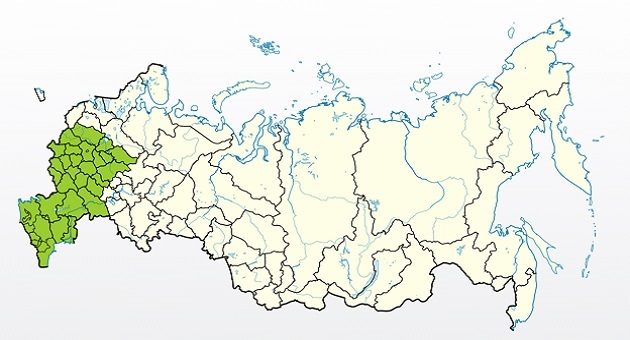
Growing regions
- North Caucasus.
- Crimea.
- Northern regions (partially).
- Moscow region.
- Middle zone.
- Leningrad region.
Origin
Around the turn of the century, the Federal State Budgetary Scientific Institution "All-Russian Research Institute for Fruit Crop Breeding" began developing columnar apple trees, completely unlike any other, capable of withstanding the harsh growing conditions of our country. Particular emphasis was placed on winter hardiness and scab resistance. In early 2010, under the leadership of Sergei Dmitrievich Knyazev, the head of the institute, a completely new hybrid was developed, named "Garland" for its distinctive appearance.
The variety was immediately sent to our own experimental farm, located in the village of Zhilina in the Oryol region. The apple tree performed well, so in 2018, it was decided to apply for an official patent for the variety. It was then added to the State Register of Breeding Achievements and zoned for the Central Black Earth and Central regions. In reality, the crop is grown in many more regions and districts.
Content
Description of the Garland apple variety
 For those looking for an autumn variety for their garden that is genetically immune to scab and resistant to low temperatures, Garland is one of the best options. The tree is compact, takes up very little space, and is exceptionally productive, early-bearing, and has a decorative appearance.
The fruits are very attractive, easy to transport, and store well. But most importantly, they have a unique flavor, reminiscent of a juicy, ripe pear. However, the quality of fruiting depends largely on proper watering, timely feeding, and fertilization, and the tree's active lifespan barely reaches two decades. Despite this, they are recommended for both small private gardens and large, commercially intensive farms.
Apples: What do they look like?
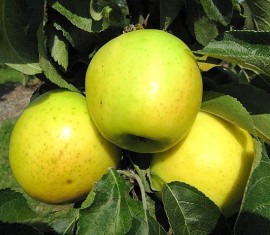
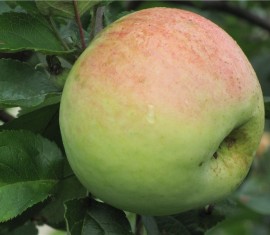
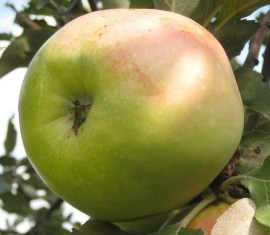
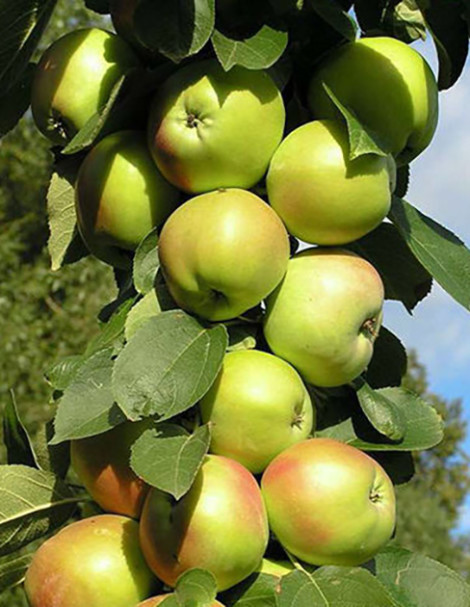
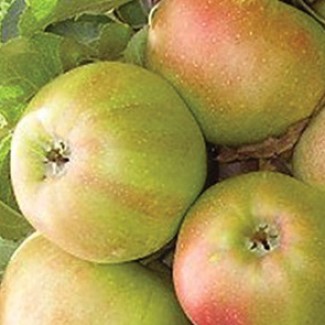
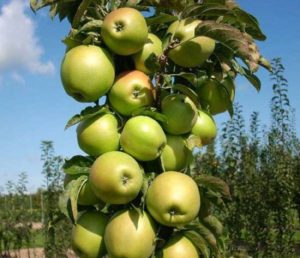 The apples are medium to large in size, round, smooth, and can be slightly flattened, though more often they are elongated toward the tip. Depending on care, climate, and weather, they can weigh 160-250 grams. Ribbing is clearly visible near the calyx, but is completely invisible elsewhere on the apple; there is no lateral seam.
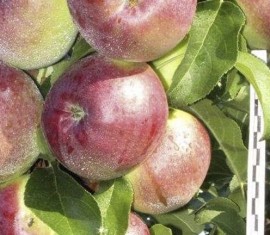
The skin is dense, fairly strong, and elastic, protecting the fruit well from mechanical damage. It is green or, when fully ripe, greenish-yellow, slightly golden. On the sunny side, a slight, diffuse, mottled blush of red or even dark red may appear. Subcutaneous dots are numerous, unevenly sized, light gray, and may have a slight greenish tint. The chemical composition can be most easily assessed by examining the following parameters:
- P-active substances – 243 milligrams.
- Ascorbic acid (vitamin C) – 11.7 grams.
- Sugar (fructose) – 12.8%.
- Titratable acids – 0.47%.
- Pectins (fiber) – 7.9%.
The flesh is medium-firm, very tender and juicy, not prickly, fine-grained, with a pleasant consistency and crispness. It is greenish or slightly lemon-colored and is considered a dessert fruit, balanced and harmonious. The taste is sweet and sour, reminiscent of the Bere Bosc pear (commonly known as Bera). It scores 4.6-4.7 points for appearance and taste on a standard 5-point scale.
Apple tree Garland: characteristics
 Crown and root system
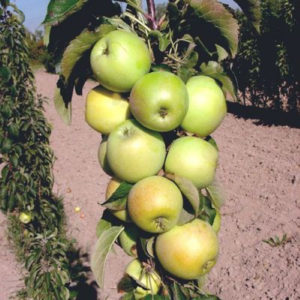 Crown and root system
The tree is considered a classic vigorous columnar tree, but in fact it can grow no more than 2.4-2.6 meters, while Geyser, for example, reaches three meters or more. With proper crown formation, growth can be limited to 2-2.2 meters to facilitate harvesting. The columnar crown is no more than 0.35-0.5 meters in diameter. Fruiting occurs on the rings and fruiting branches located along the entire trunk. The roots are gray-green or slightly brownish, smooth, but may be slightly pubescent.
The leaves are large, light green or bright green, rounded-oval, short-pointed, and can fold into a boat-like shape. They are smooth, leathery, dense, matte rather than glossy, with delicate nervation and serrated edges. The root system is branched, fibrous, of medium depth, usually lacking a central taproot, and poorly adapted to the search for water and nutrients.
Productivity and pollination
Garland is considered a high-yielding variety among columnar apple trees.
With a standard tree planting density of over 20,000 trees per hectare, this area typically yields over 200 tons of delicious, aromatic fruit. A single tree can yield an average of 14-18 kilograms, but experienced gardeners say that in favorable years, this figure easily exceeds two dozen..
The tree is semi-self-fertile, so even if there isn't a single apple tree within 45-100 meters of the garden that blooms at the right time, you'll still get fruit. However, to maximize the yield and produce larger apples, you should still interplant them with other trees. Mobile apiaries are brought into the garden, and the trees themselves are sprayed with syrup (honey or sugar diluted with water).
Winter hardiness and disease resistance
One of the parent varieties of Garland is the winter-hardy Brusnichnoe, from which the apple trees inherited their excellent cold tolerance. They can withstand temperatures down to -38-42°C with virtually no consequences, provided proper preparation and timely covering are completed. Sudden fluctuations in winter temperatures, strong winds, and icing can negatively impact the future harvest. Therefore, covering apple trees, especially young ones, requires considerable time and effort.
From scabies Garland is fully insured, as it possesses the Vf gene, which protects it. However, other fungal or bacterial infections can affect it, although not frequently. Even during years of severe epidemics, the variety usually remains barely affected by diseases, but prevention should not be forgotten. Insect pests readily damage trees, so regular and timely insecticide spraying is essential.
Rootstocks and subspecies
The variety doesn't yet have any subspecies or variants; it's new and not yet well-known among gardeners. It can be grown on various rootstocks, slightly altering the tree's characteristics. For example, on seed-grown varieties, Girlanda grows taller and is more winter-hardy, but its fruit is smaller. On semi-dwarf and dwarf varieties, the trees become more compact and miniature, but the apples grow larger, although they significantly lose frost resistance.
Features of growing Garlands
Landing
 Landing
Basic conditions
- Fruit trees thrive in sunny, well-drained locations. This apple tree also prefers its crown to be exposed to direct sunlight for most of the day. It will grow and even bear fruit in the shade, but expect nothing more than small, sour apples.
- It's best to place the Garland in a location protected from drafts, but still well ventilated. Air stagnation in the crowns should be avoided under any circumstances.
- Soil isn't particularly critical for this variety; it thrives in black soil and sandy loam, on rocky slopes, and in sand, but it definitely won't survive acidic soils. For good fruiting, it needs timely moisture and nutrition; otherwise, it won't produce any results.
- Preparing the holes in advance isn't necessary, but it's a good idea to have them. Dig 80x90 cm holes, fill the bottom with soil and fertilizer, add drainage on top, and then water. Leave the prepared holes outdoors for at least 2-3 weeks, which will ensure the apple trees thrive.
- It's best to leave about 1 meter between trees in a row, and up to 1.5-2 meters between rows. This will significantly facilitate harvesting and allow for mechanized harvesting.
- Stakes and stakes should be driven or dug into the holes immediately to support the seedlings. It's best to place them on the north side, as this will provide additional protection for the trunks from frost.
- The apple tree's root collar should remain at least 5-6 centimeters above ground level during planting to prevent roots from growing higher. Otherwise, the tree will not inherit any of the rootstock's properties and will be completely lost.
- The seedlings are placed vertically, the roots are carefully spread out on a mound of drainage material or lightly covered with soil, and then filled in layers, gently compacting. The surface is watered with 40-50 liters of water, and then mulched with sawdust or chopped grass.
Landing dates
This variety is suitable for any planting schedule, both spring and fall. However, experts recommend the former if the region's climate is relatively harsh. In the southern parts of the country, with mild weather and warm winters, trees can be planted in late September or early October, but only after the leaves have fallen. Otherwise, plant them in March or early April, before the buds swell, so the seedlings have more time to adapt to the environment.
Tree care
 Tree care
Protection from frost and pests
For the winter, Garlanda must be carefully protected from the coming cold weather. Spruce branches, straw, hay, and even dry leaves are piled on the root zone, ensuring there are no signs of rot or excessive moisture. The trunks are wrapped in burlap, roofing felt, roofing felt, or any other fabric. It is also possible to cover the variety using a tent-like method, that is, wrapping it from base to tip with tarpaulin or film.
To reduce insect damage to leaves, bark, and wood, tree trunks are whitewashed with lime to a height of 1-1.2 meters. This should be done twice a year, in spring and fall. In winter, trees are also coated with lard, fuel oil, or grease to repel hungry rodents that are eager to gnaw on young shoots, bark, and branches.
Loosening the soil, watering: proper agricultural technology
The soil around the trunk should be dug up twice a year, just before whitewashing to protect against insects. The rest of the year, you can simply hoe it, removing weeds, pulling out shoots of other plants, or root suckers. At the same time, add top dressing Fertilizers, which are absorbed much more efficiently and quickly in loose soil and watered with water, are more effective than those sprinkled on the surface. This stage is crucial for the variety. Organic matter and urea are added in early spring, and mineral complexes are left in place for the summer and fall.
Trees need watering more than anything else. If the weather is dry and hot, it's best to water at least once or twice a week. A mature tree requires approximately 25-40 liters of water in two doses (early morning and late evening). If it rains, watering can be postponed. In the fall, gradually reduce the amount of water applied, eventually eliminating it entirely by early September.
Pruning: simple crown shaping
Forming a proper Garland column is easy. Simply prune off the lateral shoots it produces in spring or fall. The key is to be careful not to miss the right time; if they become woody, the cuts will heal slowly and painfully, negatively impacting overall yield.
Every spring or fall, fruiting canes that have broken or dried out should be removed, thereby clearing the crown. Trees don't require rejuvenation, as their active lifespan is only 15-16 years. After this, the fruiting canes begin to die off, and soon the tree stops bearing fruit completely and eventually dies.
Pollinator varieties
- Vazhak.
- Gin.
- Currency.
- Malyukha.
- Chervonets.
- Ostankino.
Reproduction
- Rooting.
- Kidney grafting.
- Growing from seeds.
- Cuttings.
Diseases and pests
- Black crayfish.
- Bacterial burn.
- Powdery mildew.
- Green aphid.
- Codling moth.
- Leaf roller.
- Hawthorn.
Ripening and fruiting of Garland
The beginning of fruiting
 The beginning of fruiting
The variety's early fruiting is striking, attracting many gardeners. Buds open and ovaries ripen in the first year. However, it's best to prevent these from developing into apples and pick them off as soon as they appear. This will give the tree time to adapt to its new conditions. It's best to repeat this process in the second and third years, and harvest the first crop in the fourth or fifth year. This yield will be around 6-8 kilograms of apples, which is quite a lot.
Flowering time
This variety blooms quite late, not until the second ten days of May. However, more often, especially when the weather isn't particularly warm, the tree blooms only at the end of the month, and sometimes as late as early June. This process lasts approximately 14-18 days, during which time the bees usually have enough time to complete their cross-pollination work. Garlanda flowers are large, beautiful, slightly pinkish, but mostly white, moderately fragrant, and cup-shaped. The petals are slightly ruffled, almost curly.
Fruiting and growth
Trees grow quickly, gaining at least 55-70 centimeters per season before fruiting and 35-40 centimeters after. By the sixth to eighth year, they reach their full height and fruit production. By this time, experienced gardeners harvest over 20 kilograms of these unusual apples, distinguished by their beautiful appearance and unique flavor.
They ripen around mid- to late September, but sometimes it's better to wait until October for the apples to fully ripen. There's no need to rush; they won't fall to the ground, as they cling tightly to the branches. The fruits are highly transportable, easily surviving even long journeys, and can be stored in a cellar until January or February of the following year.
Top dressing
- Peat.
- Compost.
- Ammonium nitrate.
- Humus.
- Chicken manure.
- Superphosphate.
- Manure.
- Mineral complexes.
What to do if it doesn't bloom or bear fruit
- Check for pests or diseases.
- Transplant into the sun.
- Water.
- Fertilize.
Why do apples fall?
- Wind, hail, hurricane, rain.
- Pest damage.
- Diseases.
Please leave your feedback on the Garland variety, as many gardeners would like to grow similar ones in their gardens.