Apple tree Helena: characteristics of the variety and care
| Color | Reds |
|---|---|
| Ripening season | Summer |
| Size of apples | Small ones |
| Taste | Sour |
| Crown type | Average tree height |
| Shelf life | Low shelf life |
| Application | For recycling , Ornamental tree |
| Winter hardiness | High winter hardiness |
| Fruiting age | Up to 5 years |
 History of origin and regions of growth
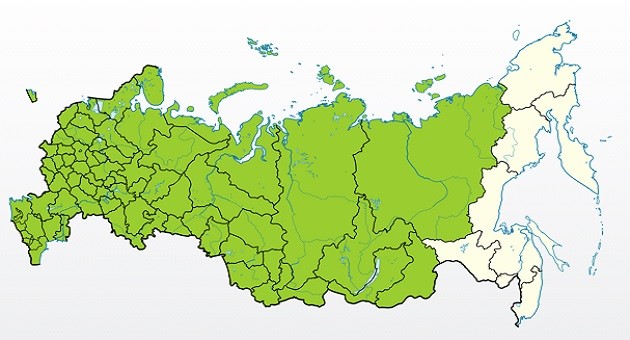
Growing regions
- Middle zone.
- Far East.
- Moscow region.
- Leningrad region.
- North Caucasus.
- Central Black Earth Region.
- Siberia.
- Crimea.
- Ural.
- Volga region.
Origin
The Helena variety is believed to have been developed in Canada in the mid-twentieth century. It was initially developed as an ornamental variety capable of withstanding the harsh North American climate. The hybridization is based on the famous Nedzvetsky apple, which became the "founding apple" of a vast family.
Helena was a perfect fit for our country. It can be successfully cultivated both in warm southern regions and further north, as far as the Urals, Siberia, and the Far East. The apple tree is not included in the State Register of Breeding Achievements and has no official zoning in Russia.
Description of the Helena variety
 This apple tree is one of those used purely for ornamental purposes. It is hardy, environmentally sustainable, and can grow even in polluted metropolitan areas, near large industrial facilities, transportation routes, in soils contaminated by emissions and chemical waste, and even in areas of radiation contamination.
Helena's fruits are numerous, attractive, and very picturesque. They are completely inedible, either fresh or processed. The tree can serve as a honey plant and pollinator. It is recommended for growing in parks, squares, and garden plots, both as part of an overall landscape design and as a stand-alone element.
Apples: What do they look like?
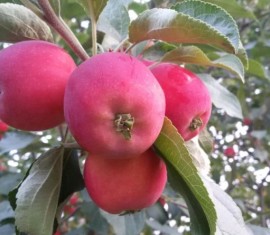
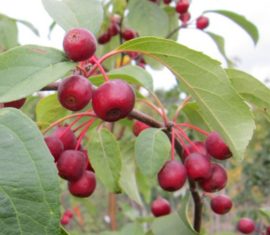
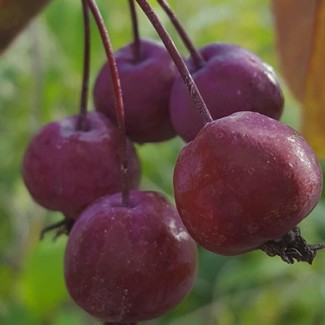
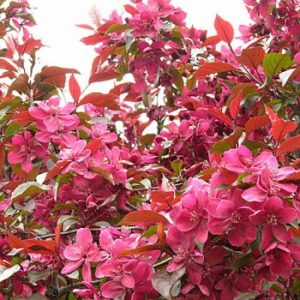 The fruits are very small, barely larger than a cherry. They weigh 2-5 grams at most, with a diameter of up to 1-1.3 centimeters. They are round or slightly flattened, and can be slightly elongated, but this is rare. The apples are predominantly irregular and asymmetrical, with pronounced ribbing, as if divided into segments.
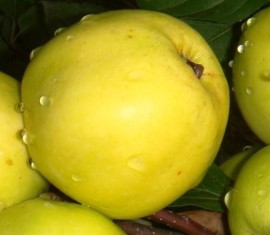
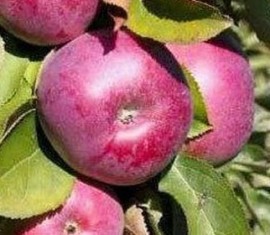
The skin is dense, even hard, thick, smooth, and shiny, and may become covered with a bluish or silvery waxy coating during ripening. It is greenish-yellow or golden-yellow in color, sometimes appearing full-bodied and translucent. The blush is spotted, striated, and streaked, red or red-orange, carmine, or purple, and covers up to 95% of the surface. Subcutaneous punctures are numerous, light, greenish, and barely noticeable.
Helena fruits have very dense, even tough, fine-grained flesh of a whitish-yellow or yellowish-lemon hue. It has an astringent, tart, highly spicy, sour-bitter taste, making it practically inedible. However, some housewives enjoy using these small apples to add a piquant flavor to preserves, not only fruit but also vegetables. They add them to meat and fish dishes and marinades.
Apple tree Helena: characteristics
Crown and root system
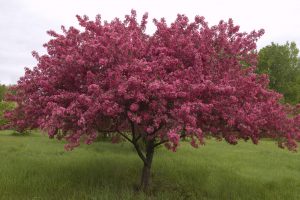 The tree is considered medium-sized, reaching only 3.5-4 meters in maturity, sometimes slightly higher. The crown is rounded or oval, becoming more spreading and weeping with age. The foliage and density are high, so maintaining the tree in good condition requires effort and regular pruning. The branches extend from the main trunk at an acute angle, pointing upward, but become more and more uncurled with age. They are covered with reddish-brown or reddish-brown bark.
The leaf blade is elongated, oval, and pointed, up to 6-7 centimeters long. It is glossy, almost plastic-like, dense, leathery, and highly shiny. The edges are serrated, crenate, and deeply serrated. The leaves are trilobed, coarsely veined, smooth, and red or raspberry-pink in color, with a distinct greenish tint when young. The root system is highly branched and deep, robust, fibrous, and well adapted for seeking water in the soil.
Productivity and pollination
It is somewhat incorrect to talk about the fertility of ornamental apple trees, since harvesting fruit is not the purpose of planting them, but some things can still be learned.
From one adult and fully ripened Helena tree trunk, you can harvest approximately 8-10 kilograms of small fruits per season, which are completely unsuitable for eating raw..
The variety is considered completely self-fertile, but it certainly benefits from the presence of pollinators. Moreover, the apple tree is an excellent pollinator for trees grown for fruit. It blooms for quite a long time, so many varieties match its blooming season perfectly.
Winter hardiness and disease resistance
Canadian apple trees, like native Russian Siberian ones, are typically highly resistant to low temperatures, and this one is no exception. Helena easily tolerates temperatures down to -30-35°C, even when they last for more than 3-4 weeks. With proper winter preparation, it can even withstand much lower temperatures. Only young trunks require protection, and fully formed ones rarely suffer damage, making it suitable for cultivation even in the Far East.
Helena has a high resistance to fungal and other infections, but it can become infected during years of severe epiphytotics. Therefore, it's best to carry out all regular spraying and preventative treatments promptly, without skipping any. The same applies to parasitic threats. It's much better and easier to prevent an infection than to treat it later.
Rootstocks and subspecies
This variety can be grown on a wide variety of rootstocks, which doesn't significantly affect its fundamental characteristics. Only the height of the trunks may change significantly; for example, dwarf trees barely reach 1.5-1.8 meters. This has virtually no effect on the quality of the fruit or the abundance of flowers.
Features of growing Helena
 Landing
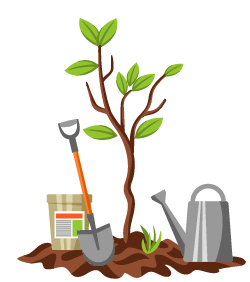 Landing
Basic conditions
- The most suitable soil is average, fertile, and neither saline nor acidic. Black soil, loam, podzolic soil, sandy loam, and even rocky mountain slopes are suitable.
- A sunny spot is the best place for Helena. Only if it receives UV rays for most of the day will it bloom most profusely. In the shade, the tree will grow weak, with thin, sparse branches, giving the appearance of being "bald."
- The root system penetrates deep into the soil, so it's important to choose a site where the groundwater level doesn't rise above 2 meters. Otherwise, the apple tree will reach the ground with its roots and rot. You can plant Helena on an artificial mound or dig a sheet of slate into the ground at a shallow depth (1.5-1.8 meters) to direct the shoots.
- Good crown ventilation is essential for this variety to avoid air stagnation. Failure to ensure this is maintained increases the risk of fungal attack significantly.
- Prepare the holes as you would for planting any apple tree variety. This is best done a season in advance, but 2-3 weeks will suffice for the trees to mature. Dig the holes 55-65 centimeters deep and approximately 85-90 centimeters in diameter. Add organic matter and minerals to the bottom, mixing them with the fertile soil from the top layer. Then, fill the hole with drainage (10-15 centimeters) and water (20-35 liters).
- Stakes or planks are driven into the holes, to which the young trees are then tied. It's best to leave these supports in place until they're 4-5 years old.
- The seedlings are inspected, the root system is carefully checked for the presence of dried shoots, they are ruthlessly cut off, and immersed in warm water for 5-9 hours.
- If you want to preserve the properties of the rootstock, the root collar should always be left 5-8 centimeters above the surface horizon.
- Place the seedling upright, straighten the rhizome to prevent it from bending, and widen the hole if necessary. Add soil in small amounts, gradually compacting it with your hands to eliminate air pockets. It's customary to water apple trees from above with 20-30 liters of water and apply mulch to the soil for additional moisture retention.
Placing trees on the south side of the stake or staking bar will not only provide support but also provide additional protection during cold weather. This is especially important when planting in the Urals, Siberia, or the Far East..
Flowering time
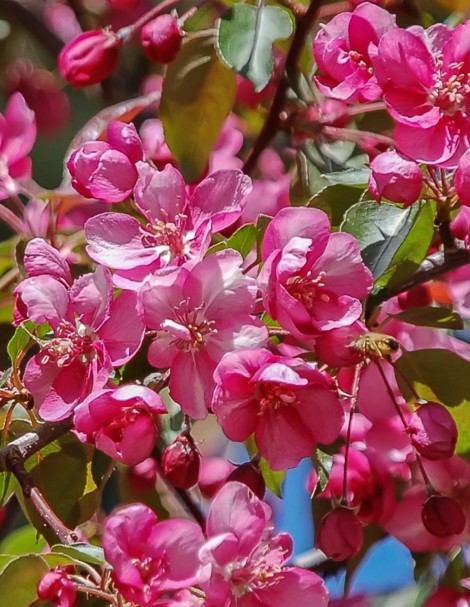
Dark burgundy, and sometimes even violet-red or purple, buds appear on the tree as early as early or mid-April, and by early May, they begin to bloom into large, fragrant flowers gathered in clusters. They don't open all at once, but gradually, giving the impression that the apple tree blooms for a very long time, up to 5-6 weeks.
The flowers themselves are large, five-petalled, saucer-shaped, yet delicately adorned with ruffled purple petals and are very fragrant. During the blooming process, the tree emits a fragrant fragrance for tens of meters around, attracting pollinating bees and other flowering plants in the area.
Tree care
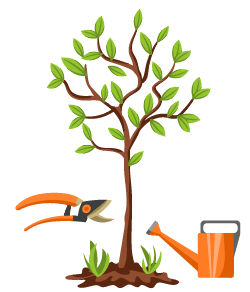 Tree care
Protection from frost and pests
Mature tree trunks don't require any special protection, even in the harsh conditions of Russian Siberia. However, the most thrifty owners still wrap their trunks with burlap, roofing felt, agrofibre, and even old tights for insulation. Straw or hay, spruce branches, or well-dried leaves can be scattered around the roots. This type of protection is primarily needed by young seedlings that haven't yet adapted to the environment.
To combat hares, hamsters, and mice, which readily gnaw the bark of young trees in winter and sometimes even plague older trees, smearing the lower parts of the trunks with pungent and unpleasant-smelling substances is effective. Suitable substances include solid oil, fuel oil, old drying oil, rancid sunflower oil, and other commercially available products.
Loosening the soil, watering: proper agricultural technology
Typically, digging around the trunk is done no more than twice a year; more is not necessary. Weeds, debris, rotting fruit, and fallen leaves are removed at this time. In the summer, the soil can be further cultivated with a hoe a few times, without going too deep. Root shoots and other growth can also be trimmed. Over the years, after about four to five years, many prefer to lay out a root circle with turf or stones, Japanese-style, and seed it with herbs or grasses.
Frequent watering of Helena is not only unnecessary, but even harmful. It can find water in the soil on its own in most cases. Only during the driest periods would it be a good idea to water it; three to four times per season is sufficient. Fertilizers and other supplements can be mixed with the water, but not until it's three or four years old; until then, the tree is sufficiently supplied with the fertilizers applied at planting.
Pruning: simple crown shaping
Ornamental apple trees are a special type that lend themselves to virtually any type of pruning. They can be made into anything from a hedge to a whimsical stand-alone specimen. It's customary to initially prune all shoots except the main stem and 2-4 scaffold branches, then trim the young shoots to your liking, adjusting the branching pattern.
Sanitary pruning must be done regularly, otherwise the apple trees' appearance can be seriously damaged. All broken, dry, or diseased shoots are trimmed off. The cut areas, known as wounds, are usually sealed. garden pitch or water-based paint, drying oil.
Reproduction
- Growing from seeds.
- Budding.
- Kidney grafting.
- Clones.
Diseases and pests
- Powdery mildew.
- Scab.
- Moniliosis.
- Black crayfish.
- Hawthorn.
- Aphid.
- Leaf roller.
Pollinator varieties
- Makovetsky.
- Pilot.
- Ruby.
- Ola.
- Royalty.
- Rudolf.
- Fuji.
- Gala.
- Idared.
Ripening and fruiting of Helena
The beginning of fruiting
 The beginning of fruiting
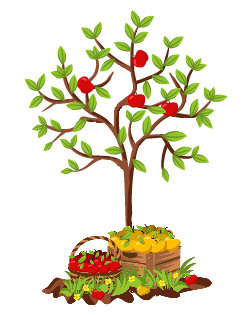
This variety is exceptionally early-bearing, with the first fruits appearing within the first year after planting. However, in most cases, these are barren flowers, which do not produce ovaries. However, full fruiting can be considered to begin in the second or third year, when the tree will already bear a large number of small, attractive apples.
Flowering time
The buds first open around early May, but in warmer regions they can open as late as April. In colder climates, flowering may begin in the middle or end of the last month of spring. The buds open one after the other, so the process takes a long time. They are purple or dark red, with flowers ranging from raspberry-red, crimson, red-orange, or even pink-raspberry, and are intensely fragrant.
Fruiting and growth
The tree grows at a moderate rate, gaining approximately 35-50 centimeters per season, which is quite respectable for an ornamental variety. Therefore, it reaches its peak quite quickly, and it's important not to miss the opportunity to shape its crown. Fruiting also peaks very quickly.
Apples ripen by late August or early September. They can be picked and processed, for example, added to jam or compotes, or left hanging on the tree until spring. They cling firmly to the branches and don't fall off even in severe frosts. They also provide excellent food for birds that haven't flown south, and they look simply stunning against the snowy winter blanket.
Why do apples fall?
- Weather phenomena.
- Early frosts.
- Pests or diseases.
What to do if it doesn't bloom or bear fruit
- Transplant into the sun.
- Protect from drafts.
- Limit or activate watering.
- Neutralize pests.
- Cure diseases.
Top dressing
- Manure.
- Compost.
- Humus.
- Superphosphate.
- Chicken manure.
- Mineral and nitrogenous complexes.
- Ammonium nitrate.
Share your own experience with the Helena apple tree variety, so even novice gardeners have no questions about cultivating these trees.