
Korobovka apple tree: characteristics of the variety and care
| Color | Striped |
|---|---|
| Ripening season | Summer |
| Size of apples | Small ones |
| Taste | Sweet |
| Crown type | Tall tree |
| Shelf life | Low shelf life |
| Application | For recycling , Fresh |
| Winter hardiness | High winter hardiness |
| Fruiting age | From 5 years old |
 History of origin and regions of growth
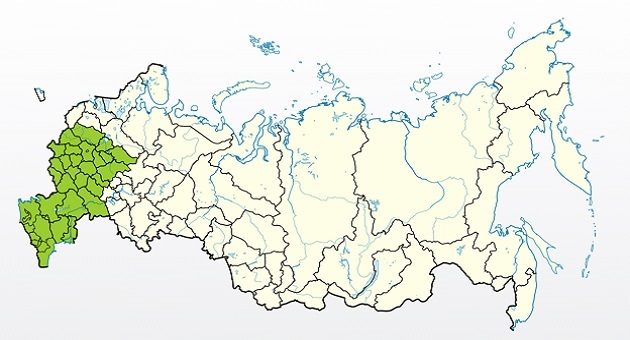
Growing regions
- Middle zone.
- North Caucasus.
- Crimea.
- Some northern regions.
Origin
This variety is considered one of the oldest still grown in garden plots today. Experts believe that Korobovka most likely originated from wild plants that grew near domesticated plants, repeatedly cross-pollinating with them and with each other.
This apple tree, with its small but sweet and delicious fruits, has many popular names: Medovka, Medunichka, Skorospelka, and Medovaya. The apples were called Korobovka for a very simple reason: at markets in cities and villages, they were traditionally sold in large bast boxes..
Historians say the first mentions of the variety in historical documents date back to the nineteenth century. Leading breeders of the time worked on it, as they documented in their reports. In the early twentieth century, the Korobovka caught the attention of the renowned Russian scientist, biologist, and student of Michurin himself, Sergei Ivanovich Isaev. He not only described the apple tree in detail but also developed several dozen new varieties based on it.
Content
Description of the Korobovka apple variety
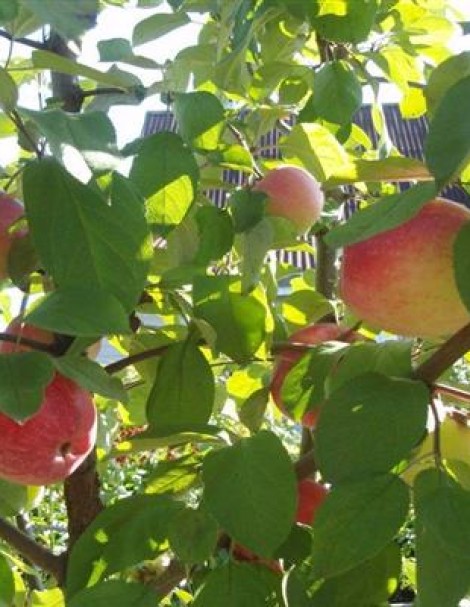
 This ancient Russian apple variety, a folk selection, has not been grown commercially for many years. The main reason for its abandonment is that its fruits, compared to new, promising varieties, are very small. However, at fruit farms across Russia, Korobovka is still used as the mother tree for winter-hardy, early-ripening apple trees.
Apples: What they look like
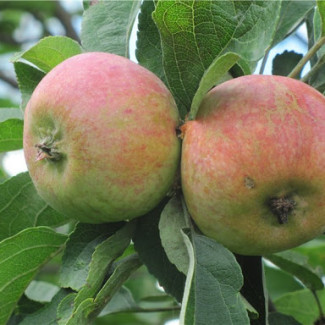
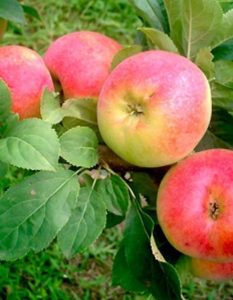 The fruits are predominantly small to very small. They rarely reach 35-50 grams in weight, with a diameter of no more than 4-6 centimeters. They are round, often unevenly sided, flattened or flattened, and nonuniform. The ribbing is subtle and barely noticeable to the naked eye.
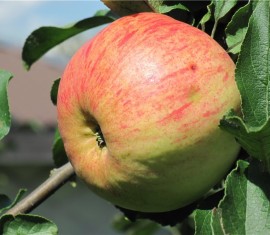
The fruit skin is dense, smooth, and glossy, often with a distinct oily coating. It is dirty green or slightly yellowish when ripe. It has a faded red-orange blush, blurred, streaked, and spotted. Subcutaneous punctures are light, numerous, light gray or slightly greenish, and clearly visible on the surface. The chemical composition is characterized by the following indicators per 100 grams:
- P-active substances (catechins) – 223 milligrams.
- Ascorbic acid (vitamin C) – 7 milligrams.
- Total sugars (fructose) – 19.8%.
- Pectins (fiber) – 11.2%.
- Titratable acids – 0.68%.
The flesh is dense, fine-grained, juicy, and crisp, with a distinct dirty-yellow hue. It is predominantly sweet, with almost no characteristic sourness, and has a distinct honey flavor. It has a pleasant, dessert-like, and harmonious taste. While the fruit has not been given a tasting score, experts note that all lovers of sweet apples rate them highly.
Apple tree Korobovka: characteristics
 Crown and root system
 Crown and root system
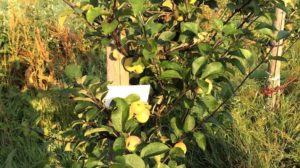
The tree is considered tall because, without any shaping, it can reach 6-7 meters or more in height, especially in warm climates. However, in northern regions, it grows no more than 5-6 meters, which is still quite tall when it comes to ease of harvesting. In its early years, the crown of the Korobovka has a distinct pyramidal shape, narrowing toward the top and widening toward the lower skeletal lids. However, over the years, it becomes broadly oval, and sometimes even spreading and weeping.
The medium-length, strong shoots extend from the trunk at an acute angle and are covered with dark brown or brown, smooth, glossy bark that tends to crack and crumble with age. The leaves are small, densely covering the branches, rounded but slightly elongated, short-pointed, matte, usually green or light green, but can even be emerald. The root system is extensive, deeply rooted, and well adapted to seeking water.
Productivity and pollination
This variety has an average yield, typical of old, traditionally bred trees. It's one of those types that is increasingly gaining popularity over time.
A mature tree typically yields approximately 40-60 kilograms of delicious, honey-scented fruit during the initial stages of full fruiting. However, the tree doesn't reach its peak until it's 15-20 years old, when it can harvest 65-80 kilograms of fruit..
This variety is considered self-sterile, so without the help of other apple varieties whose flowering periods overlap, no fruit will be produced. It's best to plant trees of different varieties close together to allow bees and wind to pollinate them. Spraying the branches and flowers with diluted sugar syrup and bringing mobile apiaries to the planting sites is recommended.
Winter hardiness and disease resistance
Its high tolerance to low temperatures and sudden temperature fluctuations has made this variety popular, despite its more than two-hundred-year history. Apple trees are virtually immune to frosts down to -35-37°C, and even after lower temperatures, no significant damage to the ovaries is observed. They bear fruit at almost the same rate as usual. If winter preparation is carried out promptly and correctly, then there is no need to worry about more severe weather conditions.
Old apple trees usually have moderate resistance to infectious fungal diseases, and Korobovka is one of them. It can be affected scab and powdery mildew, black crayfish and cytosporosis, which attacks quickly and abundantly. The tree is also susceptible to insect pests, and the codling moth simply adores tender, sweet fruits. Therefore, all insecticide and fungicide spraying should be done at the appropriate time.
Rootstocks and subspecies
The tree is most often grown on standard seedling rootstock, but it can also be grafted onto semi-dwarf and dwarf varieties. The tree's basic characteristics, other than height, remain largely unchanged. The subspecies and subvarieties of Korobovka are unknown to science.
Features of growing Korobovka
Landing
 Landing
Basic conditions
- For this variety, choose open, sunny, and wind-blown spaces, but avoid drafts. No fruit tree will tolerate this, so choose carefully.
- Groundwater levels should be at least 2-3 meters below the surface, otherwise the trees will reach it with their extensive rhizomes and rot. This will lead to the death of the trunk. For the same reason, Korobovka should not be planted near rivers or lakes, ponds, or wells.
- Leave at least 4-5 meters between trees in a row, and about the same distance between rows, to prevent them from obstructing each other in the future. Keep in mind that the crown will become more spreading and take up more space over the years.
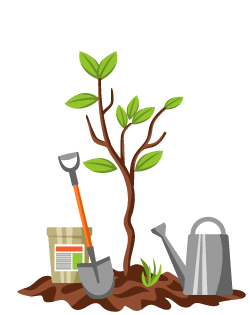
- You can plant the variety in pre-dug holes dug in the fall using the traditional method, or you can make new ones in just 2-3 weeks. They should be 60-80 centimeters deep and up to 1 meter in diameter. Add some soil to the bottom. soil with fertilizers, gravel or other drainage is placed on top, and then all this is watered with water (35-40 liters).
- It's a good idea to insert a stake (wood, plastic, or metal) into the holes immediately for staking. Ideally, it should be positioned north of the tree trunk. These stakes should not be removed until 4-5 years after planting in open ground.
- It's customary to leave the root collar 10-12 centimeters above ground to prevent trees from rooting higher. This completely negates all the rootstock's properties.
- Place the seedling vertically in the holes, cover with soil layer by layer, and compact it by hand, being careful not to compact the soil to a granite-like consistency. Water with 25-40 liters of water, and mulch the surface with sawdust, chopped grass, compost, or manure to prevent rapid evaporation.
Landing dates
The Korobovka apple tree is a very hardy and undemanding tree, so planting timing isn't particularly critical. It can be planted either in early spring, as soon as the soil thaws and the potential for frost has passed, or in the fall, when all the leaves have fallen from the trees and the frost is still at least 2-4 weeks away. Seedlings that closed root system, can be moved to open ground at any time from spring to autumn.
Protection from frost and rodents
Many people think that because a tree is frost-hardy, no preparation for the cold season is necessary, but this is a misconception. Trees still need to be protected and covered, especially when the winter promises to be frosty. Trunks are wrapped in burlap, roofing felt, or agrofibre, and mats of dry grass or straw are placed around the roots. Only very young trees can be covered using a tent-like method, as they will grow excessively tall later.
To get rid of insect pests that happily overwinter in bark crevices or at the roots, trees are treated twice a year with lime (whitewash) to a depth of at least 1-1.3 meters. To repel rodents in winter, which eat not only the bark but also young shoots, it's a good idea to coat the trunks with lard or grease.
Tree care
 Tree care
Loosening the soil, watering: proper agricultural technology
Loosening the soil is beneficial for the growth of any fruit, and not just trees. Therefore, once or twice a year, you can dig up the area around the tree's trunk. The rest of the year, you can lightly hoe the soil, preventing it from compacting. Don't forget to remove root suckers, which can be quite abundant, as well as weeds and other plants. Around the 15th to 17th year, you can cover the area around the tree's trunk with pieces of sod to make the work easier.
Korobovka doesn't require much regular watering; it does an excellent job of extracting moisture from the soil itself. However, if the weather is excessively hot and very dry, you can water the tree approximately 4-6 times per season. It's a good idea to time watering to coincide with bud formation and fruit ripening.
Pruning: simple crown shaping
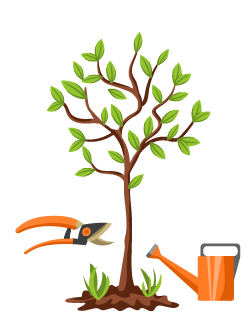
Standard pruning is performed starting two to three years after planting in open ground, especially if the tree came from a nursery rather than home-grown. The main stem is shortened by no more than a third, and all skeletal branches are shortened even further. It's best to leave no more than three or four branches, at different heights and widely spaced.
Don't forget about sanitary pruning, which is usually performed in late fall or early spring. This involves removing all diseased, damaged, or dead shoots, and sealing the cut areas with garden pitch or any other suitable material.
Pollinator varieties
- Borovinka.
- Chinese sannin.
- Folder
- Spartan.
- White filling
- Jonathan.
- Cinnamon Striped.
Reproduction
- Rooting cuttings.
- Grafting by buds and cuttings.
- Growing from seeds.
- Clones (offshoots).
Diseases and pests
- Moniliosis.
- Scab.
- Powdery mildew.
- Fruit rot.
- Cytosporosis.
- Tinder fungus.
- Green aphid.
- Codling moth.
Ripening and fruiting of Korobovka
The beginning of fruiting
 The beginning of fruiting
Korobovka doesn't begin bearing fruit early, only 7-9 years after planting. However, it produces quite a lot of fruit right away, up to half of the future harvest. At this point, you can harvest at least 25-40 kilograms of small but delicious fruit from relatively young trees.
Flowering time
This variety begins to bloom in May, like most other apple trees. However, the flowering process can fluctuate depending on the climate, other growing region factors, and even the weather. In cool, rainy winters, trees may not bloom until mid- to late-May. The flowers themselves are small, numerous, and very fragrant, densely covering the branches. They look especially beautiful on older trees, whose vines sometimes droop low to the ground, becoming spreading.
Fruiting and growth
Trees of this variety grow slowly, no more than 15-25 centimeters per year, but only after they begin bearing fruit. Before then, they quite vigorously reach 2-3 meters, adding at least 40-50 centimeters per season. Fruitfulness also increases exponentially, reaching its maximum within just a couple of years. Korobovka actively bears fruit for 25-40 years, after which it may undergo periods of rest, which can last for 2-4 years.
It's common to pick the fruit as early as early July, as they ripen by the end of June. In mid-June, they begin to ripen gradually, starting from the upper branches and moving down, and in July, this process begins en masse. The fruit holds firmly to the branches and almost never falls off on its own, unless you delay harvesting until September or October or the trunks are damaged by pests. Apples have a poor shelf life; they'll likely last barely 20-30 days, so it's best to process them immediately.
Top dressing
- Superphosphate.
- Compost.
- Nitrogen fertilizers.
- Humus.
- Potassium complexes.
- Ammonium nitrate.
- Manure.
What to do if it doesn't bloom or bear fruit
- Check for pests and diseases.
- Transplant to a sunnier location.
- Limit or increase watering.
Why do apples fall?
- Natural factors.
- Pests.
- Diseases.
Leave your feedback on the winter-hardy Korobovka variety to share your experience with others.



Comments
Our garden has Antonovka apples, white filling apples, pear apples, and even a Korobovka apple, which my parents planted. The apple tree is already blooming before the others, and their scent fills the entire garden. As soon as the fruit ripens, we eat it to our heart's content; we don't save any for storage. The only care for the apple tree is pruning it early in the spring; it overwinters well and doesn't require watering in the summer. We sprayed it for pests before flowering. This apple variety is the most delicious and sweet, and I also love baking them in the oven; they really do taste like honey!
Once upon a time, when I was a kid, my parents and I were vacationing in Gelendzhik, and there were apple orchards not far from our campsite. As funny and embarrassing as it may be to say, my parents made apples, and they still seem out of this world to me. They were so delicious, but I don't know their names. I only remember that they were winter apples, and we kept them in paper boxes all winter long, red-sided, juicy, a little tart, but sooooo delicious.
Quite an interesting apple variety. I hadn't heard of it in a while, and then I came across this article. As a child, I encountered this apple for the first time in an apple orchard; the fruits were small but very tasty. I read about all the intricacies of growing this type of apple. I'll definitely try planting it at my dacha. Thanks to this website for the detailed description.