The Beauty of the Garden apple tree: characteristics of the variety and care
| Color | Reds |
|---|---|
| Ripening season | Summer |
| Size of apples | Average |
| Taste | Sweet and sour |
| Crown type | Average tree height |
| Shelf life | Low shelf life |
| Application | For recycling , Fresh |
| Winter hardiness | High winter hardiness |
| Fruiting age | Up to 5 years |
 History of origin and regions of growth
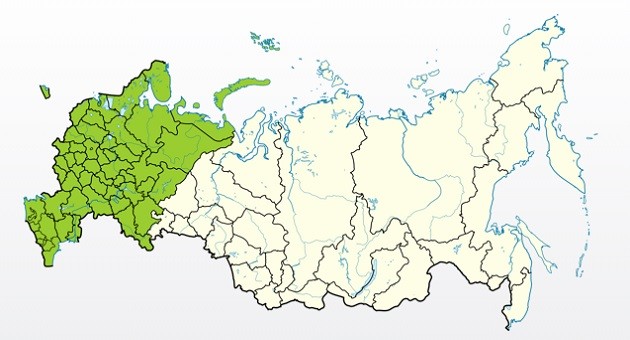
Growing regions
- Middle zone.
- North Caucasus.
- Moscow region.
- Leningrad region.
- Crimea.
- Northern regions (selective).
Origin
The invention of this apple tree belongs to the famous Russian scientist, biologist, breeder Sergei Ivanovich Isaev, a follower and student of the “father of selection” Michurin himself.
Around the mid-1950s, the Krasavitsa Sada apple tree was developed at the Lomonosov Moscow State University Experimental Station in Michurinsk by crossing the ancient Russian variety Borovinka and the Baltic variety Suislepskoe. Officially, the Krasavitsa Sada apple tree is not included in the State Register of Breeding Achievements, nor is it zoned.
Content
Description of the Beauty of the Garden variety
 This tree was widespread throughout the central part of the Russian Federation in the mid-twentieth century, and due to its high frost resistance, it was found even in harsher regions. However, with the emergence of promising new varieties, it began to decline, although it is still quite common in small private farms. It is resistant to scab and other fungal infections.
"Beauty of the Garden" is a late-summer variety with a remarkable yield and beautiful fruit. The apples begin to ripen on the vines quite early, but are considered less tasty than those of the parent variety, "Susleypskoe." The fruit may become smaller during heavy harvests, and the tree itself occasionally takes rest breaks. Recommended for small gardens.
Apples: What do they look like?
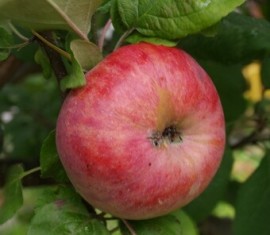
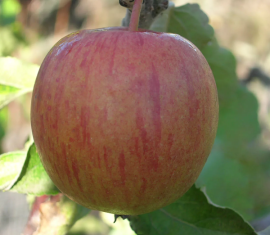
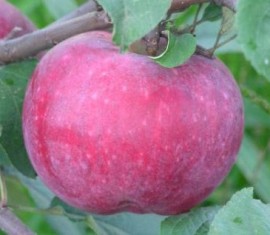
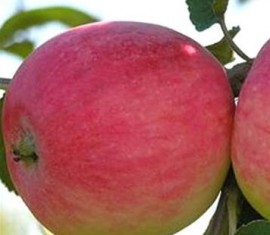
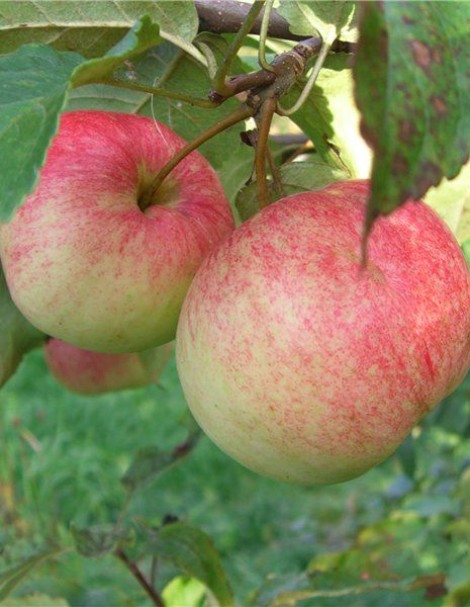
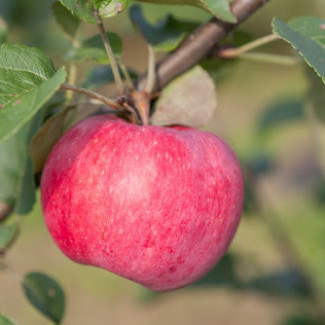
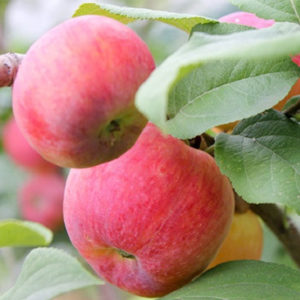 The fruits of the Beauty of the Garden are usually medium to larger in size, but can be large. They grow to 140-150 grams, but can easily reach 170-200 grams. The fruit is round, sometimes slightly asymmetrical, flattened, and slanted to one side. The ribbing may be completely invisible, or it may be slightly visible from the calyx side.
The skin is dense, smooth, and glossy, yet delicate, fragile, and lacking elasticity, making the apples easily damaged. It has a greenish-green hue when unripe, later taking on a snow-white hue, even a slightly deep porcelain color. The blush is blurred, spotted, speckled, or striped, ranging in shades of crimson, carmine-orange, or bright red, and covers approximately 45-75% of the surface. Subcutaneous punctures are small but numerous, and they are light in color, making them quite visible. The chemical composition is easily assessed by the following parameters:
- P-active substances – 187 milligrams.
- Ascorbic acid (vitamin C) – 10.4 grams.
- Sugar (fructose) – 9.2%.
- Titratable acids – 0.37%.
- Pectins (fiber) – 12.6%.
The flesh is fine-grained, very juicy, dense, tender, and has a pleasant consistency, without being prickly. The flavor is sweet and sour, considered a dessert fruit, but has not received an official tasting rating.
Apple tree "Beauty of the Garden": characteristics
Crown and root system
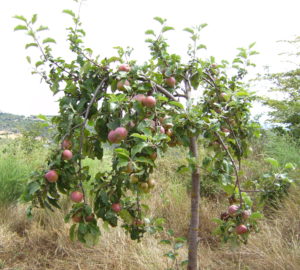
The apple tree is of medium height, growing no more than 3.5-4.5 meters in height.Its crown is rounded, but over the years it can become broadly oval and even slightly spreading. It has a moderate tendency to become dense and, with proper care, does not become excessively overgrown. Branches generally extend from the trunk at a nearly 90-degree angle, covered with dark brown or fulvous-brown bark, and bear fruit in mixed colors.
The leaves are medium-sized, ranging in color from light green to emerald, depending on growing conditions, care, and region. They are dense, oval-elongated, short-pointed, and can form a boat-shaped form. The margins are serrate-crenate, serrated, and wavy, often with a pubescent underside. The root system is deep, highly branched, and depending on the rootstock, may or may not have a central taproot. It is well adapted to the search for nutrients and water.
Productivity and pollination
The main advantage of these apple trees is their truly impressive yield. In a single season, the Beauty of the Garden can yield 200-235 kilograms of fragrant fruit, and sometimes even more. It easily rivals the Antonovka, but these apples are clearly inferior in terms of shelf life..
This variety will produce some fruit even without pollinators, but it's unlikely to reach its maximum yield. Therefore, it's best to plant varieties with suitable flowering times within 45-80 meters of each other. During flowering, mobile apiaries are brought to the planting sites, and the trees are sprayed with honey or sugar syrup.
Winter hardiness and disease resistance
The tree is highly resistant to the most severe frosts. It even tolerates temperatures down to -37-40°C quite well. If properly prepared and protected, even lower temperatures are completely unaffected. If the humidity is excessive, the temperature fluctuates sharply, and the temperature swings from freezing to thawed, or if there are drafts, even such a hardy tree may succumb to disease or even die.
The crop is moderately resistant to scab, cytosporosis, powdery mildew, and other unpleasant "surprises" of nature. Apple trees are rarely affected, but when they are, they attack very quickly and heavily, affecting not only the leaves but also the fruit. Insects can be a real nuisance for a gardener, so it's best to take preventative measures promptly and regularly.
Rootstocks and subspecies
Beauty trees can be grown on various rootstocks, which can result in them developing their unique qualities and properties. Dwarf rootstocks produce larger fruits, but are less cold-hardy. Vegetative rootstocks can tolerate the lowest temperatures but grow to nearly five meters in height. For more precise information, consult the vendors where you purchase your planting material.
Features of growing the Beauty of the Garden
 Landing
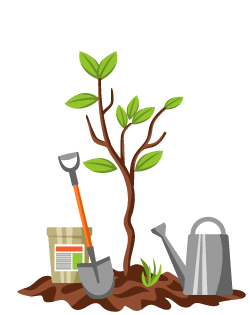 Landing
Basic conditions
- The "Beauty of the Garden" variety will definitely appreciate a sunny, open space. The crown needs to be evenly illuminated throughout most of the day, otherwise the trees will grow weak and the harvest will be consistently small. The fruit may be sour, small, or may not appear at all.
- It's important to avoid planting trees in locations prone to flooding or where groundwater levels rise excessively. If no other suitable location is available, ensure proper drainage or plant the tree on an artificial mound.
- Soil acidity is very important, as if it exceeds 5.6-6.5 pH, the tree may die. Therefore, sandy loam, loamy clay, or black soil are first "quenched," for example, with ordinary lime.
- You can prepare the holes 5-8 months in advance, or 4-5 weeks before planting. Dig the holes 60-70 centimeters deep and up to 1 meter in diameter, add fertilizer to the bottom, add drainage, and fill with 45-50 liters of water.
- Root collar The rootstock always remains at least 6-8 centimeters above the soil surface to prevent the tree from rooting higher. In this case, all the properties of the rootstock are negated.
- Before planting, cutting the roots, as recommended for some varieties, is absolutely not recommended. They can only be gently spread out to ensure they lie flat and have ample space.
- If the seedlings have an open root system, then if there are leaves on the tree, they need to be torn off by 80-90%, that is, almost all.
- Stake stakes are dug into the holes immediately, and the trees are then tied to them. Placing them on the north side will provide the apple trees with support and additional protection from the cold.
- Place the seedling vertically, sprinkle it with soil, compact it with your hands, water it with 40-50 liters of water, the surface mulch.
Disembarkation time
This beauty can be planted in both spring and fall. In the first case, a warm, dry day in late March or early April is ideal, while in the second case, late September or early October is ideal. There should be no sap flow in the trunks at this time. It's important to watch for buds; they should still be dormant in the spring, and then wait until the leaves have fallen in the fall.
Tree care
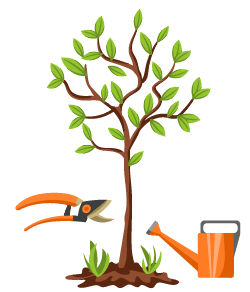 Tree care
Protection from frost and pests
Trees easily withstand quite severe frosts without any cover, so in southern regions, many don't even consider it. However, in areas where there's a risk of temperatures below -20-25°C, it's best to follow all standard guidelines. For example, spruce branches and straw mats are placed around the roots, and in particularly harsh areas, soil is raked up. Trunks are wrapped in various materials: burlap, roofing felt, old tights, or roofing felt. Young trees, while they're not very tall, can be covered completely, like a tent.
To protect apple trees from insects, they are whitewashed to a height of approximately 1-1.2 meters with ordinary lime diluted with water; this also effectively disinfects the trunk. Lard melted into lard and spread on the underside of the tree, fuel oil, grease, old drying oil, and other unpleasant and pungent-smelling substances will also protect against rodents.
Loosening the soil, watering: proper agricultural technology
Dig around the trunk at least once a year, unless the area is covered with sod. At the same time, remove any debris, rotting leaves, and fruit, as this can promote disease and attract insects. You can hoe the soil 4-5 times per season to provide oxygen to the roots. To make things easier, you can sow regular lawn grass or herbs such as dill, parsley, cilantro, marjoram, and mint.
Watering The beauty tree doesn't need water; it's perfectly capable of providing itself with moisture. However, in particularly arid regions or during the hottest and most humid years, it's still best to water 35-40 liters per mature tree 4-6 times during the growing season. By mid-August, all watering should be stopped, otherwise the tree won't have time to prepare for winter.
Pruning: simple crown shaping
Trees are left undisturbed for the first year after planting in open ground to allow them to adapt to the new conditions. The first pruning is done in the second or third year. Then, all branches are shortened by approximately one-third, leaving only two or three lateral scaffold shoots besides the central conductor. The tree will quickly grow new branches, so there's no need to worry. Annual crown thinning is necessary, otherwise, it will become overgrown and lose proper ventilation.
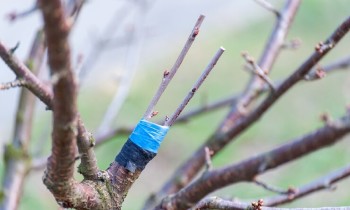
In the fall and spring, branches are also inspected for diseased or broken ones. These are ruthlessly cut back, and all cut areas are generously coated with garden pitch. Also removed are shoots growing inward or sticking up vertically; these only create unnecessary bulk and will not bear fruit.
Pollinator varieties
Reproduction
- Rooting.
- Kidney grafting.
- Cuttings.
Diseases and pests
- Scab.
- Bacterial burn.
- Powdery mildew.
- Green aphid.
- Codling moth.
- Leaf roller.
- Hawthorn.
Ripening and fruiting of the Beauty of the Garden
The beginning of fruiting
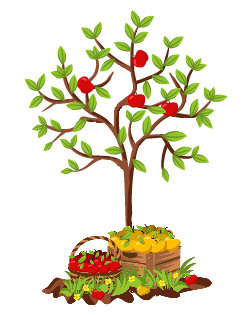 The beginning of fruiting
This is a fast-growing variety, so it begins bearing fruit for the first time only 4-5 years after planting. However, it can bloom earlier; the flowers should be picked off immediately, preferably while still in bud form. They will simply waste nutrients from the tree and never develop into fruit, making them completely useless and even harmful to the tree. Initial harvests are not abundant, yielding only 5-10 kilograms of fruit, but the quality of the apples will be consistent, exactly the same as in future years.
Flowering time
This garden beauty is a summer variety, so it blooms quite early compared to other apple tree types. By late April, buds are appearing, which by early May or mid-May open into fragrant, beautiful, and delicate, pinkish-white, cup-shaped flowers. By the end of the month, they have completely fallen, leaving a veritable carpet of delicate leaves beneath the tree. To prevent the fruit from becoming smaller, it's customary to thin the blossoms by about half. This is best done after the petals have fallen.
Fruiting and growth
The Beauty grows quickly, reaching at least 45-50 centimeters in height per season. The tree quickly reaches its maximum height, gradually increasing its yield. By the 7th to 9th year, it can begin bearing fruit fully, and by the 10th to 12th year, record yields of 220-240 kilograms of fruit are achieved.
The ripening period begins around August 20th-25th, when the fruit can be picked. They all ripen at the same time, so there's no need to worry about fruit falling off. You can tell when they're ripe by the waxy coating on the surface. The shelf life of the fruit is not great; they can be stored in a special refrigerator for up to 30 days, and even less in a cellar, no more than 15-20. By then, the entire harvest must be processed or eaten, otherwise it will simply spoil.
Top dressing
- Peat.
- Compost.
- Ammonium nitrate.
- Humus.
- Chicken manure.
- Superphosphate.
- Manure.
- Mineral complexes.
What to do if it doesn't bloom or bear fruit
- Check for pests or diseases.
- Transplant into the sun.
- Water.
- Fertilize.
Why do apples fall?
- Wind, hail, hurricane, rain.
- Pest damage.
- Diseases.
Please leave your feedback on the Beauty of the Garden variety so that other gardeners can learn from your experience and draw conclusions from it.