Apple tree Zaryanka: characteristics of the variety and care
| Color | Reds |
|---|---|
| Ripening season | Summer |
| Size of apples | Small ones , Average |
| Taste | Sweet and sour |
| Crown type | Average tree height |
| Shelf life | Low shelf life |
| Application | Fresh , For recycling |
| Winter hardiness | High winter hardiness |
| Fruiting age | Up to 5 years |
 History of origin and regions of growth
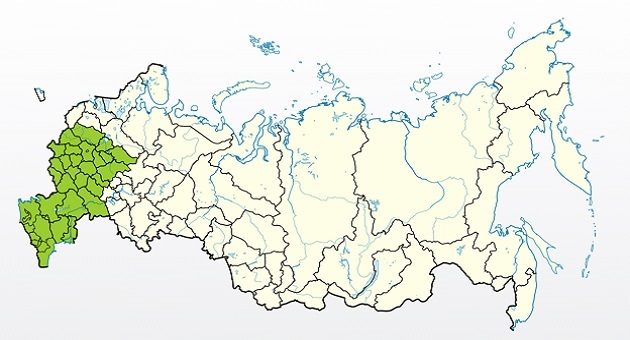
Growing regions
- Moscow region.
- Leningrad region.
- North Caucasus.
- Crimea.
- European part of Russia.
Origin
The new Orlov apple trees boast distinctive characteristics that attract gardeners across virtually the entire country. The state-owned All-Russian Research Institute for Fruit Crop Breeding (VNIISPK) began developing the Zaryanka variety in the late 1960s. It was developed in 1976 by breeding the SR0523 hybrid with the Antonovka Krasnobochka variety. The authors are considered to be Nina Glebovna Krasova, Zoya Mikhailovna Serova, Vladilen Vasilyevich Zhdanov, and Evgeny Nikolaevich Sedov.
In 1978, the apple tree was first applied for inclusion in the list of breeding achievements, after which it was submitted for official variety testing. Zaryanka was only classified as an elite variety in 1984, and in 1999, it was added to the State Register and zoned for the Central and Central Black Earth regions.
Content
Description of the Zaryanka variety
 This autumn variety has attracted attention for over two decades. Its main advantage is considered to be its genetic immunity to the main apple disease – scabiesBut that's not all: despite its compact size, the apple tree is highly productive, resistant to harsh growing conditions, and undemanding in terms of watering, soil, and care.
The fruits of the Zaryanka are beautiful, aromatic, and delicious. They are perfect for eating fresh or making jam, juice, or compote. A drawback is that the fruits quickly fall off when overripe. This variety is recommended for intensive commercial gardens and individual cultivation in home gardens.
Apples: What do they look like?
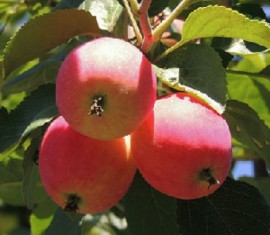
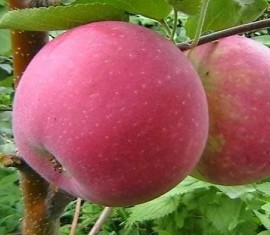
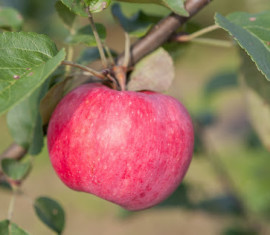
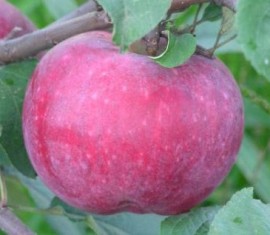
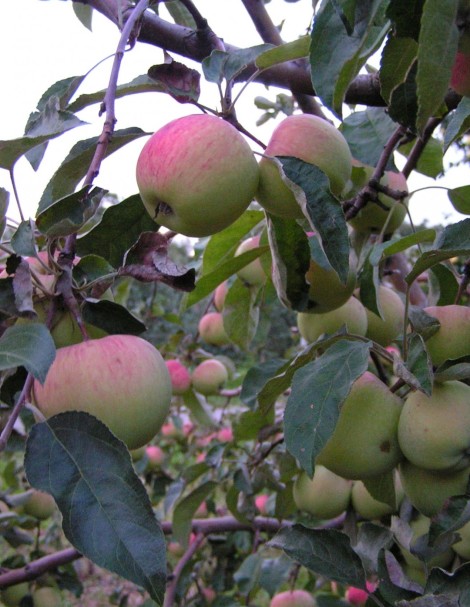
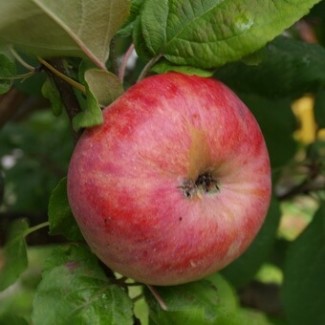
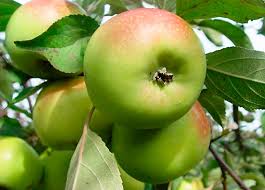 The fruits are generally medium-sized or even slightly larger than average. They can reach 120-140 grams in weight, and occasionally even reach 160-170 grams, although this is rare. The apples are round or round-conical in shape, often flattened along the central axis, and can be symmetrical or slanted to the side. The ribbing is smooth and almost invisible, and the side seam is completely invisible.
The skin is dense, somewhat hard, thick, elastic, smooth, shiny, dry, and glossy. Its color is green, but as it ripens, it becomes increasingly yellow-green or golden-yellow. The blush is distinctive and complex, consisting of several undertones. The underlying blush, blurred and spotted, is translucent, pink or raspberry-pink, and occupies 75-90% of the skin's surface. A more intense, speckled and striped pattern of brownish-red or purple-red is visible over it. Subcutaneous dots are small, green, and clearly visible. Experts recommend understanding the chemical composition by assessing several characteristic factors:
- P-active substances (catechins) – 428 milligrams.
- Ascorbic acid (vitamin C) – 19.5 milligrams.
- Fructose (total sugars) – 12.2%.
- Pectins – 14.9%.
- Titratable acids – 0.74%.
The flesh is dense, fine-grained, prickly, crisp, and refreshing. It is also very tender, with a pleasant consistency and texture, very juicy, and a distinctive but not overpowering aroma. The flavor is considered harmonious, dessert-like, and balanced, offering a sweet and sour combination with a hint of wine and spice. Experts have given it a 4.3 for flavor and a 4.4 for appearance on a 5-point scale.
Apple tree Zaryanka: characteristics
Crown and root system
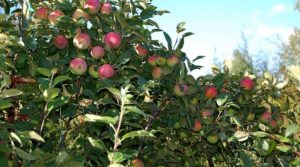 The variety is considered medium-sized, but it would be more logical to classify it as a natural semi-dwarf. The maximum length of a robin can reach is 3.7-4 meters., occasionally slightly higher. The crown is round or rounded-oval, neat, compact, and dense at the mid-height. Skeletal branches extend at right angles, pointing upward, and are covered with gray or gray-brown bark without pubescence. Fruiting is concentrated on simple and compound rings.
The leaves are matte, small, oval-elongated, leathery, dense, green or dark green, and wrinkled. The apex is long and twisted like a propeller; the margins are serrate-crenate, finely serrated, and may curl downward. The root system is highly branched, fibrous, and shallow, with a shallow depth, and is moderately adapted to seeking moisture in the soil.
Winter hardiness and disease resistance
The Robin's tolerance to low temperatures is perfectly suited to the temperate climate of our country. It easily tolerates temperatures down to -32-37°C without sustaining significant damage. If buds or even wood freeze, the tree recovers very quickly, with virtually no impact on the following year's harvest. However, proper winter protection is essential.
The variety has true genetic immunity to scab, expressed by the Vm gene. However, the apple tree is not immune to other diseases either, and is only affected in extreme cases. This is especially true when preventative maintenance is not carried out promptly, the tree trunk area is not cleaned, air stagnates in the crowns, and excess moisture accumulates in the area.
Rootstocks and subspecies
The Zaryanka apple tree doesn't yet have any subspecies or subvarieties, as it's a relatively new development. It's grown on various rootstocks, imparting some unique characteristics and qualities to the apple tree. For example, an even more compact, low-growing variety can be grown on a dwarf rootstock, but this will reduce its frost resistance slightly.
Features of growing the Robin
 Landing
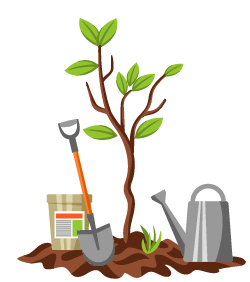 Landing
Basic conditions
- Open spaces are ideal for planting apple trees. They need direct sunlight for most of the day, otherwise the tree will weaken and die.
- Planting the Robin in a drafty location is undesirable, but crown ventilation should not be neglected. Maintaining a balance will achieve the best results.
- Apple trees don't penetrate the soil with their roots too deeply, so the groundwater level at the planting site can be 2-2.2 meters. If the water level rises higher, the rhizome begins to rot, which can have irreversible consequences. For this reason, avoid planting the Zaryanka near rivers or lakes, in marshy areas, floodplain lowlands, or near artificial reservoirs or wells.
- The holes are prepared in advance, 4-7 months before planting, but if you're late or purchased seedlings spontaneously, you can prepare them at least 1-2 weeks in advance. Additionally, if you choose the spring planting option, you can bury the apple trees at a 45° angle and leave them there until spring, before moving them to their permanent location.
- Dig holes 50-60 centimeters deep, pour half a bucket of soil mixed with fertilizers (organic, minerals) into the bottom, add the same amount of soil or drainage (stones, vermiculite, broken brick), and fill with 40-50 liters of water.
- There should be at least 2.8-3.5 meters of space between trees in a row, and more space can be made between rows for ease of fruit picking and maintenance.
- The tree's root collar should always be left above the ground level. Keep in mind that soil subsidence will occur over time. After a few days, you'll need to add some soil, but be sure to allow for this. A distance of 7-9 centimeters is ideal.
- Place the tree vertically on a pre-assembled mound of drainage material in the center of the hole, support it by the trunk, and fill it with soil. Compact it by hand, trying to eliminate any air pockets. Shaking the trunk is ideal, as this allows the loose soil to easily fill the voids. Water the surface (45-50 liters) and apply mulch to further retain moisture. manure, compost, sawdust or any available material.
Landing dates
It's acceptable to plant the Robin in either spring or fall; it thrives nearly equally well. However, in harsher regions, the former is recommended, while in milder regions, the latter. A good time is the third ten days of April or early May, and in fall, late September through mid-October.
Tree care
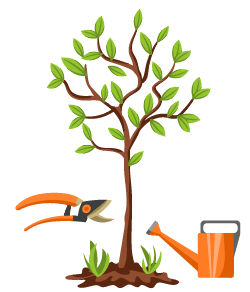 Tree care
Protection from frost and pests
When trees are young, it's easy to cover them for the winter using a tent-like method, which is no longer possible with mature trees. However, the garden will still need to be protected. Therefore, it's best to start from mid-season. August Reduce or eliminate any watering. The trunk can be wrapped in burlap, Sanbond, or roofing felt, and the root area can be covered with straw, hay, or spruce branches.
To prevent insects from breeding under the bark, in cracks and chips, apple trees are whitewashed twice a year, 1-1.3 meters above the soil surface. Lubricating the trunk with fuel oil, lard, or grease effectively protects against rodents. Commercial pest control products are also effective and can be purchased at affordable prices at any gardening store.
Loosening the soil, watering: proper agricultural technology
Dig around the apple tree's trunk no more than twice a year; this is sufficient for its well-being. In between, the day after applying water, you can carefully hoe the soil, preventing it from compacting into a tight ball. At the same time, remove shoots from other plants, weeds, and root suckers.
Apple trees are watered infrequently, approximately once or twice a month, unless there's rain. In hot, extremely dry weather, apple trees can be watered with 25-30 liters in two doses (morning and evening) once a week or every 10 days. Fertilizers and fertilizers can be dissolved in the water at appropriate times, but not earlier than 2-3 years after planting.
Pruning: simple crown shaping
Learning to properly shape trees isn't difficult. The recommended form for Zaryanka is a sparse, tiered tree, the most popular among gardeners. Shaping should begin in the first year, when the central conductor is removed by a third, all branches are pruned, leaving only 2-3 skeletal shoots, and these are shortened by about the same amount. Subsequently, regular pruning and maintenance are all that's required.
Every year, in the fall and spring, inspect the tree, trimming all branches growing inward, as well as those sticking upward. Dry, broken, and diseased branches should be removed. Wounds are sealed. garden pitch or at least a swamp.
Pollinator varieties
- Wine.
- Velvet.
- Marina.
- Arkad.
- Antonovka.
- Autumn striped.
- Dark-skinned girl.
- Korobovka.
- Cinnamon striped.
- White filling.
Reproduction
- Layers.
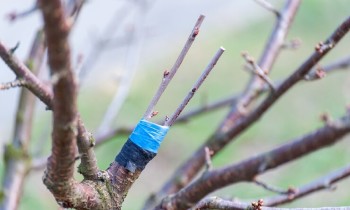
- Grafting cuttings.
- Clones.
- Growing from seeds.
Diseases and pests
- Rust.
- Powdery mildew.
- Spider mite.
- Cytosporosis.
- Weevil.
- Fleas.
- Black crayfish.
- Codling moth.
Ripening and fruiting of the Robin
The beginning of fruiting
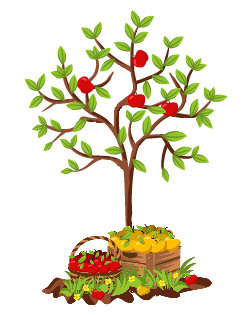 The beginning of fruiting
The tree begins to produce buds as early as 2-3 years after planting in open ground. For the first time, it's recommended to completely remove all flowers before they begin to form into ovaries, allowing the plant to develop foliage and rhizomes. The first harvest can be expected as early as 3-4 years, yielding approximately 6-9 kilograms of apples.
Flowering time
All early and late summer apple trees typically bloom in early May. However, cold, rainy weather in spring, along with late frosts, can significantly delay this until mid- or even late May. The process usually lasts approximately 12-16 days, sometimes a little longer. The flowers themselves are fragrant, beautiful, and densely covered with branches. They are medium-sized, with fleshy and very delicate petals of a faint pink color. Unopened buds may appear red or reddish-purple.
Fruiting and growth
The tree grows quite quickly. In just one year, it can reach 35-55 centimeters in height. After fruiting begins, the rate slows slightly, but not significantly. Zaryanka reaches its maximum growth quickly, while also rapidly increasing its fruiting rate. Harvests are already fully productive by the sixth to ninth year. The variety's active lifespan exceeds half a century, and there is no noticeable periodicity in fruiting—the apple tree bears fruit equally abundantly every year.
The harvest season begins in mid- to late August. However, it's best to consume fresh apples 5-10 days after picking and storing. However, they won't keep for long, even in the ideal conditions of a dedicated refrigerator. At best, Zaryanka apples will delight you with their pleasant taste and texture for 2-3 months, no more. After that, they lose all their beneficial properties, including juiciness and flavor.
Top dressing
- Peat.
- Superphosphate.
- Compost.
- Wood ash.
- Dolomite flour.
- Humus.
- Manure.
What to do if it doesn't bloom or bear fruit
- Inspect for diseases or pests.
- Limit or increase watering.
- Feed or apply fertilizer.
- Transplant to a sunny place.
Why do apples fall?
- Natural weather conditions (wind, rain, hurricane, hail).
- Overripe.
- Pest damage.
- Diseases.
Share your own experience with the Zaryanka apple variety so that any gardener can learn about it before planting and achieve maximum results.