Miasskoye apple tree: characteristics of the variety and care
| Color | Reds |
|---|---|
| Ripening season | Summer |
| Size of apples | Average |
| Taste | Sweet and sour |
| Crown type | Average tree height |
| Shelf life | Low shelf life |
| Application | For recycling , Fresh |
| Winter hardiness | High winter hardiness |
| Fruiting age | From 5 years old |
 History of origin and regions of growth
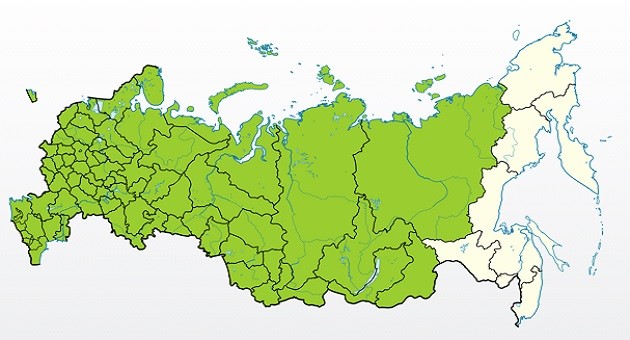
Growing regions
- Ural.
- Crimea.
- Siberia.
- Leningrad region.
- North Caucasus.
- Dagestan.
- Central Black Earth Region.
- Middle zone.
- Moscow region.
Origin
The variety's origins date back to 1948, when it was first developed at the experimental station of the South Ural Research Institute of Fruit, Vegetable, and Potato Growing. The authors of the variety are Mikhail Aleksandrovich Mazunin and Pavel Aleksandrovich Zhavoronkov. The new variety was developed by crossing the Ural Ribbed variety and the Cinnamon (Brown) Striped variety. Field testing was conducted over a long period, spanning over two decades.
The first application for inclusion of this new variety among elite varieties was submitted in 1978, but it was accepted ten years later, in 1988. Then, the apple tree, given the beautiful name Miasskoye, was entered into the State Register of Breeding Achievements and officially zoned for the Ural region. In fact, it can be grown practically anywhere in the country, except in the northernmost and coldest regions.
Description of the Miass variety
 The new variety was immediately appreciated by nearby Ural farms. The trees are very compact, neat, and space-saving. At the same time, they exhibit excellent environmental adaptability, hardiness, tolerance to various soils and growing conditions, and winter hardiness, and are noted for consistently high yields. However, the standard apples are not particularly drought-tolerant, and when moisture is insufficient, the apples become bland and grassy in taste.
The Miasskogo apples, although medium-sized, are very attractive. They are juicy, have a strong, rich flavor, and are very tasty and sweet. They are easily transported over long distances and keep well in the cellar, compared to other summer varieties. This apple tree is recommended for both individual cultivation and intensive commercial plantings.
Apples: What do they look like?
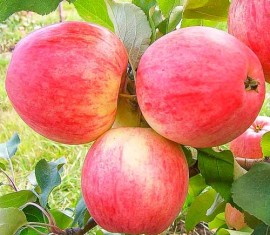
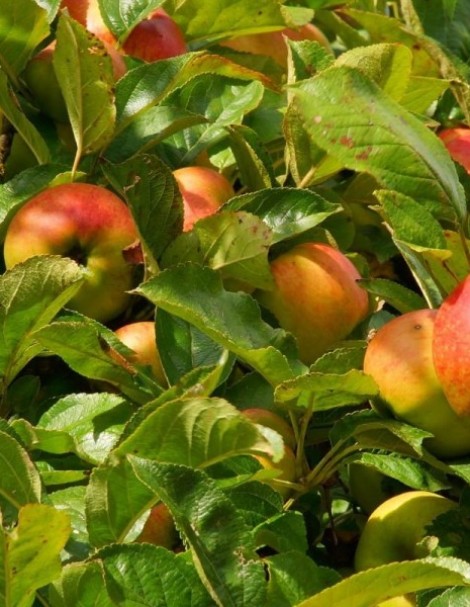
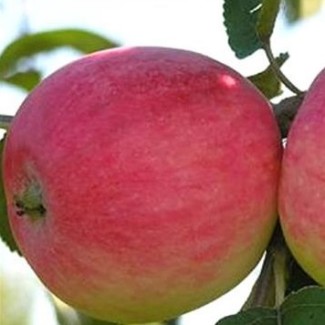
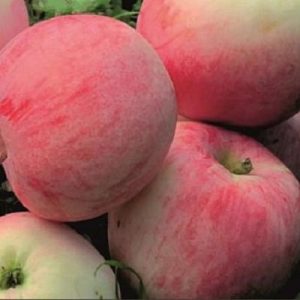 Most of the fruits are medium-sized, but some can be large. The average weight of apples is 120-140 grams. Their shape is round, but most often flattened, regular, even, and broadly ribbed, without a distinctive side seam. They are most often uniform, asymmetrical, and slanted to one side.
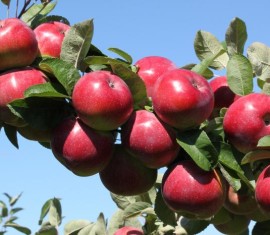
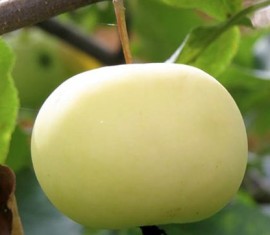
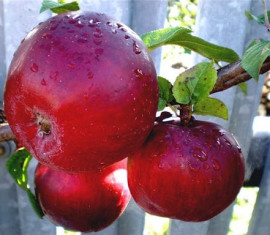
The fruit's skin is quite thick, rough, hard, and durable, elastic, providing reliable protection from mechanical damage. It is smooth, shiny, and glossy, with a yellowish-green or yellowish-white hue, sometimes golden-white. The blush is translucent but clearly visible, most often appearing on the sunny side as blurred spots of a red-carmine or red-pink hue, sometimes speckled and striped. Subcutaneous punctures are visible; they are light, large, and numerous. Apple quality can be determined by their chemical composition:
- P-active substances (catechins) – 234 milligrams.
- Ascorbic acid (vitamin C) – 28.9 milligrams.
- Total sugars (fructose) – 9.9%.
- Pectins (fiber) – 13.7%.
- Titratable acids – 0.7%.
The Miass apple has a very distinctive flesh: coarse-grained, slightly fibrous, and easily recognizable. The flavor is considered dessert-like, balanced, and harmonious, with a sweet and sour tang, tinged with a hint of wine-like acidity. The fruit's aroma is very powerful and carries far. According to professional tasters, the apples score a maximum of 4.5 out of 5 for taste and appearance.
Miasskoye apple tree: characteristics
Crown and root system
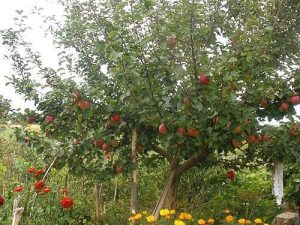 The variety is generally considered to be of medium height, although it can be safely classified as a natural semi-dwarf. Without additional pruning, trees reach a maximum height of 3.5-3.8 meters, very rarely 3.9-4The crown shape is round, oval-pyramidal, rounded-pyramidal, or oval-elongated, spreading but regular. Shoots are set at right angles to the trunk; they are straight, thick, of medium length, covered with smooth bark of a grayish-green, green-brown, or gray-brown hue. Fruiting is mixed, occurring on rings, shoots, and twigs.
The leaves are medium to large, ovate-elongated, ovate-oval, smooth, flattened, leathery, highly glossy, and pubescent. They are long-pointed, with serrated, crenate, and finely serrated margins. The root system is deeply buried, branched, and mostly fibrous, with a small number of small branches, making it moderately adapted to moisture management.
Productivity and pollination
Experts classify Miasskoe as a high-yielding variety, given its small stature and early ripening period.
In favorable years, a skilled grower can typically harvest approximately 70-80 kilograms of aromatic and delicious fruit from a single mature tree of this variety. In some cases, these figures increase slightly, but during droughts, they can drop by 40-50%.
A relatively self-fertile variety can barely achieve pollination rates of 15-18% of its maximum potential, so it absolutely requires pollinators on site. These pollen must be active enough, otherwise good results are unlikely. It's a good idea to spray the trunks with sugar syrup in the spring and bring mobile apiaries to gardens.
Winter hardiness and disease resistance
Apple trees are winter-hardy enough to withstand temperatures down to -29-34°C with virtually no damage. However, they don't tolerate sudden changes or fluctuations, so it's best to cover them in any region, even relatively warm ones, as sudden weather changes from severe frost to thaw and back cannot be ruled out.
Miass has no genetic immunity to diseases. It can be affected scab, powdery mildew, cytosporosis, other fungi, and parasites. However, the tree's field resistance is excellent; it is rarely and not heavily infected, and treatment is relatively easy, while prevention can minimize the risk of infection.
Rootstocks and subspecies
It's preferable to grow trees on standard or dwarf rootstocks; this variety has no subspecies. There are no columnar or creeping varieties, so be careful when purchasing from uncertified sellers.
Features of growing Miass
 Landing
 Landing
Basic conditions
- This variety thrives in almost any soil, but it's best to choose a lightly soiled sandy loam or loamy soil. The tree also grows well in podzolic soils and black soil, but will require supplementation with clay and sand.
- A sunny location is essential for proper growth and development of apple trees, as they grow weak in the shade and may refuse to bloom. The garden can receive some shade, but not more than a few hours a day.
- The tree's rootstock isn't buried too deeply, so groundwater depth isn't a key factor. However, if the water table is too close, the roots may rot. It's not advisable to plant trees in a swamp or floodplain meadow, or directly next to a river, stream, lake, or shallow well.
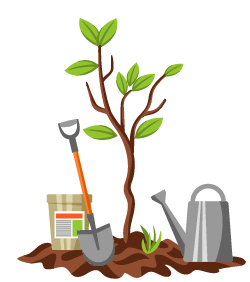
- It's important to dig holes for planting apple trees in advance, at least 2-3 weeks in advance, as they need to be exposed to the elements. Dig holes up to 80 centimeters deep and 90 centimeters in diameter (they can be widened later if needed). Add topsoil to the bottom, mixed with fertilizer (except nitrogen-based). Then lay crushed brick, vermiculite, or coarse screenings on top for drainage, and water the entire area.
- It would be a good idea to insert or hammer stakes, rods, or trellises into the holes immediately for tying up; this will provide the trees with additional support and protection during the cold weather.
- Trees are spaced 2.5-3.5 meters apart in a row, with rows spaced 3-4 meters apart. This will not only give them ample room to grow, but also make harvesting and maintenance easier for the owners.
- If you want to preserve the qualities of the rootstock, which is usually required, leave the root collar 10-12 centimeters above the surface, taking into account that the soil may settle after the initial watering.
- Place the seedling in the hole, cover with soil, shaking it to fill all the voids, tamp it down with your hands or feet, and water it. Mulch the surface to further retain moisture.
Landing dates
The Miasskoye variety is quite hardy, so it thrives equally well when planted in both spring and fall. You can choose a warm, dry day in March-April or September-October to plant the apple trees. The key is to ensure the soil is warm enough at that time and there's no sap movement in the trunks.
Tree care
 Tree care
Protection from frost and pests
Despite apple trees' frost resistance, they need to be properly prepared for winter and covered. All watering should be stopped no later than early September, without taking into account natural precipitation, which is impossible to accurately control. After the leaves have fallen, prune the trees, then clear the tree trunks, cover them with straw or spruce branches, and wrap the trunks in burlap.
To repel insects that damage bark and wood, tree trunks are whitewashed with lime twice a year, in spring and fall, but commercially available products can and should also be used. The most environmentally friendly way to get rid of rodents is to coat apple trees with lard or grease, which have a strong, unpleasant odor.
Loosening the soil, watering: proper agricultural technology
You should dig around the trunk at least once a year, but twice is better. It's also a good idea to remove root suckers, weeds, and other plant shoots. As the soil grows, you can loosen it the next day after each watering to prevent it from compacting into a solid lump and becoming rock-hard. Debris should also be cleared regularly to prevent disease.
Young trees should be watered frequently, at least once a week. As they get older, 6-8 times per season is sufficient. However, keep in mind that in extreme heat and lack of natural precipitation, even mature apple trees will need to be watered more frequently. Sprinkler irrigation or drip irrigation are excellent solutions.
Pruning: simple crown shaping
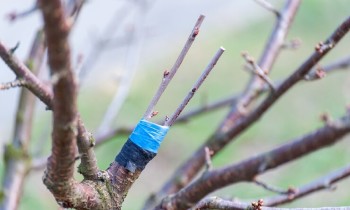
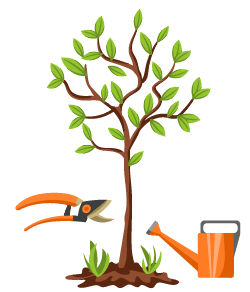
The tree isn't prone to becoming overgrown, so pruning shouldn't be a problem. Form the crown in the first year by arranging 2-3 main branches in tiers, spaced far apart. Subsequently, simply remove any branches that protrude upward, into the crown, or cross over. It's a good idea to begin rejuvenating the tree after 10-12 years, removing 2-3 mature shoots at a time, allowing the new shoots to develop.
Sanitary pruning is usually done in the fall, but don't be afraid to cut off a broken branch right away. Remove any dead or diseased branches; they're no longer useful. Don't leave cut areas untreated; it's best to seal them with garden pitch or paint.
Diseases and pests
- Scab.
- Cytosporosis.
- Powdery mildew.
- Black crayfish.
- Leaf roller.
- Leafhopper.
- Scale insect.
- Hawthorn.
- Green aphid.
Ripening and fruiting of Miass
The beginning of fruiting
 The beginning of fruiting
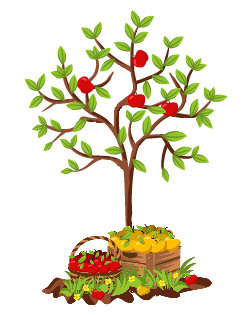
Although these trees are commonly considered early-fruiting, they are not. They begin to bear fruit no earlier than 5-6 years after planting, and yields in the first few years are clearly poor.
Flowering period
The buds open quite early, in mid- to late April, and very rarely in early May in southern regions. Therefore, pollinators that bloom at the same time must be carefully selected for the Miass apple tree. The apple blossoms themselves are large, extremely fragrant, and pale pink or white. The process takes quite a long time, at least 12-16 days, so bees and wind usually handle the pollination process even in poor weather.
Fruiting and growth
Apple trees grow at a medium rate, reaching approximately 35-45 centimeters per year. This process accelerates before fruiting begins, but slows slightly after the apples begin to ripen on the branches. Therefore, fruitfulness doesn't increase very quickly. A full harvest isn't expected until the 10th to 12th year. Fortunately, the tree's active lifespan is quite long, ranging from 60-75 years.
This is a late-summer variety, so the first apples will ripen only at the end of August, sometimes a little earlier. They ripen fairly evenly and are prone to shedding, so it's best to pick them immediately to prevent them from falling to the ground. The fruit is easy to transport in crates, but will only last for 35-50 days, depending on storage conditions. They are suitable for making juices, preserves, jams, dried fruit, and baby food.
Top dressing
- Potassium.
- Superphosphate.
- Humus.
- Peat.
- Calcium.
- Manure.
- Compost.
What to do if it doesn't bloom or bear fruit
- Increase watering.
- Remove insects.
- Cure diseases.
- Fertilize.
- Move to a sunny place.
Why do apples fall?
- Overripe.
- Wind, rain, hail, snow.
- Pests or diseases.
Leave a review of the Miasskoye apple tree variety so that even a novice gardener can receive useful information firsthand.