Kulikovskoye apple tree: characteristics of the variety and care
| Color | Reds |
|---|---|
| Ripening season | Winter |
| Size of apples | Average |
| Taste | Sweet and sour |
| Crown type | Average tree height |
| Shelf life | Average shelf life |
| Application | Universal variety |
| Winter hardiness | High winter hardiness |
| Fruiting age | Up to 5 years |
 History of origin and regions of growth
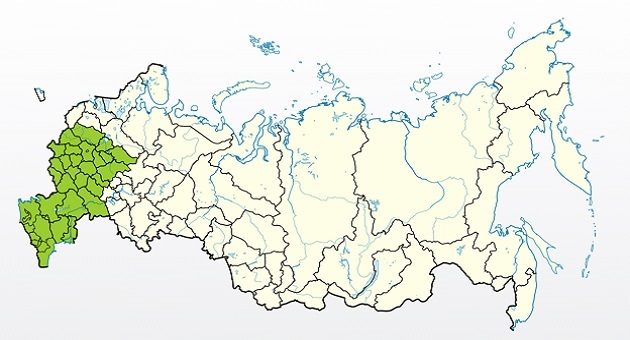
Growing regions
- Oryol region.
- Tatarstan.
- Moscow region.
- Middle zone.
- Kursk region.
- Tambov region.
- Mordovia.
- North Caucasus.
- Leningrad region.
Origin
Development of the variety began in the mid-1950s. In 1961, the first seedling from open pollination of the King apple tree was obtained and grafted onto the well-known Antonovka Krasnobochka apple. The authors were Nina Glebovna Krasova, Evgeny Nikolaevich Sedov, and Maria Vasilyevna Mikheeva. In 1968, the new variety produced its first few fruits, and by 1974, it had been included in the elite.
Kulikovsky had a long journey before an application for inclusion in the State Register of Breeding Achievements was submitted in 1983. It was only added in 1997. The apple tree was zoned for the Central, Middle Volga, and Central Black Earth regions. In fact, it can be grown throughout the central part of the country, thrives in the Leningrad Region and the Moscow Region, and is even cultivated in some areas of the Urals and Siberia.
Content
Description of the Kulikovskoe variety
 This apple tree boasts a wide variety of advantages, attracting gardeners from virtually all over the country. It produces substantial harvests regularly, without interruption, and is truly early-bearing. High environmental resistance, low maintenance, and undemanding soil conditions—all of these qualities characterize the Kulikovskoye variety.
Its fruits are attractive and have high consumer and commercial qualities. They are tasty, aromatic, easy to transport even over long distances, and they keep well until spring. This variety is recommended for intensive commercial gardens, as well as for private cultivation in home gardens.
Apples: What do they look like?
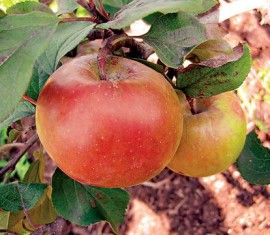
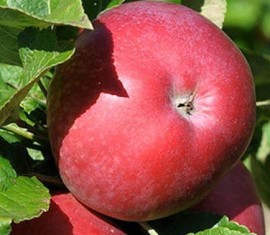
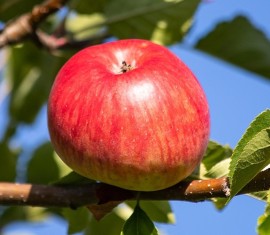
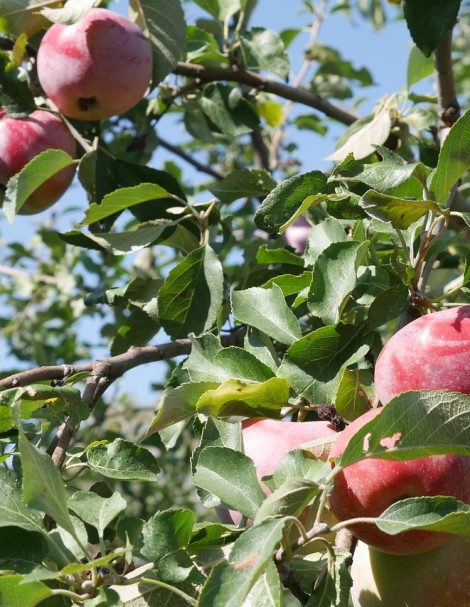
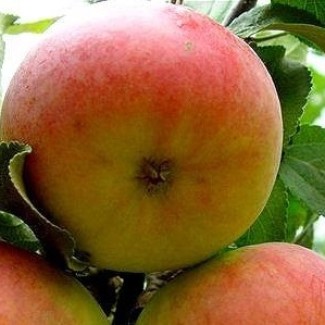
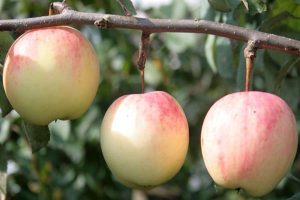 The fruits are medium or slightly larger in size. They can easily reach 130-170 grams. The shape of the fruit is round or spherical, and the apples are usually symmetrical and uniform. Ribbing is completely invisible, as is the side seam.
The skin is very dense, sometimes even hard, smooth, highly glossy, and shiny. As it ripens, it becomes covered with a dense but colorless waxy-oily coating, giving it a greasy appearance. The base color is green or whitish-green, and may turn white-yellowish as it ripens. The blush is streaked, striped, or blurred, with a reddish-brown, slightly crimson, or even purple hue, covering 45-60% of the surface. Subcutaneous punctures are numerous, small, and moderately visible. Professionals recommend evaluating the following parameters to understand the chemical composition:
- P-active substances (catechins) – 115 milligrams.
- Ascorbic acid (vitamin C) – 11.7 milligrams.
- Fructose (total sugars) – 9.6%.
- Pectins – 10.1%.
- Titratable acids – 0.38%.
Kulikovsky has snow-white, slightly creamy or greenish flesh of medium density. It is quite juicy, fine-grained, and has a pleasant, slightly wine-like aroma. The flavor is considered sweet and sour, a table-like quality, scoring only 4.2-4.3 points out of a possible 5 on a professional tasting scale.
Kulikovskoye apple tree: characteristics
Crown and root system
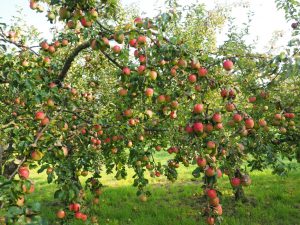 The tree is classified as medium-sized, medium-growing. Kulikovskoe without pruning easily reaches 4-4.5 meters, occasionally 4.5-5, but no longer grows, so pruning is usually not a problem. The tree's shape is round or round-oval, drooping or even weeping in old age, with a moderately dense crown. Branches extend from the trunk at right angles and are covered with bark that is prone to cracking, flaking, and brownish-gray or dark gray. The shoots are long and straight, with tips directed horizontally or downward. This variety bears fruit on fruiting shoots and ring shoots.
The tree has dark green or rich green leaves, leathery, dense, slightly glossy or even matte, with delicate veining. They are short-pointed, with recurved tips, serrate-crenate, wavy margins, and a felt-like pubescence on the back. The root system is well-developed, fibrous, and branched, with numerous small branches for water-seeking.
Productivity and pollination
The variety is considered to be high-yielding, although it cannot “reach” Antonovka or even Yubiley Moskvy.
A single mature tree trunk, if properly cared for properly, yields approximately 150-170 kilograms of aromatic fruit per year. In favorable years, the yield can reach 170-180 kilograms, but it's unlikely to exceed that..
The variety is conditionally self-fertile. It will produce some fruit even when there's no other apple tree within 50-150 meters. However, it's best to plant Kulikovskoye interspersed with varieties that bloom at the appropriate time, as this significantly increases its fruit production. The most advanced gardeners treat flowering apple trees with sugar syrup to further attract bees.
Winter hardiness and disease resistance
The frost resistance of apple trees is generally considered high, although it would be more accurate to classify it as moderate. Apple trees easily tolerate temperatures down to -27-32°C, but only in low humidity and for short periods. In a moderate continental climate, severe cold and sudden temperature changes are not a problem, but in some cases, buds, bark, and even wood may be damaged. Therefore, it is important to carefully and promptly cover trees for the winter.
Kulikovskoye is quite resistant to fungal diseases, as well as other diseases. Even during the most severe epidemics, the leaves may be affected, but the apples are perfectly edible. However, preventative measures should not be neglected; they should be carried out promptly and regularly.
Rootstocks and subspecies
The variety is grown on different rootstocks, which can alter its properties slightly. For example, dwarf and semi-dwarf varieties produce even more compact trees, although their overall winter hardiness is reduced. Such manipulations generally do not affect fruit quality.
Features of growing Kulikovsky
 Landing
 Landing
Basic conditions
- For planting apple trees, choose a location that receives full sun throughout the day. Trees in shady areas may die immediately or grow weak and spindly.
- It's best to choose a site protected from drafts but still well-ventilated. Trees grow poorly and slowly in strong winds, while stagnant air increases the risk of fungal growth. A careful balance is essential.
- Trees don't like high groundwater, so you should choose a site where they don't reach a surface higher than 2-2.5 meters. It's acceptable to plant apple trees on artificial mounds, or to create a barrier by digging a sheet of slate or something similar at a depth of two meters.
- There's no need to prepare the holes in advance of the season, but they should be left to stand for at least 2-4 weeks. Dig holes 60-70 centimeters deep and 80-90 centimeters in diameter, add fertilizer to the bottom, cover with a thin layer of soil or drainage material, and fill with water (35-40 liters).
- It is customary to leave at least 3.5-4 meters of distance between tree trunks, and 5 meters between rows, for ease of further care and harvesting.
- If the properties of the rootstock need to be preserved, the root collar should be left 4-6 centimeters above the surface.
- Place the seedling on the soil (drainage), making a small mound in the center of the hole. Spread the roots out so they lie freely. Cover with soil and gradually compact it layer by layer by hand to eliminate any air pockets. Then, press the compactor down with your feet, but not too hard, and then water with 30-45 liters of water. To further retain moisture, you can mulch the soil surface with sawdust or any other material.
Landing dates
In southern regions with warm and temperate climates and generally favorable weather, apple trees can be planted in spring and fall, when the sap in the trunks has already or has not yet begun to flow. This means around March-April, before the buds begin to open, or in September-October after the leaves have fallen. In colder climates, the spring option is preferable.
Tree care
 Tree care
Protection from frost and pests
Standard winter tree protection measures are sufficient for Kulikovsky. Young first-year trees can be wrapped like a tent, while taller ones can be wrapped in burlap, old tights, or agrofibre. During the harshest winters, spruce branches, hay, straw, or even just soil can be piled on the root area. Needless to say, all this will have to be removed in early spring.
To prevent insects from nesting in the peeling bark, the trunks are cleaned every fall with a stiff brush and whitewashed with a thick lime solution. Rodents can be repelled by coating the trees with fuel oil, rendered lard, old drying oil, or grease.
Loosening the soil, watering: proper agricultural technology
The root zone should be dug up twice a year at first, and then once a year starting from the fifth or sixth year. Over time, you can sow flowers, herbs, and spices near the roots, and cover the soil with sod. But initially, it's a good idea to hoe the soil about 5-8 times per season, preferably after each watering the following day. At the same time, remove weeds and root shoots, as well as shoots from other plants.
Water trees frequently in the first and second years after planting. The optimal schedule is once every 10-14 days. Apply approximately 15-25 liters of water per tree twice, morning and evening. It's best to apply fertilizer along the crown of the tree to ensure better absorption of the nutrients.
Pruning: simple crown shaping
The most suitable form for the Kulikovsky, as for most apple trees, is considered to be a sparsely tiered form. This type of tree has branches spaced far apart, at varying heights. The first formative pruning is done in the year of planting, removing a third of the trunk and shortening the branches by 7-12 centimeters per tier. Subsequently, all that remains is to trim excess branches, maintaining the desired shape.
Regularly perform sanitary pruning in the fall and early spring. Remove shoots protruding into the crown, vertically growing shoots, broken, diseased, cracked, and dry ones. All of these will hinder further growth and development. Starting from the 12th to 15th year, you can begin rejuvenating the tree by pruning 2-3 mature branches per year.
Pollinator varieties
- Cliff.
- Moscow's Anniversary.
- Stroevskoe.
- King Jonagold.
- Antonovka.
- Olympic.
- Korobovka.
- Borovinka.
- Elstar.
Reproduction
- Clones.
- Growing from seeds.
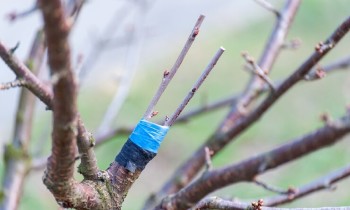
- Grafting of buds and cuttings.
Diseases and pests
- Scab.
- Spotting.
- Cytosporosis.
- Black crayfish.
- Rust.
- Green aphid.
- Copperhead.
- Hawthorn.
- Weevil.
Ripening and fruiting of Kulikovsky
The beginning of fruiting
 The beginning of fruiting
For a late-winter variety, this apple tree bears fruit quite early. Flowers appear for the first time in the third or fourth year, but it's best to remove them completely to allow the tree to develop a crown and root system. Harvests can begin in the fifth or sixth year. They won't be particularly impressive, but you'll definitely get 4-5 kilograms of apples.
Flowering time
Buds appear on the branches as early as late April, and in warmer regions where spring begins earlier, they can appear as late as mid-May. They usually open in mid-May, but when it's cold or there's constant rain and little sun, they can be delayed until early June. The flowers are large, beautiful, saucer-shaped, with delicate, elongated petals. They are intensely fragrant and densely covered with short peduncles.
Fruiting and growth
Kulikovskoye quickly gains height, reaching 45-65 centimeters in a year, depending on weather, care, fertilizer, and other external factors. The variety's fertility increases gradually, producing more and more fruit each year. By the 8th to 10th year, it already produces a standard 100 kilograms, and after a few more years, it reaches its maximum yield.
The fruits begin to ripen around the end of September in warmer regions, and by early October in cooler areas. However, this is only the technical, picking maturity, at which point the fruit has not yet reached its peak flavor. Ripeness can be determined by the oily coating that easily wipes off the surface. The apples are picked, but there's no need to rush; they remain firmly attached to the branches until the first frost, and are then stored. Consumer maturity occurs only after 1-1.5 months of storage, and the maximum shelf life in a good cellar is until February.
Top dressing
- Nitrogen complexes.
- Superphosphate.
- Manure.
- Compost.
- Humus.
- Chicken manure.
- Urea.
What to do if it doesn't bloom or bear fruit
- Check for the presence of parasites and diseases.
- Increase watering.
- Feed.
- Transplant.
Why do apples fall?
- Wind, rain.
- Parasitic lesions.
- Diseases.
Share your own experience with the Kulikovskoye apple tree variety so that any gardener can learn about it before planting and achieve maximum results.