Apple tree Freshness: characteristics of the variety and care
| Color | Reds |
|---|---|
| Ripening season | Winter |
| Size of apples | Average , Large |
| Taste | Sweet |
| Crown type | Average tree height |
| Shelf life | High shelf life |
| Application | Universal variety |
| Winter hardiness | High winter hardiness |
| Fruiting age | Up to 5 years |


 History of origin and regions of growth
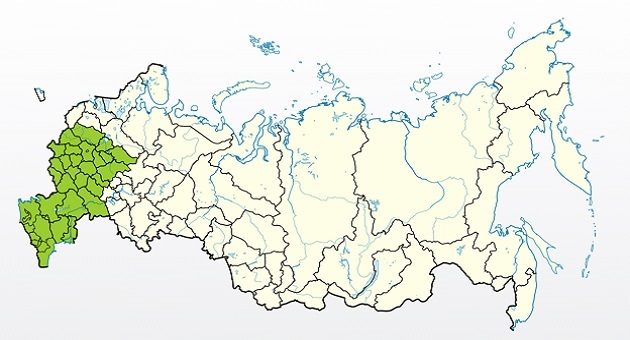
Growing regions
- Some northern regions.
- North Caucasus.
- Crimea.
- European part of Russia.
Origin
In the mid-1970s, a group of Soviet breeders, including Yevgeny Nikolayevich Sedov, Vladilen Vasilyevich Zhdanov, and Zoya Mikhailovna Serova, developed the first new apple variety, later named "Svezhest." The parents were Antonovka-Krasnobochka and the complex hybrid PR12T67, created from F2 M. floribunda and the "American" Welsi. The tree grew well, developed, and bore its first fruit in 1985.
In 1994, the seedlings were classified as elite and sent for field trials to various farms across the country. The new apple trees performed extremely well, so in 2001, it was decided to include them in the State Register of Breeding Achievements and zone them for the Central and Central Black Earth regions.
Content
Description of the Freshness apple variety
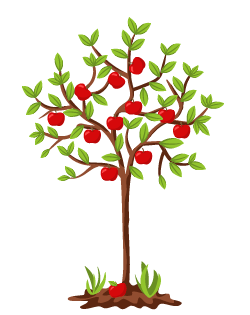 Gardeners immediately fell in love with these compact, medium-sized trees, which quickly gain height and begin producing a good harvest. They are easy to grow, require little maintenance, are tolerant of soil and moisture, and, most importantly, have a genetic immunity to scab and some other fungal infections. They produce good harvests every year without a resting period, and have a long, active lifespan.
The fruits have high marketability: they are tasty, aromatic, and beautiful. Like most winter varieties, these apples have an enviable shelf life, retaining their unique flavor and aroma until spring. They are recommended for growing not only in the garden but also for intensive commercial plantings.
Apples: What they look like
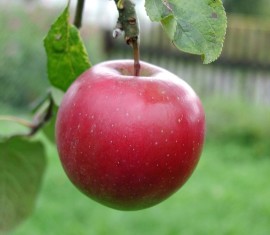
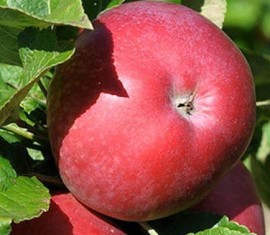
 The fruits are usually large to larger than large, and uneven in size. On a single tree, the majority of the fruit will weigh between 125-145 grams, but some weighing 200-230 grams or even more are also likely to be found. They are round, smooth, and can be slightly flattened along the central axis, resembling a barrel, with wide, smooth, and poorly defined ribs.
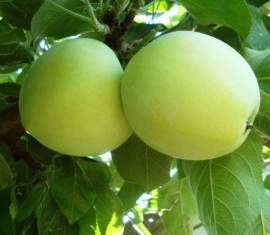
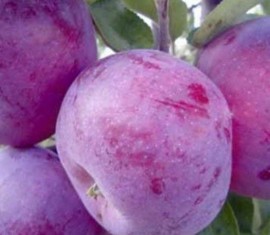
The skin is glossy, dense, elastic, and smooth, with a noticeable oily coating. It is green, and when ripe, yellow-green or golden. The blush covers 70-85% of the surface and is blurred and streaky, sometimes with speckles and stripes. The color is red, carmine-red, or slightly raspberry. Subcutaneous punctures are few and small, gray or gray-green, barely noticeable against the variegated skin. The chemical composition can be easily assessed by the following characteristics:
- Titratable acids – 0.78%.
- Sugars (fructose) – 9.1%.
- Pectins (fiber) – 17.6%.
- Ascorbic acid (vitamin C) – 12.3 milligrams.
- P-active substances (catechins) – 436 milligrams.
The flesh is dense and prickly, crisp, fairly fine-grained, and juicy. It has a distinct greenish tint. It has a subtle but distinctive and pleasant apple aroma. The flavor is sweet and sour, considered table-like, balanced, and harmonious. Professional tasters give it 4.2 points for flavor and 4.3 for appearance out of a possible 5.
Apple tree Freshness: characteristics
Crown and root system
 This tree is considered to be medium-sized and fast-growing. Without pruning, under normal conditions, it can stretch up to 3.5-4.5 meters, and sometimes even more.However, gardeners typically limit standard trees to 3-4 meters. The crown has a clearly visible round or spherical, sometimes broadly oval, shape, and is moderately dense. Branches extend from the central core at an acute angle; they are not thick, but angular and geniculate, curved, directed in various directions, but mostly upward, and covered with glossy, shiny bark of a reddish-brown or brown color.
The leaves are dark green or rich green, shiny and glossy, rounded-elongated, leathery, dense, ovate, with a blunt, short-pointed tip. The leaf margins are wavy, finely serrated, and serrated, and may have slight pubescence on the reverse side. The root system is fibrous, branched, robust, and of medium depth, well adapted to seeking water in the soil.
Productivity and pollination
The breeders and authors of the variety's description indicated a medium-sized yield. However, in recent years, practicing gardeners have discovered that trees can produce much more fruit than expected.
One mature 'Svezhest' tree can yield approximately 230-280 kilograms of long-lasting, high-quality fruit, as measured in 2009-2019. It should be noted that this increase is gradual and largely depends on the quality of care, climate, and weather conditions in the region where the apple trees are grown..
The variety is conditionally self-fertile, but self-pollination will yield a small number of fruits, approximately 5-12% of the potential yield. Freshness requires pollinators that are appropriate for the flowering period. Below is a list of the most suitable varieties, which are recommended to be planted within 45-60 meters of each other for cross-pollination.
Winter hardiness and disease resistance
The variety's resistance to low temperatures is quite high. It tolerates temperate climates well. We tolerate the changeable weather in the Moscow region and the harsh, prolonged cold of the Leningrad Region. However, it's important to properly prepare for winter and cover trees for the entire cold season.
To the five races scabies Apple trees have a built-in immunity (the Vf gene) in their genetic code, and the variety is also quite resistant to other fungal apple infections. Even when all the apple trees in the orchard are sick, Freshness delights with green foliage and healthy fruit.
Rootstocks and subspecies
It's too early to talk about the diversity of the "Svezhest" variety's subspecies, but it can be grown on a variety of rootstocks. The most popular is the dwarf variety, which produces very compact trees 2-2.2 meters tall. These trees begin bearing fruit earlier, producing slightly larger fruits than the parent variety, but suffer from reduced frost resistance, and their lifespan is reduced to 30-45 years.
Features of growing Freshness
 Landing
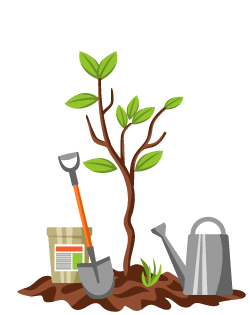 Landing
Basic conditions
- All fruit trees require good light and ventilation, and these apple trees are no exception. Therefore, planting sites must be chosen appropriately; in the shade, they will grow weak, and the apples will be small.
- The Freshness tree won't tolerate high groundwater levels. Its roots penetrate deep into the soil, and if they reach moisture, they will inevitably begin to rot. Then the tree will likely die. If the groundwater level in the only accessible area rises above 2.2-2.5 meters, you can create a special "glazing block": dig a sheet of slate at a depth of two meters or lay a layer of roofing felt or tar paper.
- Experienced gardeners usually prepare holes for any apple tree the previous season, but Freshness doesn't particularly need this. You can dig holes measuring 60x90 cm just a week or even four to five days before planting. Add fertile soil with a small amount of fertilizer and drainage to the bottom, drive in a stake for tying, and then add 15-35 liters of water.
- Leave at least 4.5-5 meters between plants in a row, and 4-4.5 meters between rows. This will ensure that mature apple trees do not interfere with each other's growth in the future.
- The seedlings are placed vertically so that their root collars rise above the surface by 5-7 centimeters, covered with soil to half the depth, tamped by hand to eliminate air pockets, then the rest is added, lightly tamped again, and the surface is mulched.
Landing dates
It's best to plant Freshness trees in spring, as statistics show a higher survival rate. Experienced gardeners recommend early or mid-April, when the threat of frost has passed but the buds have not yet opened. Planting in the fall is also possible, but finding the right weather and day will be more difficult, as the sap flow in the trunk must have stopped, and frost is still at least 3-5 weeks away. Planting trees with closed root systems can continue throughout the growing season.
Frost protection
The variety is highly winter-hardy, but it's important not to completely abandon preparation for winter. Around late September or early October, watering should be stopped completely, otherwise the sap flow may not stop in time. Trunks are wrapped in burlap or agrofibre, roofing felt, or tarpaulin. Young trees can be covered with a ball, or soil can be piled onto the trunk area.
Tree care
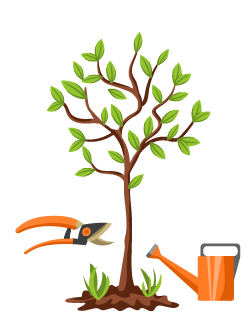 Tree care
Loosening the soil, watering: proper agricultural technology
Trees respond very favorably to timely soil cultivation around them, as they prefer adequate oxygen. This should be done twice a year, and the tree trunk area should also be hoeed 6-8 times per season. This will prevent air from entering the soil and will also remove all weeds, shoots from other plants, and root suckers.
When young, the variety requires frequent watering, approximately once a week, and if the weather is very dry and hot, even every 4-5 days. As it matures, the frequency of watering can be reduced to 6-8 times per season, primarily during flowering, fruit set, and harvest ripening.
Pruning: simple crown shaping
Freshness follows all the standard care and pruning procedures for all apple trees. In the first year, the trunk is cut back by a third, and all other shoots (skeletal branches) are also shortened so that they are pruned in layers. It's important to promptly prune out shoots that protrude upward, as well as shoots that grow inward.
Sanitary measures are mandatory every spring, pruning any dead or damaged branches that are found. All measures can also be carried out in the fall, but experienced gardeners say that one treatment is sufficient, as the trees are weakened after the procedure and are therefore susceptible to frost damage in the winter.
Pollinator varieties
- Gloucester.
- Berkutovskoe.
- Auxis.
- Spartan.
- Ligol.
- Champion.
- Ruby.
- Antaeus.
- Venyaminovskoe.
Reproduction
- Growing from seeds.
- Rooting.
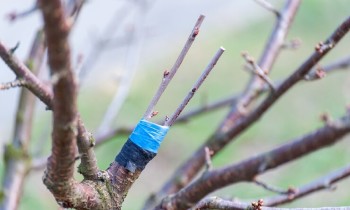
- Kidney grafting.
- Cuttings.
Diseases and pests
- Powdery mildew.
- Black crayfish.
- Green aphid.
- Codling moth.
- Scale insect.
Ripening and fruiting of Freshness
The beginning of fruiting
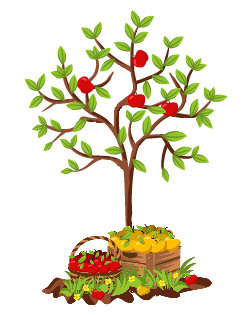 The beginning of fruiting
The variety is considered early-bearing, as the first apples can be tasted approximately 4-5 years after planting in the garden. However, the first buds can actually be seen as early as the spring of the 3rd year. It's best to pluck them at this time, as the plant needs to fully develop its rhizome and build up foliage before wasting energy on fruiting. In the first few years, fruit production will be modest, only 5-8 kilograms, but don't worry, the apple tree quickly increases its fertility.
Flowering time
This winter apple tree blooms quite late, not until late May, but usually in early June. Only then do the beautiful, large pink buds form, which then bloom for approximately 14-18 days. During this time, the wind and bees will have ample time to ensure cross-pollination. The flowers are large, beautiful, and fragrant, with fleshy, dense petals, white with a distinct pink tint.
Fruiting and growth
Apple trees are characterized by rapid growth, reaching 35-60 centimeters in just one year. Therefore, they quickly reach their full size and maximum fruit production. In just four to five years, you can harvest at least one hundred kilograms of delicious and beautiful apples, suitable not only for fresh eating but also for making juices, jams, preserves, and compotes.
The harvest is usually in late September or the first half of October. The apples ripen uniformly, so you can pick all the apples from the tree on a specific day. There's no need to worry about them falling to the ground, as the fruit clings firmly to the branches. Consumer maturity, when the sugars in the fruit are fully condensed, occurs approximately 30-45 days after picking and cellaring. Their shelf life is generally 6-8 months. In an ideal cellar with controlled temperature and humidity, they can be stored until the next harvest.
Top dressing
- Mineral complexes.
- Peat.
- Humus.
- Superphosphate.
- Chicken manure.
- Ammonium nitrate.
- Compost.
- Manure.
What to do if it doesn't bloom or bear fruit
- Provide additional feeding.
- Check for pests or diseases.
- Transplant into the sun.
- Fertilize.
Why do apples fall?
- Wind, hail, hurricane, rain.
- Pest damage.
- Diseases.
Please leave your feedback on the Freshness variety so that other gardeners can also learn something useful from it to enhance their experience.