Apple tree 'Constellation': characteristics of the variety and care
| Color | Reds |
|---|---|
| Ripening season | Winter |
| Size of apples | Average , Large |
| Taste | Sweet and sour |
| Crown type | Columnar tree |
| Shelf life | High shelf life |
| Application | Fresh , Storage , For recycling |
| Winter hardiness | High winter hardiness |
| Fruiting age | Up to 5 years |
 History of origin and regions of growth
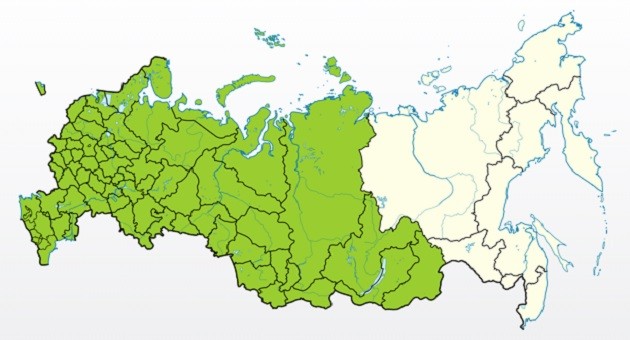
Growing regions
- Some northern regions.
- Ural.
- Siberia.
- North Caucasus.
- Crimea.
- Middle zone.
Origin
This winter columnar apple variety was first developed at the Oryol Experimental Station of the All-Russian Research Institute of Fruit Crops. It was most likely developed through a complex breeding process that involved many different donors: 224-18, the columnar donor SR0523, and the American variety Vazhak, as well as other hybrids. An application for the Sozvezdie variety to be accepted was submitted in 2015, but it has not yet been added to the main list or officially zoned.
Content
Description of the apple tree variety Sozvezdie
 Gardeners in the northern regions of our country have long awaited a columnar tree like Sozvezdie. It easily tolerates even the most severe frosts, produces abundant fruit annually, and requires little attention or care. The trees of this variety are compact, don't take up much garden space, and are short, making harvesting easy.
The fruits grow quite large, tasty, and attractive, storing well over the winter. This apple tree is recommended for private gardens and small fruit farms due to its short fruiting period.
Apples: What they look like
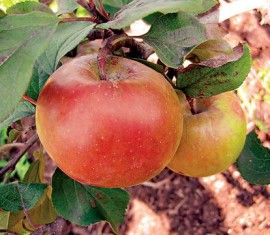
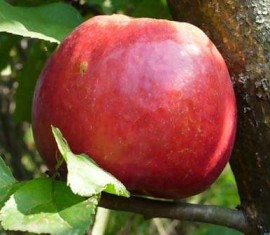
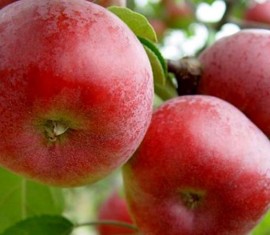
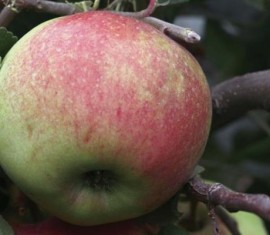
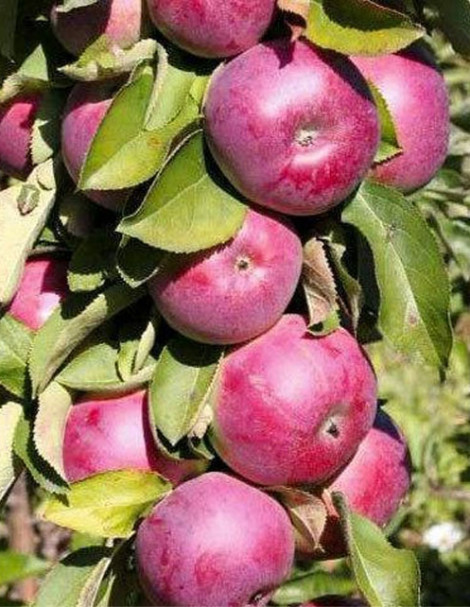
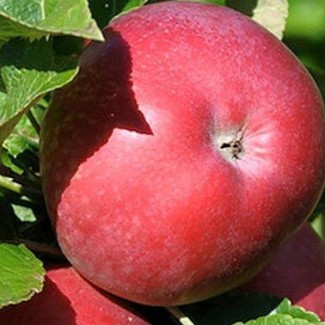
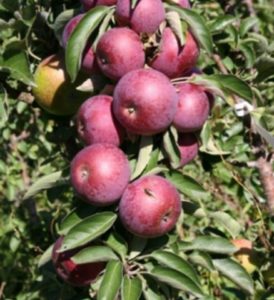 Most often, the tree's fruits are medium or slightly larger in size. They weigh approximately 120-140 grams, but in some cases can reach as much as 150-180 grams. However, this requires good care and favorable weather and climate conditions. They are round, smooth, and generally uniform in size, spherical, but can be slightly flattened. Ribbing is barely noticeable, but a seam is often visible on the side.
The skin is dense, glossy, shiny, fairly strong and elastic, but not very thick. It has a characteristic greenish or greenish-yellow color that is very difficult to discern. The underlying hue is usually hidden beneath a very dense, dark red or beetroot-colored blush, sometimes with a slight purple tint. By the time it ripens, it develops a dense waxy coating, giving the apples a bluish-gray appearance. Subcutaneous dots are small, light-colored, and clearly visible against the dark surface of the fruit. The chemical composition is typically assessed based on the following parameters:
- P-active substances – 295 milligrams.
- Ascorbic acid (vitamin C) – 11.8 grams.
- Sugar (fructose) – 13.7%.
- Titratable acids – 0.68%.
- Pectins (fiber) – 11.4%.
The flesh has a distinctive, slightly greenish or creamy green hue. It is fine-grained, fairly dense, prickly, crisp, and extremely juicy, with a spicy, unusual, saffron-like aroma. The flavor is considered balanced, harmonious, sweet and sour, with a slight hint of wine. Experts give the fruit 4.3 out of 5 stars for taste and appearance.
Apple tree Constellation: characteristics
Crown and root system
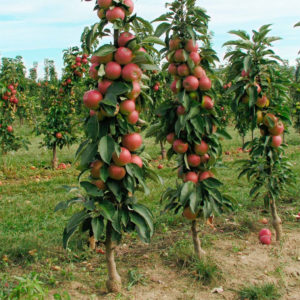 This is a classic columnar tree that grows as a single trunk. The maximum height of such a tree is 2.2-2.5 meters.In some cases, it can grow slightly larger, but this is considered an anomaly. The crown is compact, with a radius of only 25-35 centimeters. Fruiting occurs on the rings and fruiting twigs that grow directly from the trunk. The bark on the trunk is usually brown or greenish-brown, and sometimes brown, and may be slightly pubescent.
The leaves are medium-sized, dark green or just green, very dense, leathery, and glossy. They are elongated, with a long, pointed tip, a serrate-crenate, heavily serrated and wavy margin, and coarse ribbing. The root system is medium-deep, fibrous, robust, and highly branched.
Productivity and pollination
As a columnar tree, the apple tree produces very attractive crops, making it a welcome guest in almost any garden.
In a single season, the winter-ripening columnar apple tree Sozvezdie typically yields no more than 5-7 kilograms of fragrant, delicious fruit. However, with proper care and growing conditions, timely fertilizing and watering, some experienced gardeners achieve yields of up to 15-17 kilograms..
The tree is completely self-fertile, requiring no other varieties to produce fruit. However, those in the know claim that the presence of suitable pollinators nearby will double the yield, which is a significant increase. During flowering, mobile apiaries can be brought into the garden and the trees can be sprayed with sugar or honey syrup.
Winter hardiness and disease resistance
It's this remarkable winter hardiness that has made this variety so popular on the market. It easily withstands the harshest Siberian cold with proper shelter and winterization. Even frosts down to -37-42°C won't harm the apple trees if everything is done correctly. Therefore, they can be grown in Siberia and even sometimes in the Far East.
The Constellation shows good resistance to a wide variety of diseases. Scab Powdery mildew and powdery mildew can affect trees during the most severe epidemics, but usually only the leaves are affected. The fruit is still perfectly edible. Insects can damage the tree, so preventative measures with insecticides, as well as fungicides, are essential.
Rootstocks and subspecies
There's no official information about the Sozvezdie apple tree's subspecies. However, it can be grown on various rootstocks, imparting some unique characteristics to the variety. For example, dwarf and semi-dwarf varieties will produce larger fruits, but their winter hardiness will be reduced.
Features of growing Constellation
 Landing
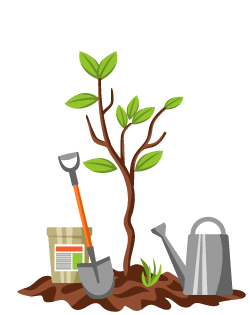 Landing
Basic conditions
- Like any other fruit tree, apple trees should be planted in sunny areas. In the shade, the variety will still produce a harvest, but it will be meager, and the fruits will be small and sour.
- The Constellation dislikes strong drafts, but is unlikely to tolerate a lack of ventilation either. The crowns need to be well ventilated in summer and adequately protected from drafts in winter, otherwise bud freezing is inevitable. Plantings can be arranged under the protection of taller plants, the walls of buildings and structures, or high hedges and fences.
- It's not customary to plant trees where groundwater is close to the surface, as this can cause root rot. Growing apple trees near rivers, ponds, lakes, and springs is also not recommended. It's not a good idea to plant a garden in a floodplain meadow, a lowland, or a swamp.
- Experienced gardeners prefer to prepare planting holes specifically for the season ahead, but this isn't necessary for this variety. Simply dig holes 70 centimeters deep and 80-90 centimeters in diameter, fill them with fertilizer, add drainage if needed, and water them (30-45 liters) approximately 2-3 weeks in advance.
- Special metal, wood, or plastic strips are immediately inserted into the holes. I tie the seedlings to them after planting to prevent wind damage and to facilitate winter shelter. Columns like the Constellation can never be removed from their supports.
- Leave at least 50-60 centimeters between holes, and at least 1 meter between rows or between other plants. This will prevent future conflicts between trees.
- Root collar The tree's rootstock should always be left above the soil horizon. If you deepen it, the roots will grow higher, and the rootstock's properties will be lost.
- Place the seedling upright and cover it with soil in layers, compacting it by hand without packing it too hard. After this, water the trees with 35-40 liters of water, and mulch the surface to retain moisture.
Landing dates
Constellation trees can be planted either in spring or late fall, once the sap has stopped flowing in the trunks and the leaves have completely fallen. In spring, a good time is late April or May, and in autumn, no earlier than late September, but no later than 2-4 weeks before the first frost. All trees with closed root systems (in bags, pots, or containers that don't require additional disposal) can be transplanted into open ground at any time during the growing season.
Tree care
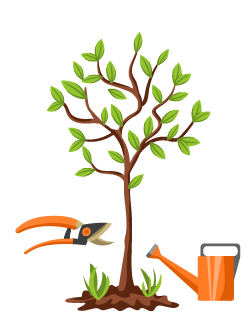 Tree care
Protection from frost and pests
Despite the variety's exceptional frost resistance, it still needs to be covered for the winter. First, the tree needs to be properly prepared, which means stopping watering no later than the end of September. Otherwise, the sap flow in the trunks may not stop in time. Next, cover the root zone with spruce branches, bundles of dry grass or straw, and leaves. The trunks are wrapped in burlap, old nylon tights, roofing felt, or roofing felt. The tree's compact size allows for a tent-like shelter, which can easily be constructed from film or tarpaulin.
It repels insects well. whitewash Lime the trunks to about half their height, which will prevent them from settling in the bark crevices for the winter. To prevent rodents from damaging the trees, they are generously coated with grease, drying oil, rendered animal fat, or any other pungent-smelling substances.
Loosening the soil, watering: proper agricultural technology
Digging around the trunk will require extreme caution, as part of the rhizome is located close to the surface. However, this will need to be done at least twice a year, while also removing weeds, root suckers, shoots from various plants, and other unwanted debris. It's advisable to hoe much more frequently, ideally after each watering. This will prevent the soil from compacting into a tight ball when added moisture.
You'll need to water frequently, but not excessively. The key is to avoid overdoing it. Ideally, follow the ten-day rule. That is, apply water only if there has been no natural precipitation for ten days. After rain, heavy rain, or even hail, wait another ten days before watering again. If possible, it's advisable to use drip irrigation or overhead sprinklers.
Pruning: simple crown shaping
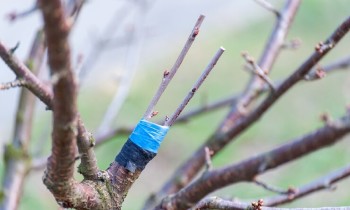
The tree grows as a single trunk, rarely producing lateral skeletal shoots. These should be immediately pruned, and the wounds sealed with garden pitch. However, they appear extremely rarely, primarily when the terminal bud freezes. The recommended procedure is to cut the lateral shoots down to the second bud and grow a new apex.
Sanitary pruning usually involves only removing dead twigs and shoots that have already "fulfilled" their purpose. They will no longer bear fruit, so you can safely remove them. No rejuvenation is required; you simply won't have time. The tree's active fruiting period is 10-12 years. After this period, the apple tree will need to be uprooted and replaced with a new one.
If you plan your planting and harvesting schedule correctly, you can ensure a smooth fruiting process for your Constellation, even in the smallest of spaces.
Pollinator varieties
- Vazhak.
- Triumph.
- Jonathan.
- Ostankino.
- Gala.
- Korobovka.
- Chervonets.
- Borovinka.
- Gin.
Reproduction
- Rooting.
- Kidney grafting.
- Growing from seeds.
- Cuttings.
Diseases and pests
- Black crayfish.
- Powdery mildew.
- Bacterial burn.
- Scab.
- Green aphid.
- Codling moth.
- Leaf roller.
- Hawthorn.
Ripening and fruiting of the Constellation
The beginning of fruiting
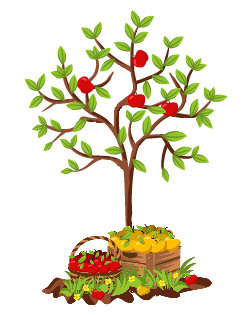 The tree is considered a precocious fruiterer, like most other columnar trees. Flowers can be seen on it already in the first year in the nursery, but it's best to pluck them immediately so the apple tree has time to adapt to the new conditions and develop branches and rhizomes. Officially, fruiting begins between the 2nd and 4th years, when it's possible to harvest approximately 1-3 kilograms of aromatic fruit suitable for any purpose.
Flowering time
The Sozvezdie variety is considered a late autumn or winter apple tree, so its flowering often begins later than that of most apple trees. Buds appear on the tree only in the second half of March, and they may not open until the end of the month or even early June. This variety blooms beautifully, its entire trunk covered in large, snow-white flowers, with massive, cup-shaped blossoms gathered in clusters of several.
They have a mild but pleasant spicy scent, and the tree looks very decorative and attractive at this time. The process lasts approximately 14-18 days, but much depends on weather conditions. The cooler the winter, the longer the bloom will last, but the flowers may not be as abundant.
Fruiting and growth
The tree is fast-growing, capable of reaching 45-60 centimeters in a single season, quickly reaching its natural maximum height. It also increases its fruit production very quickly. By the fifth to seventh year, a full harvest of up to 12-15 kilograms of fruit can be achieved. A short lifespan is considered a drawback of this variety, but for a true apple lover, this is only a temporary obstacle.
The fragrant fruits ripen in late September, and sometimes even in October, right up until mid-September. They cling tightly to the twigs, so they're unlikely to fall to the ground, so there's no need to rush harvesting. When ripe, they develop a very thick, bluish-gray waxy coating, signaling the time to pick and store them. They have a long shelf life, retaining all their qualities until the following summer, and sometimes even until the next harvest. Although they're also suitable for processing, they're juicy and delicious.
Top dressing
- Peat.
- Compost.
- Ammonium nitrate.
- Humus.
- Superphosphate.
- Manure.
- Mineral complexes.
What to do if it doesn't bloom or bear fruit
- Check for pests or diseases.
- Transplant into the sun.
- Water.
- Fertilize.
Why do apples fall?
- Wind, hail, hurricane, rain.
- Pest damage.
- Diseases.
Please leave your feedback on the Sozvezdie variety, as many gardeners would like to grow similar ones in their gardens.