Apple tree Yubiley Moskvy: characteristics of the variety and care
| Color | Reds |
|---|---|
| Ripening season | Winter |
| Size of apples | Average |
| Taste | Sweet and sour |
| Crown type | Average tree height |
| Shelf life | High shelf life |
| Application | Universal variety |
| Winter hardiness | High winter hardiness |
| Fruiting age | From 5 years old |
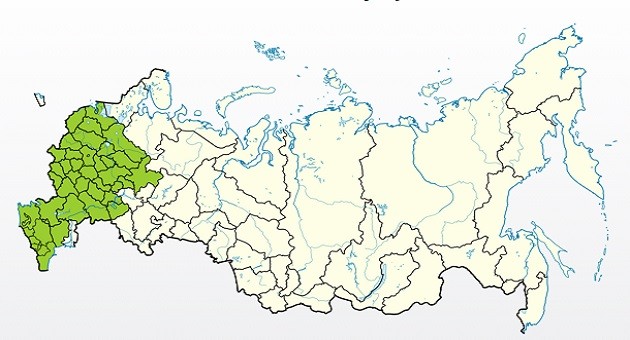 History of origin and regions of growth
Growing regions
- Oryol region.
- Moscow region.
- Middle zone.
- Kursk region.
- Tambov region.
- North Caucasus.
- Lipetsk region.
- Voronezh region.
- Leningrad region.
Origin
The variety was experimentally sown at the Oryol Experimental Station (Zhilina village) of the Federal State Budgetary Scientific Institution "All-Russian Research Institute of Fruit Crop Breeding" in 1982. The authors were eminent biologists and pomologists Vladilen Vasilyevich Zhdanov, Zoya Mikhailovna Serova, Evgeny Alekseevich Dolmatov, and Evgeny Nikolaevich Sedov. The apple tree, beautifully named Yubiley Moskvy, was obtained through open pollination of the hybrid 814.
The new seedling first bore fruit in 1991. By 1996, an application had been submitted, the tree was sent for official variety testing, and was classified as an elite variety. A year later, the apple tree was approved for cultivation in the Central Black Earth Region. Official zoning and inclusion in the State Register of Breeding Achievements only occurred in 2002. Since then, the apple tree has been actively grown throughout the central part of the Russian Federation, and slightly further south and north.
Content
Description of the Yubiley Moskvy variety
 This new apple tree is attracting the attention of gardeners for several reasons. First, it possesses strong genetic immunity to scab, as it contains the Vf gene. Second, it is compact, taking up little space in the garden. Third, it is quite environmentally friendly and can be grown even in the most polluted areas, within the city limits, making it attractive to gardeners in Moscow, St. Petersburg, and other metropolitan areas.
The Yubiley Moskvy apples are medium-sized, yet very attractive in appearance, and have high marketability. They are easy to transport, difficult to damage, and ripen late, but can be stored until March or even later. This apple tree is recommended for cultivation in small garden plots and in commercial orchards.
Apples: What do they look like?
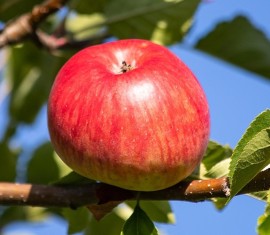
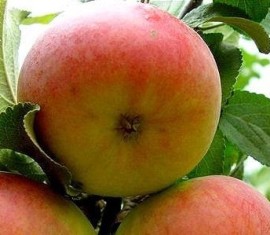
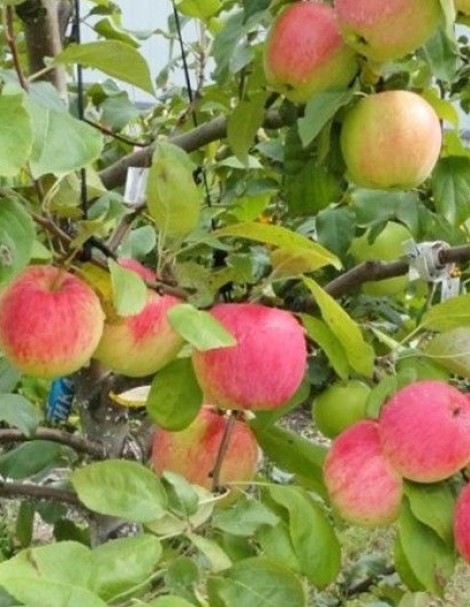
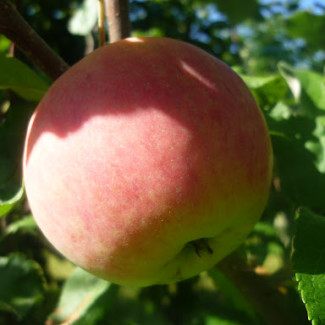
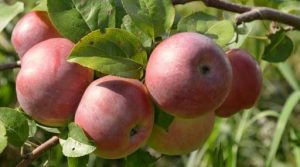 The fruits are medium-sized, but sometimes slightly larger. Their weight typically ranges from 140-180 grams maximum. Their shape is typically round or round-elongated, oblong-conical, cylindrical, or even sometimes turnip-shaped. They are generally uniform and symmetrical, but sometimes slanted to one side. There is no lateral seam; the wide ribs, although smoothed, are clearly visible.
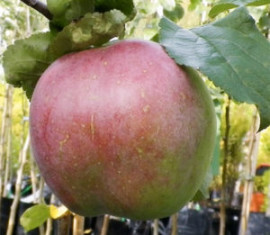
The apple skin is medium-thick and dense, glossy, smooth, and shiny. When fully ripe, it becomes covered with an oily, waxy, almost colorless coating, giving it a greasy appearance. Initially, the base color is yellow-green, becoming golden or golden-yellow over time. The underlying blush is dense, occupying approximately 65-90% of the surface. It is crimson, red-crimson, and can be pinkish, striped, speckled, or even with a uniform, mottled, diffuse undertone. Subcutaneous punctures are numerous; they are gray and very visible. The chemical composition is recommended to be assessed based on the following data:
- P-active substances (catechins) – 388 milligrams.
- Ascorbic acid (vitamin C) – 6.9 milligrams.
- Fructose (total sugars) – 8.7%.
- Pectins – 10.1%.
- Titratable acids – 0.63%.
The Yubiley has very dense, very juicy flesh with a pleasant, slightly spicy aroma. It consists of large grains, is prickly, crisp, and easily broken apart. It has a greenish or creamy-greenish hue, and can be slightly lemony. Professionals give it a tasting score of 4.3-4.4 on a 5-point scale.
Apple tree Yubiley Moskvy: characteristics
Crown and root system
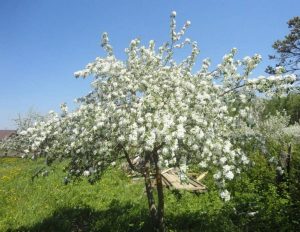 The trees are fast-growing, with a medium-sized, compact, neat crown. The maximum height of the apple tree without pruning is approximately 4.5-5.5 meters. The crown is not very dense, and the foliage is good. The branches are set at an angle of approximately 90° from the central core; they are rounded in cross-section, long, geniculate, and can be slightly curved, as if arched, and covered with gray or grayish-brown bark. The variety bears fruit on both complex and simple ring-shaped branches.
The leaves are medium-sized or large, elongated, oval, and sometimes ovate. They are wrinkled, short-pointed, and highly glossy, with a serrate-crenate, finely serrated margin and coarse nervation. The root system is medium-deep, predominantly fibrous, and highly branched, with numerous small branches running close to the surface.
Productivity and pollination
The degree of fertility of Jubilee largely depends on the region of cultivation, correctness and timeliness of care.
In a single season, a mature tree can yield up to 200-220 kilograms of fragrant, beautiful fruit. Thrifty growers can sometimes increase this figure to 220-250 kilograms..
The Yubiley Moskvy variety is considered conditionally self-fertile. This means that some fruit will be produced even if there is no other apple tree nearby. However, you shouldn't expect more than 35-40% of the potential fruit yield. Therefore, trees should be planted interspersed with other trees, no further than 45-90 meters away.
Winter hardiness and disease resistance
Any variety that can survive and bear fruit in difficult conditions conditions of the Moscow region and the Leningrad Region, can be considered frost-resistant by default. If the temperature in the region does not drop below -28-32°C for more than a week or two, there is nothing to worry about. When frozen in special chambers during variety testing, seedlings received a damage rating of 3.5 at -40°C, but did not die and were able to fully recover over several years.
Genetic resistance to scab is a significant advantage for many gardeners living in conditions of regularly high humidity. However, this apple tree is susceptible to other diseases, albeit infrequently, and regularly suffers from parasites. Therefore, it's best to carry out preventative treatments promptly.
Rootstocks and subspecies
No subspecies of this variety are known yet, so be wary of purchasing from sellers offering dwarf or columnar varieties. Yubiley is grown on various rootstocks, imparting some of the apple tree's characteristics, which have virtually no effect on the quality of the fruit.
Growing Jubilee of Moscow
 Landing
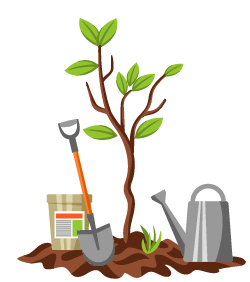 Landing
Basic conditions
- For this variety, you need to choose a very sunny location, without shade, otherwise the trees may die in the first year after planting.
- Good ventilation is desirable, but no drafts. In strong winds, apple trees often become ill, become weak, and sometimes refuse to bloom or produce fruit.
- Any soil is suitable, except for those that are excessively acidic and salty. Sandy loam, black soil, loam, podzolic forest soils, and other soils—Yubiley will thrive in all of these, with timely and proper care.
- The groundwater level should be no higher than 2-2.2 meters, as the apple tree's roots can reach it and rot. If there's no other place, simply bury a sheet of slate or another barrier at a depth of 1.5-2 meters.
- It's recommended to leave about 3-3.4 meters between plants, and up to 4.5-5 meters between rows. This will significantly simplify future maintenance.
- Dig the holes in advance, the season before planting the apple trees. They should be approximately 75-80 centimeters deep and up to 1 meter in diameter. Add soil and fertilizer to the bottom, a 10-15 centimeter drainage layer, and fill with water (45-60 liters).
- The root collar (the grafting site) is always left above the surface, otherwise none of the rootstock's properties will be preserved.
- Place the tree upright, carefully spreading the roots, covering them with soil, and tamping them down with your feet, but not too hard. Water the tree with 45-50 liters of water, and mulch the surface.
Landing dates
Young Yubiley Moskvy saplings cannot tolerate severe frosts and dislike high humidity and sudden temperature fluctuations. Therefore, it is preferable to plant them in the spring, after the soil has warmed up completely. A good time is around late March or early April; it's important that the buds have not yet begun to open. With their root system closed, apple trees can be transplanted into the soil at any time during the growing season; they take root very well.
Tree care
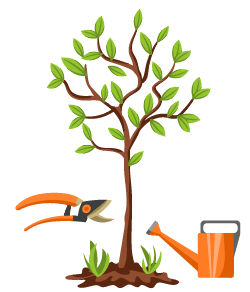 Tree care
Protection from frost and pests
Young trees can be wrapped in a tent-like fashion, from rootstock to tip, with burlap, agrofibre, or even tarpaulin. For older trees, simply wrapping the trunk with suitable materials is sufficient, but you can also pile spruce branches, soil, well-dried straw, leaves, or hay onto the root zone.
An annual brushing of the trunk with a stiff brush effectively eliminates insects, removing their likely nesting sites in the bark crevices. To prevent mice, hares, hamsters, and other rodents from eating the bark or branches, you can coat the trunks with a thick layer of lard, grease, or fuel oil.
Loosening the soil, watering: proper agricultural technology
Apple trees need to be dug up twice a year to ensure the soil is loose and oxygenated. You can also hoe the soil in the summer, for example, the day after each watering. This will prevent the soil from compacting into a solid, hard lump, and will allow oxygen to reach the roots. Over the years, around the fifth to eighth season, you can cover the root zone with sod to make this task easier.
After planting, the anniversary is needed water Frequently, at least once every 10-12 days. As the plant grows, you can reduce the frequency to 1-2 applications per month as needed. Add fertilizers and other nutrients with the water so they are better absorbed. If possible, it's a good idea to set up drip irrigation or sprinkler irrigation.
Pruning: simple crown shaping
Almost all apple trees thrive in a sparse, tiered crown, and the Yubiley is no exception. However, the tree is quite flexible and can be shaped into anything from a bowl to a cordon. It's best to begin shaping it in the first year, removing one-third of the central core and leaving no more than 3-5 skeletal branches.
Sanitary pruning should be done not only every fall but also in the spring. This involves removing all damaged, diseased, dry, excess, cracked, and pest- or fungal-infested shoots. Also, immediately prune any shoots that grow vertically and those that grow inward, crowding the crown.
Pollinator varieties
- Cliff.
- Stroevskoe.
- Korobovka.
- Antonovka.
- Fetch.
- Gala.
- Borovinka.
- In memory of the Yesaul.
- Elstar.
Reproduction
- Grafting cuttings.
- Clones.
- Growing from seeds.
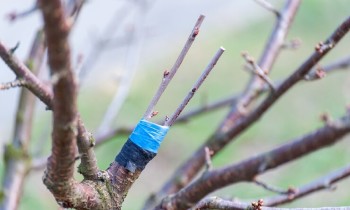
- Kidney grafting.
- Layers.
Diseases and pests
- Monililosis.
- Powdery mildew.
- Spotting.
- Rust.
- Cytosporosis.
- Copperhead.
- Flower beetle.
- Weevil.
- Codling moth.
- Hawthorn.
Ripening and fruiting of the Moscow Jubilee
The beginning of fruiting
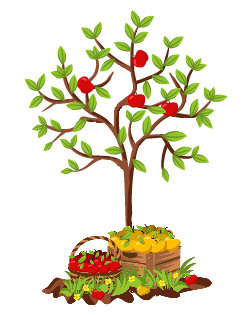 The beginning of fruiting
This variety can't be called early-bearing. The first fruits can be picked from the tree no earlier than 7-8 years after its birth. However, flowers can be found earlier. Starting in the 3-4th year, the tree typically produces only barren flowers, so it's best to pluck them immediately, preventing them from drawing excess sap while the tree develops its crown and rhizome. The first harvest will only yield 5-8 kilograms of fruit, but that's still not bad.
Flowering time
The mid-season blooming of the buds makes it easy to find pollinators for this variety. They appear on the tree as early as early May, with a distinct pink hue. However, after blooming, they transform into large, slightly pinkish, but mostly pure white, saucer-shaped flowers. Their petals are fleshy and delicate, and the flowers themselves have a powerful fragrance, which actively attracts a variety of pollinating insects.
Fruiting and growth
The tree grows quite quickly, producing approximately 35-50 centimeters of branches per season. Therefore, it can reach its maximum height in just a few years. Growth accelerates before the fruit begins to ripen, but then slows slightly. Fruitfulness increases gradually, adding several kilograms per year. A full crop can be expected no earlier than 12-14 years, when it reaches its peak. The apple tree's lifespan is still unknown, but it is expected to produce fruit for 55-75 years.
Technical (harvestable) maturity doesn't occur until the second half of September. At that point, apples should be picked from the tree before they become overripe, otherwise their shelf life will be significantly reduced, although they'll likely not fall to the ground. However, consumer maturity doesn't occur until October, when the sugars in the fruit have fully caramelized and they'll be at their most delicious. They can be transported easily, even over long distances, and stored in a cellar or special storage facility. refrigerator until spring.
Top dressing
- Nitrogen fertilizers.
- Superphosphate.
- Ammonium nitrate.
- Manure.
- Compost.
- Humus.
- Chicken, pigeon droppings.
- Urea.
- Minerals.
What to do if it doesn't bloom or bear fruit
- Believe in parasites.
- Check for any diseases.
- Increase watering.
- Feed.
- Transplant.
Why do apples fall?
- Wind, hail, hurricane, frost, snow.
- Parasitic lesions.
- They are very overripe.
Share your own experience with the Yubiley Moskvy apple tree variety so that any gardener can learn about it before planting and achieve maximum results.