Makovetsky apple tree: characteristics of the variety and care
| Color | Reds |
|---|---|
| Ripening season | Autumn |
| Size of apples | Small ones |
| Taste | Sweet and sour |
| Crown type | Average tree height |
| Shelf life | Low shelf life , Ornamental tree |
| Application | For recycling |
| Winter hardiness | High winter hardiness |
| Fruiting age | Up to 5 years |
 History of origin and regions of growth
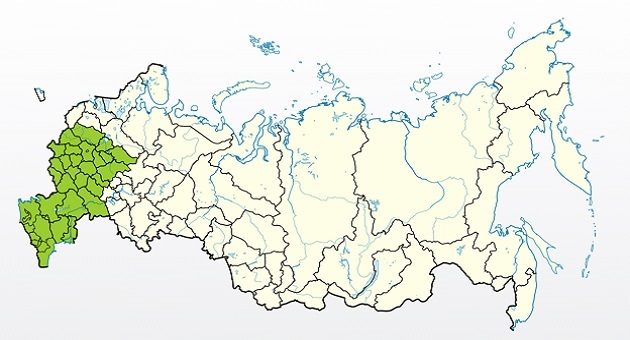
Growing regions
- Middle zone.
- Moscow region.
- Leningrad region.
- North Caucasus.
- Central Black Earth Region.
- Crimea.
- Volga region.
Origin
Most ornamental varieties are based on the famous Niedzwiecki apple tree, and this one is no exception. Reliable information in official sources is scarce, and the variety's history is rather obscure. It is known that Polish pomologist and breeder Anton Wroblewski, while studying hybrid seedlings obtained from open pollination, selected several specimens that he liked best.
This occurred at the Kornik Arboretum station sometime in the mid-1920s or early 1930s. It was he who named the new seedling after the renowned Polish scientist Stefan Makovetsky, who lived in the late nineteenth century in the Khmelnytsky region of modern-day Ukraine. Makovetsky's apple tree quickly spread throughout the world due to its beautiful appearance and the complete edibility of its fruit. The variety is not listed in the State Register of Breeding Achievements and has no official regionalization.
Content
Description of the Makovetsky variety
 Landscape designers immediately fell in love with this apple tree. It's low-maintenance, doesn't require any special fertilizers or frequent watering, and is resistant to low temperatures and intense summer heat. It grows equally well in remote gardens and in the highly polluted conditions of modern cities. The tree's appearance is very attractive not only during flowering but also at other times of the year.
Makovetsky's abundant fruit is a beautiful sight. They hang from the branches in picturesque clusters and may not fall until spring. Moreover, the apples are also quite edible. They are eaten fresh, made into compotes, dried candied, and used to make preserves and jams. This variety is recommended for ornamental planting and can be used to create improvised bonsai, picturesque arches, hedges, and espaliers.
Apples: What do they look like?
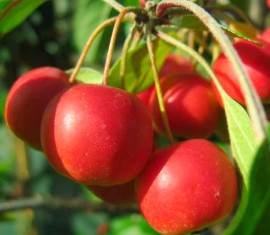
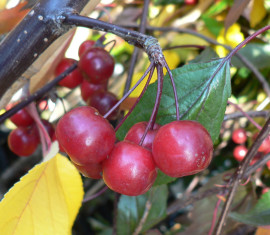
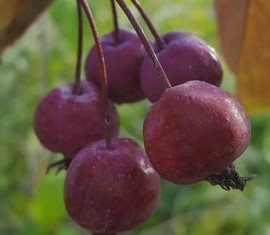
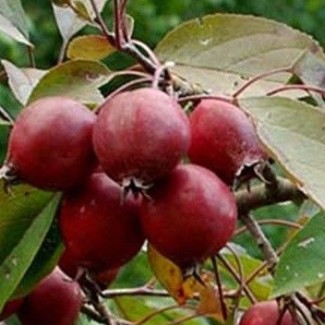
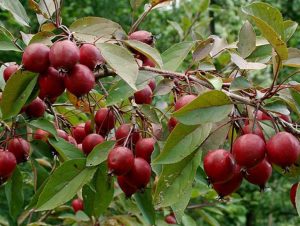 The fruits are small to very small, with a diameter of 0.5-3 centimeters, sometimes up to 5. They can grow to weigh 4-15 grams, sometimes reaching 25-35. The apples are generally medium to below average in size, symmetrical, round, but more often round-elongated, oblong, or slightly cylindrical. They are smooth, with slight ribbing and smoothed stems, red in color, long and thin.
The skin is dense, sometimes even hard, thick, elastic, and durable. It is smooth and shiny, and may develop a dense waxy coating during ripening. Its primary hue is yellow or yellow-green, but this is completely hidden by the deep blush. This gives apples their red, maroon, beetroot, or purple appearance. Subcutaneous spots are dark gray or grayish-green, almost invisible, small, and few in number. The chemical composition is characterized by the following list of data:
- P-active substances (catechins) – 112 milligrams.
- Ascorbic acid (vitamin C) – 11.1 milligrams.
- Fructose (total sugars) – 7.2%.
- Pectins – 12.4%.
- Titratable acids – 1.1%.
The flesh is initially dense, fine-grained, and quite juicy. After the first frost, it can become greasy, slightly bitter, and unpleasant. The basic flavor is tart and sour, with a slight hint of sweetness, astringent, and not to everyone's taste. There is no official tasting rating.
Makovetsky apple tree: characteristics
Crown and root system
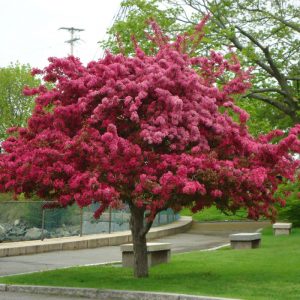 The trees of this variety are medium-sized and fast-growing. They can reach a maximum height of 4.5-6 meters without any formative pruning.The crown is broadly oval, spreading, and over the years becomes drooping and even weeping. Branches are straight or curved, can be geniculate, medium-thick, and rounded in cross-section. They are set at or near a right angle to the trunk, covered in reddish-brown or reddish-brown bark, and bear mixed fruit.
The leaves are small, oval, slightly elongated, short-pointed, leathery, glossy, and highly shiny. The margins are predominantly serrated, sharply serrated, crenate, and flat, and may fold slightly into a boat shape. Young leaflets are usually a bright red; by midsummer, they acquire a burgundy-red or dark red hue, and by autumn, they may turn orange-red or even yellow-orange. The root system is medium-deep or deep, fibrous or taproot on wild trees, and is well adapted to seeking moisture.
Productivity and pollination
It's not customary to discuss the yield of ornamental apple trees, as they aren't grown for their fruit. However, some information can be gleaned from what gardeners say.
In a good year, a single Makovetsky tree can yield approximately 25-50 kilograms of small, tart fruits. There is no consistent pattern in fruiting, but yields can fluctuate slightly from year to year, depending on climate and weather..
The tree is completely self-fertile and requires no external pollinators to produce fruit. The Makovetsky variety itself is a high-quality, inexpensive pollinator for many varieties with suitable flowering times. Therefore, it is often used as a pollinator in intensive commercial orchards.
Winter hardiness and disease resistance
Ornamental apple trees, descendants of the Nedzvetsky variety, have outstanding cold tolerance. This variety easily survives harsh winters, when temperatures drop to -32-34°C for extended periods. If no more severe frost is expected, no special measures are required. The trunks are wrapped in burlap, spruce branches are placed around the roots, the soil is raked, and covered with straw or hay. In the coldest regions, it is permissible to wrap the trees in balls.
The trees have average resistance to bacterial and fungal diseases. Prevention and timely treatment with industrial pesticides will certainly not harm them. It's also worth spraying the apple trees against insect pests. Scab It attacks trees rarely, but very abundantly, like an avalanche, so it makes sense to be on the safe side.
Rootstocks and subspecies
Ornamental apple trees are grown on a wide variety of rootstocks. They will thrive on almost any. Dwarf and semi-dwarf trees grow more compact, only reaching 2-2.5 meters, but they can also be trained as creeping trees. There are no columnar varieties.
Features of growing Makovetsky
 Landing
 Landing
Basic conditions
- The apple tree thrives in open, sunny areas. However, it will also thrive in shade, won't die, and will delight you with beautiful blossoms and fruit.
- It's best to plant this variety where the groundwater level isn't too high. It will reach the moisture and begin to sprout. If a suitable location isn't available, you can create a decorative mound, a bank, or dig a sheet of slate at a depth of 1.7-2 meters to act as a rhizome cutter, directing it horizontally in different directions.
- Drafts usually don't do much harm to Makovetsky apple trees, but it's still best to choose quiet, secluded corners of the plot.
- Almost any soil is suitable for this variety, but it grows much more actively and quickly in fertile soil.
- Planting holes should be dug no later than 3-4 weeks before this point. They must be allowed to settle, otherwise the rhizomes will be burned by the fertilizer. Dig holes 50-70 centimeters deep and approximately 60-90 centimeters in diameter, add organic matter and minerals to the bottom, cover with drainage material, and add 40-50 liters of water.
- It's a good idea to drive a stake or plank into the hole immediately to tie the young seedlings to. It's best to tie it with natural mailing twine or rope, forming a figure-eight. This will minimize damage to the tree's bark in wind.
- When planting and wanting to preserve the qualities of the rootstock, you need to leave the apple tree grafting site (root collar) above the soil surface by approximately 4-8 centimeters.
- A pile of drainage material is made in the center of the hole. The apple tree is placed on it, spreading its roots, covered with soil, and compacted. Water with 25-40 liters of water. If needed, the soil can be mulched with any suitable material for additional moisture retention.
Landing dates
Like any other variety, ornamental apple trees can be planted in both early spring and late fall. Choose a warm, clear, rain-free day in late March or early April, when the sun has warmed the soil. In autumn, the optimal time is after the leaves have fallen, around late September or early October, sometimes continuing until the end of the month or even early November.
Tree care
 Tree care
Protection from frost and pests
The Makovetsky variety is highly cold-hardy, so it doesn't require any special care. In warm climates, it doesn't need any shelter; watering should be stopped by September. In colder climates, the trunks can be wrapped in burlap or even completely covered, like a tent. Straw, hay, spruce branches, well-dried leaves, or polystyrene foam can be placed on the roots. Remember, all this will need to be removed in early spring before the sap begins to flow.
Apple trees are whitewashed with lime to protect them from insects that nest in the crevices of the bark. The tree can be brushed beforehand, which adds an extra touch of grooming. To prevent hungry rodents from damaging the bark or young shoots during the winter, the trees are generously coated with lard, fuel oil, grease, or old drying oil.
Loosening the soil, watering: proper agricultural technology
The soil around young Makovetsky trees should be tilled twice a year. This is most often done in the spring or fall, either before the sap begins to flow in the trunk or after the growing season has ended. Weeds, basal shoots, and plant offshoots should be removed immediately, but not overly so. Some roots are located close to the surface and it's important not to disturb them. In the summer, you can lightly hoe the soil, for example, on the second day after watering and fertilizing, to prevent it from becoming compacted.
Watering Makovetsky trees are watered as needed, but not excessively. Young seedlings require 2-3 times a month, while mature trees benefit from natural precipitation, plus 3-4 times per season. Watering can be timed to coincide with flowering, fruit set, and ripening. Fertilizers and fertilizers are also commonly applied at this time; they are absorbed much better and faster with water.
Pruning: simple crown shaping
In the first year, remove a third of the central conductor's height and form 2-4 scaffold branches, placing them at different heights. It's important that they are spaced far apart. Later, you can create any shape you like, from a hedge or cordon to a pyramidal or tall, sweeping form. It's entirely possible to create a creeping tree from an ornamental apple tree, but there's little point in doing so, as it's not grown for fruit.
Reproduction
- Growing from seeds.
- Budding.
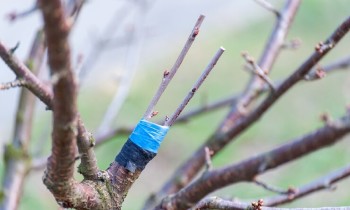
- Kidney grafting.
- Clones.
Diseases and pests
- Powdery mildew.
- Scab.
- Moniliosis.
- Black crayfish.
- Hawthorn.
- Aphid.
- Leaf roller.
Pollinator varieties
- Nedzvetsky.
- Siebold.
- Ola.
- Royalty.
- Antonovka.
- Sargent.
- Chinese.
- Ranetka.
- Borovinka.
Ripening and fruiting of Makovetsky
The beginning of fruiting
 The beginning of fruiting
This is a very early-ripening apple tree, like most ornamental varieties. Flowers can be seen on it already in the first year, followed by small, cute-looking apples. However, the first full harvest is not until the third or fourth year. At that point, approximately 2-5 kilograms of fruit can be harvested from the branches. Many leave them hanging on the branches until spring, as the red spots on the snow-white blanket look very picturesque and unusual. They also provide additional decoration. top dressing for non-migratory birds during the long winter.
Flowering time
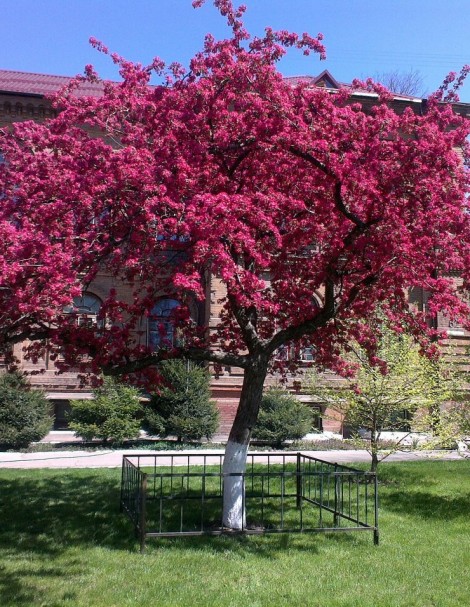
The buds of this variety are very large, burgundy or dark red, sometimes a rich red or beetroot hue. When they open, they transform into large, fragrant, single flowers of a reddish-pink hue. They densely cover the branches, completely concealing them from view. They bloom around mid-May, sometimes a little earlier or later. Moreover, they don't all bloom at once, but in stages, so the process seems to last for 1-1.5 months.
Fruiting and growth
Makovetsky apple trees grow quite rapidly, most rapidly in their youth and then slowing with age. The tree can grow approximately 20-45 centimeters per year, reaching its peak growth by the sixth to ninth year. Gradually, the tree's fruitfulness also increases, but a full harvest will take seven to ten years. By then, the apples are truly abundant.
The fruits ripen as early as September. This is the best time to pick and process them. If they sit on the vines too long, they will lose not only their flavor but also their consistency, making them unusable. Keeping them fresh won't last more than 1-2 weeks, and even then, there's no guarantee they'll stay fresh, bitter, or unpleasant-tasting. Therefore, it's customary to process the harvested fruit immediately, within 1-2 days.
Why do apples fall?
- Weather phenomena.
- Early frosts.
- Pests or diseases.
What to do if it doesn't bloom or bear fruit
- Transplant into the sun.
- Protect from drafts.
- Restrict or activate watering.
- Neutralize pests.
- Cure diseases.
Top dressing
- Manure.
- Compost.
- Humus.
- Superphosphate.
- Chicken manure.
- Mineral and nitrogenous complexes.
- Ammonium nitrate.
Share your own experience with the Makovetsky apple tree variety so that even novice gardeners have no questions about cultivating these trees.