Rudolf apple tree: characteristics of the variety and care
| Color | Reds |
|---|---|
| Ripening season | Autumn |
| Size of apples | Small ones |
| Taste | Sour |
| Crown type | Average tree height |
| Shelf life | Low shelf life |
| Application | For recycling , Ornamental tree |
| Winter hardiness | High winter hardiness |
| Fruiting age | Up to 5 years |
 History of origin and regions of growth
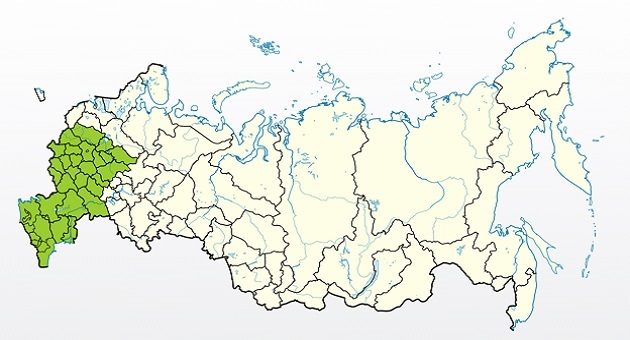
Growing regions
- Middle zone.
- Moscow region.
- Leningrad region.
- North Caucasus.
- Central Black Earth Region.
- Crimea.
- Volga region.
Origin
There are several theories about the origins of the ornamental hybrid apple tree with the beautiful male name Rudolf. It is certain that several varieties were used in its creation, and that it was brought to us from across the ocean – from cold Canada. Many experts say it was first bred in Poland, others say it was bred in Germany, and still others claim it was grown in the United States and named after Santa's famous reindeer.
In the Soviet Union, the apple tree was grown from seed only in the mid-1960s. Rudolf is not listed in the State Register of Breeding Achievements and has no official zoning. It is successfully grown in the temperate climate of the central zone, further south, north, and east. Many gardeners claim the hybrid even grows in the Urals, Siberia, and the Far East.
Description of the Rudolf variety
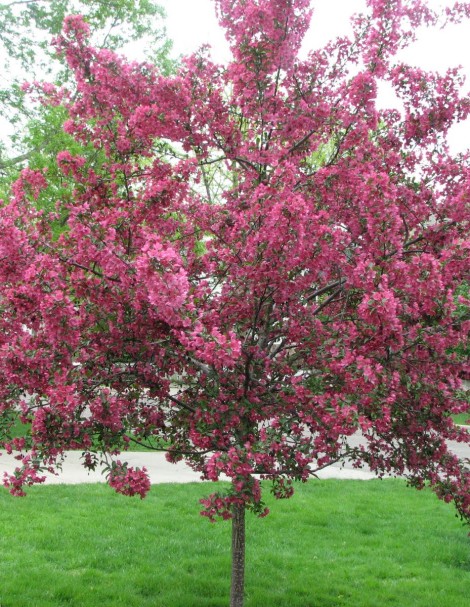
 The apple tree is distinguished by its tall stature and attractive appearance. Its crown is typically pyramidal, but is easily shaped, allowing it to be literally "twisted into ropes." Moreover, it retains its attractiveness throughout the growing season, at various stages. Rudolf is frost-hardy, tolerates sudden temperature fluctuations, from thaws to severe frosts, and is highly environmentally resilient, even withstanding hot, dry periods.
Rudolf produces small, sparse fruits, though I don't grow it for harvesting. Nevertheless, they are attractive, juicy, slightly tart, but perfectly edible. They're perfect for decorating garden plots, large and small parks, recreation areas, squares, and home gardens.
Apples: What do they look like?
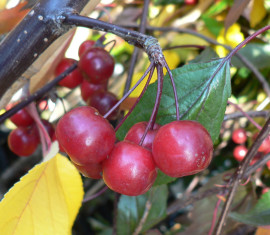
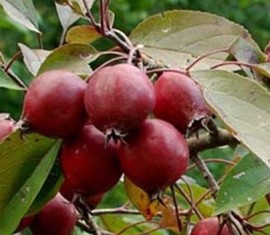
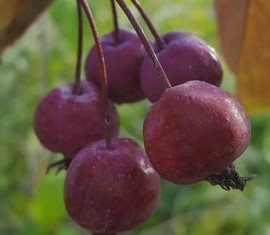
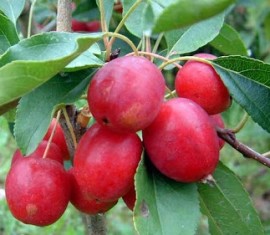
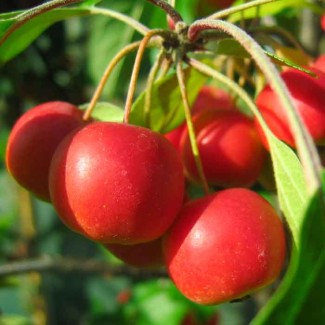
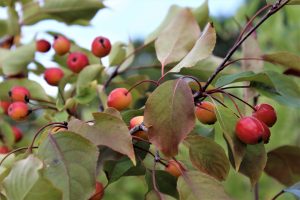 The fruits are small to very small. They barely reach a weight of 5-15 grams with a diameter of 1-2.5 centimeters. The apples are round in shape, but can be slightly elongated, almost cylindrical, or flattened. They are smooth, with barely noticeable ribbing, highly glossy and shiny, and have no waxy or oily coating.
The fruit skin is dense, somewhat thick, strong, and elastic. Its base color is yellow or honey-yellow, sometimes slightly lemon-colored. The blush can cover 45-85% of the surface. It is dense, vaguely mottled, and densely envelops the fruit, with a red, carmine-red, or bright red hue, sometimes appearing red-orange. Subcutaneous spots are medium gray, small and few in number, and virtually invisible. Assessing the chemical composition is easy, based on a few indicators:
- P-active substances (catechins) – 101 milligrams.
- Ascorbic acid (vitamin C) – 4.6 milligrams.
- Fructose (total sugars) – 3.8%.
- Pectins – 9.2%.
- Titratable acids – 0.79%.
Rudolf apples have fairly firm flesh, fine-grained and dense, difficult to bite into, not brittle, but crisp and firm. It's moderately juicy, not completely dry or cottony, but it's not exactly juicy either. The apples' flavor is, as they say, an acquired taste. They are astringent, tart, piquant, spicy, and more on the sour side, but with a slight aftertaste that leans toward sweetness. These apples have not been officially rated, as they haven't been tested.
Rudolf apple tree: characteristics
Crown and root system
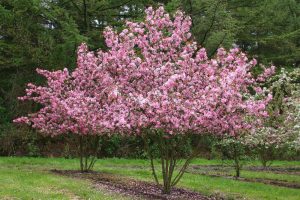 Trees of this variety are quite tall, even considered tall. These apple trees easily reach 5.5-6.3 meters without formal pruning. However, they are usually limited to 3-4 meters to enhance the appearance of the site. The crown is rounded or oval, and can be pyramidal, broadly oval, or even spreading, weeping, or drooping. It all depends on the desire and skill of the gardener performing the pruning. Branches are moderately dense, with good foliage, extending from the trunk at right angles, pointing upward, and covered with glossy, smooth, pubescent bark of a reddish-brown, brownish, or reddish-brown color.
The leaves are medium-sized, elliptical, dense, leathery, glossy, and shiny. They are dark green, sometimes emerald, and turn reddish or red-orange in autumn, giving the apple trees a distinctive, picturesque appearance. The root system is robust, deeply rooted, and predominantly fibrous, but can also be taproot. It is extensively branched and well adapted to seeking water in the soil.
Productivity and pollination
Large, six-meter-tall apple trees cannot be considered productive. They don't meet any of the criteria for non-ornamental varieties.
One mature, large tree trunk can produce approximately 5-6 kilograms of small, yet beautiful fruits during the growing season. Moreover, the fruiting yield is not affected by weather, proper care, or regular fertilizing..
Pollinators won't hurt Rudolf, but they won't bring much benefit either. The apple tree blooms for a very long time, so finding suitable apple trees won't be difficult at all. Ideally, the variety itself should serve as a pollinator.
Winter hardiness and disease resistance
The variety's resistance to low temperatures makes it a favorite in virtually any garden across our vast country. It easily tolerates temperatures as low as -29°C to -34°C without sustaining significant damage, even if the temperatures last for more than two or three weeks. If the trees do freeze, the damaged branches are pruned, and recovery is short-lived. Rudolf is also generally drought-tolerant, so it doesn't require frequent watering.
The variety has no natural immunity to disease, so preventative treatments will need to be carried out regularly. Care must be taken to avoid excessive humidity, as this encourages fungal growth. Parasitic threats to the apple tree are also quite real, and spraying against them should be done promptly.
Rootstocks and subspecies
These pliable trees can be grown on a wide variety of rootstocks. However, to make them a little shorter and more compact, it's worth choosing dwarf and semi-dwarf varieties. This doesn't affect the cultivar's ornamental appearance much, but the standard height barely reaches 2-2.8 meters, with a crown diameter of 2-2.5 meters, significantly saving space in a garden or park. There are no columnar or creeping Rudolf varieties.
Features of growing Rudolf
 Landing
 Landing
Basic conditions
- This variety prefers open, sunny spaces. It grows in the shade, but its decorative qualities are significantly inferior to those varieties that bask in ultraviolet rays. Its branches become thin and sparsely spaced, as are the leaves. The tree blooms selectively, producing few buds.
- Drafts don't significantly affect the growth of this variety, but it prefers fresh, unstained air. Blowing winds can occasionally lead to additional disease, so it's best to choose a well-ventilated, draft-free location.
- The depth of the groundwater table can play a major role in successful cultivation. If it's too close, the apple tree's rootstock will inevitably rot. For the same reason, Rudolf should not be planted directly near bodies of water, ponds, rivers, lakes, or shallow wells. If there's no other place, you'll have to build a mound and plant the tree on an artificial hill.
- There should be a 3-4 meter gap between trees in rows, and 4-5 meters between rows. However, since these apple trees are primarily used for landscaping, the following guidelines can be followed. First, low-growing shrubs and other plants can be placed 1-1.2 meters away from the apple tree, and second, anything taller should be spaced 4-5 meters away. This will prevent the variety from being shaded and its ornamental qualities will not be compromised.
- When planting, the root collar should protrude above the ground by at least 4-7 centimeters.
- You don't have to prepare the holes a year in advance; digging them just 3-5 days before planting is sufficient. Dig holes 50-60 centimeters deep and up to 1 meter in diameter, add organic fertilizer and a small amount of phosphorus-potassium fertilizer to the bottom, add drainage, and fill with 15-20 liters of water.
- You should immediately drive in stakes to which the young seedlings will be tied using natural twine, for example, hemp.
- Place the apple trees on drainage, cover with soil, and spread the roots out. Firmly compact the soil by hand and water with 25-30 liters of water. Mulch the area around the tree trunks for additional moisture retention.
Landing dates
The further north you plant your apple trees, the more preferable spring planting is. For mild, southern regions, it doesn't make much difference whether you plant the seedlings in early spring, in March-April, or in autumn, in September-October. Trees can be grown in pots, and they can also be purchased with a bare root system. These varieties can be transplanted into the open ground at any time during the growing season.
Tree care
 Tree care
Protection from frost and pests
All apple trees are traditionally properly prepared and covered for the winter to prevent frost damage to the buds and wood. Young, small trees can be wrapped in a ball-shaped burlap from the ground to the treetops. Larger, mature trees can be wrapped at the base of the trunk, and the root zone can also be covered with straw, hay, or spruce branches, and the soil can be raked up.
To protect trees from insects that settle in the bark for the winter, clean the bark with a stiff brush after the leaves fall, then whitewash the trunk with a thick lime solution. Whitewashing should be repeated in the spring. Rendered lard, fuel oil, or grease applied liberally to the lower part of the trunk will help repel rodents. The unpleasant odor will deter pests from eating the bark and young branches.
Loosening the soil, watering: proper agricultural technology
You'll need to dig no more than twice a year; this is enough to thoroughly loosen the soil and remove unwanted tree shoots, root suckers, and weeds. However, it's best to hoe 3-4 more times between diggings. It's best to do this on the second day after glaze, otherwise the soil in the heat may form a dense lump, which will then be very difficult to disturb.
Watering Young trees need watering 2-3 times per month, while mature and old trees need watering 3-4 times per season. Their rhizomes are already well adapted to seeking moisture, making Rudolf resistant to prolonged drought. Fertilizers and other supplements can be added along with the water to ensure the trees retain their decorative qualities.
Pruning: simple crown shaping
In the first year, the sapling is pruned by a third, ruthlessly cutting off the central core. Just a few skeletal branches are left, widely spaced at varying heights, which can then be shaped into any desired form. The choice of shape is always up to the owner of the park or garden, and the tree itself is easily manipulated in almost any way.
Sanitary pruning for Rudolf not only won't hurt, it's essential. Dry, damaged, and diseased shoots should be removed immediately, and cut marks should be covered. garden pitchOtherwise, this will affect the tree's decorative appeal. Branches that thicken the crown are also removed, but this should be done in the spring or fall, before the sap begins to flow.
Reproduction
- Growing from seeds.
- Budding.
- Kidney grafting.
- Clones.
Diseases and pests
- Powdery mildew.
- Scab.
- Moniliosis.
- Black crayfish.
- Hawthorn.
- Aphid.
- Leaf roller.
Pollinator varieties
- Autumn striped.
- Siebold.
- Ola.
- Royalty.
- Antonovka.
- Fuji.
- Ranetka.
- Borovinka.
Ripening and fruiting of Rudolf
The beginning of fruiting
 The beginning of fruiting
This apple tree is early fruiting, although it is rarely grown for fruit. However, it may bloom in the first year, but these are mostly barren flowers. In the second or third year, you can harvest the first crop, which will consist of just a few dozen small but very attractive apples. They are unlikely to amount to even a kilogram, but they are enough to add to jam for a piquant flavor.
Flowering time
There are no exact dates for Rudolf, as its blooming period depends directly on the growing region, as well as weather, climate, and other external factors. The blooming period begins around early or mid-May and can continue until the end of June. The apple tree blossoms in a flurry, but gradually, with faded buds being replaced by newer ones, so it seems like the tree blooms for about a month, or even a month and a half.
Its flowers are large, with delicate, fleshy petals in shades of red, beetroot red, blue, or even purple. They cover the branches densely, and when they fall, they fall to the ground in a solid pink carpet, a truly picturesque sight.
Fruiting and growth
Apple trees grow very quickly, reaching 65-75 centimeters in height in the first few years. However, as the fruit begins to ripen, the growth rate slows slightly, but not significantly. Yield increases slowly and gradually. It will take 4-6 years to reach the desired 5-6 kilograms. The active lifespan of an apple tree, from first to last fruiting, is only 15-25 years, a factor that must be taken into account when planting.
The fruits ripen in early autumn, usually in September. They can then be harvested and even stored for 5-9 days. However, the harvest must be completely processed within this time, otherwise it will spoil. They are traditionally dried, made into compotes, jams, and preserves. The fruits can be left hanging on the branches until winter; they will only fall when temperatures drop below -2-3°C. Rudolf cannot be stored or transported.
Why do apples fall?
- Weather phenomena.
- Early frosts.
- Pests or diseases.
What to do if it doesn't bloom or bear fruit
- Transplant into the sun.
- Protect from drafts.
- Limit or activate watering.
- Neutralize pests.
- Cure diseases.
Top dressing
- Manure.
- Compost.
- Humus.
- Superphosphate.
- Chicken manure.
- Mineral and nitrogenous complexes.
- Ammonium nitrate.
Share your own experience with the Rudolf apple tree variety, so even novice gardeners have no questions about cultivating these trees.