Royal Beauty Apple Tree: Variety and Care Features
| Color | Reds |
|---|---|
| Ripening season | Autumn |
| Size of apples | Small ones |
| Taste | Sour |
| Crown type | Average tree height |
| Shelf life | Low shelf life , Ornamental tree |
| Application | For recycling |
| Winter hardiness | High winter hardiness |
| Fruiting age | Up to 5 years |
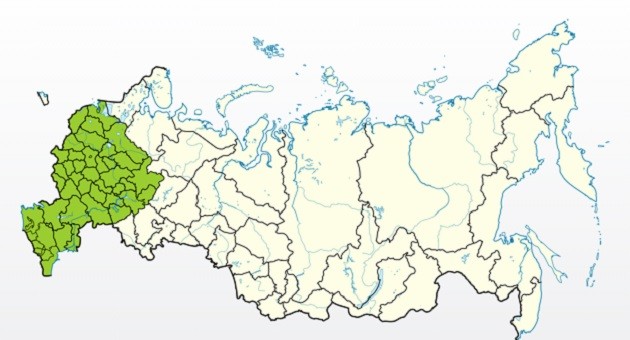 History of origin and regions of growth
Growing regions
- Middle zone.
- Moscow region.
- Leningrad region.
- North Caucasus.
- Central Black Earth Region.
- Crimea.
- Volga region.
Origin
This variety is another hybrid of the famous Nedzvetsky, who became the founder of a large family of domestic ornamental apple trees. Royal Beauty, which translates as "royal beauty" or "royal beauty," was developed in the mid-twentieth century by domestic pomologists as a purely ornamental variety.
Content
Description of the Royal Beauty variety
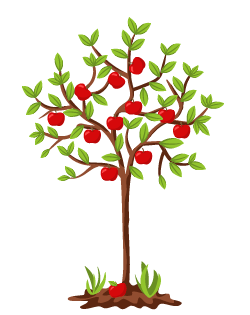 This deciduous, red-leaved apple tree immediately caught the eye of landscape designers across the country for its high ornamental qualities. It bears fruit early and regularly, producing quite a good harvest of small fruits.
The fruits themselves ripen on the tree and are very small. They have an attractive and picturesque appearance, but can taste sour and bitter. Apple trees are recommended for growing to decorate parks, gardens, and homesteads.
Apples: What do they look like?
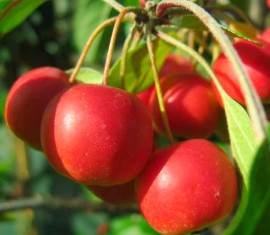
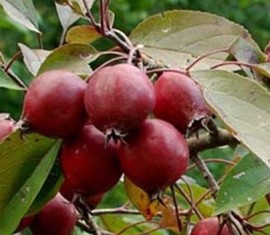
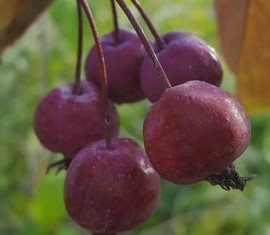
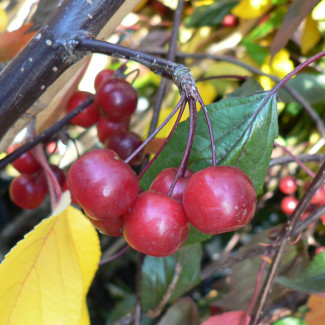
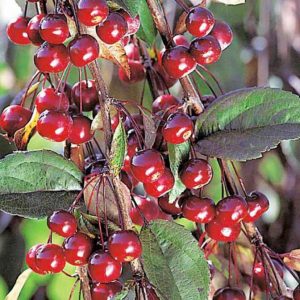 The fruits are mostly small to very small, round or slightly rounded-elongated, almost oblong. They are 2.5-4 centimeters in diameter and weigh no more than 5-10 grams in the best cases. The ribbing is slightly noticeable near the calyx, smoothed out, and not particularly visible.
The skin is very dense, strong, and elastic, even hard. It is glossy and shiny, and when ripe, it becomes covered with a loose, waxy, silvery, bluish bloom. The base color is yellow or even yellow-orange. The blush is dense, purple, or dark red, maroon, or beetroot red, diffuse, covering over 80% of the surface. Subcutaneous punctures are almost invisible; they are small and inconspicuous, grayish-green in color. For a complete picture, the chemical composition can be assessed using the following data:
- P-active substances (catechins) – 102 milligrams.
- Ascorbic acid (vitamin C) – 4.1 milligrams.
- Fructose (total sugars) – 1.8%.
- Pectins – 13.2%.
- Titratable acids – 1.48%.
The flesh is dense, fine-grained, somewhat firm, and very difficult to bite into. It has a distinct purple-pink or slightly raspberry hue, is not very juicy, and is woody. The flavor can be described as astringent, tart, highly spicy, sour, and bitter. Royal Beauty apples are considered inedible and can even cause poisoning in small children. However, many home cooks use the small fruits for canning and marinades. Professional tastings of these apples are not available.
Royal Beauty Apple Tree: Characteristics
Crown and root system
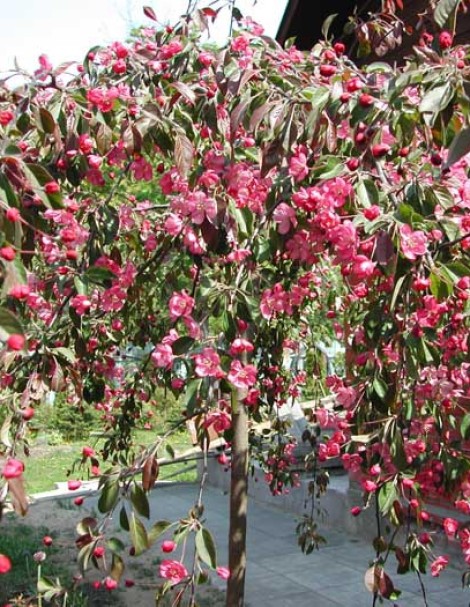
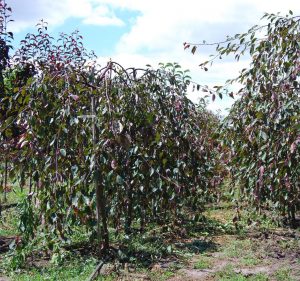 The apple tree is generally considered a medium-sized tree, but it grows slowly, so it takes time to reach its full height. The average height of the tree is approximately 3-5 meters, sometimes slightly less or more. The crown is initially oval or broadly oval, but over the years it becomes drooping and weeping. The branches are long and straight, sometimes reaching to the ground, and are covered with brown or reddish-brown bark.
The leaves are fairly narrow, slightly elongated, oval or more elliptical, and long-pointed. They are reddish or purple in color, glossy, leathery, and highly shiny. The undersides may have a felt-like pubescence. Young leaves are green with a slight brownish tint, later turning green-red, and in autumn they acquire a purple or red-brown, sometimes burgundy, color. The root system is deeply rooted, branched, and vigorous, well adapted to seeking water in the soil.
Productivity and pollination
Despite the obvious inedibility of the fresh fruit, the tree produces quite a good yield.
One mature Royal Beauty tree can yield approximately 6-12 kilograms of very small fruits per season. The quantity may fluctuate slightly from year to year, but not significantly..
Pollination is excellent with this variety; it's completely self-fertile. It doesn't require any external pollinators to produce ovaries and then fruit. While nearby suitable apple trees will have a positive effect on fertility, the effect will be minimal. Moreover, the variety itself can be an excellent pollinator for other varieties blooming at the same time.
Winter hardiness and disease resistance
Gardeners love this apple tree for its high resistance to low temperatures, beyond its beauty. It can withstand frosts down to -32-34°C without any damage, even when they last for more than 2-3 weeks at a time. The tree also boasts exceptional environmental resilience, withstanding polluted soil and air, severe air pollution, and can even grow near busy highways and large industrial sites.
The apple variety has a moderate resistance to various fungal and other infections. If cultivation practices are improper and humidity is high, problems can arise regularly. Pests also readily attack apple trees. Therefore, timely preventative treatments are essential.
Rootstocks and subspecies
Essentially, Royal Beauty is a subspecies of its parent variety, so it has no distinctive characteristics of its own. However, it can be grown on a wide variety of rootstocks. This will give the standard trees slightly different qualities; for example, it allows for control over the height and compactness of the crown, as well as the flowering period, albeit slightly.
Growing Royal Beauty
 Landing
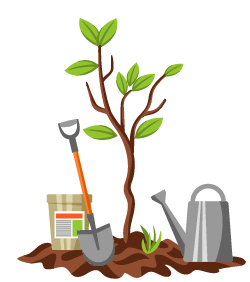 Landing
Basic conditions
- Planting sites should be well-ventilated but draft-free. Strong winds, especially in the fall and spring, can cause tree diseases.
- Groundwater levels in the area should not be higher than 2-2.2 meters, otherwise the trees will reach them with their roots and rot.
- The planting site must receive direct sunlight for most of the day. Trees in the shade will grow poorly, their trunks will become thin and weak, and the tree may even die.
- Saplings must be selected very carefully, paying attention to the condition of the root system. All shoots must be alive, strong, and fresh. Before planting, young apple trees are dipped in warm water for 5-8 hours to soak in moisture.
- It's not necessary to dig holes for Royal planting in advance; you can do this several weeks or even 5-9 days in advance. Dig holes 70-90 centimeters deep and approximately 90-100 centimeters in diameter. Add a small amount of topsoil mixed with fertilizer to the bottom. Then, cover the entire hole with drainage material (stones, bricks, vermiculite) and water (25-40 liters).
- The root collar is left 4-8 centimeters above the surface to prevent roots from growing higher. If this happens, all the properties of the rootstock will be completely lost.
- Place the seedling in the hole, spreading out all the roots so they don't interfere with each other and lie freely, without tucked under. Cover with soil in thin layers, compacting each layer by hand to eliminate any air pockets or voids. Water with 30-40 liters of water, and mulch the surface to retain moisture.
Landing dates
Trees show good survival rates when planted in both spring and fall. Early spring trees should be planted in late March or early April in more northern regions with harsh weather conditions. In milder, warmer climates, they can be transplanted to the ground in the fall, in late September or early to mid-October, after the leaves have fallen. All varieties with a closed root system can be planted in open soil at any time, but only if the root ball around the seedling is not disturbed.
Tree care
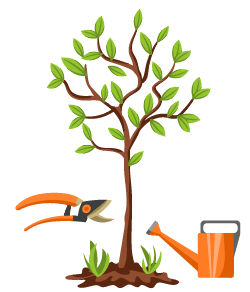 Tree care
Protection from frost and pests
Although trees are very resilient to low temperatures, it certainly doesn't hurt to properly prepare them for winter. This is especially true for plantings in regions with harsh weather conditions, short summers, and long, harsh winters.
Watering should be completely stopped before the start of autumn, at the end of August. Tree trunks should be wrapped in burlap or covered with a tent-like covering. Spruce branches, hay, straw, and dried leaves should be thrown over the roots. It's important that all of this is thoroughly dried to prevent rotting, otherwise the trees will die.
Annual cleaning with a hard brush and whitewashing of the trunk with lime, as well as spraying with industrial products, will help repel insects. Rodents can be repelled by coating the trunks with strong-smelling substances such as fuel oil, grease, or rendered animal fat.
Loosening the soil, watering: proper agricultural technology
Dig around the apple tree's trunk no more than twice a year. This should be done very carefully to avoid damaging the shallow roots. During the growing season, you can hoe the soil several times, removing weeds and root suckers. In the fall and spring, be sure to remove debris, dry leaves, and rotting fruit from under the tree.
Trees don't require frequent fertilizing or watering, as they are self-sufficient. Fertilizing the soil for the first time is recommended no earlier than 2-3 years; the fertilizer applied at planting will be sufficient for apple trees. To improve nutrient absorption, dilute the fertilizer with water and water it around the perimeter of the tree's crown. The day after watering, especially if the weather is dry and hot, be sure to loosen the soil, otherwise it will compact into a dense lump and prevent oxygen from reaching the rhizomes.
Pruning: simple crown shaping
Royal Beauty is very pliable, so pruning is usually straightforward. The main rule is to not prune more than one-third of the total branch volume at one time. When young, in the nursery, one-year-old apple trees are trained in sparse tiers, but later you can use any preferred style. The trees don't suffer from excessive crown density, so there won't be much work involved.
In the fall and spring, a sanitary pruning should be carried out, and all shoots protruding inward or vertically upward should be removed. Broken, diseased, and dry branches should also be removed. Cuts should be sealed. garden pitch, drying oil, and water-based paint. This will significantly reduce stress on the tree, and it will recover more quickly.
Reproduction
- Growing from seeds.
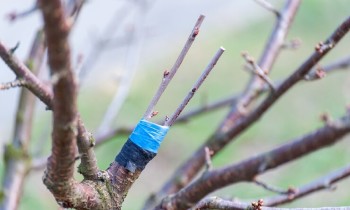
- Budding.
- Kidney grafting.
- Clones.
Diseases and pests
- Powdery mildew.
- Scab.
- Moniliosis.
- Black crayfish.
- Hawthorn.
- Aphid.
- Leaf roller.
Pollinator varieties
- Makovetsky.
- Autumn striped.
- Siebold.
- Ola.
- Royalty.
- Rudolf.
- Fuji.
- Ranetka.
- Helena.
Ripening and fruiting of Royal Beauty
The beginning of fruiting
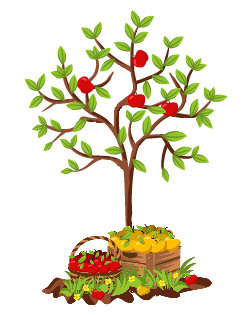 The beginning of fruiting
The apple tree is considered a precocious fruiterer, and rightly so. Buds begin to bloom as early as the first or second year, but these are usually barren flowers. Fruiting begins in the third or fourth year. The fruits grow singly, not in clusters, and are scattered quite densely from the branches already in their first years. During this period, you can harvest approximately 1-1.5 kilograms of bitter fruit.
Flowering time
Royal lily begins to bloom as early as early or mid-May, depending on the climate, weather, and other environmental conditions in the region. The process continues for over a month, approximately 4-6 weeks, as some buds are already fading while others are just beginning to open. The flowers themselves are large, beautiful, a vibrant burgundy, red-burgundy, slightly pink-raspberry hue, sometimes with a violet tint. They densely cover the branches and are pleasantly fragrant, the scent lingering even from several dozen meters away.
Fruiting and growth
Apple trees don't grow very quickly, producing no more than 25-40 centimeters of natural growth per year. Therefore, some prefer faster-growing varieties. However, slow growth does have its advantages, as these apple trees live for over 45-60 years, unlike, say, the Makovetskiy. Conversely, their fruiting increases very quickly, and by autumn, within 2-4 years, the branches are densely laden with small fruits. The maximum harvest will take approximately 5-8 years after planting in open ground.
Apples ripen as early as September. Then they can be picked and processed. Fresh fruits of this variety are not suitable for eating, but they are perfect as an addition to preserves. These apples also cannot be stored, and transporting them far is pointless. Many leave them hanging on the branches until spring. They do not fall off, but serve as excellent food for birds and create a stunning composition against the white blanket of snow.
Why do apples fall?
- Weather phenomena.
- Early frosts.
- Pests or diseases.
What to do if it doesn't bloom or bear fruit
- Transplant into the sun.
- Protect from drafts.
- Limit or activate watering.
- Neutralize pests.
- Cure diseases.
Top dressing
- Manure.
- Compost.
- Humus.
- Superphosphate.
- Chicken manure.
- Mineral and nitrogenous complexes.
- Ammonium nitrate.
Share your own experience with the Royal Beauty apple tree variety, so even novice gardeners have no questions about cultivating these trees.