Apple tree Mana: characteristics of the variety and care
| Color | Reds |
|---|---|
| Ripening season | Autumn |
| Size of apples | Average |
| Taste | Sweet and sour |
| Crown type | Average tree height |
| Shelf life | Low shelf life |
| Application | Fresh , For recycling |
| Winter hardiness | High winter hardiness |
| Fruiting age | Up to 5 years |
 History of origin and regions of growth
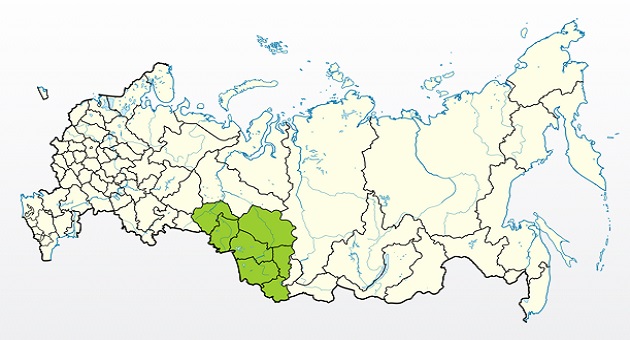
Growing regions
- Omsk region.
- Altai and Altai Krai.
- Tyumen Oblast.
- Tomsk region.
- Kemerovo region.
- Novosibirsk region.
Origin
The new variety was developed at the M.A. Lisavenko Siberian Research Institute of Horticulture, specifically at the Krasnoyarsk Experimental Fruit Growing Station. The authors are considered to be Alexandra Semyonovna Tolmacheva and Nikolai Nikolaevich Tikhonov. It was obtained by crossing the Ranetka Laletino variety and the well-known Papirovka variety in the mid-1960s.
In 1973, the first application was submitted, after which the new apple tree was included among the elite and submitted for official variety trials. It passed with flying colors, and in 1991 it was added to the State Register of Breeding Achievements. The variety was zoned for the West Siberian region.
Description of the Mana variety
 The apple tree is hard to miss, thanks to its many positive qualities that few old or new varieties can boast. It has enviable frost resistance and can grow in the harshest weather conditions, while remaining early fruiting and high-yielding. The tree doesn't require special attention or care, tolerates any soil, easily withstands drought, and scab gets sick extremely rarely.
Mana fruits are beautiful and delicious, suitable for fresh eating and any kind of processing, from juices and candies to drying. The shelf life of the fruits leaves much to be desired, but many gardeners overlook this. They are recommended for cultivation in commercial gardens and for individual plots.
Apples: What do they look like?
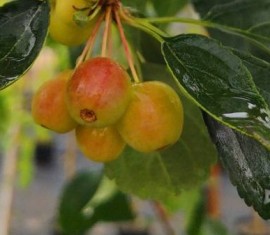
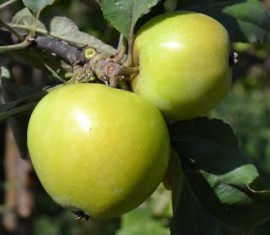
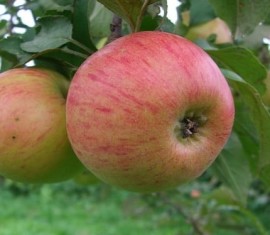
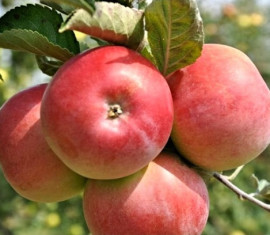
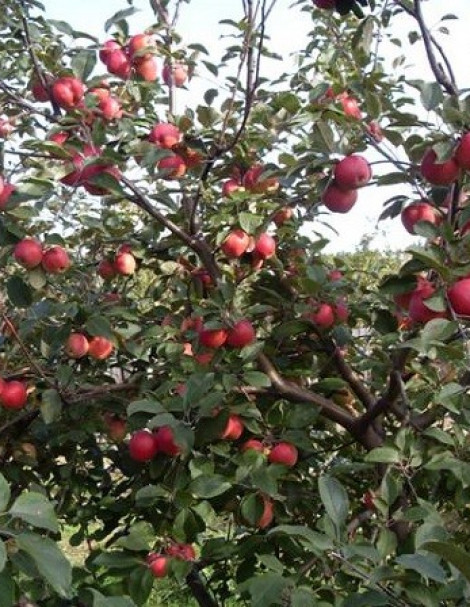
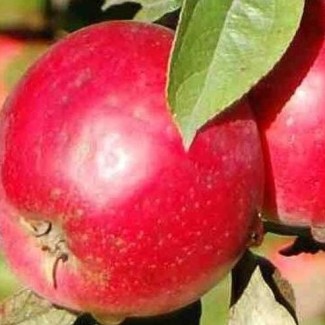
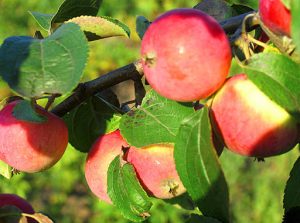 The fruits of this semi-cultivated apple tree are considered large among similar varieties. In reality, they are smaller than average, barely reaching 70-90 grams. They are round, cup-shaped, or barrel-shaped, slightly elongated, but can also be spherical. The ribbing is well defined, and the lateral seam is visible.
The skin is fairly thick but easily cracked, lacking elasticity, and offers limited protection from mechanical damage. It is smooth, glossy, and highly shiny, becoming coated with a thick, waxy, oily coating as it ripens, giving the apples a greasy appearance. The base color is light green or yellow, with a dense, diffusely spotted, mottled, striped, brownish-purple, or bright red blush, sometimes raspberry-colored or even cherry-colored, covering most of the surface. Subcutaneous punctures are numerous, small, light, and easily visible. The chemical composition is easily assessed using the following data:
- P-active substances (catechins) – 232 milligrams.
- Ascorbic acid (vitamin C) – 15.6 milligrams.
- Fructose (total sugars) – 9.9%.
- Pectins – 20.2%.
- Titratable acids – 1.2%.
The apples have a thin flesh; some even describe it as spongy and cottony, but it's quite juicy and pleasant to the taste. It's coarse-grained, sweet and sour, with astringent notes. The aroma is medium, slightly spicy, and lemonade-wine-like. Professionals give the fruit a maximum score of 4.2 on a 5-point tasting scale.
Apple tree Mana: characteristics
Crown and root system
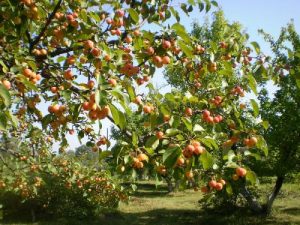 The tree grows very quickly, while remaining medium-sized. The maximum height without formative pruning is only 4-5 meters, and even then only in some casesThe vast majority of standard trees barely exceed 3-3.5 meters. The crown is rounded and slightly dense, with medium-thick shoots of rounded cross-section, which can be straight or slightly geniculate, covered with bark of a greenish-olive or slightly brownish hue and without pubescence. Fruiting occurs on simple and compound ring shoots, as well as on yearling growth.
The leaf blade is oval or oval-ovate, wide, with a short-pointed tip that can be curled, and the margins are serrate-crenate and serrated. They are green, dark green, or sometimes even emerald green, with rough ribbing and a leathery, glossy, and shiny surface. The root system is well-developed, branched, and fibrous in most rootstocks, but some standard rootstocks also have a taproot.
Productivity and pollination
The variety is considered not only early-bearing but also highly productive. Compared to northern and Siberian apple trees, the tree truly stands out, and overall, its fruitfulness can be considered average.
One tree of the Mana variety can produce 50-60 kilograms of aromatic fruits annually and without rest breaks, and in the most favorable years, 75-80, provided that proper and timely care is provided..
Apple trees are completely sterile without pollinators. Therefore, they must be planted within 90-100 meters of potential pollen donors. Additionally, commercial orchards treat the trees with syrup, and mobile apiaries are brought to the planting sites during the flowering period.
Winter hardiness and disease resistance
These apple trees' resistance to low temperatures, as well as sudden changes and fluctuations, is almost exemplary. They suffer no significant damage even in the harshest winters, when temperatures drop to -42-45°C, provided they are properly prepared and properly protected for the winter. Typically, frosts as low as -30°C (-82°F) cause no harm to the trees, even without prior preparation.
Fungal infections, the most dangerous for apple trees of which is scabMana is almost immune. It is extremely rarely affected by fungi, although this does occasionally occur during years of excessive humidity and epiphytotics. If the trees do become infected, it usually affects the foliage, while the fruit remains suitable for processing and fresh consumption. Regular preventative treatment with insecticides and fungicides is still recommended to avoid unnecessary risks.
Rootstocks and subspecies
There are no columnar varieties of Mana, but creeping forms can easily be formed from wood with some skill. Vegetative rootstocks are considered the most popular; they are the most winter-hardy, but trees grow well on dwarf and semi-dwarf soils. However, the fruit becomes noticeably larger, but frost resistance drops sharply. Such trees will need to be properly wrapped for the winter.
Features of Mana cultivation
 Landing
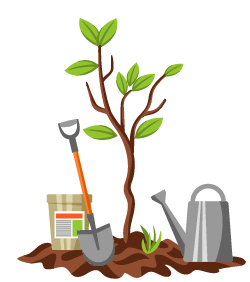 Landing
Basic conditions
- In the north and Siberia, choosing the right location for apple trees is crucial, otherwise they may die in the first year after planting. Manu is best planted in a sunny, open area with good ventilation. However, strong winds and drafts will not do the tree any good, so striking the right balance is crucial.
- Groundwater levels aren't particularly important for the tree, as long as they don't reach more than 2.5 meters above the surface. Apple tree roots can reach the groundwater and cause rot. It's not recommended to plant near a river or lake, pond, stream, swamp, or floodplain.
- The soil shouldn't be excessively salty or acidic, as apple trees don't tolerate these, but otherwise there are no special requirements. Moreover, soil acidity can be neutralized with lime, after which, after a couple of years, it will become just right for growing fruit crops.
- You can dig planting holes 5-8 months in advance, but if you've already missed the deadline, 4-6 weeks will suffice. The hole should be at least as large as the rhizome, so dig it 80-90 centimeters deep and up to 1 meter in diameter. Add organic matter and minerals mixed with the topsoil to the bottom, fill with drainage or soil, and water.
- It's a good idea to immediately drive planks, rods, or stakes into the holes for support. These can be made of wood or plastic; metal is best avoided, as it oxidizes quickly. The supports can be removed no earlier than 4-5 years after planting, or even better, in the 2-3 year of fruiting.
- The grafting point of the tree onto the rootstock must remain above the surface if the rootstock's properties are to be preserved. If the root collar is buried, the roots will grow higher and the rootstock's qualities will be compromised.
- Place the seedling on a mound of soil or drainage material raked into the center of the hole, spreading the rhizomes so that the shoots don't bend or interfere with each other. Cover with soil, compact it with your feet, but not too hard, water generously, and mulch with sawdust, compost, or manure.
Landing dates
All Siberian and northern apple trees are recommended to be planted exclusively in the spring. Some gardeners choose autumn, but without experience, this often results in the trunks freezing. It's difficult to predict when frost will last at least 4-5 weeks in our harsh, unpredictable climate. Therefore, it's best to choose a warm day in late March or early April, when the soil has warmed, but the sap has not yet started to flow in the trunks. Beginners are advised to purchase trees with closed root systems, which can be planted in the garden at any time during the growing season.
Tree care
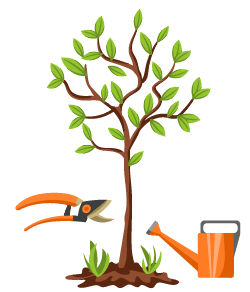 Tree care
Protection from frost and pests
In the harshest regions, a full range of measures must be taken to protect crops before winter. To do this, stop watering in August or early September. Straw or hay, spruce branches, or simply piled soil can be piled on the root zone. All this should be removed in early spring.
Whitewashing the trunks twice a year with a regular lime solution mixed thickly with water is effective against insects. In winter, the trunk should also be coated with fuel oil, grease, or melted lard to discourage rodents from eating young bark and tender shoots.
Loosening the soil, watering: proper agricultural technology
All fruit crops are typically dug twice a year, but for Mane, once a year is enough when the tree is young. Over the years, this procedure can be dispensed with entirely; simply lightly hoeing the soil, removing weeds and root suckers, will suffice. The most experienced gardeners, starting in the sixth or seventh year, begin laying sod around the trunk and sowing flowers or herbs to provide natural aeration.
Only young seedlings in their first few years of life may require watering, and only during the driest periods. One-year-olds can benefit from watering twice a month, but over time, you can reduce this to 3-5 waterings per year, and only if the need is strong. It's also convenient to apply fertilizer with water, but it's best to break up the soil with a hoe the following day.
Pruning: simple crown shaping
Trees are not prone to excessive density, so pruning won't require much effort. Trees should be trained from the first year. The central conductor is pruned to a height of about a meter, and two or three skeletal branches are made even shorter. They should be at different heights and spaced far apart; the rest is ruthlessly pruned.
Every year in the fall, the Manu is inspected and all dry shoots and diseased or broken branches are removed. This will prevent the tree from wasting energy on useless "ballast" and will allow it to produce more abundant harvests. Starting in the 7th or 8th year, several older branches can be pruned to rejuvenate the trees.
Pollinator varieties
- Pepinchik Krasnoyarsk.
- Idared.
- Indo.
- Askold.
- Alyonushka.
- Borovinka.
- Lada.
- Marina.
Reproduction
- Grafting or rooting cuttings.
- Layers or clones.
- Growing from seeds.
- Kidney grafting.
Diseases and pests
- Cytosporosis.
- Pit bitterness.
- Bacterial burn.
- Scab.
- Powdery mildew.
- Black crayfish.
- Fleas.
- Flower beetle.
- Codling moth.
- Hawthorn.
- Green aphid.
Ripening and fruiting of Mana
The beginning of fruiting
 The beginning of fruiting
Apple trees are considered early fruiting because they begin bearing fruit as early as 3-4 years after planting. For dwarf rootstocks, this period can reach 2-3 years. The first buds begin to appear in the first year, even in the nursery, but it's recommended to pluck them immediately to prevent them from needlessly draining the tree's sap. They likely won't develop into ovaries, and the tree still needs to develop foliage and rootstock.
Flowering time
The tree blooms mid-season, around early to mid-May, like most other apple trees, making it much easier to find pollinators. Already in early May, you can spot pink buds that open into large, deeply cupped, snow-white flowers with a powerful, pleasant fragrance. The process lasts over two weeks, so wind and bees usually take care of pollination.
Fruiting and growth
Mana grows 35-55 centimeters in height per season, and even more under favorable conditions. It also increases productivity, producing more apples each year. By the 8th to 10th year, fruiting reaches its full potential. However, once it reaches its peak, the tree may transition to intermittent fruiting. This means the fruit production will fluctuate slightly from year to year, but not significantly.
Apples are typically harvested starting in September, around mid-month. A good sign of ripeness is a full blush and a distinct oily, waxy coating. It's unlikely that apples will last more than 6-8 weeks, so it's best to process them immediately; they're especially delicious in purees, compotes, and juices.
Top dressing
- Compost.
- Ammonium nitrate.
- Urea.
- Humus.
- Liquid manure.
- Minerals.
- Superphosphate and potassium sulfate.
What to do if it doesn't bloom or bear fruit
- Make sure there are no diseases.
- Check for pests.
- Increase watering.
- Feed.
- Transplant.
Why do apples fall?
- Natural weather conditions.
- Pests.
- Diseases.
- Overripening.
Leave your original review of the Mana apple tree variety so that every gardener can learn something new or simply refresh their knowledge.